Results

Oracle pushes modern HR - there is more than technology

Oracle pushes modern HR - there is more than technology

Oracle had their first HCM World conference from February 4th to February 6th in Las Vegas and it rolled out the big guns - both CEO Larry Ellison and President Mark Hurd presented - something you usually do not see at an Oracle conference - except for Oracle OpenWorld. It was good to see both executives so well versed in people processes and the HCM pitch.  


Nobody questions Oracle on technology, so whoever had the idea to de-emphasize the technology aspect for the sake of the thought leadership aspect, deserves the big kudos on the Oracle side. Apart from a demo between Mark Hurd and Gretchen Alarcon - software was relegated to the many track sessions. And beside from Larry Ellison's presentation and a few glimpses of Chris Leone's - it was never the talk about the technology - but always about the challenges and struggles enterprises and Chief People Officers face every day. And the good news was - Oracle lead with the business problem - and not the technology, a radical departure from the past the traditionally wanted to convince customers mainly on the technical merits of its products. Doesn't work for the HCM audiences, so good move to adjust to it.


Oracle HCM Cloud Progress

We were surprised by the uptake of momentum of Oracle HCM cloud back at OpenWorld - but can now report continued momentum in customer uptake. Oracle is close at moving calendar date and go live progression on a proportional scale - which is a pretty encouraging sign. Customer go lives are all over the globe, speaking for a good sales effort beyond North America, which can be a challenge for US based vendors.

More importantly, the road map is not fizzling out in terms of functionality richness, and the upcoming release R8 (sorry all details were under NDA) includes new functionality in the areas that are hard for all vendors to create and  maintain. It was equally good to see that Oracle is tackling (and needs to keep tackling) the integration issues - both horizontally with other applications as well as internally to Oracle HCM Cloud between the Oracle Fusion HCM side and the Taleo side. This integration remains one of the weaknesses of the Oracle HCM portfolio - but Oracle is confident that it can convince customers to accept the integration issues due to significant functional leadership on the recruiting side. And while that functional leadership is certainly given for now - it will be an area to keep a watchful eye on in the future.

Oracle also had the bravado to let the analysts play on the new iPad app - and can now successfully claim that even analysts can use their HCM system. Few other vendors have given the opportunity to the analyst community and this certainly raises the ante from a competition perspective. From the 90 minutes using the iPad app we can say that it's highly functional, easy to use and built in such a way that it is highly likely to make an every day user (like a manager) happy using it.


Next steps for Oracle HCM cloud

As mentioned most information about the roadmap was under NDA - but Oracle lifted the kimono on a few areas that can be shared:

  • Workforce Optimization - Oracle plans to get into the workforce management arena starting with the support of mini and macro re-organizations. Oracle HCM cloud will allow to analyze and predict worker and / or organizational challenges and opportunities, model and plan actions derived on these findings and then execute on them at a certain point in time. 
  • New and expanded Mobile HCM - Oracle plans to deliver a new mobile experience both for tablets and smart phones. Interestingly Oracle also offers some offline capabilities - something of immense value for real mobile work warriors. 
  • BI Benchmarks - Oracle plans to provide more insight around the recruiting process - leveraging it's strong market position with Taleo, which enables 11% of all US hires, add 1.2 million job openings per quarter and features profiles of 417 million job candidates. 
  • Work Life Apps - Oracle donated a fitbit to HCMWorld attendees and organized a step competition amongst the attendees - a great showcase of the soon to be released Work Life Apps the company is planning. 
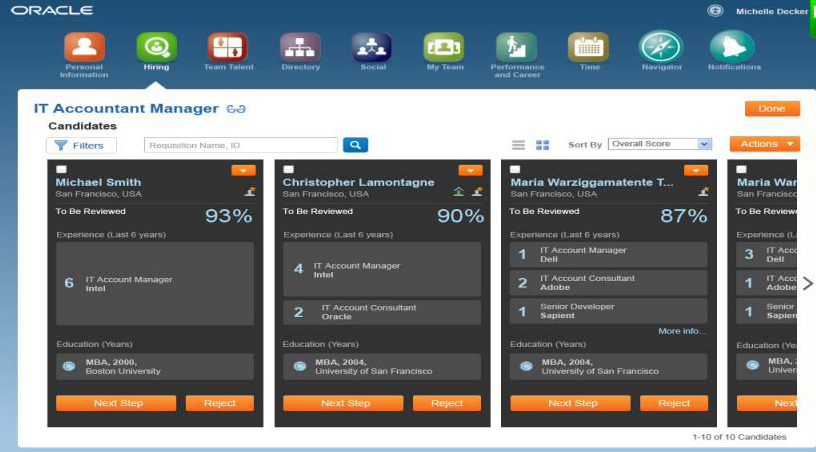
Screenshot of the new HCM Cloud User Experience

Social matters

Oracle - starting with Larry Ellison - did not get tired at stressing how important the social aspect of HCM are and how well Oracle HCM cloud can support them - given that Oracle Social Network (OSN) is baked into the platform that Oracle HCM cloud is build upon. 


The scenarios Oracle stressed were - not surprisingly around 

  • Collaboration - Enable users to collaborate and find expertise in the context of their business process. 

  • Discovery - Enrich employee profiles and job descriptions with reputation and influence in social media communities. 

  • Referrals -  Syndicate and post open job requisitions and source candidates through social networks.

  • Consolidate - Bring together all social media activities for HCM. 

Oracle is also shipping a number of social HCM applications - of which two are publicly known. The first is My Reputation, a capability that analyzes social activity, allows also for integration with 3rd party social networks and rewards users for participation and brand building activities. The second was  more enablement around social sourcing, allowing for automated employee referrals, job posts to Twitter and Facebook and capabilities to build talent communities. 

These are all compelling scenarios for HCM professionals. The main challenge Oracle has with the integration of OSN is the harsh user interface change between the Oracle HCM cloud user interface and the OSN interface on the iPad product. This maybe temporary - but better be addressed by Oracle, sooner than later. 


BigData  Plans

Oracle sees two aspects of BigData and HCM. On the one side the enrichment of all HCM data with BigData, e.g. the capture and availability of social streams and feeds - on the other side the capability to benchmark on the huge data available across the Taleo customers. In both cases Oracle has the technological capability to pull both aspects of - with the second scenario having more immediate impact on the recruiting function.


Integration matters

As mentioned before - the Fusion DNA and the Taleo DNA are on different technology platforms and Oracle has chosen to integrate Taleo - not to re-write recruiting functionality from scratch on the Fusion Appliations technology stack. On the positive side it means that Oracle has very good - some say market leading - recruting functionality at hand - on the negative side it means there is an integration effort that needs to be addressed in every customer implementation that spans across Oracle HCM Cloud. 

The good news is, that the company is looking at providing better integration, starting with a single master data set for work structures, employee master and an unified profile. Oracle also pledged a consistent user experience across mobile and desktop and common reporting and analytics - making the different back end systems a non issue for end users. The most important ambition though is around the convergence to a single technology platform - including a common programming model, common exstensibility framework and a single security and role framework.

Oracle even went so far to release a roadmap - unfortunately under NDA - but rest assured the analyst community will monitor progress and we would applaud publicizing it sooner than later. Oracle should be encouraged to do so - as the public plans for integration between Fusion R8 and Taleo 13B got a very good review with clients, prospects and the partner ecosystem.


Peoplesoft - Alive & Kicking

The Peoplesoft update by Paco Aubrejuan was again very valuable, it remains intriguing how powerful and strong the product and brand are. Customers keep moving and upgrading - all the way to the latest release, 9.2. And if Oracle keeps supporting customers well, the end is not in sight (yet). On the contrary Oracle is investing  more into Peoplesoft, even with latest technology - as the press release around new in memory applications for Peoplesoft HCM. It will be tough to find a software asset acquired approximately 10 years ago that get an in memory capability added in 2014. Ultimately a showcase that Oracle keeps investing in acquired products and creates values for customers using these products - the whole Apps Unlimited program (our take here). 


MyPOV

All in all a very promising first event for the expected HCMWorld conference series. Oracle talking business best practices is a welcome change, the investment and  momentum around Oracle HCM Cloud continue with traction and the roadmap is rich in new functionality. Even though Oracle has come a long way on user experience, it now needs to tackle cross product suite usability concerns (between Oracle HCM Cloud and Oracle Social Network) and share and deliver to it ambitious integration and convergence roadmap for the underlying technologies behind the different pieces of Oracle HCM Cloud.  

Future of Work Tech Optimization Next-Generation Customer Experience Revenue & Growth Effectiveness Data to Decisions Innovation & Product-led Growth New C-Suite Marketing Transformation Digital Safety, Privacy & Cybersecurity SuccessFactors workday SAP Oracle AI Analytics Automation CX EX Employee Experience HCM Machine Learning ML SaaS PaaS Cloud Digital Transformation Enterprise Software Enterprise IT Leadership HR LLMs Agentic AI Generative AI business Marketing IaaS Disruptive Technology Enterprise Acceleration Next Gen Apps IoT Blockchain CRM ERP finance Healthcare Customer Service Content Management Collaboration Chief People Officer Chief Information Officer Chief Customer Officer Chief Human Resources Officer Chief Technology Officer Chief Information Security Officer Chief Data Officer

The real supply chain disruptor…Amazon.com

The real supply chain disruptor…Amazon.com

The past few weeks, or really the past few years, have given us plenty of examples of Amazon slowly but surely cranking up their disruptive aspect when it comes to supply chains. Of course, when we think of Amazon we think of the giant of eCommerce. A company that has not physical retail channel but one that can sell us anything from a copy of the Iliad to furniture to baby’s diapers. For me Amazon is the biggest winner from the crazy dot com days of the late 1990s. The giants associated with that era – Yahoo, AOL, WebVan, eBay, Geocities, Lycos – to name a few. Yes Google was around then, but I would argue their real rise to prominence came after the bubble.

But the one name that weather that storm and is a massive player – Amazon. The reality is that Amazon is that they are not only the 800lb gorilla in eCommerce and retail but also for supply chains. Here are some areas where Amazon is a disruptive supply chain force:

  • Delivery – Anyone who watched or read about the coming of Amazon drones is probably expecting to get their copy of “50 Shades of Grey” or their latest set of Dr Dre Beat headphones dropped off by an unmanned flying machine. There is also the buzz that Amazon will look to have same day delivery, could be empowered by the rise of the drones. The eCommerce giant is also looking to conquer the enigma that is grocery delivery. Combine all these projects and you quickly realize that Amazon is bringing a whole
    Coming to your personal airspace.

    Coming to your personal airspace.

    new perspective to delivery. The reality is that they might not be able to achieve all these lofty goals…but the fact they are pushing these ideas out there and that they are driving the conversation is disruptive enough.  The fact that same day delivery is being mentioned will drive how our expectations are set as consumers. If I believe I can get fresh produce delivered to my door, do I accept getting anything that isn’t similar from the likes of Shaws, Whole Foods, Tesco, Giant Eagle, Safeway or any of the other grocery chain?

  • Warehousing – Amazon has mastered this for a long time, ever since they started selling CDs and Books via the internet. In order to fulfill these massive online catalog and to do so in a timely fashion, they have become masters of how to manage a warehouse and more importantly how to run an efficient pick and pack, inventory and distribution from geographically placed warehouses. Their acquisition of Kiva demonstrates that they see how
    The rise of the machines.

    The rise of the machines.

    robotics and the rise of the machines will disrupt how we run our warehouses. There has been some rumbling about how they drive their warehouse work force to ensure they can meet their tighter and tighter fulfillment windows. This might become more disruptive from a negative perspective. However, overall look for Amazon to change the way warehousing is approached.

  • Demand management – In the supply chain space, the holy grail is around better understanding and anticipation of what true demand is. A whole host of companies ranging from the likes of Orchestro, RSi, IRI, JDA, Steelwedge, SAP, Oracle, Kinaxis, Terra Technology to name a few, are all offering solutions that profess can better determine or predict what actual demand will be. But what about Amazon? They are already savvy when it comes to understanding what our buying habits on their web site – what else can or would we want to buy? Now comes word that Amazon has patent to provide “anticipatory delivery.” They are looking to better anticipate our demand! Wow. They will be able to put inventory on trucks before we even a)know we want the product b)order the product…talk about getting ahead of the demand curve. This goes beyond what some are tagging as demand sensing and moves into true demand anticipation. Again, will they be able to pull this off? Who cares. The fact they are speaking of being able to do so will create a disruptive mental wave that will have consumers wondering…”hey why can’t you anticipate what I want!”
  • Mobility – The Kindle is a quiet mobile supply chain device. How? It allows Amazon to place mobile ordering kiosks in consumers hands. Giving Amazon another point where they can check on demand and buying patterns. Add to this the Amazon app that is available on iOS or Android and you have a mobile powerhouse. One that allows the company to get as close
    A cash register and inventory system in your pocket!

    A cash register and inventory system in your pocket!

    as you can when it comes to POS information. With the app one could argue that Amazon have found a way to get into the four walls of the brick and mortar stores. Consumers have been trained to use the app as a mobile cash register and inventory system. Your daughter wants the latest American Girl doll? Scan a bar code or snap a picture and see what Amazon has…and if you want click “Buy Now” with your Prime account and boom, it gets delivered to your door.

So Amazon is the quiet supply chain disruptor. Whether or not they can pull off some of the projects they are tackling is inconsequential (well maybe not that inconsequential…). The fact that Amazon is driving the discussion around some of these hot button topics means all players within the supply chain cannot ignore some of the game changers that are on the table.

Amazon at the end of the is all about pushing more inventory through their system. But in doing so they are creating some mega changes when it comes  to how supply chains think about and tackle a host of issues. Next time you get a box from Amazon remember – they are shaking up the supply chains as we know them.

Have a disruptive technology implementation story? Get recognized for your leadership. Apply for the 2014 SuperNova Awards for leaders in disruptive technology.

Matrix Commerce Tech Optimization Data to Decisions Innovation & Product-led Growth amazon Supply Chain Automation Cloud Digital Transformation Disruptive Technology Enterprise IT Enterprise Acceleration Enterprise Software IoT Blockchain ERP Leadership Collaboration M&A Chief Customer Officer Chief Procurement Officer Chief Supply Chain Officer

Actuate Acquires legodo ag

Actuate Acquires legodo ag

Logodo_en

Actuate Corporation (NASDAQ: BIRT) has acquired legodo ag. Based in Karlsruhe, Germany, legodo develops software to allow organizations to tap into information stored in existing applications to create personalized customer communications.  More than 40,000 people have used the software in organizations like Deutsche Bahn, Deutsche Telekom, GEHE Pharmahandel, Lufthansa, Swisscom, Telenor, and Telefonica. The company has a catchy tag line - Now it's personal.

“The acquisition of legodo extends Actuate’s offering with tight integration to Siebel among other packages,” said Steve Jones, Co-Vice President and Co-General Manager of the Content Services Group at Actuate.

The legodo Customer Communications Suite accesses systems such as Oracle Siebel, SAP, Salesforce, Sugar CRM, and the Oracle Sales Cloud with preconfigured interfaces frequently bypassing the need to program. Connectors to SQL, text, and Web services are also available.

“Many companies have invested a great deal of effort and money in putting in place CRM systems to obtain detailed information about their customers,” said Marc Koch, formerly CEO at legodo. “But when it comes to using that information in communications to customers, this knowledge is often not utilized to provide a customer with a personal experience.”

Marc Kresin, formerly legodo’s CTO and Chief Product Manager; and Koch have joined Actuate as Director of Product Management, and as Director of Marketing, respectively, within the Content Services Group at Actuate. Both were consultants at Siebel Systems previously in their careers.

Kresin and Koch can be reached at +49 721 66 592-0

Tech Optimization Chief Financial Officer Chief Information Officer

Meet the Constellation Orbits Influencers - Chris Meyer and Sam Fiorella

Meet the Constellation Orbits Influencers - Chris Meyer and Sam Fiorella

In the third installment of our "Meet the Constellation Orbits Influencers" series I'll introduce you to business strategy visionary, Chris Meyer, and digital marketing guru, Sam Fiorella.

Chris Meyer is a thought leader focusing on the information economy, globalization and business innovation. His latest book is "Standing on the Sun".

Chris's mission is to anticipate and shape the future of business. He has pursued this goal as an entrepreneur, executive, consultant, author, and the leader of a think tank.?? Based on the ideas in his 2002 book Future Wealth, Chris developed a plan for a business based on a network of thought leaders. He joined The Monitor Group in 2006 to develop this idea as Monitor Networks, where he was Chief Executive from 2004 to 2009. In 2006, he co-founded Monitor Talent, to take these ideas forward operationally.

Chris has published three books about adaptive enterprise and network-based innovation, including the BusinessWeek Best Seller Blur: The Speed of Change in the Connected Economy, Future Wealth - the book on which Monitor Talent is based, and It’s Alive: The Coming Convergence of Information, Biology and Business.

COORDINATES
Constellation Profile: https://www.constellationr.com/users/chris-meyer
Twitter: @chrismeyer16
LinkedIn: www.linkedin.com/in/chrismeyernerve
 

Sam Fiorella is an authority on the intersection between customer experience and digital marketing.

Fiorella is partner at Sensei Marketing, a consulting and technology firm focused on aiding global companies grow their business value through improved customer experiences. He is co-author of Influence Marketing: How To Create, Manage, and Measure Brand Influencers in Social Media. Fiorella is a 20 year sales & marketing veteran with over 1600 digital projects to his credit for clients including Morgan Stanley, AOL, Hyatt Gaming Management, Snyder's of Hanover, Hitachi, the Home Depot, Kraft Foods, Drees Homes, and American Idol. Fiorella holds a few professorships: professor of Marketing at Seneca College and Adjunct Professor at Rutgers' Center for Management Development. When he's not working with clients or teaching, he's sharing his analyses of the convergence of customer experience and digital marketing on the  Huffington Post and Social Media Monthly Magazine.

COORDINATES
Constellation Profile: https://www.constellationr.com/users/samfiorella
Twitter: @samfiorella
LinkedIn: https://www.constellationr.com/users/samfiorella
 

The Constellation Orbits influencer network extends the reach of Constellation's coverage area to the bleeding edge of digital disruption, and establishes Constellation Research as the authoritative source for analysis of the latest developments in disruptive technology. Constellation hand-picked twenty thought leaders to join Constellation Orbits for their expertise, influence, and fearlessness in identifying trends, cutting through marketing hype, and informing their early adopter audience of significant developments in disruptive technology. You can find analyses from these thought leaders (along with analyses from Constellation Analysts) on the Constellation blog--the enterprise's authoritative source for disruptive technology analysis. https://www.constellationr.com/blog-news
 

New C-Suite Marketing Transformation Future of Work Innovation & Product-led Growth Chief Executive Officer Chief People Officer Chief Marketing Officer

How to Fast Track Project Management Success with Project Online

How to Fast Track Project Management Success with Project Online

1

8863_clip_image001_3If you’re like me, I suspect that you are working on multiple projects day-in day out. In fact, your job title might not even be “project manager”. These days, regardless of your role, we are all engaged with projects large or small.

What tools do you use to help you with managing your projects? Did you know that email is still the most common tool people rely on to manage their projects? While email works, you know it’s not as reliable as it should be.

What if you can efficiently keep track of project schedule, communications, files, who’s working on what, integrate existing tools you use like email or Microsoft Office suite of products and relevant reports from beginning to end—all in one place that’s accessible by any device and computing platform?

All this is possible today with Project Online powered by Office 365. Project Online allows you to quickly and easily keep your team on the same page, work together however that’s best and provide relevant information to the right person at the right time. More importantly, you can make the most out of Project Online by integrating it with tools that you already use like Microsoft Windows, Office, mobile devices and even non-Microsoft technologies. Are you excited?

Check out my Digital WPC blog post as I share 5 ways that Project Online can help you fast track project management success.

SharePoint AR Chief Customer Officer Chief People Officer

To Anticipate and Shape the Future of Business

To Anticipate and Shape the Future of Business

1

I was a little surprised and more than a little delighted when Ray asked me to join Orbits.  Surprised because my mission is “to anticipate and shape the future of business” in general—I’m not an analyst of the technology industry. That said, my work has always been rooted in how technology was enlarging the envelope of the global economy. So what you’ll see here will be observations of how the business environment is evolving, sometimes with a tech flavor, sometimes not. My current book, for example, looks at the emerging economies to see the next practices that will drive the evolution of capitalism. 

And delighted because Ray and Constellation have established a culture of energy and excellence, and I’m pleased to contribute to it. I will write here about new, sometimes half-baked thoughts about the world economy, capitalism, globalization, and economic research, hoping to provoke comment and insight from you. If we have a productive conversation here, we may collectively shape the future of business.

New C-Suite Future of Work Innovation & Product-led Growth Next-Generation Customer Experience Leadership Chief Executive Officer

How IT Can Pitch SharePoint as a Strategic Business Platform to Decision Makers

How IT Can Pitch SharePoint as a Strategic Business Platform to Decision Makers

1

CloudBusinessI’ve had the great opportunity to spend time with some of AvePoint Public Sector’s customers in my role as vice president for customer strategy and solutions. In most of my conversations, a recurring topic that kept bubbling up is the fact that a lot of executive decision makers still don’t perceive Microsoft SharePoint as an essential business platform unlike Enterprise Resource Planning (ERP), Customer Relationship Management (CRM), and Human Resources (HR) platforms. SharePoint is mostly viewed as a utility tool for business users to store files and/or centralized repository for group collaboration.

As IT continues to provide value to the business with limited resources, it is critical to elevate the strategic business value of SharePoint. As you know, when implemented with realistic business buy-in, it can accelerate and transform business engagement in any organization.

How can we effectively engage decision makers to understand the strategic business value of their SharePoint investment? Check out my post at AvePoint Community to learn the 4 steps on how you can pitch SharePoint as a strategic business platform.

New C-Suite Tech Optimization Innovation & Product-led Growth SharePoint AR Chief Information Officer Chief Customer Officer Chief People Officer

The Science Behind Team Dynamics

The Science Behind Team Dynamics

Constellation Orbits thought leader Dr. Janice Presser explains "Teamability in Action" at Constellation's Connected Enterprise 2013.

Future of Work Chief People Officer
On <iframe width="560" height="315" src="//www.youtube.com/embed/_ZmC3E_IA_o" frameborder="0" allowfullscreen></iframe>
Media Name: screendrjanice.png

How are we to defend anonymity?

How are we to defend anonymity?

If anonymity is important, what is the legal basis for defending it?

Foreword

Cynics have been asking "is privacy dead?" for at least 40 years. Certainly information technology and ubiquitous connectivity have made it nearly impossible to hide, and so anonymity is critically ill. But privacy is not the same thing as secrecy; privacy is a state where those who know us respect the knowledge they have about us. Privacy generally doesn't require us hiding from anyone; rather it requires restraint on the part of those who hold Personal Data about us.

The typical public response to data breaches, government surveillance and invasions like social media facial recognition is vociferous. People usually energetically assert their rights to not be tracked online, and not to have information about them exploited behind their backs. These reactions show that the idea of privacy is alive and well.

The end of anonymity perhaps

Against a backdrop of spying revelations and excesses by social media companies especially in regards to facial recognition, there have been recent calls for a "new jurisprudence of anonymity"; see Yale law professor Jed Rubenfeld writing in the Washington Post of 13 Jan 2014. I wonder if there is another way to crack the nut? Because any new jurisprudence is going to take a very long time.

Instead, I suggest we leverage the way most international privacy law and privacy experience - going back decades - is technology neutral with regards to the method of collection. In some jurisdictions like Australia, the term "collection" is not even defined in data privacy regulations. Instead, the law just uses the plain English sense of the word when it frames principles like Collection Limitation: basically, you are not allowed to collect (by any means) Personal Data without a good and express reason. It means that if Personal Data gets into a data system, the operator of the system is accountable under privacy law for that data. It does not matter how it got there.

NOTE: "Personal Data" is now the dominant term in privacy and data protetcion law worldwide, with a pretty consistent definition, namely any information that can be reasonably identified with (that is, associated or linked with) a natural person. Personal Data does not need to be uniquely identifying. And, recgnising the potential for identification -- which might be done some time the in future through such means as data linkages -- a piece of data can be categorised as Personal Data before it is identified. Thus most experts agree that IP addresses, MAC addresses and photographs should be regarded as Personal Data. The term Personally Identifiable Information (PII) is common in the U.S. and has typically had a much tighter technical definition; for example under HHIPA rules, specific items such as zip code are enumerated as "PII". It is best to avoid the term "PII" in general data privacy discussions. 

This technology neutral view of Personal Data collection has satisfying ramifications for all the people who intuit that Big Data has got too "creepy". We can argue that if a named record is produced afresh by a Big Data process (especially if that record is produced without the named person being aware of it, and from raw data that was originally collected for some other purpose) then that record has logically been collected. Whether Personal Data is collected directly or indirectly, or is in fact created by an obscure process, privacy law is largely agnostic.

Prof Robenfeld wrote in his article, "the NSA program isn't really about gathering data. It's about mining data. All the data are there already, digitally stored and collected by telecom giants, just waiting." [italics in original]

Logically, if the output of data mining is identifiable (and especially if the raw data input was previously anonymous) then the data mining operation is collecting Personal Data, albeit indirectly, untouched by human hands. As such, the data miners should be accountable for their newly minted Personal Data just as though they had collected gathered it directly from the persons concerned.

To reinforce the point, I wonder if we should have a special name for how Personal Data is created by Big Data processes, including re-identification?  I suggest the name "Algorithmic Collection". 

For now, I don't want to go into the rights and wrongs of NSA surveillance. I just want to show a new way to frame the privacy questions in surveillance and Big Data, making use of existing jurisprudence. If I am right and the NSA is in effect collecting fresh Personal Data out of raw data, as it goes about its data mining, then we may already have a legal framework for understanding what's going on, within which we can objectively analyse the rights and wrongs. The NSA might still be justified in mining data, and there might be no actual technical breach of information privacy law, if for instance the NSA enjoys a law enforcement exemption. These are important questions that need to be debated elsewhere (see my recent blog on our preparedness to actually have such a debate.

But Collection is not limited everywhere

There is an important legal-technical question in all this: Is the collection of Personal Data actually regulated? In the USA there is no general restriction against collecting Personal Data; there is no broad data protection law, and in any case, some versions of the US Fair Information Practice Princples (FIPPs) don't even feature Collection Limitation. So there may be few regulations in the USA that would carry my argument. Nevertheless, surely we can use international jurisprudence in Collection Limitation instead of creating new American jurisprudence around anonymity?

So I'd like to put the following questions to Jed Rubenfeld:

  • Do technology neutral Collection Principles in theory provide a way to bring de-anonymised data within the scope for data privacy laws, and thus address peoples' concerns with Big Data?
  • How might international jurisprudence around Collection Limitation translate to the American environment?
  • Does this way of looking at the problem create new impetus for Collection Limitation to be introduced into American privacy principles?

Appendix: "Applying Information Privacy Norms to Re-Identification"

In 2013 I presented some of these ideas to an online symposium at the Harvard Law School Petrie-Flom Center, on the Law, Ethics & Science of Re-identification Demonstrations. What follows is an extract from that presentation, in which I spell out carefully the argument -- which was not obvious to some at the time -- that when genetics researchers combine different data sets to demonstrate re-identification of donated genomic material, they are in effect collecting patient Personal Data. I argue that this type of collection should be subject to ethics committee approval just as if the researchers were collecting the identities from the patients directly.

... I am aware of two distinct re-identification demonstrations that have raised awareness of the issues recently. In the first, Yaniv Erlich [at MIT's Whitehead Institute] used what I understand are new statistical techniques to re-identify a number of subjects that had donated genetic material anonymously to the 1000 Genomes project. He did this by correlating genes in the published anonymous samples with genes in named samples available from genealogical databases. The 1000 Genomes consent form reassured participants that re-identification would be "very hard". In the second notable demo, Latanya Sweeney re-identified volunteers in the Personal Genome Project using her previously published method of using a few demographic values (such as date or birth, sex and postal code) extracted from the otherwise anonymous records.

A great deal of the debate around these cases has focused on the consent forms and the research subjects' expectations of anonymity. These are important matters for sure, yet for me the ethical issue in de-anonymisation demonstrations is more about the obligations of third parties doing the identification who had nothing to do with the original informed consent arrangements. The act of recording a person's name against erstwhile anonymous data represents a collection of personal information. The implications for genomic data re-identification are clear.

Let's consider Subject S who donates her DNA, ostensibly anonymously, to a Researcher R1, under some consent arrangement which concedes there is a possibility that S will be re-identified. And indeed, some time later, an independent researcher R2 does identify S and links her to the DNA sample. The fact is that R2 has collected personal information about S. If R2 has no relationship with S, then S has not consented to this new collection of her personal information.

Even if the consent form signed at the time of the original collection includes a disclaimer that absolute anonymity cannot be guaranteed, re-identifying the DNA sample later represents a new collection, one that has been undertaken without any consent. Given that S has no knowledge of R2, there can be no implied consent in her original understanding with R1, even if absolute anonymity was disclaimed.

Naturally the re-identification demonstrations have served a purpose. It is undoubtedly important that the limits of anonymity be properly understood, and the work of Yaniv and Latanya contribute to that. Nevertheless, these demonstrations were undertaken without the knowledge much less the consent of the individuals concerned. I contend that bioinformaticians using clever techniques to attach names to anonymous samples need ethics approval, just as they would if they were taking fresh samples from the people concerned.

Resources

Why Cloud Geography Matters in a Post Snowden/NSA Era

The FIDO Alliance

New C-Suite Digital Safety, Privacy & Cybersecurity Tech Optimization Future of Work FIDO Infosec Security Zero Trust Chief Customer Officer Chief Executive Officer Chief Information Security Officer Chief Privacy Officer

Meet the Constellation Orbits Influencers - Richie Etwaru and Chris Morace

Meet the Constellation Orbits Influencers - Richie Etwaru and Chris Morace

This is the second installment of our "Meet the Constellation Orbits Influencers" series. Today I'll introduce you to two more of our Orbits thought leaders: Richie Etwaru and Chris Morace.

Richie Etwaru is a futurist and innovator in the application of big data analytics.

Etwaru is a leader in design thinking, organizational transformation, innovation, and thought leadership. He has operated a portfolio of over 100 MM enterprise next generation technology projects. He is a former CIO, CTO, COO, Head of Innovation, holds international patents, and has spoken at events across the world. A champion for global innovation, Mr. Etwaru, is responsible for defining and delivering the global next generation enterprise product suite for health and life sciences at Cegedim Relationship Management. He is a lifetime student completing his PhD, passionate about identifying and nurturing talent, and strives to stay hungry and humble forever.

COORDINATES
Constellation Profile: https://www.constellationr.com/users/richieetwaru
Twitter: @RichieEtwaru
LinkedIn: www.linkedin.com/in/richieetwaru
 

Chris Morace's insights shed light on the Future of Work and the Consumerization of IT.

Morace has spent the last 20 years of his career helping large enterprises implement the digital technologies that revolutionize the way we work and communicate. Leading Jive Software’s product strategy and, subsequently, serving as Chief Strategy Officer has given him a front row seat to the transformation unfolding in business today. In addition to serving as a product visionary, he meets on a daily basis with executives from organizations like T-Mobile, Thomson Reuters, UBM, Genentech, the Clinton Global Initiative, Mylan, Avon, and hundreds of others. His work brings him into frequent collaboration with thought leaders across general business and technology domains, from industry analysts to technology visionaries.

Chris studied biology, tracked to be a doctor, and only through a twist of fate and the power of the 1990s technology bubble, pursued a career in high tech. His love of science was driven by a strong desire to understand the hidden “why” behind things. He thrives on uncovering the patterns that offer insights and then using this skill to help others navigate the new business reality of constant change.  This all ultimately led him to author the New York Times & USA Today best selling book, Transform, How Leading Companies are Winning with Disruptive Technologies.

COORDINATES
Constellation Profile: https://www.constellationr.com/users/cmorace
Twitter: @thinkoutloud
LinkedIn: www.linkedin.com/in/chrismorace
 

The Constellation Orbits influencer network extends the reach of Constellation's coverage area to the bleeding edge of digital disruption, and establishes Constellation Research as the authoritative source for analysis of the latest developments in disruptive technology. Constellation hand-picked twenty thought leaders to join Constellation Orbits for their expertise, influence, and fearlessness in identifying trends, cutting through marketing hype, and informing their early adopter audience of significant developments in disruptive technology. You can find analyses from these thought leaders (along with analyses from Constellation Analysts) on the Constellation blog--the enterprise's authoritative source for disruptive technology analysis. https://www.constellationr.com/blog-news



 

Future of Work Next-Generation Customer Experience Innovation & Product-led Growth Chief People Officer