Results

Meet the Constellation Orbits Influencers - Paul Van Essche and Louis Columbus

Meet the Constellation Orbits Influencers - Paul Van Essche and Louis Columbus

Happy Valentines day! We're continuing to show love for our Constellation Orbits members by highlighting a few each day with our "Meet the Constellation Orbits Influencers" series. Today we'll meet change management visionary Paul Van Essche and all-things-cloud expert, Louis Columbus. Catch the latest insights from Paul and Louis right here on the Constellation blog.

Paul Van Essche is a change management expert tapped for his deft hand at successfully transforming change-resistant businesses.

Paul van Essche is the founder/owner of the independent management and tech consulting firm van Essche & Associates. He is a Swiss and South African citizen with qualifications in electronic and industrial engineering as well as project and business management. He has 29 years experience gained in over 20 countries on five continents in multiple industries, serving a range of blue-chip firms and international organizations. As a change management specialist, Van Essche has successfully effected radical change in some of the most resistant business environments. Van Essche has been independent since 1999, is an accomplished public speaker and negotiator, and is bilingual (English-French).

COORDINATES
Constellation Profile: https://www.constellationr.com/users/paulve
Twitter: @paul_vanessche
LinkedIn: ch.linkedin.com/in/paulvanessche

Louis Columbus is a Cloud Philosopher and an international business strategy professor.

Louis Columbus is a Product Marketing Executive at Plex Systems. He's focusing on how manufacturers can streamline their business strategies with cloud computing.   Previously Louis was senior manager at Cincom Systems and an industry analyst at AMR Research. He earned his MBA from Pepperdine University and completed the Strategic Marketing Management & Digital Marketing Programs at the Stanford University Graduate School of Business. Louis teaches graduate-level courses in International Marketing, International Business and global competitive strategy in the MBA Program at Webster University.  When he's not teaching or writing for Forbes, he spends his time musing all aspects of the cloud-present and future.

COORDINATES
Constellation Profile: https://www.constellationr.com/users/louiscolumbus
Twitter: @louiscolumbus
LinkedIn: www.linkedin.com/in/louiscolumbus?
 

The Constellation Orbits influencer network extends the reach of Constellation's coverage area to the bleeding edge of digital disruption, and establishes Constellation Research as the authoritative source for analysis of the latest developments in disruptive technology. Constellation hand-picked twenty thought leaders to join Constellation Orbits for their expertise, influence, and fearlessness in identifying trends, cutting through marketing hype, and informing their early adopter audience of significant developments in disruptive technology. You can find analyses from these thought leaders (along with analyses from Constellation Analysts) on the Constellation blog--the enterprise's authoritative source for disruptive technology analysis. https://www.constellationr.com/blog-news
 

New C-Suite Tech Optimization Innovation & Product-led Growth SaaS PaaS IaaS Cloud Digital Transformation Disruptive Technology Enterprise IT Enterprise Acceleration Enterprise Software Next Gen Apps IoT Blockchain CRM ERP CCaaS UCaaS Collaboration Enterprise Service Chief Executive Officer Chief Information Officer Chief Technology Officer Chief Information Security Officer Chief Data Officer

Disruptive Trends - Technology Ignorance Plagues Politics

Disruptive Trends - Technology Ignorance Plagues Politics

ConstellationRG_logoConstellation Research has identified a series of political, economic, societal, technological, environmental, and legislative trends that will impact your business and your career. At a high level, the noted advisory services firm has identified the following trends:

  • Political issues point to a lack of digital proficiency in the political class,
  • Economic trends continue to favor innovation over incremental improvement,
  • Societal shifts show the impact technological innovation is having on everyone's lives,
  • Technological trends continue to fuel innovation and disruption,
  • Environmental factors limit the long-term possibilities,
  • Legislative reform lags behind technology and loses relevancy as a result.

Here we examine the trend in politics.

Technology ignorance plagues the political class in the West.

Across the Western economies, few elected officials have science backgrounds. Meanwhile, scientists hold eight out of China’s top nine government posts. The lack of science and engineering fundamentals often hinders digital business discussions and the implications of technology policy are unclear to decision makers, who become timid and dependent on lobbyists and other influencers who don't provide unbiased information. For example, lack of scientific understanding around climate change and pollution control technology creates an emotional discussion instead of an objective scientific method approach which causes the United States not to radify the Kyoto Protocol even though 192 other countries agree to the treaty. Severe weather across the much of United States this winter starts to have political implications in cities like Atlanta where citizens start to question the wisdom of such a policy. 

On February 27th Constellation Research will be holding a free webinar titled Six Trends Influencing Digital Business Disruption in 2014 to discuss this point and more. The Webinar will be held from 10:00 AM - 10:45 AM PST

New C-Suite Tech Optimization Chief Executive Officer Chief Information Officer

Why Cloud ERP Adoption Is Faster Than Gartner Predicts

Why Cloud ERP Adoption Is Faster Than Gartner Predicts

1

200393880-001A recent study completed by Gartner titled Survey Analysis: Adoption of Cloud ERP, 2013 Through 2023 published on January 24, 2014, written by Nigel Rayner advises CIOs and application leaders of financial services institutions to “consider cloud ERP as a potential replacement for aging core ERP systems that are out of support or running on an old technology platforms (such as mainframes).“

The methodology is based on a survey of Gartner Research Circle members from North America, EMEA, APAC and Latin America from companies that range in size from $10M to $10B.

Key take-aways of the study including the following:

  • Including the 2% that already have core ERP in the cloud, a total of 47% of organizations surveyed plan to move their core ERP systems to the cloud within five years. This is because their ERP requirements tend to be focused around administrative ERP (financials, human capital management and procure-to-pay) where there is a wider range of cloud options (compared with manufacturing).
  • In aggregate, 30% of respondents say that the majority of their ERP systems will be on-premises for the foreseeable future as can be seen from the following graphic.

cloud adoption pie chart

  • 30% of organizations surveyed said they planned to keep the majority of their ERP systems on-premise for the foreseeable future.  Manufacturing organizations dominated this survey segment.

Why Cloud ERP Is Accelerating Faster Than Gartner Predicts

Two-tier ERP is the Trojan Horse of cloud ERP.  If Gartner had asked their respondents about if and how cloud-based ERP systems are being considered and used in two-tier ERP strategies globally, their survey and previous forecasts would have been significantly different.

From researching and working with manufacturers where two-tier ERP strategies make perfect sense for extending their legacy ERP systems to move into new markets, the following key take-aways emerge:

  • Achieving faster time-to-market while reducing cost of quality.  This is quickly turning into a year of transition for many supply chains, with the shift most noticeable in aerospace and defense.  Tighter project schedules driven by reduced budgets, coupled with more aggressive launch schedules is making this the year of the agile supplier.  Cloud-based ERP systems are essential to suppliers in this industry especially.
  • Legacy ERP systems lack scalability to support 21rst century compliance. One CIO who is a good friend jokingly refers to the legacy ERP systems populating each division of the manufacturing company he works for as fuel for his silos of excellence.  His point is that legacy ERP systems don’t have the data models to support the current quality management and compliance requirements corporate-wide and are relegated to siloed roles in his organization.  Cloud-based applications, specifically designed for ISO 9100, AS9100 Rev. C can do what legacy systems can’t, which is span across the aerospace manufacturer’s entire operations.
  • SaaS-based manufacturing and distribution software will increase from 22% in 2013 to 45% by 2023.  According to MintJutras, a leading research and advisory firm tracking ERP trends, a survey completed in 2013 shows SaaS-based applications will steadily grow from 22% of all manufacturing and distribution software installed to 45% within ten years.  The catalyst for much fo this growth will be two-tier ERP system adoption.
  • Microsoft’s New CEO knows the enterprise and cloud’s role in it. Satya Nadella has the daunting task of bringing innovation back into Microsoft.  As Anshu Sharma writes in his blog post today Satya Nadella: Microsoft, Coffee and the Relevance Question provides an excellent analysis of the challenges and paradoxes faced by the new Microsoft CEO.  It’s common knowledge in the Microsoft Partner community that the company runs one of the largest two-tier ERP system architectures in IT today, with an SAP R/3 instance in headquarters and Microsoft Dynamics AX running in each subsidiary.
  • All cloud ERP providers including Microsoft intend to monetize two-tier as much as they possibly can, architecting their respective Cloud OS strategies and enterprise suites to capitalize on it. Microsoft released an overview of their Cloud OS strategies in the following presentation, which provides a thorough overview of their perspective of the hosting market and how it relates to their apps business. Also included is the following graphic, Cloud OS: Innovation at Scale.  All of the factors taken together will drive up adoption of Microsoft Dynamics AX 2012 and streamline two-tier enterprise sales across all cloud ERP providers.  Last year at Microsoft Worldwide Partner Conference the announcement was made that Microsoft Dynamics AX 2012 would be available on Windows Azure in July, 2014.

cloud scale

  • Mobility is unifying the manufacturing shop floor to the top floor faster than anyone thinks.  In traditional ERP systems mobile platforms are most often used for material handling, warehouse management, traceability, quality management, logistics and service tracking. From the discussions I’ve had with CIOs and a few CEOs of manufacturing companies, there’s a high level of interest in analytics, alerts and approvals on Android and Apple tablets.  These apps and the speed of results they deliver are the new corporate bling. Intuitive, integrated and fast, these mobile apps make it possible for senior managers to check up on operations for wherever they are globally, in addition to approving contracts and being notified of events via alerts.  For Gartner’s assessment of cloud ERP to have been complete in this survey, mobility also needed to be covered
Tech Optimization Data to Decisions Digital Safety, Privacy & Cybersecurity Innovation & Product-led Growth Future of Work New C-Suite SaaS PaaS IaaS Cloud Digital Transformation Disruptive Technology Enterprise IT Enterprise Acceleration Enterprise Software Next Gen Apps IoT Blockchain CRM ERP CCaaS UCaaS Collaboration Enterprise Service AI Analytics Automation Data to Decisions eCommerce finance HCM HR ML Machine Learning Supply Chain LLMs Agentic AI Generative AI Robotics B2B B2C CX EX Employee Experience business Marketing Metaverse developer Quantum Computing Growth Leadership Social Healthcare VR Customer Service Content Management M&A Chief Information Officer Chief Technology Officer Chief Information Security Officer Chief Data Officer Chief Executive Officer Chief Digital Officer Chief Analytics Officer Chief Financial Officer Chief Operating Officer Chief Marketing Officer Chief Revenue Officer

Cognitive Dissonance and Influence Marketing

Cognitive Dissonance and Influence Marketing

1

Cognitive Dissonance

Despite social proof casting doubt on their veracity, it seems that social scoring platforms continue to be popular in social media marketing.

We shouldn’t be surprised; these tools offer a quick, if not effective, means of identifying those who might help brand messages cut through the growing online noise.  Despite this, I’m still rather optimistic on the future of influence marketing. 

I’ve been pleased with the changes I’ve noted while presenting our book and its methodology to clients and general audiences at conferences this past year.

While slow, there’s definitely recognition that audience segmentation and customer decision-making processes are largely ignored by marketers and platforms seeking to use influence marketing as a key business development strategy.

The Next Level of Influence – Cognitive Dissonance

A premise that seems to resonate well with audiences exploring true influence marketing is the concept of cognitive dissonance, which social scientists explain as a feeling of discomfort that results from holding two conflicting beliefs.

In terms of influence marketing we can think of it this way: What transpires in the minds of potential consumers when a product recommendation offered by socially popular personalities or media outlets, conflicts with preconceived notations or previous experiences with that product?

Similarly, what occurs in the purchase decision process when online social recommendations conflict with the consumer’s social, political, or religious views?

Chesterfield Cigarette

A popular example is cigarette marketing during the 1960s, which positioned smoking as healthy when early medical evidence demonstrated a link between smoking and cancer.

This is a good example of cognitive dissonance: Through various media channels, celebrities were used to advocate the smoking of cigarettes, yet consumers were – often subconsciously – aware that cigarettes were bad for their health.  A conflict existed.

 Marlboro Baby

Similarly, we can look to those advocating boycotts of brands like Chic-fil-A for speaking out against gay rights. The desire to eat at the popular fast food establishment may conflict with moral, social, and political views in many.

Which conflicting side wins when consumers make a decision, and how do marketers use influence marketing to sway those decisions?

Creating Cognitive Dissonance

It’s important to note that often the dissonance that exists in consumers’ minds is created by conflicting social commentary or opposing recommendations. A prime example is the battle occurring between Android and iOS mobile operating systems.

Consumers are faced with conflicting messages from influencers, media, and advertising that promote one over the other. Consumers, whose personal preferences and experiences match those shared by a large online community, find their decision-making process conflicted when faced with overwhelming social advocacy for the alternative.

When marketers understand the logistics of cognitive dissonance, it can be used as an effective marketing strategy.

For example, Android-based mobile phone manufacturers can use monitoring software and natural language processing to discover online conversations that would indicate which groups of consumers are experiencing cognitive dissonance that would negatively affect purchase decisions to their favor.

From this base, marketers can realign both content marketing and influencer identification efforts to support those whose decision to buy an Android-based device is conflicted or to insert conflict into the decision-making process of those whose instinct is to purchase an iOS-based device.

Understanding the effects of cognitive dissonance on consumer behavior is a new frontier for influence marketing and can be used offensively as well as defensively.

Managing Existing Customers

Of course, this dissonance occurs post-purchase as well, and so it’s critical to apply this thinking to existing customers. Just as prospects experience cognitive dissonance when making a purchase decision, social science and psychology has proven the concept of “buyer’s remorse” in customers.

Most consumers experience some cognitive dissonance, even if just momentarily, after purchasing a product.

  • “Did I make the right decision?”
  • “Did I shop around enough?”
  • “Was there a better price available elsewhere?”

The existence of this conflict can be damaging towards a brand’s efforts to build repeat business and brand advocates. We discuss this in Influence Marketing:

Influence marketing is often relegated to customer acquisition efforts, yet the need to create advocates and social proof around a brand necessitates better engagement with existing customers. Identifying cognitive dissonance in existing customers allows marketers to pinpoint the micro-influencers that may help alleviate the tension and sway their belief towards a feeling of satisfaction with the purchase and possibly even advocacy. Left alone, consumers with these feelings may return the product, or worse, turn to social channels to complain about it. The returns and online negativity can be curbed when true influence marketing techniques are applied to this consumer segment.

Be it defensive or offensive sales strategy, or customer satisfaction efforts, the use of influence marketing to offset cognitive dissonance in prospects and customers is a science that marketers must quickly become adept at.

Marketing Transformation Next-Generation Customer Experience Innovation & Product-led Growth Chief Customer Officer Chief Marketing Officer

Meet the Constellation Orbits Influencers - Sholto Macpherson and Theo Priestley

Meet the Constellation Orbits Influencers - Sholto Macpherson and Theo Priestley

Today in the latest installment of our "Meet the Constellation Orbits Influencers" series we'll meet Sholto Macpherson and Theo Priestley - two influencers known for their objective analysis of enterprise disruption. Read the latest insights from Sholto and Theo right here on the Constellation blog.

Sholto Macpherson is an award-winning business technology journalist and expert on cloud software and services.

Since June 2011 he has published http://BoxFreeIT.com.au, Australia’s only news website dedicated to cloud software for Australian and New Zealand businesses. In 2012, Macpherson won the national IT Journalism award for Best Columnist for his Cloud Channel column in CRN Australia magazine on the transition from server software to cloud software. Macpherson possesses 11 years of experience contributing to magazines and websites, radio and TV segments, webinars and conferences on enterprise and SMB technology and the cloud-led productivity revolution. His stories have appeared in the Australian and Sydney Morning Herald newspapers and industry websites such as CRN.com.au and iTnews.com.au.

COORDINATES
Constellation Profile: https://www.constellationr.com/users/sholtomacpherson
Twitter: @sholtomac
LinkedIn: au.linkedin.com/in/sholtomacpherson

Theo Priestley is a Business Process Management thought leader and Chief Evangelist at Software AG.  
Globally responsible for enabling the brand and technology awareness strategy at Software AG, Priestley is regarded as one of the top thought leaders in Business Process Management and was recently featured in Analytics Week's Top 200 Big Data influencers. He possesses a keen sense for understanding disruptive trends affecting the enterprise and consumer world.
Prior to joining Software AG Theo spent over a decade as a successful business transformation consultant. During that time he also became an advisor to enterprise software companies, conducting independent industry analysis on the top technology trends and client-based attitudes towards software implementation and business change projects. Priestley is known for his strong and honest opinions.

COORDINATES
Constellation Profile: https://www.constellationr.com/users/tpriestley
Twitter: @ITredux
LinkedIn: uk.linkedin.com/in/theopriestley?
 

The Constellation Orbits influencer network extends the reach of Constellation's coverage area to the bleeding edge of digital disruption, and establishes Constellation Research as the authoritative source for analysis of the latest developments in disruptive technology. Constellation hand-picked twenty thought leaders to join Constellation Orbits for their expertise, influence, and fearlessness in identifying trends, cutting through marketing hype, and informing their early adopter audience of significant developments in disruptive technology. You can find analyses from these thought leaders (along with analyses from Constellation Analysts) on the Constellation blog--the enterprise's authoritative source for disruptive technology analysis. https://www.constellationr.com/blog-news
 

New C-Suite Future of Work Tech Optimization Innovation & Product-led Growth SaaS PaaS IaaS Cloud Digital Transformation Disruptive Technology Enterprise IT Enterprise Acceleration Enterprise Software Next Gen Apps IoT Blockchain CRM ERP CCaaS UCaaS Collaboration Enterprise Service Chief Customer Officer Chief Executive Officer Chief Information Officer Chief Marketing Officer Chief Technology Officer Chief Information Security Officer Chief Data Officer

Mobile isn’t a device. It’s a state of mind!

Mobile isn’t a device. It’s a state of mind!

1

I seem to get into a debate every single day at work. Then it spills over to twitter or someone who is asking me for advice or just pontificating. It starts out innocuously at first. People want to talk about mobile. They dive into smartphones and eventually end up at tablets and then stop. That’s their definition of mobile. It’s either a smartphone or a tablet. Then someone from down the hall or somewhere on twitter pipes up, well I have a laptop and isn’t that mobile? So the debate starts.

New York state of mindThe problem with this type of thinking is that people are focused on the device. Who cares? So what if it’s a smartphone or tablet? What’s the difference if it’s a laptop? Let’s not forget there is this new category called wearables that may fit this definition as well. Why waste all this time talking about the device? There’s more than enough hot air in the world and not enough time to debate what is or isn’t mobile.

It’s time to realize that mobile isn’t a device, it’s a state of mind. People need to adopt a mobile mindset. It’s not about the specific device that you use but what you are able to do with it. A device itself isn’t a tool either. It’s just one piece of the puzzle that fits together in this landscape of enablement.

A tool is some piece of technology that you use to accomplish some goal. An axe is a tool that allows you to cut down a tree/gather wood as a resource (unless in the middle of a zombie apocalypse, where it makes a great weapon). A smartphone or a tablet doesn’t allow you to do anything with it except use it as projectile to hurt someone or something. What makes these devices powerful is the combination of the utility of the device with the app on it that you use to accomplish something. A smartphone running a navigation app is a tool that helps you get somewhere. A tablet with an educational app allows you to learn something. The tool enables you to accomplish a goal. Having a great app without a good device to run it on is worth just as much as having a great device without any apps – absolutely nothing.

In this mindset, we are focused on enabling our people to get stuff done, which is all they really care about. It’s not a question of phone, tablet, laptop, desktop or wearable, but what they enable you to do. A desktop or a laptop can be considered mobile if they enable you to get your job done when and where you need to while being more productive and agile. Maybe it’s a kiosk in a mall, a laptop at the local coffee shop, a smartphone while at your kid’s ball game, or a tablet while sitting on the subway, it’s all about having the right set of tools at the right time in the right place. That’s what mobile is about.

I can’t tell you how many arguments I hear about iOS versus Android, Samsung versus Apple, or Windows Phone versus Blackberry. The point isn’t that one of these devices or OSes is better than the others. They aren’t unless the use case exists. There’s nothing wrong with having a preference for one or the other but it certainly shouldn’t devolve into a holy war. IT shouldn’t be in the business of providing solutions but instead providing right time experiences that enable users to be more flexible and agile while being more productive and efficient when and where they need to be. Since IT is in the experience business (or at least should be), we pick the best tool sets for our users so that they can become enabled. We look at devices, ecosystems and applications that make our users want to be effective. We Focus on their needs (FUN principle) and meeting their expectations. We are (or should be) turning their work into a thing they do while integrating their work and personal life. We are striving to give them the moments that they need to make their time valuable. In that view, does it matter what the specific device is?

It’s time to stop the silliness of which device is mobile and which isn’t. As my good friend Philippe Winthrop likes to say, “I can bring my 24 pound Osborne portable with me, it’s mobile!” The fact that he doesn’t have the arm strength to carry it more than a block doesn’t mean much if it allows him to do what he needs to when he requires it. Mobile has nothing to do with the devices people are using and everything to do with the mindset of enablement. You just need to decide whether it’s a mindset you’re going to support by providing the right tools to your people because I guarantee you that your competitors will.

New C-Suite Innovation & Product-led Growth Chief Information Officer

Why "IT Projects" Fail

Why "IT Projects" Fail

1

I doubt there is single subject in this entire industry that's been given more air and space than the stubbornly surviving "Why IT Projects Fail". You'd think we'd have worked it out by now! But no, Sisyphus-like, we seem doomed to repeat our fate, while sad accounts of lousy and failed projects distract us like mosquitoes at the lake-house, complete with the equally bugging list of hack remedies, lessons learned, and ever-so-tired CSFs - Critical Success Factors - now one of the oldest TLAs since TLAs were a thing.      

And just when we thought it was safe to go back in the water, the whole subject was given a monumental energy-boost late last year by the very publicly disastrous implementation of the US Government's new on-line Medical Insurance system. Google this title and see: anything written after October last year makes mention of it. 

So I've accepted the challenge to say something different on this tired subject, or at least say it differently. I'm taking the "senior executive sponsorship, experienced team, clear objectives" mantra for granted here, and have tried to distill it all down to just a few succinct points that, I sincerely hope, encapsulate the issues, and will make a real and tangible difference if heeded. 

In my humble opinion therefore, why do these projects underperform so badly, and so often fail outright? Why do we so often get it wrong?

1. They’re not IT projects. 

An IT project replaces wired computer networks with wireless ones, or upgrades email servers for greater speed and capacity, for example. Overhauling the way in which social security benefits are managed and paid is a business project, and needs to be managed as such. Managing business projects like IT projects will invariably cause them to fail because the skills, methods and tools required for each are significantly different (see 2. below). Rather, they should be branded, managed and supported as “business transformation” projects, which is exactly what they should be if they are worth doing at all. Why would you invest in a project in the first place if you weren’t expecting significant beneficial change, and bottom-line impact? IT can make that change possible, but it doesn’t make it happen. 

2. Fundamentals are not respected.

The fundamentals of any operation or project, whether you’re making shoes, or growing potatoes, or computerizing a national health service, have a lot in common, even if the execution (obviously) varies. They require the management of the same three primary resource classes: people, process and technology. Unless conscientious, skilled farmers (people) prepare their fields appropriately (process) with well-maintained ploughs and the right fertilizer (technology), their crops will fail. Failed projects in general, and failed business transformation projects in particular, have insufficiently experienced, qualified and/or motivated people, using inadequate and/or inappropriate methods to implement the wrong and/or wrongly configured technology. It defies reason, but this mistake is made repeatedly: non-specialized people, capable only of muddling through, are expected to execute strategically critical projects with the same technology that everyone else bought (and mostly failed with), without adequate support. Imagine if the same approach was adopted by your surgical team, or even your auto mechanic...

3. Partners are mismanaged. 

Arguably this element would fall under process or method in the fundamentals area, but it is so critical, and such a major cause of failure, that it requires its own mention. In addition, clients are often over-reliant on their partners, particularly management and IT consulting firms, to provide the people, processes and technology for their projects in the first place, as well as all the advice and knowledge relating to these assets and how they should be deployed. “Managing” partners means keeping them honest and getting good if not excellent value from them, and actively steering them away from the "we win whether you win or lose" paradigm - an insidious reality that the vast majority of decent clients are so blissfully unaware of. This may sound simple but it’s far more difficult than anyone who has never attempted to do so could possibly imagine. 

4. Recipes replace Leadership.

Somehow we've come to believe that 100'000-line project plans are the recipe for guaranteed success, and that all we need to do is execute to the letter and all will be fine. Nothing could be further from the truth. Even in complex projects, if your plan goes over about 1000 lines, you're in trouble. Keep it simple, don't treat the project as a sausage-making exercise, encourage creativity and adaptability, and provide your team with continuous reminders of the higher goals, motivation, encouragement and support. Of course, "leadership" is one we could talk about for hours, but that's a subject for another post...

Bottom Line

So, the bottom line is this: manage a transformation like a transformation, not like a server upgrade. Decide what you want to achieve, and keep aiming for it and working towards it -unwaveringly. Make sure senior people are responsible for and tied into the success and the benefits you expect, every step of the way, and put them under pressure to deliver. Staff the effort with competent, experienced people, put them under pressure too, but support them and the mission purposefully and energetically. If you need external help, find the very best - remembering that big names don't guarantee you the best result - and push them relentlessly to deliver fair value, possibly giving them some skin in the game too. Be bold, trust your gut, and just do it. 

Post Scriptum: the most fabulously excellent book I’ve ever read on the sticky question of leadership is “Artists, Craftsmen and Technocrats: The Dreams, Realities and Illusions of Leadership” by Patricia Pitcher. I believe it’s been republished under the title “The Drama of Leadership” but get a copy of either one. Absolutely mandatory reading.  

Media Name: Paul ID.jpg
New C-Suite Tech Optimization Chief Marketing Officer

Upgrade Notes: Siebel Innovation Pack 2013 - Part 2

Upgrade Notes: Siebel Innovation Pack 2013 - Part 2

Alexander Hansal

In his Siebel Essentials blog, Alexander Hansal writes about upgrading to latest release of Siebel.

In the second part of our notes on an upgrade from Siebel 8.1.1.x to Innovation Pack 2013, we are back waiting for the Siebel Upgrade Wizard to finish its arduous task.

When suddenly...


8. Backup the Database and execute DB stats

At this step, the Upgrade Wizard stops with the above dialog and urges us to take a backup of the database and then execute DB stats. This is obviously a manual step.

The Database Upgrade Guide shares with us the necessary lines for executing DB stats as follows (Oracle database example):
 

EXEC DBMS_STATS.gather_schema_stats (ownname => '', cascade

=>true,estimate_percent => dbms_stats.auto_sample_size);

The above command (with the correct table owner name which usually is SIEBEL) must be run using a SYSDBA account.

Alternatively you can run the more sophisticated stats package available from My Oracle Support as Document Id 781927.1 (thanks to Oli for the link).

Because I encountered problems with too many open cursors on a previous occasion, I also used the following command to increase the maximum amount of open cursors for my Oracle database (not sure if this is truly necessary for Oracle 11g):

alter system set open_cursors=500 scope=spfile;
 
After doing all that, I restarted the database which should now be in perfect condition for the remaining steps.
 
9. Siebel Tools invocations
 
As the Upgrade Wizard continues, it generates command lines for Siebel Tools, which naturally only works when you run the process on a Windows machine with Siebel Tools installed. If you run on UNIX/Linux, please check the Database Upgrade Guide for details on how to conduct these steps.
 
The first Siebel Tools invocation is actually a batch compilation of the New Siebel Repository to a new SRF file. This file is then renamed in order to replace the siebel_sia.srf of Siebel Tools. In the first part of this series, I described how to download the vanilla SRF, and here we see that good guy Upgrade Wizard even ensures that Siebel Tools has a fresh vanilla SRF for 8.1.1.11. Nonetheless, it is a good thing to know where to get a vanilla SRF without having to run a full compile.
 
The second Siebel Tools invocation is the IRM proper. Siebel Tools will start up with the following dialog.
 
 
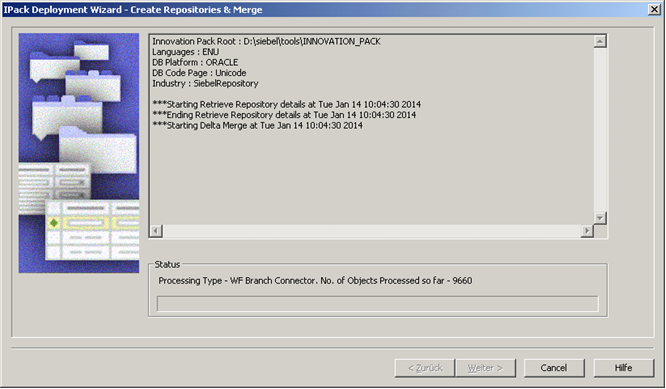
The IPack Deployment Wizard (introduced in 8.1.1.10) shows the progress of the actual repository merge. Again, we have to be very patient as this takes hours.
 
10. Error Recovery (hopefully not needed)
 
As I said above, this process went belly up on me on one occasion, so if you have the same bad luck, here are the steps to re-start the process (after you have removed the error condition, which in my case was a lack of open cursors).
 
First, rename the now unusable New Customer Repository (or delete it entirely) using Siebel Tools.
Then re-import the prior_custrep.dat file as “New Customer Repository”. Here is the command line to do that:
 
SES_HOME\siebsrvr\bin\repimexp.exe /a I /G ENU /u SADMIN /p ******** /c "Siebel_DSN" /D SIEBEL /M y /R "New Customer Repository" /F SES_HOME\dbsrvr\oracle\prior_custrep.dat /l D:\repd_custrep_man.log
 
Finally, restart the Upgrade Wizard from command line using a command similar to the following:
 
 
SES_HOME\siebsrvr\BIN\siebupg /m  master_upgrep_dev_811sia.ucf
 
11. Analyze and resolve merge conflicts in Siebel Tools
 
This step in the process of upgrading to IP 2013 can be inherently lengthy and complex depending on how much time (and customization) elapsed between your last upgrade (or first installation) and IP 2013. Basically, you have to identify conflicting objects or properties and resolve the conflicts. In this older post, I have described the merge conflict scenarios based on a major release upgrade.
 
The Innovation Pack versions of Siebel Tools have some new functionality around the merge log views which is a filter for critical conflicts and a Hierarchical Merge Report window. Both utilities assist us in identifying and resolving merge conflicts more easily.
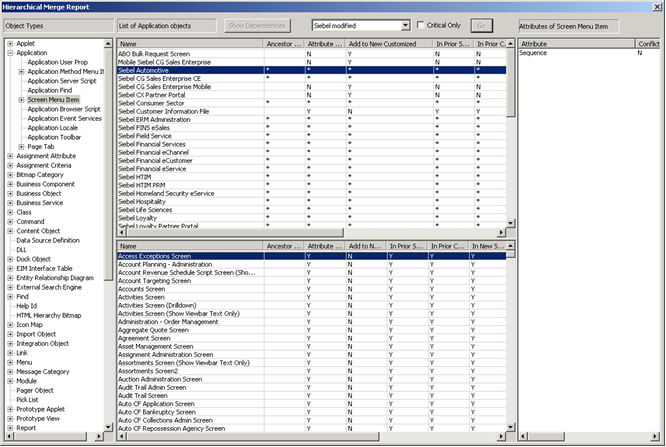
 
The Hierarchical Merge Report window in Siebel Tools IP 2013
So after a few weeks, you should be ready to continue with the upgrade process...
 
12. Mark Conflicts as Resolved
 
Once you have resolved all conflicts, it's time to restart the IRM Wizard and officially mark the conflicts as resolved. To start Siebel Tools in IRM mode, you use a command like the following:
 
 
TOOLS_HOME\bin\siebdev.exe /u SADMIN /p ******** /d "ServerDataSrc" /c "TOOLS_HOME\BIN\ENU\tools.cfg" /l ENU /iPackmode /IRM UpgDeltaMerge
 
Siebel Tools will launch with the IPack Deployment Wizard and we are prompted to check the Conflict resolution completed flag and click Finish.
 
 
13. (Optionally) Run Log Parser
 
This is the final step in the "upgrep" process. As indicated in the previous post, we can use the logparse command line utility to generate an HTML summary. This is the command to invoke the Log Parser:
 
SES_HOME\siebsrvr\BIN\logparse /S "SES_HOME" /G ENU /R upgrep_dev_811sia
 
In the above command "upgrep_dev_811sia" is the name of the log destination folder which is created by the upgrade wizard in the Siebel server log directory.
 
The logparse.exe reads all log files in this folder and generates a variety of very insightful HTML files which can be accessed from a start page which will usually open in your default browser when you are running it on Windows.
 
14. Upgrade the Physical Schema
 
The development database must undergo some more treatment before an object manager can access it. In particular, there is no "Siebel Repository" yet.
 
Again, we invoke the Database Configuration Wizard to collect the parameters to conduct the final upgrade steps, a process which is also known as "upgphys", or "Upgrade Physical Schema".
 
Some key steps that the upgrade wizard executes are:
 
  • Export "New Customer Repository" to a .dat file
  • Truncate the repository tables
  • Import the new customer repository as "Siebel Repository"
  • Migrate Open UI manifest data from XML files to the database


The last step in the above list applies especially to customers who were already using (and customizing) Siebel Open UI in versions 8.1.1.9 or 8.1.1.10.
 
Once the upgrade wizard has finished, we have a real 8.1.1.11 development database, ready to rock'n'roll.
 
Summary
 
'tis but a patch doesn't really hold true when it comes to upgrading to Innovation Pack 2013, even from previous patch levels of 8.1.1.x or 8.2.2.x.
 
Prepare yourself for a separate, somewhat lengthy multi-step upgrade project and read the documentation before you start and you are on the safe side.
 
 
This post originally appeared in the Siebel Essentials Blog.
Tech Optimization Oracle Chief Information Officer

Meet the Constellation Orbits Influencers - Esteban Kolsky and Brent Leary

Meet the Constellation Orbits Influencers - Esteban Kolsky and Brent Leary

In the fourth installment of our "Meet the Constellation Orbits Influencers" series it is my pleasure to introduce customer strategists and CRM provocateurs, Esteban Kolsky and Brent Leary. Read the latest CRM industry insights from Esteban and Brent right here on the Constellation blog.

Esteban Kolsky is is the principal and founder of ThinkJar, an advisory and research think tank focused on customer strategies.

Kolsky leverages more than 25 years in technology, customer service, communities and social media, online and offline marketing, CRM and enterprise strategy to assist vendors and clients in getting the results they need. An influential thought leader, Kolsky coined the terms: Customer Interaction Hub, Community-Based Customer Service, and Enterprise Feedback Management. Kolsky's expertise ranges the spectrum of customer strategies-- online or offline, customer-centric or organization-centric, traditional or community-based service and support. Prior to founding ThinkJar he spent eight years at Gartner.

COORDINATES
Constellation Profile: https://www.constellationr.com/users/estebankolsky
Twitter: @ekolsky
LinkedIn: www.linkedin.com/in/estebankolsky

Brent Leary is a CRM industry analyst, advisor, author, speaker and award winning blogger. He is co-founder and Partner of CRM Essentials LLC, an Atlanta based CRM advisory firm covering tools and strategies for improving business relationships. Clients include Microsoft, IBM, Oracle, Intuit, SAP and other major technology companies. In 2009 he co-authored Barack 2.0: Social Media Lessons for Small Business.  Leary is in the process of writing his next book, "The Amazon Effect: How a New Customer Culture is Creating Crazy New Business Opportunities and Killing Companies That Won’t Adapt", due out in 2014.
Recognized by InsideCRM as one of the 25 most influential industry leaders, Leary also is a past recipient of CRM Magazine's Most Influential Leader Award.  He serves on the national board of the CRM Association, on the advisory board of the University of Toronto's CRM Center of Excellence, and on the editorial advisory board for The Atlanta Tribune magazine.  Leary writes regularly CRM Magazine, Inc.com, and America Express OPEN, and serves on the advisory board for Social Media Today. 

COORDINATES
Constellation Profile: https://www.constellationr.com/users/brentleary
Twitter: @BrentLeary
LinkedIn: www.linkedin.com/in/brentleary?
 

The Constellation Orbits influencer network extends the reach of Constellation's coverage area to the bleeding edge of digital disruption, and establishes Constellation Research as the authoritative source for analysis of the latest developments in disruptive technology. Constellation hand-picked twenty thought leaders to join Constellation Orbits for their expertise, influence, and fearlessness in identifying trends, cutting through marketing hype, and informing their early adopter audience of significant developments in disruptive technology. You can find analyses from these thought leaders (along with analyses from Constellation Analysts) on the Constellation blog--the enterprise's authoritative source for disruptive technology analysis. https://www.constellationr.com/blog-news
 

New C-Suite Marketing Transformation Next-Generation Customer Experience Data to Decisions Future of Work Innovation & Product-led Growth Digital Safety, Privacy & Cybersecurity Chief Customer Officer Chief Executive Officer Chief Information Officer Chief Marketing Officer

Are Smart machines or smarter processes behind the Internet of Things ?

Are Smart machines or smarter processes behind the Internet of Things ?

1

robot

The new Robocop movie launches this week and James Cameron painted a bleak future for humans and smart machines but this is the complete opposite of what the potential holds for the Internet of Things.

Cisco told us that there will be 50 billion connected devices on the planet but only late last year Morgan Stanley predicted that number to rise to 75 billion. That doesn’t include some 200+ new device types still to be classified. With smart toothbrushes telling us we’re scrubbing our teeth wrong, smart forks berating our calorie count and smart fridges either ordering the milk or spamming our inboxes you can understand that our once silent consumer toys will soon become a tired cacophony of data noise for us to pay attention to.

But these are not smart machines. Not by a long shot.

Smart machines or smart processes ?

A General Electric turbine generates power but also 500Gb of data a day. It spins all day long but at the same time it’s communicating its state and health to a myriad of systems and processes that monitor it. That data is extremely useful if used in the right way but the machine itself is not considered smart. Now imagine how that machine that can communicate when it could potentially have a critical failure, in advance. Crazy but it’s true. In industrial situations a machine can advise the systems when its likely to fail due to being monitored against performance and tolerance levels. The process can schedule maintenance in advance before the event occurs through the data it’s receiving, but not only this it can tell other turbines to take a spread of the load during the maintenance and then switch back again once the repairs are completed.

To the outside world nothing has happened because it was all seamless. We are nearing an industrial world where the concept of zero downtime could well be a reality.

And this is nothing to fear.

Some smart things a day keep the doctors away

Google Glasses and wearable technology represent a massive shift in citizens harnessing the data they generate for their own use. Imagine taking constant readings from a Jawbone Up or Nike Fuelband and having them delivered to your doctor ? If you’re being treated for smoking, cancer, recovering from an operation and you deviate from your prescribed healthcare then your doctor can immediately get in contact and find out why. Imagine the reduction in strain on an overloaded healthcare system if you can catch and treat symptoms before they become problematic. I know one pharmaceutical company who is developing on Google Glass for hospital use, for consultants and doctors doing the rounds to wear them, scan bar or QR codes at a patient door and instantly be fed the right medical information about them, the treatment required, procedures like wearing gloves and masks, even down to scanning the dosage before it’s been administered. Everything is recorded and traced back to the patient’s medical records and hospital’s automated processes.

Again, this connectivity and ability to use machine (or thing!) generated information is nothing to fear.

Connecting the dots (and things)

Fonterra, who are responsible for more than one-third of the world’s international dairy trade created a solution where containers were tracked from the pack plants through departure ports, transship ports, to the destination port, and on through to either warehouse or customer delivery. All container tracking events were received in real-time so business operations were alerted when events did not occur as expected, for example, if containers were left behind at transhipment ports, or incorrect quantities are received. It allowed them to monitor processes and manage costs to the tune of millions of dollars far better than they had ever done previously.

We’ve conducted research ourselves by placing RFID transponders on maritime containers to allow us to fully automate a manual container identification process by using transponder readings to link to the business processes, thereby accelerating transhipment processes and making transhipment a more effective and efficient component of container logistics.

And not a Terminator in sight yet.

Skynet is real but it’s the good guy

The way we think about business and data in a world where machines and things are considered smart is changing, connectivity will spur the next revolution where analytics and big data will give us insight we never had before. Stand alone monolithic systems are the past, it’s now about the integration, analytics and using data generated for meaningful purpose.

Machines aren’t smart no matter how much we allude them to their Hollywood cousins. The smart comes from what we can do with the information those machines are telling us.


New C-Suite Data to Decisions Innovation & Product-led Growth Future of Work Tech Optimization Next-Generation Customer Experience Digital Safety, Privacy & Cybersecurity AI ML Machine Learning LLMs Agentic AI Generative AI Robotics Analytics Automation Cloud SaaS PaaS IaaS Quantum Computing Digital Transformation Disruptive Technology Enterprise IT Enterprise Acceleration Enterprise Software Next Gen Apps IoT Blockchain CRM ERP CCaaS UCaaS Collaboration Enterprise Service developer Metaverse VR Healthcare Supply Chain Leadership business Marketing finance Customer Service Content Management Chief Customer Officer Chief Information Officer Chief Technology Officer Chief Information Security Officer Chief Data Officer Chief Executive Officer Chief AI Officer Chief Analytics Officer Chief Product Officer