Results

Reflecting on Constellation Connected Enterprise #CCE2023

Reflecting on Constellation Connected Enterprise #CCE2023

Constellation Research hosted Constellation Connected Enterprise at Half Moon Bay, California, October 24-26.

Reflections

Of course, we all heard a lot about AI at #CCE2023. Every single Constellation Research client is looking at artificial intelligence — or is anxious that AI is looking at them! So, by design, this year’s event was structured around AI. Clients, vendors and Constellation’s analysts looked at AI from every angle, research theme and vertical.

Nevertheless, I feel CCE 2023 was actually all about data!

Maybe that’s just my bias (more on that later) or maybe it’s because the only thing any AI can do right now — especially large language models — is feed us information.

Here are some of the data-related learnings from another truly wondrous CCE.

Data quality and Data rights

On the Healthcare Industry Insights panel patient and biometric rights advocate Divya Chander unpacked privacy with Richie Etwaru. Divya said healthcare privacy is ”not a simple question of giving up data”. We need to look at who uses a patient’s data, why they use it, and how is it safeguarded.

On the Mastering Data to Decisions panel, Equifax’s Manish Limaye reminded us “do not forget fitness for purpose”. That's another one of the critical properties for progressive data protection; see my summing up below. 

Data Inc. companies, the future of post AI business

Ray Wang gave us a sneak peak at his major new research (and probably his next book) on “Data Inc. Companies”—new organisations that will master data in radical new ways, for precision decision making and closer connections between physical and digital worlds, delivering exponential advantage and trust.  

As always, Ray gave us a string of dizzying analyses and hot takes. My favorite: TopGolf is the “bowling alley of golf” with booths, fast food, beer and … data. Golf club maker Callaway acquired TopGolf for the enormous volumes of data on the ordinary golfers’ swing.

Among Ray’s latest pearls of wisdom, I especially love:

  • understand how to partner for data sources and signals
  • generate new derivatives, and
  • nourish networks.

Bias

Let’s remember that not all bias is terrible. In fact, no natural intelligence could work and survive in the real world if not for in-built bias. As the ruthless George Clooney character said in Up in the Air, “I stereotype. It’s faster”.

So bias is everywhere, both good and bad. It’s difficult to assess or even talk about bias partly because the word has negative and political connotations.

One of the liveliest recurring discussions at #CCE2023 was about AI versus human doctors. Statistics were flung around about medical error rates. But the way I look at it—see what I did there—the very idea of AI doctors is so new we should admit that we are all carry a preconceived picture of what AI healthcare is like.

AI as we know it now, dominated by Large Language Models, is barely one year old; as yet there can’t be any meaningful studies of healthcare outcomes.

So, all we have to go on is models of the impact AI might have in healthcare. All models are biased. The only model truly free of bias is the real world, and no one has the patience to watch how that one plays out.

The neatest insight about bias came from Kate Carruthers, the Chief Data & Insights Officer at the University of New South Wales. Indeed it was so neat, you might have missed it. On the Data To Decisions panel Kate told us that “Data is important because it fuels decisions. But data is not inert. Making the choice of which data to use means decisions have already been made.” That is, we are constantly making decisions, the basis of which is data that we might not have given any conscious thought. That’s bias!

MyPOV

To sum up, in the closing analysts’ Ask Me Anything panel I observed that traditional cybersecurity is too defensive for the digital age. Protecting the Confidentiality, Integrity and Availability (“C.I.A.”) of data is not wrong but it’s a limited worldview.

More progressive digital data protection looks at the factors that make data valuable — originality, permissions, AI auditability etc. — and optimises those factors.

More from CCE 2023:


Data to Decisions Digital Safety, Privacy & Cybersecurity Distillation Aftershots Innovation & Product-led Growth Future of Work Tech Optimization Next-Generation Customer Experience Big Data Security Zero Trust AI ML Machine Learning LLMs Agentic AI Generative AI Robotics Analytics Automation Cloud SaaS PaaS IaaS Quantum Computing Digital Transformation Disruptive Technology Enterprise IT Enterprise Acceleration Enterprise Software Next Gen Apps IoT Blockchain CRM ERP CCaaS UCaaS Collaboration Enterprise Service developer Metaverse VR Healthcare Supply Chain Leadership business Marketing finance Customer Service Content Management Chief Analytics Officer Chief Data Officer Chief Digital Officer Chief Executive Officer Chief Information Officer Chief Information Security Officer Chief Privacy Officer Chief Technology Officer Chief AI Officer Chief Product Officer

Software development becomes generative AI's flagship use case

Software development becomes generative AI's flagship use case

Generative AI has its benchmark use case: Developer productivity. Why? Software engineers are pricey and the returns on multiple fronts--costs, developer engagement and overall value creation--are hard to ignore.

In recent days, the intersection of software development and generative AI has been noted repeatedly. Panels at Constellation Research's Connected Enterprise (CCE 2023) covered the topic multiple times on automation and AI panels. In addition, CEOs including Amazon's Andy Jassy, Microsoft's Satya Nadella and Alphabet's Sundar Pichai all noted developer productivity gains with generative AI and outlined where enterprises are headed.

Today, generative AI is taking manual and rote tasks away from developers and boosting productivity. Yes, generative AI means you may not have to add engineers as quickly, but it also allows them to move upstream. Lower-level engineers can be upskilled with generative AI. The math is also clear. ZipRecruiter estimates software engineer average salaries are about $140,000. Indeed puts a Bay Area software engineer working at Meta at about $167,000 on average. Salaries can also go way higher based on skills.

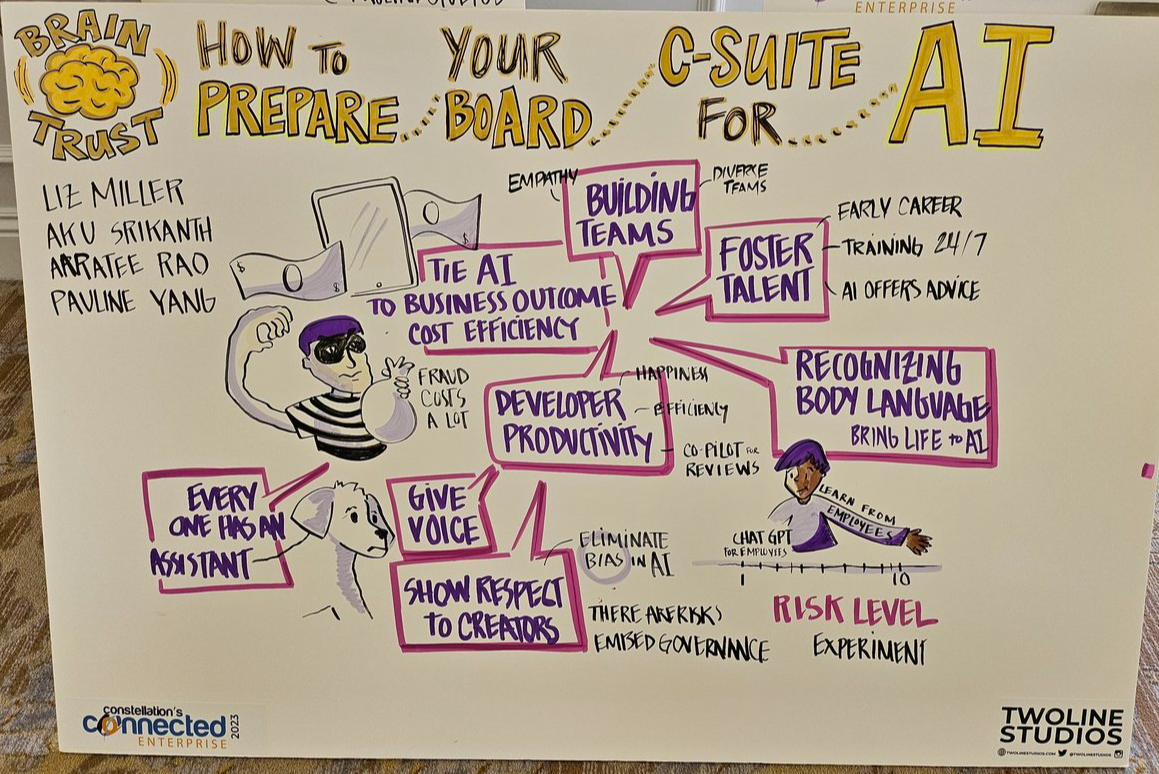
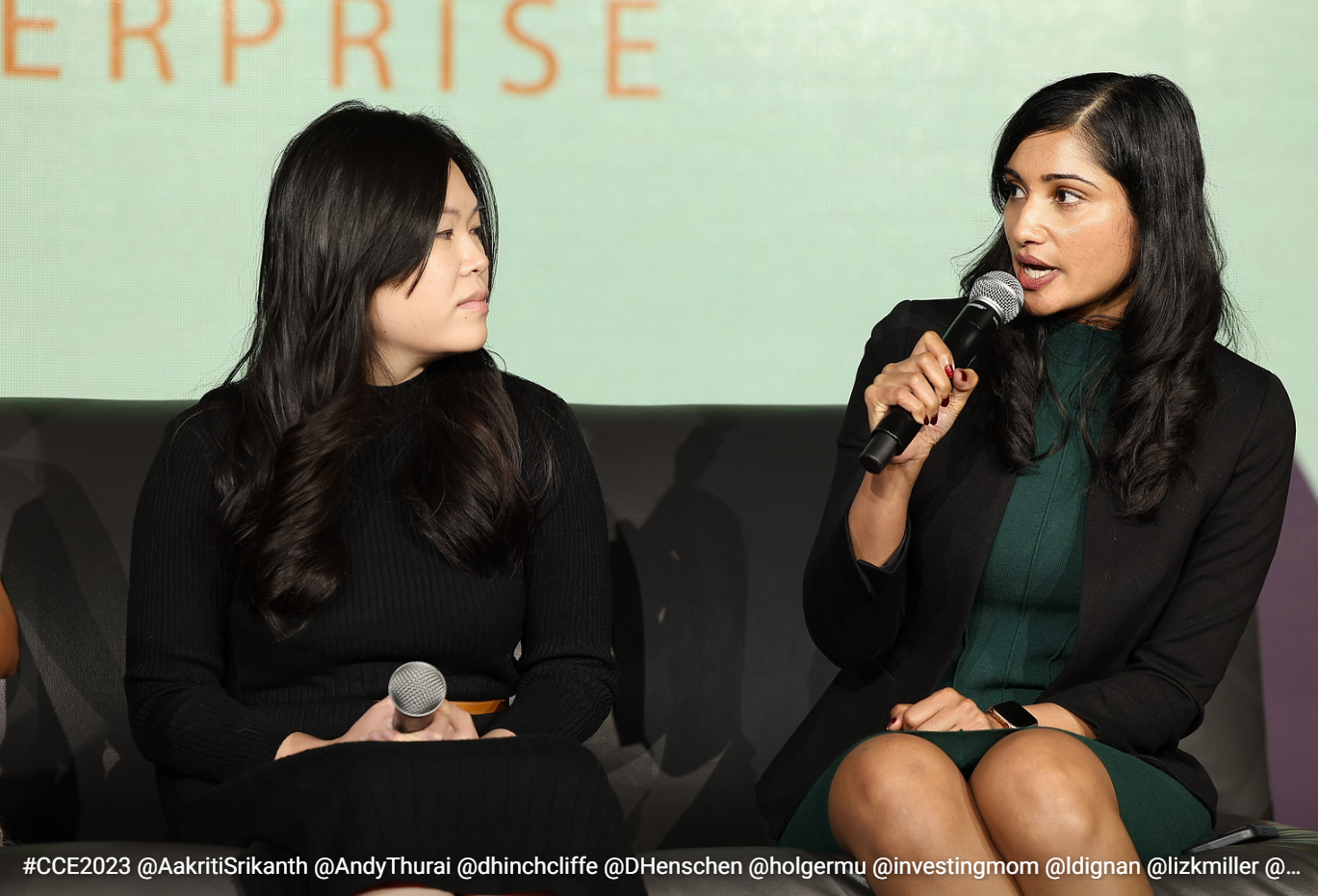
Speaking at CCE 2023, Aaratee Rao (pictured right below), Managing Director at JP Morgan Chase, noted that cost efficiency always plays well. "How do we automate, automate, automate and use AI using machine learning, and to really make sure we save money," said Rao, who noted that cost optimization and quality improvements all boost customer experience.

Pauline Yang (pictured left below), a Partner at Altimeter Capital speaking on the same CCE panel, laid out the software development economics. Yang said:

"One of the big use cases that we've seen really take off is developer productivity. If you talk to CTOs, they have all these different metrics--how happy their developers are, how much more pull requests are they getting, or how more productive their senior engineers are. We believe that a lot of companies are becoming software companies, even if you're not selling software, and the costs of engineers right now are so high that 40% productivity gains with your engineers is massive and so is happiness of paid developers. All of those gains are economic value."

Nadella said 40% productivity gains could be conservative. "With GitHub Copilot, we are increasing developer productivity by up to 55%, while helping them stay in the flow and bringing the joy back to coding," said Nadella on Microsoft's earnings call. He cited Shopify, Maersk and PwC as customers using GitHub Copilot to boost software developer productivity. 

Amazon CEO Andy Jassy, speaking on the company's third quarter earnings call, said that AWS' CodeWhisperer AI coding companion is gaining traction with its customization features. "The number one enterprise request for coding companions has been wanting these companions to be familiar with customers' proprietary code bases. It's not just having code companions trained in open-source code, companies want the equivalent of a long-time senior engineer who knows their code base well," said Jassy.

The major cloud players are playing some role in using generative AI to boost software developer productivity. Pichai, outlining Google Cloud's results during Alphabet's earnings, noted PayPal and Deutsche Bank were using Duet AI to boost developer productivity.

And as previously reported, Oracle's move to rewrite Cerner's code base is largely being automated with generative AI and "coming along very nicely."

Rao said copilots for technologists ae critical. "I lead a team of technologists and we're looking at copilots. How do we really do AI to see make sure that developers can be more productive when it comes to code reviews? We can get things done much faster, but you're going to see scrutiny. Is it safe to use?" she said.

Jassy noted that the potential is there for generative AI to know all forms of code well enough to improve quality along with productivity. "It's just a game changer if you can allow your engineers not to have to do the more repetitive work of cutting and pasting and building certain functions that really, if somebody knew your code base better, could do. And so, it's real -- it's a productivity game changer for developers," he said.

Other panelists throughout CCE noted that this generative AI copilot approach to software development can also develop entry level engineers faster because copilots would be a 24/7 code coach. Yang said:

"How do you help the engineers who only have a year of experience with a tool that's encoded with 30 years of experience and help them become better at their jobs much faster?"

Data to Decisions Tech Optimization Future of Work Innovation & Product-led Growth New C-Suite Next-Generation Customer Experience Digital Safety, Privacy & Cybersecurity ML Machine Learning LLMs Agentic AI Generative AI Robotics AI Analytics Automation B2B B2C CX EX Employee Experience HR HCM business Marketing Metaverse developer SaaS PaaS IaaS Supply Chain Quantum Computing Growth Cloud Digital Transformation Disruptive Technology eCommerce Enterprise IT Enterprise Acceleration Enterprise Software Next Gen Apps IoT Blockchain CRM ERP Leadership finance Social Healthcare VR CCaaS UCaaS Customer Service Content Management Collaboration M&A Enterprise Service GenerativeAI Chief Information Officer Chief Technology Officer Chief Executive Officer Chief Data Officer Chief Digital Officer Chief Analytics Officer Chief Financial Officer Chief Operating Officer Chief Marketing Officer Chief Revenue Officer Chief AI Officer Chief Information Security Officer Chief Product Officer

Intel's Q3 better than expected as PC business stabilizes

Intel's Q3 better than expected as PC business stabilizes

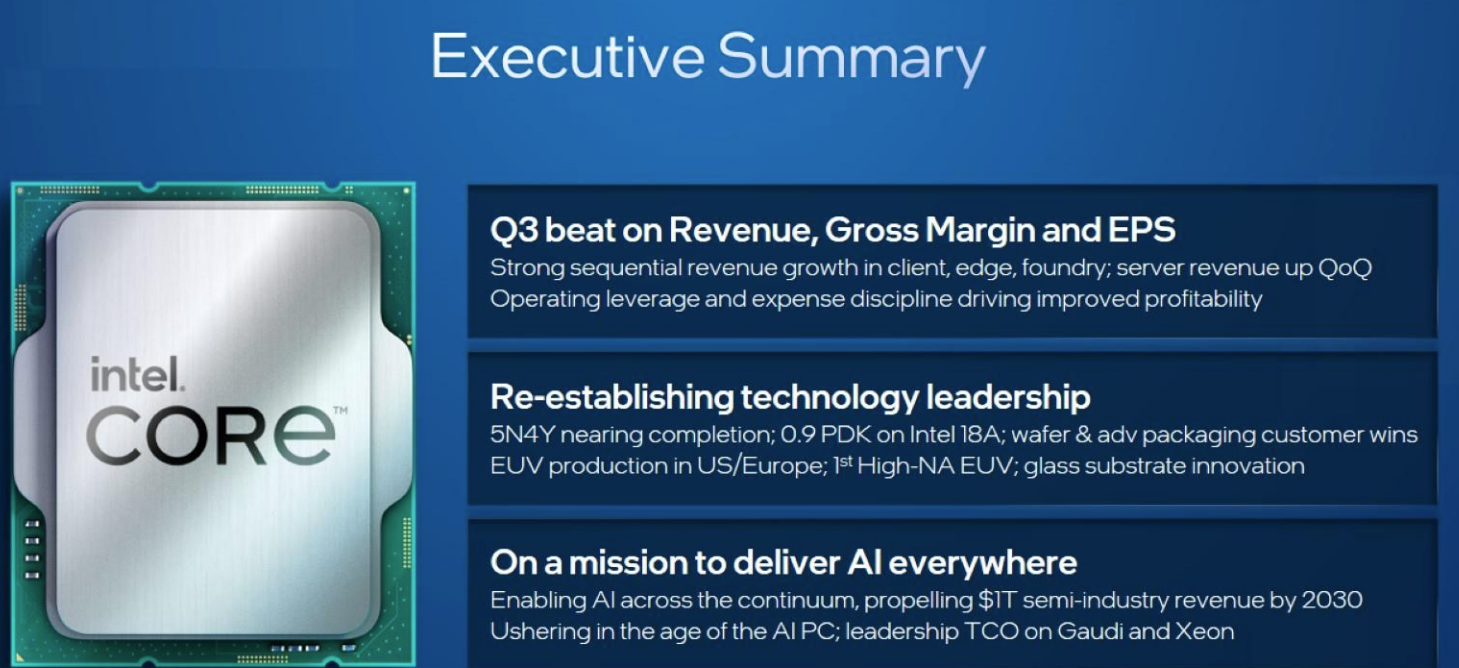
Intel handily topped third quarter expectations as the company's PC business stabilized.

The company reported third-quarter earnings of 7 cents a share on revenue of $14.2 billion, down 8% from a year ago. Non-GAAP earnings for the quarter were 41 cents a share. 

Wall Street expected Intel to report non-GAAP earnings of 22 cents a share on revenue of $13.6 billion.

While Intel isn't the juggernaut it once was, the company appears to be rebounding.

The company projected fourth quarter revenue of $14.6 billion to $15.6 billion with non-GAAP earnings of 44 cents a share.

CEO Pat Gelsinger said the company delivered "across-the-board progress" and is moving forward with its foundry business. By the numbers:

  • The PC business had revenue of $7.9 billion, down 3% from the third quarter a year ago.
  • Data Center and AI had revenue of $3.8 billion, down 10% from a year ago.
  • Network and Edge delivered third quarter revenue of $1.5 billion, down 32% from a year ago.
  • Foundry revenue was $311 million.

Tech Optimization Data to Decisions intel Big Data Chief Information Officer Chief Technology Officer Chief Information Security Officer Chief Data Officer

AWS delivers $7 billion in operating income in Q3

AWS delivers $7 billion in operating income in Q3

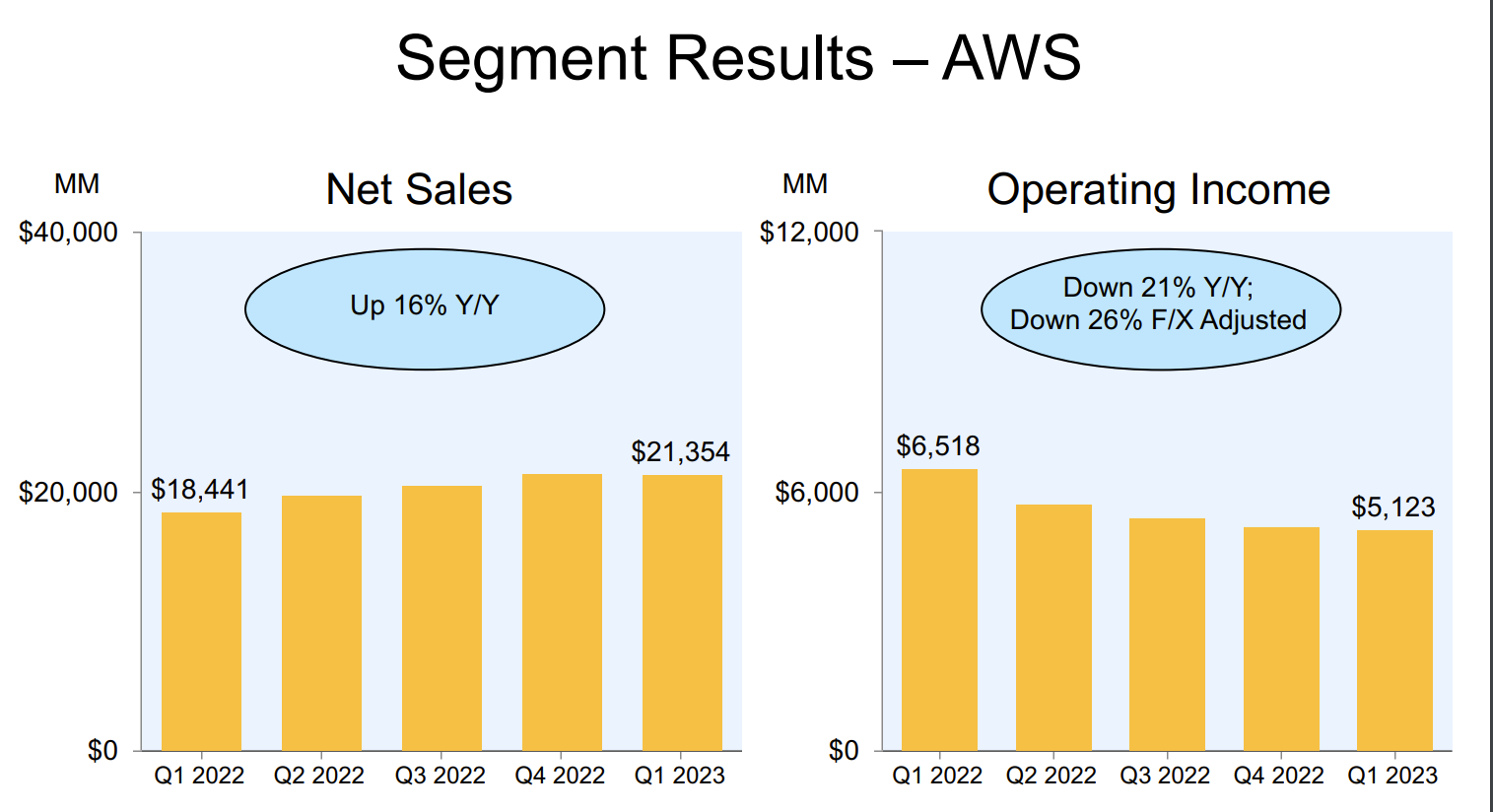
Amazon Web Services third quarter revneue was up 12% from a year ago to $23.1 billion with operating income of $7 billion. 

AWS was expected to report revenue of $23.2 billion.

For comparison, Microsoft Azure delivered revenue growth of 29% and Google Cloud's growth was 22%. 

Amazon reported third quarter net income of $9.9 billion, or 94 cents a share, on revenue of $143.1 billion, up 13% from a year ago. Amazon was expected to deliver to third quarter earnings of 58 cents a share on revenue of $141.4 billion.

The company said its North America commerce business delivered third quarter operating income of $4.3 billion on revenue of $87.9 billion, up 11%. International sales were $32.1 billion, up 16% from a year ago.

In a statement, Amazon CEO Andy Jassy said the commerce business delivered on cost savings and speed of delivery. He added that the AWS business "continued to stabilize." Jassy said:

"The AWS team continues to innovate and deliver at a rapid clip, particularly in generative AI, where the combination of our custom AI chips, Amazon Bedrock being the easiest and most flexible way to build and deploy generative AI applications, and our coding companion (CodeWhisperer) allowing enterprises to have the equivalent of an experienced engineer who understands all of their proprietary code is driving momentum with customers."

As for the outlook, Amazon projected fourth quarter revenue between $160 billion and $167 billion with operating income between $7 billion and $11 billion.

More:

Tech Optimization Data to Decisions Innovation & Product-led Growth Future of Work Next-Generation Customer Experience Digital Safety, Privacy & Cybersecurity amazon ML Machine Learning LLMs Agentic AI Generative AI AI Analytics Automation business Marketing SaaS PaaS IaaS Digital Transformation Disruptive Technology Enterprise IT Enterprise Acceleration Enterprise Software Next Gen Apps IoT Blockchain CRM ERP finance Healthcare Customer Service Content Management Collaboration Chief Information Officer Chief Executive Officer Chief Technology Officer Chief AI Officer Chief Data Officer Chief Analytics Officer Chief Information Security Officer Chief Product Officer

Opaque Systems names ServiceNow alum Fulkerson CEO

Opaque Systems names ServiceNow alum Fulkerson CEO

Opaque Systems, a software startup focused on confidential computing, has named Aaron Fulkerson as CEO. Fulkerson most recently ran ServiceNow's Impact unit and was Founder and CEO of MindTouch, which was acquired by Nice Systems.

With the addition of Fulkerson, Dr. Rishabh Poddar, co-founder and CEO until recently, will become CTO. Opaque Systems has raised $22 million in Series A funding in 2022 to bring total financing to $31.6 million. Investors include Walden Catalyst Partners, Storm Ventures, Thomvest Ventures Intel Capital, Race Capital, The House Fund, and FactoryHQ.

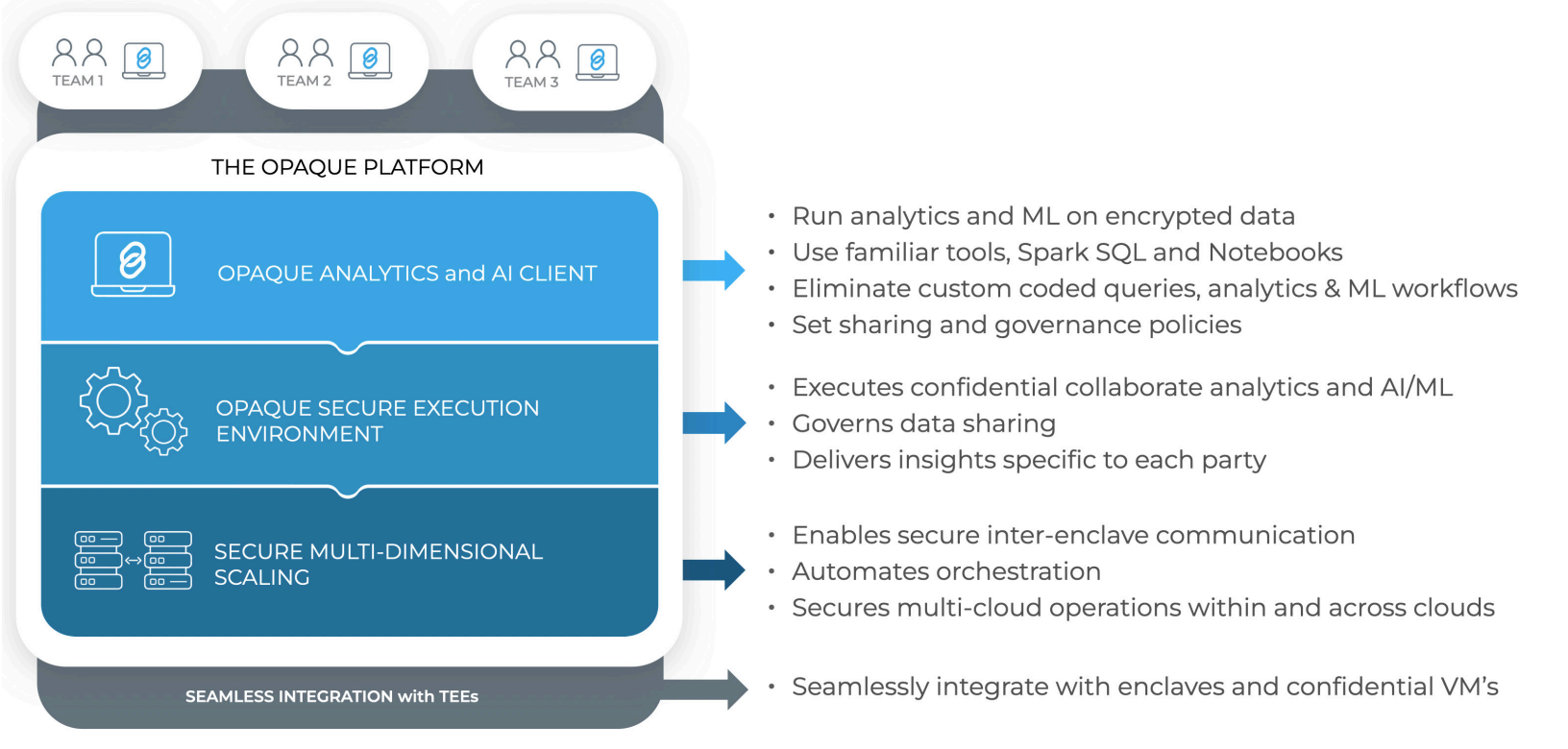
Opaque Systems features an analytics and AI platform that's built for confidential computing and enables data to be shared and analyzed by multiple parties while maintaining confidentiality and protecting data. The company provides Data Clean Rooms as well as OpaquePrompts, a privacy layer for large language models, for multiple industries including manufacturing, finance, healthcare and insurance.

I caught up with Fulkerson and Poddar to talk privacy, data management and generative AI as well as the need for a platform agnostic privacy technology provider. Here are the takeaways from our conversation.

What brought you to Opaque Systems? At ServiceNow, Fulkerson ran the Impact unit, which drives personalized recommendations, training and experts on demand to drive value from ServiceNow's platform. That personalization required data and model training that was often challenged by data privacy and data sovereignty. At the same time, generative AI and large language models (LLMs) surged. "For many organizations there's some layer of privacy over the top of an LLM that allows an organization to use it without exposing proprietary data or sensitive information," said Fulkerson. "There's going to have to be a privacy wrapper and privacy enhancing technologies. What Opaque Systems has done is built a product with verifiable trust in the DNA of every digital interaction. It was impossible to pass up the opportunity."

The technology. Opaque Systems has a specialized software stack that offers encryption as well as a digital signature at the hardware level. Intel pioneered confidential computing hardware, which is now available on all the major cloud vendors enabling Opaque Systems to focus on the software.

Although Opaque Systems got started with data clean rooms, Fulkerson said the vision for the company is broader. Data clean rooms are a feature available from multiple vendors, but most of these efforts are tied to platforms. Opaque Systems offers a privacy layer across multiple data sets and systems. "Opaque is allowing companies and organizations to encrypt data sets, put it into an Opaque room with multiple other encrypted data sets and then you can run data processing jobs while maintaining encryption," explained Fulkerson. "Encryption in transit is typical but we have encryption at the time of processing." He added that verifiable trust technology allows for analytics, machine learning models and other applications to be built on top of encrypted data.

Generative AI use cases. Poddar said generative AI is in Opaque Systems wheelhouse because it is fundamentally about running AI and analytics on sensitive data. "LLMs are an emergent and particularly exciting class of AI applications evolving as we speak, but we've seen a bunch of data privacy issues," said Poddar. "Enterprises will have to define and figure out their privacy strategies around LLMs."

"If you're training a model, you don't want the model to remember your confidential data," said Poddar. "You want to guarantee your data remains protected and encrypted while still allowing these generative AI workloads to be run on that data. LLMs were a natural extension of our core capabilities around confidential AI and analytics."

Poddar and Fulkerson added that LLM use cases in the enterprise are exploratory for now, but that'll change quickly, and privacy issues will need to be addressed.

Privacy first deployments. Fulkerson said the shift from exploratory generative AI use cases to production will happen in the next year. "Generative AI is going to be the killer app and we have to be able to provide a data privacy wrapper."

Fulkerson said Opaque Systems has a bevy of financial services customers using Opaque's analytics. "We're working with financial institutions that have data sets that can't be shared across business units because of regulatory requirements or different geographies even within their own organizations," he said. "If you have a retail bank, wealth management and lender you can't share data across them. If you're able to encrypt those first party data sets, you can use analytics to solve problems like fraud detection and anti-money laundering."

Customer 360 efforts will also become privacy first because of regulations as well as the need to enrich profiles with encrypted data, said Fulkerson.

Poddar added that LLMs will become part of the AI pipeline in enterprises and privacy ops will become a crucial component. "People will need to think about privacy and security issues from the ground up as they adopt this technology," he said.

The state of privacy. Fulkerson today's software paradigm for privacy revolves around contracts and that's not going to scale well with LLMs and generative AI applications. "Whenever you use software in the cloud or any kind of service, you trust that the vendor will be good custodians of your data. That's a problem," said Fulkerson. "You could be working with trusted third parties vulnerable to attacks. The problem then gets compounded in the context of cloud and collaboration."

In other words, trust needs to be verifiable and cryptographically assured so data can be shared in a way that solves problems, said Fulkerson.

Poddar added that auditing and following the data trail will also become critical in the age of generative AI. "We guarantee at all times that your data is used only in the way you permit and that it is verifiable by you, auditable by you, and you retain control," said Poddar.

Data to Decisions Digital Safety, Privacy & Cybersecurity Innovation & Product-led Growth Future of Work Tech Optimization Next-Generation Customer Experience Security Zero Trust AI GenerativeAI ML Machine Learning LLMs Agentic AI Analytics Automation Disruptive Technology Chief Information Officer Chief Information Security Officer Chief Privacy Officer Chief Executive Officer Chief Technology Officer Chief AI Officer Chief Data Officer Chief Analytics Officer Chief Product Officer

IBM's Q3 led by software revenue

IBM's Q3 led by software revenue

IBM reported better-than-expected third quarter results as software revenue grew 8%.

The company reported third quarter earnings of $1.7 billion, or $1.86 a share, on revenue of $14.8 billion, up 4.65% from a year ago. Non-GAAP earnings for the quarter were $2.20 a share.

A consensus of Wall Street analysts estimated that the company would earn $2.13 per share on $14.73B in revenue.

Arvind Krishna, CEO of IBM, said the company was seeing clients adopt its watsonx AI and data platform. That adoption is also generating consulting revenue.

The company reported that third quarter consulting revenue was up 6% and infrastructure sales fell 2%.

By the numbers:

  • Red Hat revenue was up 9%.
  • Automation revenue was up 145.
  • Security revenue was down 2%.
  • Data and AI revenue was up 6%.
  • IBM zSystem revenue was up 9%.

As for the outlook, IBM said it expects 2023 revenue to be up 3% to 5% in constant currency.

In prepared remarks, Krishna said:

"AI is projected to add $16 trillion to the global economy by 2030. Keep in mind that AI for business is different than AI for consumers given their need for more accurate results, trusted data and governance tools. AI techniques such as foundation models, large language models and generative AI, give businesses the ability to create 100 AI models from a single data set. Early client engagements experience a 70 percent faster time to value. That is why we are seeing a
lot more interest from business in using AI to boost productivity and reduce cost. Productivity gains will come from enterprises turning their workflows into simpler, automated processes with AI."

Data to Decisions Tech Optimization Digital Safety, Privacy & Cybersecurity Innovation & Product-led Growth Future of Work Next-Generation Customer Experience IBM SaaS PaaS IaaS Cloud Digital Transformation Disruptive Technology Enterprise IT Enterprise Acceleration Enterprise Software Next Gen Apps IoT Blockchain CRM ERP CCaaS UCaaS Collaboration Enterprise Service ML Machine Learning LLMs Agentic AI Generative AI AI Analytics Automation business Marketing finance Healthcare Customer Service Content Management Chief Information Officer Chief Technology Officer Chief Information Security Officer Chief Data Officer Chief Executive Officer Chief AI Officer Chief Analytics Officer Chief Product Officer

ServiceNow reports strong Q3, ups outlook for 2023

ServiceNow reports strong Q3, ups outlook for 2023

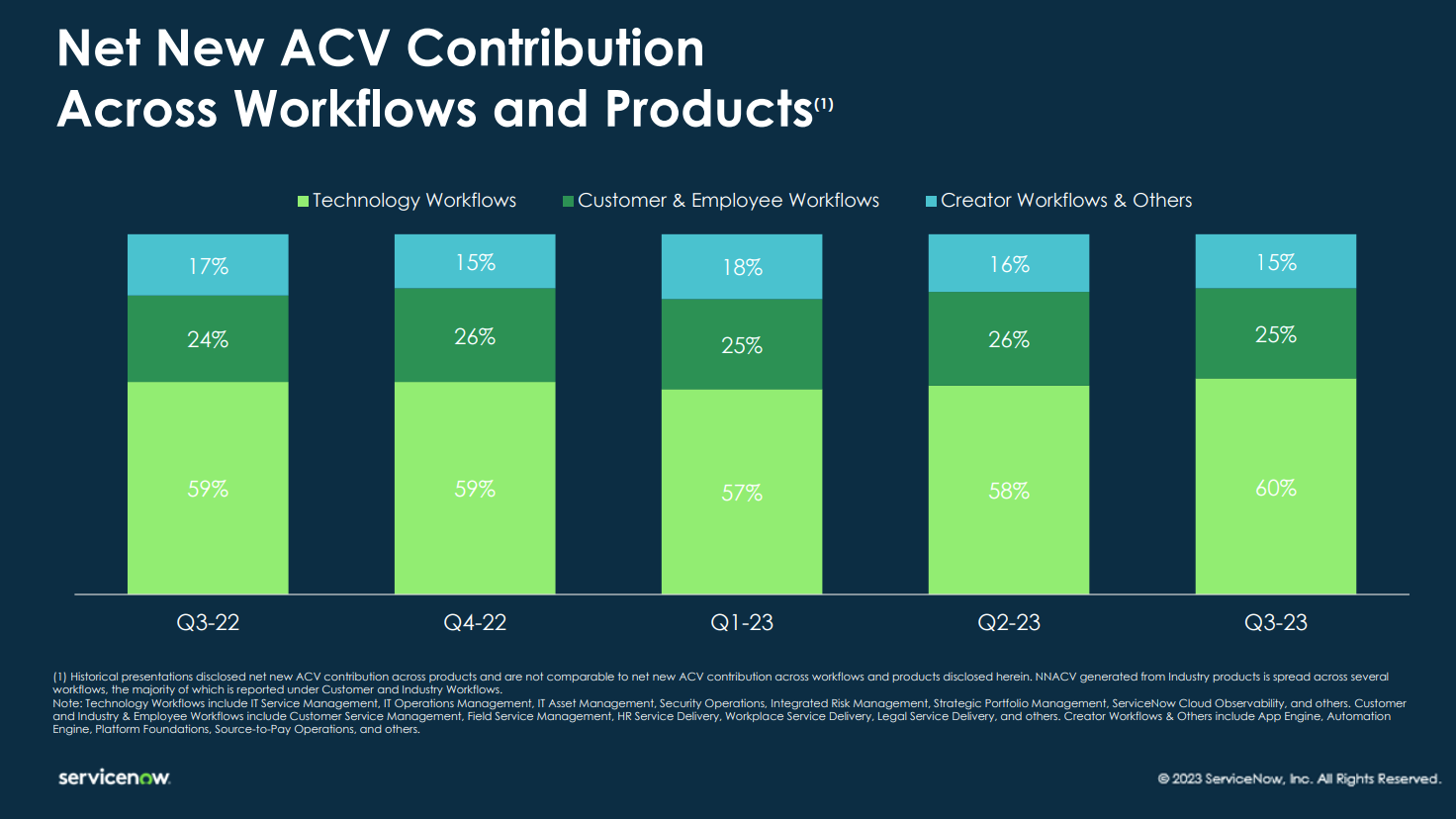
ServiceNow raised its outlook for 2023 as its third quarter subscription revenue grew 27% and the company ended the quarter with 49 customers with more than $20 million in annual contract value.

The company reported third quarter earnings of $242 million, or $1.17 a share, on revenue of $2.29 billion, up 25% from a year ago. Non-GAAP earnings in the quarter were $2.92 a share. Analysts were expecting non-GAAP third quarter earnings of $2.55 a share.

As for guidance, ServiceNow projected fourth-quarter subscription revenue of $2.32 billion to $2.325 billion. For 2023, ServiceNow projected subscription revenue of $8.625 billion to $8.64 billion, up 25.5%.

ServiceNow CEO Bill McDermott said the company's platform play for transformation and AI is rolling. "This is a highly unique, differentiated company that is reshaping business as the intelligent super platform for the enterprise."

The company is gaining wallet share and has 1,789 customers with more than $1 million in annual contract value.

On a conference call with analysts, McDermott said the following:

  • "All of our workflow businesses were in 14 or more of the top 20 deals, ITSM, ITOM, ITAM, security and risk, customer, employee, and creator. Within our technology workflows, security and risk had a very strong quarter, with 10 deals over 1 million. Employee workflows had a stellar quarter with seven deals over 1 million and one deal over 10 million."
  • ServiceNow's federal business posted its best quarter in the company's history. "We had 19 federal deals over 1 million, including three deals over 10 million," he said. 
  • "GenAI represents 36% of AI spending overall. We believe every dollar of global GDP will be impacted by AI over the next several years. This isn't a hype cycle. It is a generational movement."
  • "GenAI represents a tailwind of growth for ServiceNow. We have over 300 customers in our pipeline from every industry, every buying center and every stage of testing. Our GenAI SKU drove the highest number of customer requests for a pre-release product in our history."
  • "All CEOs right now are either in a move to increase productivity or take costs out. And obviously, while doing so, they also have the added challenge of new business model innovation."
Data to Decisions Innovation & Product-led Growth Future of Work Tech Optimization Next-Generation Customer Experience Digital Safety, Privacy & Cybersecurity servicenow AI GenerativeAI ML Machine Learning LLMs Agentic AI Analytics Automation Disruptive Technology Chief Information Officer Chief Executive Officer Chief Technology Officer Chief AI Officer Chief Data Officer Chief Analytics Officer Chief Information Security Officer Chief Product Officer

Meet Data Inc. and what a post AI company looks like

Meet Data Inc. and what a post AI company looks like

The post-AI business model will revolve around vast unique data sets and collectives that create value chains that monetize new services. The companies that are successful will lead in the future.

That's the upshot from Constellation Research CEO Ray Wang. Speaking at Connected Enterprise 2023, Wang said:

"We don't have enough data to make AI work. Billions of dollars will be wasted on AI implementation without a data strategy."

The issue is that enterprises will need more data to train models so you can actually trust AI. As a result, companies will start sharing data in collectives and create value chains.

More from CCE 2023:

What data will be needed to create this next generation enterprise called Data Inc.?

Wang said there will be the following types of data to truly leverage AI:

  • Unique data sets.
  • Network and data.
  • Longitudinal data sets.
  • Derived Data advantage.
  • New classes of data.

This data will create a new flywheel of services, businesses and products that monetize well. Here's what you'll need to make Data Inc. work. 

  1. You'll need data mastery.
  2. Understand how to partner for data sources and signals.
  3. Generate new derivatives that will create new data.
  4. Monetize outcomes.
  5. Engage stakeholders and create win-wins for partners, employees, and others.
  6. Nourish networks. Data Inc. companies will be valued on data.
  7. Trust but verify.
  8. Systems for ethics to address thorny issues.
Data to Decisions Innovation & Product-led Growth Future of Work Tech Optimization Next-Generation Customer Experience Digital Safety, Privacy & Cybersecurity Big Data ML Machine Learning LLMs Agentic AI Generative AI AI Analytics Automation business Marketing SaaS PaaS IaaS Digital Transformation Disruptive Technology Enterprise IT Enterprise Acceleration Enterprise Software Next Gen Apps IoT Blockchain CRM ERP finance Healthcare Customer Service Content Management Collaboration Chief Information Officer Chief Technology Officer Chief Information Security Officer Chief Data Officer Chief Executive Officer Chief AI Officer Chief Analytics Officer Chief Product Officer

2024 and beyond at CCE 2023: A few predictions to ponder

2024 and beyond at CCE 2023: A few predictions to ponder

Constellation Research analysts outlined a series of predictions for the years ahead at Constellation Research Connected Enterprise 2023.

CEO Ray Wang was moderating an early panel at CCE with our merry band of analysts about predictions. He was put on the spot and asked about ERP in the next 10 years. Wang's reply: "It'll still be here."

His other takeaway is that a mentor once told him that predicting the future is possible if you go back 30 to 50 years, examine what happened and change names around.

With all those caveats in mind, here are a few of trends to ponder.

Doug Henschen:

  • Leading enterprises are consolidating data in lakehouses and data fabrics that are far more flexible than the data warehouses of yore. That move will be a necessary step to making use of all your data—structured, semi-structured, unstructured—to drive AI. 
  • Boundaries between analytics/BI and predictive data science are already eroding. As we move into GenAI, those boundaries will disappear. We’ll want to ask, “what happened, why did it happen, what’s next and what should we do about it?”

Dion Hinchcliffe:

  • Boards are seeking AI impact immediately, pressuring CIOs.
  • AI transformation of work a big focus area.
  • Generative AI is just the beginning of AI revolution.
  • Transformative AI solutions to drive growth are the end-game.

Liz Miller:

  • The roadmap for use of gen AI for improving employee and customer experience is not well defined.
  • The creator economy is here, and businesses are not ready.
  • There's too much data and not enough strategy to drive experience.

Holger Mueller:

  • We are in the era of infinite computing.
  • The availability of computing is no longer a constraint. LLMs are really LKMs (knowledge models) or need to become LKMs.

Andy Thurai:

  • The possibilities for AI are boundless.
  • Business leaders are excited about AI.
  • Those business leaders are also freaked out about AI use cases.

Steve Wilson:

  • A big progressive vision for data protection is emerging.
  • There's an urgent need to get the data you need in real time at the edge.
  • The quality of metadata to tell you if it’s true.
  • Safety to data infrastructure needs to be taken seriously. It's like clean drinking water.

My time frame is a bit shorter but here are a few working theories for the next 12 months and change.

  • Generative AI in enterprise moves from productivity to more growth, transformation.
  • There will be vendor consolidation. Enterprises were doing it, but M&A will pick up.
  • Automation will move beyond low hanging fruit. What are pitfalls?
  • Few enterprises have their data games down. As result we GenAI backlash because it's highly unlikely that enterprises will acknowledge they don't have their data acts together.
  • Smaller vendors may be in trouble. IT spending reflection of S&P 500, customers are consolidating vendors and a lot of debt will be refinanced.
Data to Decisions Digital Safety, Privacy & Cybersecurity Future of Work Marketing Transformation Matrix Commerce New C-Suite Next-Generation Customer Experience Tech Optimization Innovation & Product-led Growth Connected Enterprise AI GenerativeAI ML Machine Learning LLMs Agentic AI Analytics Automation Disruptive Technology Chief Information Officer Chief Experience Officer Chief Executive Officer Chief Technology Officer Chief AI Officer Chief Data Officer Chief Analytics Officer Chief Information Security Officer Chief Product Officer

Microsoft's Azure revenue growth picks up sequentially in Q1

Microsoft's Azure revenue growth picks up sequentially in Q1

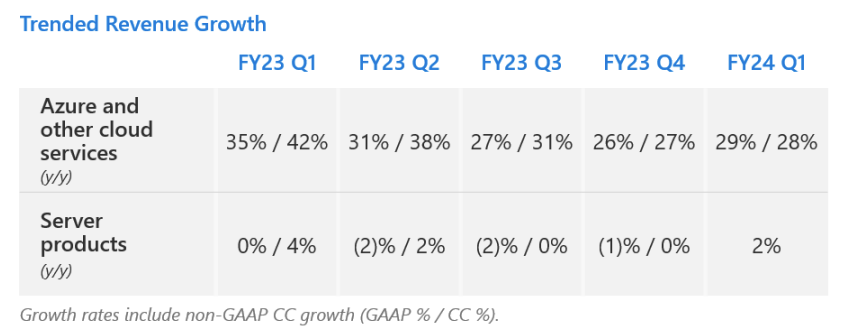
Microsoft reported better-than-expected fiscal first quarter results as its cloud services posted strong growth led by Azure revenue, which was up 29% from a year ago.

The cloud software giant reported first quarter earnings of $22.3 billion, or $2.99 a share, on revenue of $56.5 billion, up 13% from a year ago. Wall Street was expecting Microsoft to report first quarter earnings of $2.65 a share on revenue of $54.50 billion. 

In a statement, CEO Satya Nadella said copilots "are making the age of AI real" for consumers and enterprises. CFO Amy Hood said Microsoft Cloud revenue of $31.8 billion, up 24% from a year ago, drove the quarter.

Those growth rates trumped Google Cloud growth for the September quarter. Microsoft Azure revenue growth accelerated in the first quarter from the fourth quarter.

Speaking on Microsoft's earnings conference call, Nadella said that Azure is gaining share due to OpenAI, model training and new infrastructure. He said:

"Azure again took share as organizations bring their workloads to our cloud. We have the most comprehensive cloud footprint with more than 60 data center regions worldwide, as well as the best AI infrastructure for both training and inference. And we also have our AI services deployed in more regions than any other cloud provider. This quarter, we announced the general availability of our next-generation H100 virtual machines."

Nadella added that 40% of the Fortune 100 is in preview with Microsoft's copilots.

Hood said Microsoft Cloud gross margins will remain flat with a year ago, but the company continues to invest heavily in cloud infrastructure. She gave the following guidance:

  • Productivity and Business Processes second quarter revenue will grow between 11% and 12%.
  • Office 365 revenue growth will be up 16% in the second quarter.
  • Intelligent Cloud revenue in the second quarter will grow between 17% and 18% or $25.1 billion to $25.4 billion. "Revenue will continue to be driven by Azure, which as a reminder can have quarterly variability, primarily from our per-user business and from in-period revenue recognition, depending on the mix of contracts," said Hood. "In Azure, we expect revenue growth to be 26% to 27% in constant currency, with an increasing contribution from AI. Growth continues to be driven by Azure consumption business and we expect the trends from Q1 to continue into Q2. Our per user business should continue to benefit from Microsoft 365 suite momentum, though we expect continued moderation in seat growth rates, given the size of the installed base."
  • PC units for Windows appear to have stabilized.

By the numbers:

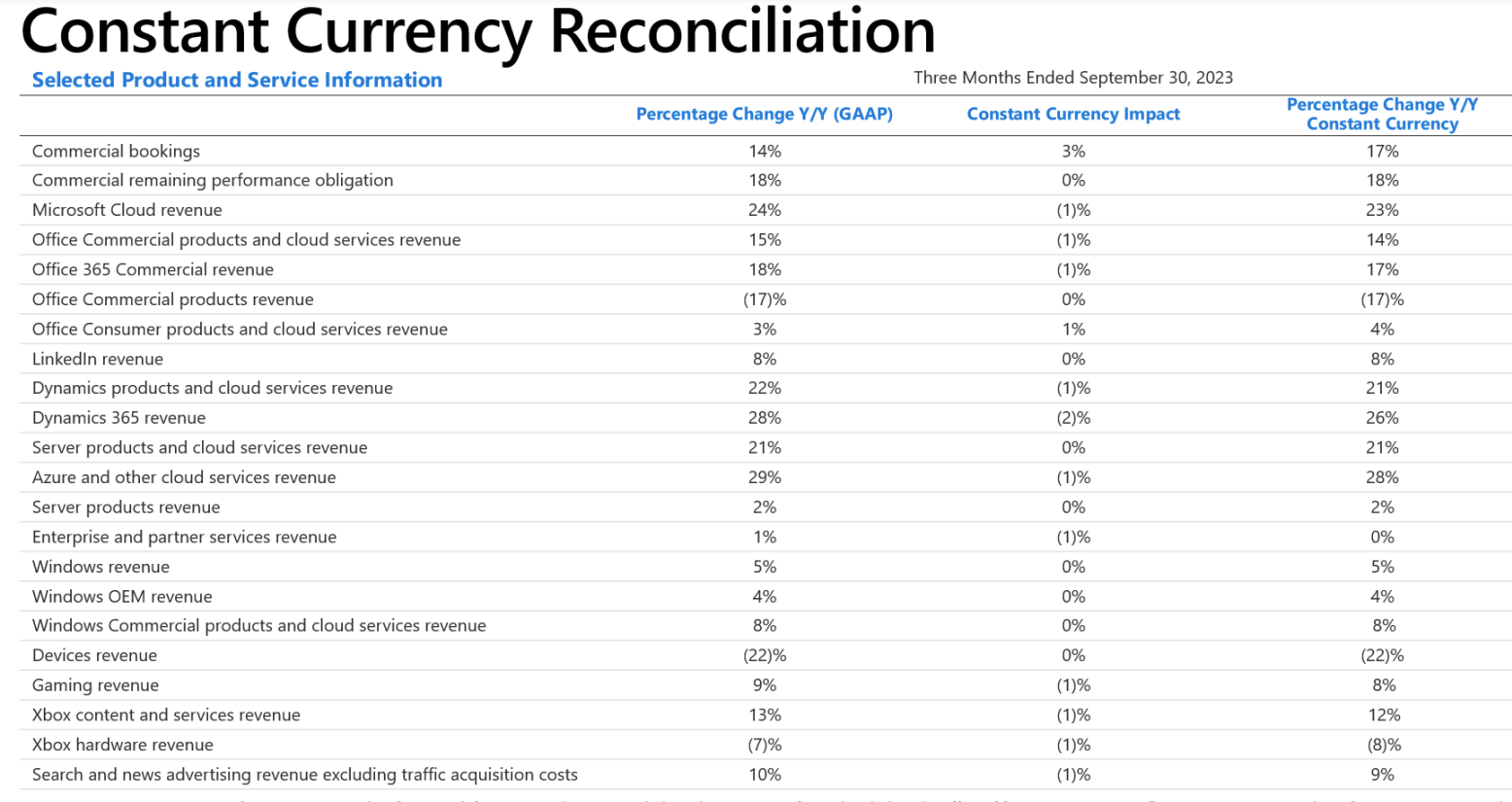
  • Office Commercial products and cloud services revenue was up 15% fueled by Office 365. Office Consumer revenue growth in the first quarter was up 3%.
  • LinkedIn revenue was up 8% in the first quarter.
  • Devices revenue fell 22%.
  • Windows revenue was up 5% for the quarter.

Here's the full growth lineup by product line.

Data to Decisions Tech Optimization Innovation & Product-led Growth Future of Work Next-Generation Customer Experience Digital Safety, Privacy & Cybersecurity Microsoft SaaS PaaS IaaS Cloud Digital Transformation Disruptive Technology Enterprise IT Enterprise Acceleration Enterprise Software Next Gen Apps IoT Blockchain CRM ERP CCaaS UCaaS Collaboration Enterprise Service AI GenerativeAI ML Machine Learning LLMs Agentic AI Analytics Automation Chief Information Officer Chief Technology Officer Chief Information Security Officer Chief Data Officer Chief Executive Officer Chief AI Officer Chief Analytics Officer Chief Product Officer