Results

Google Cloud CEO Thomas Kurian on DisrupTV: Generative AI will revamp businesses, industries

Google Cloud CEO Thomas Kurian on DisrupTV: Generative AI will revamp businesses, industries

Google Cloud CEO Thomas Kurian said companies are starting to reimagine their businesses for artificial intelligence one process at a time. The big question is what industries hit scale first. 

Speaking on DisrupTV, Kurian said "in virtually every field, we're seeing people take the persona that they had, and then creating a digital version of that persona using AI and this is happening incredibly quickly."

"The common theme is taking the skills of the model that represents what human beings can do, but now creating a digital persona and assisting a function," he said.

Kurian cited use cases across industries including healthcare, insurance, cosmetics and media to name a few. Many of these industries started out with AI use cases that revolved around classification and categorization. The next phase for AI was prediction using models based on different parameters. Generation is the new phase.

"Generation is the next skill as you train a model with a set of inputs and it can generate output," said Kurian. "You can now put together and automate a complete workflow for the whole company. And this is happening in many places. We see it happening at scale at many around the world."

Related: Cloud customers still optimizing spend and should forever | Google Cloud delivered third quarter revenue of $8.4 billion, up 22% from a year ago, with an operating profit of $266 million

Constellation Research CEO Ray Wang asked Kurian whether incumbent companies or startups had advantages in generative AI. Kurian said:

"We're very early in the market. To do AI well, we need high quality data sets to fine tune the state-of-the-art models. For high quality datasets, you need state of the art models, and you obviously need the infrastructure to serve the models. But then just as importantly, you need to integrate these into the application surface.

The companies that succeed will have capabilities for state-of-the-art models that are driven by high quality datasets that they own, and the ability to activate these models. within account within the context of an application surface.

There will obviously be disruptors and they will take a function of process that was done in one way and fundamentally change it. You will see disruptions in different industries, where the fundamental business model itself may change.

"The winners are always those that solve a fundamental problem materially."

Going forward, generative AI will be democratized and simplified. AI will be an enabler for new technologies and access. In other words, we'll all become programmers to some degree. Kurian said:

"The code generation model will generate the skeleton code and create the environment. You can say 'hey, I want to support a million and a half users with less than 10 seconds latency of 10 milliseconds latency and I need to guarantee four nines of availability' and the system will do it for you. There's no reason that that cannot be done with where models are. And by doing that, we again change how widely accessible these things are. We are also very encouraged by the fact that we can make these models work not just for people in affluent countries, but also people in emerging markets."

Kurian also touched on other topics.

Security. Kurian said AI is already detecting threats, but also prioritizing them. "We built a model that can look at the threats that are emerging in your infrastructure, which one needs priority and how does that threat affect you," he said. "Models don't have that emotional bias. So, they can look at many more patterns to detect what's going on what is the attack the attack surface. It can remediate it and automate the creation of the rulebook to resolve the problem. We're applying AI to the whole spectrum."

AI-driven cybersecurity attacks. "We also see AI being used by bad actors to create new types of threats and we're also building our platform to thwart new types of threats," he said.

Running Google Cloud. Kurian said Google had great products but needed to build out enterprise capabilities as an independent unit.

"We're the fifth largest software company in the world, which is a long, you know, huge credit to the team. But when we looked at it, we felt we needed to do four things really well. You need to take great technology but convert it into solutions that people can use. Just having technology that's not accessible is a challenge.

Second, we need to build a great go to market function. What kind of structure do you have? How do you focus? We started with a set number of industries and countries.

It's an ecosystem game. It's not your company against another company. It's your ecosystem. So, we made decisions very early to partners. We started with 100 partners today there are 100,000 partners. And part of that is we wanted to bring that ecosystem so that people realize it's a bigger pie that they are creating, not slicing off the same pie. That's the third one.

And then you have to do something really well. It's just like sports. In order to play really well, you have to do the grunt work of training. We have to do a lot of the things below the surface of the water such as the systems, the legal contracting, and the frameworks to be more efficient as an organization. Those were all put in place so that you can go faster. Unless you have a strong core, you can't really play well. We've been super fortunate that we've been blessed with such a great team of people that have done so much of the work to get us where we are today."

Data to Decisions Tech Optimization Digital Safety, Privacy & Cybersecurity Innovation & Product-led Growth Future of Work New C-Suite Next-Generation Customer Experience Google Google Cloud SaaS PaaS IaaS Cloud Digital Transformation Disruptive Technology Enterprise IT Enterprise Acceleration Enterprise Software Next Gen Apps IoT Blockchain CRM ERP CCaaS UCaaS Collaboration Enterprise Service AI GenerativeAI ML Machine Learning LLMs Agentic AI Analytics Automation Chief Information Officer Chief Technology Officer Chief Information Security Officer Chief Data Officer Chief Executive Officer Chief AI Officer Chief Analytics Officer Chief Product Officer

Apple Q4 better than expected, but it has a Mac sales sink

Apple Q4 better than expected, but it has a Mac sales sink

Apple's fourth quarter results were better-than-expected but revenue was down for the fourth consecutive quarter. Mac sales in the quarter were weaker than expected, but may get a lift with new MacBook Pro models on tap. 

The company reported fourth quarter earnings of $1.46 a share on revenue of $89.5 billion, down 1% from a year ago.

Wall Street was expecting Apple to report fourth quarter earnings of $1.39 a share on revenue of $89.28 billion.

Here's a breakdown of Apple fourth quarter results by product line and their targets via LSEG.

  • iPhone revenue: $43.8 billion; Estimate: $43.81 billion
  • Mac revenue: $7.61 billion; Estimate: $8.63 billion
  • iPad revenue: $6.44 billion; Estimate: $6.07 billion
  • Wearables, Home and Accessories revenue: $9.33 billion; Estimate: $9.43 billion
  • Services revenue: $22.31 billion; Estimate: $21.35 billion

In a statement, CEO Tim Cook said the company has a strong lineup for the holiday season including new Macs. Overall, Apple's game plan is to monetize its user base with services and subscriptions.

For fiscal 2023, Apple reported net income of $96.99 billion, or $6.13 a share, on revenue of $298.08 billion.

Other items to know:

  • China revenue in the fourth quarter was $15.08 billion, down from $15.47 billion a year ago.
  • Americas revenue was $40.11 billion, up from $39.8 billion a year ago.
  • Europe and Japan revenue was down slightly from a year ago.

Constellation Resarch CEO Ray Wang said:

"Despite continued revenue decline, Apple is a digital giant and flight to safety stock in good times and bad. The macro conditions are elongating the iPhone replacement cycle. China is the challenge as iPhone 15 sales slow and Huawei has revamped its offerings. The elongation of iPhone replacement cycles is the headwind. 

The new Mac Lineup provides cost savings and higher margins and could revitalize sales. The vertically integrated strategy is working For Mac, iPhone, Watch, and ultimately Vision Pro. Services is the bright spot. All eyes on the holiday forecast for the December quarter." 
 

More:

Next-Generation Customer Experience apple Chief Information Officer

Palantir's commercial business scales with help of AI boot camps

Palantir's commercial business scales with help of AI boot camps

Palantir's commercial annual revenue run rate is closing in on the company's government business as Palantir Artificial Intelligence Platform (AIP) gains enterprise traction.

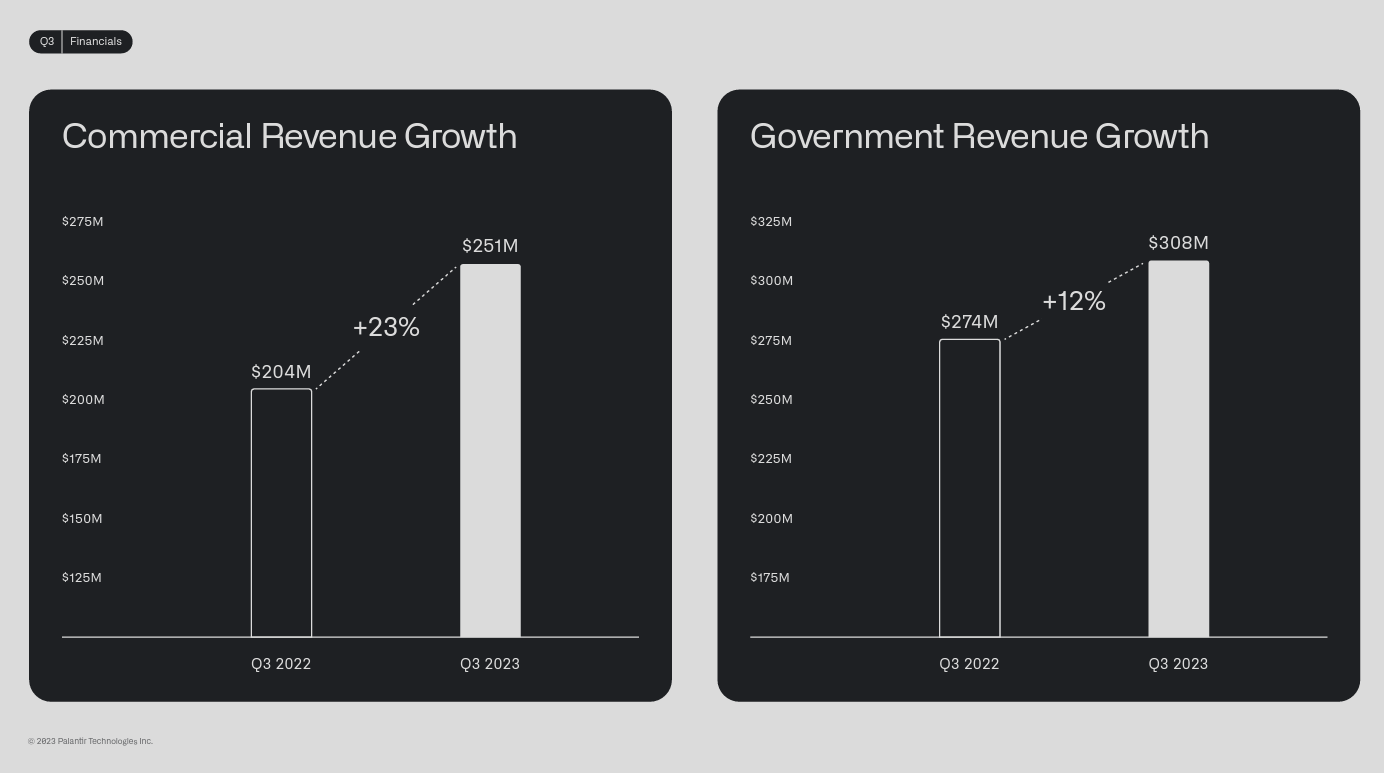
The upcoming parity point between commercial revenue and Palantir's core government business is worth watching. In the third quarter, Palantir commercial revenue grew 23% to $251 million with US revenue growing 33% to $116 million. Government revenue grew 12% to $308 million in the third quarter.

Overall, Palantir reported third quarter earnings of $72 million, or 3 cents a share, on revenue of $558 billion, up 17% from a year ago. Adjusted earnings were 7 cents a share. The results handily topped expectations.

Palantir has been trying to grow its enterprise revenue base for years and now has 181 commercial customers, up 37% from a year ago. As for the outlook, Palantir is projecting 2023 revenue between $2.216 billion and $2.22 billion. J.D. Power, Palantir team up on generative AI apps for auto value chain

On a conference call with analysts, Ryan Taylor, Palantir's Chief Revenue Officer, said the company closed 80 deals including 12 worth $10 million or more across 11 industries.

Taylor said:

"We're also seeing the acceleration of larger deals and shorter times to conversion and expansion, including a multiyear deal in excess of $40 million with one of the largest home construction companies in the U.S. to start up pilot and converted all within Q3. This growth is in part due to AIP's continued transformation of the way we partner with and deliver value for our customers, and we expect AIP's impact to continue to intensify."

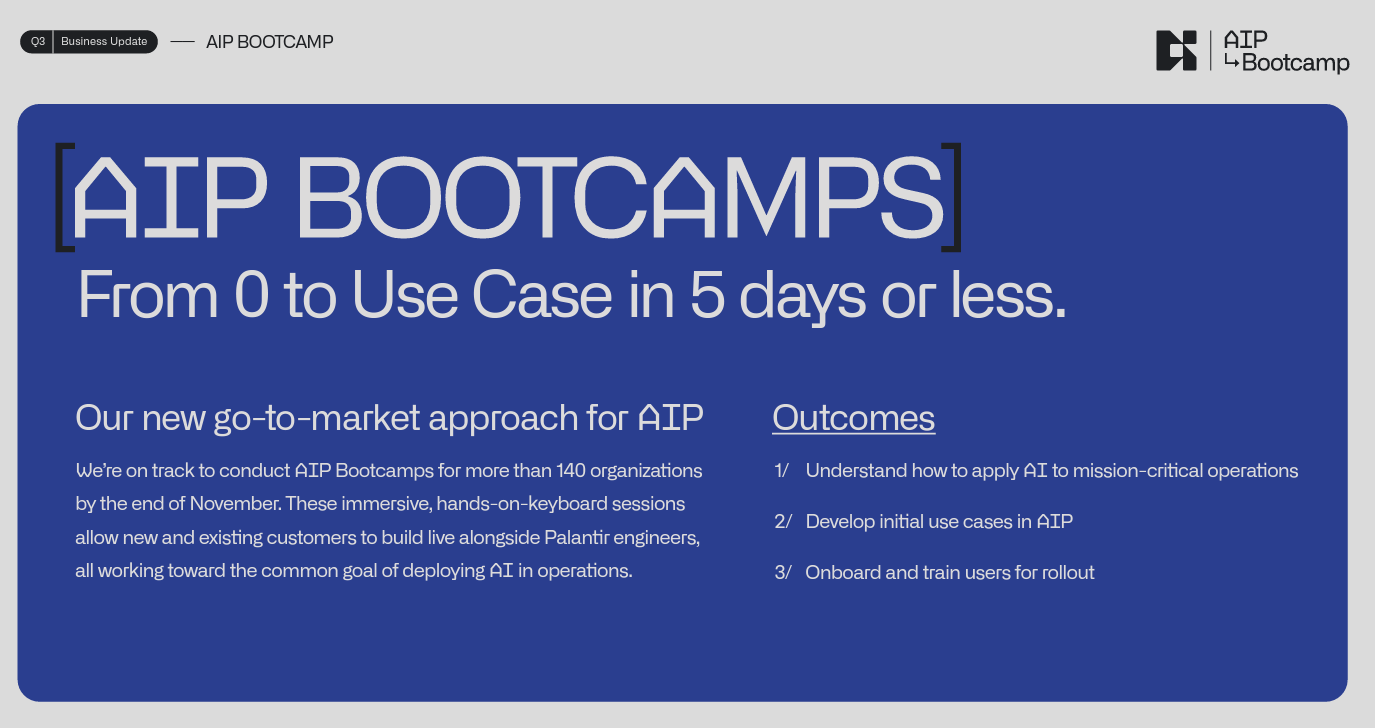
Palantir has seen traction with "AIP boot camps," which deliver real workflows on customer data in 5 days or less. That approach is driving contract expansions. "We're on track to conduct boot camps for more than 140 organizations by the end of November, nearly half of those are taking place this month alone, which is more than the number of U.S. commercial pilots we conducted all of last year," said Taylor. "We almost tripled the number of AIP users last quarter and nearly 300 distinct organizations have used AIP since our launch just five months ago. We will continue investing meaningfully in boot camps as our go-to-market strategy for AIP."

Of course, Taylor noted that Palantir's government business remains strong and should accelerate going forward.

Shyam Sankar, Palantir's CTO, said AIP boot camps are driving the point home that you can't use LLMs without tools to provide algorithmic reasoning. Sankar recently gave a talk on the topic.

According to Palantir CEO Alex Karp the commercial success isn't surprising if you zoom out and consider the company's military experience. Karp said:

"AIP and U.S. commercial is not only is disrupting the market, it's setting a standard that I don't believe any other software company will be able to reach partly because they misunderstood the value of LLMs and their relative importance, and lack of importance, partly because they don't have decades of experience on the frontline as we do in the military with managing the core ways in which you make these things precise, the way in which you provide governance."

Karp added that AIP enables enterprises to manage LLMs and "basically pen test your enterprise." "My view of what we should do is build products that are so good that the competition stops competing, whether that's in commercial or on the battlefield and that's what we're doing. And that's what we're seeing in AIP," said Karp.

Data to Decisions Innovation & Product-led Growth Future of Work Tech Optimization Next-Generation Customer Experience Digital Safety, Privacy & Cybersecurity ML Machine Learning LLMs Agentic AI Generative AI AI Analytics Automation business Marketing SaaS PaaS IaaS Digital Transformation Disruptive Technology Enterprise IT Enterprise Acceleration Enterprise Software Next Gen Apps IoT Blockchain CRM ERP finance Healthcare Customer Service Content Management Collaboration Chief Information Officer Chief Data Officer Chief Executive Officer Chief Technology Officer Chief AI Officer Chief Analytics Officer Chief Information Security Officer Chief Product Officer

SAP Build Code adds generative AI tools, bridges to process data, Java, JavaScript

SAP Build Code adds generative AI tools, bridges to process data, Java, JavaScript

SAP launched SAP Build Code development tools that leverage generative AI and court Java and JavaScript developers as well as connect to data stores across the enterprise.

At SAP's TechEd 2023 conference, SAP outlined a series of tools that aim to enable developers to build applications and connect them to the SAP Business Technology Platform. These pro code tools, which build on last year's low code/no code rollout, feature the following:

  • Generative AI productivity tools to connect heterogenous systems.
  • Vector embedding capability in SAP HANA Cloud to handle unstructured data and provide context to models.
  • SAP AI Foundation, a developer repository to build AI-driven business apps.
  • Development tools that are optimized for Java and JavaScript and interoperate with ABAP Cloud development.
  • Code generation via SAP's generative AI assistant Joule.
  • Unification of design and run-time services to build interfaces using Java and Node.js.
  • The ability to work in Visual Studio cloud hosted environments.
  • Simplified API management so developers can connect to third party systems, link processes and keep business context.

SAP Build Code will be generally available in the first quarter.

The ERP giant's other big play was to connect its SAP Build Code developer base to its process optimization tools including SAP Build Process Automation, SAP Signavio, which will get a large language model specific to business processes or large process model, and SAP Integration Suite. By connecting development and process optimization, SAP is looking to keep data on its platform while extending into other third-party systems. To that end, SAP also said that models built in DataRobot can be hosted inside SAP AI Core and used in SAP Build applications and extensions.

More:

In addition, SAP Datasphere will get updates to import business context from SAP S/4HANA Cloud, SAP S/4HANA, SAP Business Warehouse and SAP BW/4HANA for data integration. Datasphere will also have simplified data sharing as well as prebuilt business content with a release planned for the fourth quarter.

Constellation Research's take

Holger Mueller, Constellation Research analyst, handicapped SAP's announcements. He said:

"SAP is doing right by its developer community with the launch of Build Code – which took a temporary back seat with all the attention the low code/no code offering had in the last 12 months. It is of strategic importance for both SAP customers and SAP alike that existing customers can move their ECC based customizations and extensions to the cloud future, where they need to upgrade to S/4HANA by 2027.

Given that most custom SAP code is in ABAP though, the SAP developer community wonders why the focus was Java/JavaScript. Certainly, a more en vogue platform today, but it is easier to move alike code / programming language – than re-writing. It would have been a big win if SAP could have delivered all pro-code tooling in 2023.

On the HANA side it is important that HANA gets the now 'standard' AI vector feature – what it will mean for in memory usage will have to be seen – but a key step to keep HANA and HANA data (where all of S/4 HANA data is) relevant in the AI age. What needs to be clarified is the basic working of SAP’s AI platform – that would have been a prime-time topic for TechEd. We may now have to wait till Sapphire."

Data to Decisions Tech Optimization Digital Safety, Privacy & Cybersecurity Innovation & Product-led Growth Future of Work Next-Generation Customer Experience SAP AI GenerativeAI ML Machine Learning LLMs Agentic AI Analytics Automation Disruptive Technology Chief Information Officer Chief Technology Officer Chief Information Security Officer Chief Data Officer Chief Executive Officer Chief AI Officer Chief Analytics Officer Chief Product Officer

ServiceNow CEO McDermott talks business transformation, generative AI, processes

ServiceNow CEO McDermott talks business transformation, generative AI, processes

ServiceNow CEO Bill McDermott said workflow and process optimization are blending as enterprises shift away from siloed data and infrastructure to focus on transforming operations with new technologies such as generative AI.

McDermott, speaking during ServiceNow’s industry analyst day, closed out sessions with ServiceNow executives who outlined generative AI plans, strategy, target industries and returns on investment.

He said enterprises have created "a hornet's nest of complexity." "The number one reason that digital transformation hasn't delivered positive ROI to businesses is integration. And that's why 85% of the businesses that have gone on transformation didn't get a positive ROI, because nothing integrates," said McDermott.

ServiceNow reports strong Q3, ups outlook for 2023 

What's changed is an inflection point where enterprises have to cut costs, leverage new technologies and be agile enough to navigate a bevy of unknowns.  McDermott said IT budgets are likely to rise and "generative AI is the main cause of the increase." "I've tested this theory with CEOs that they're going to lean even more heavily on SG&A functions. They're not going to do what they've always done, which is upgrading older technology and 1,000 points of dim light point solutions. They're going to start stopping things in favor of investing in platforms that matter. There's about a half a dozen initiatives that matter and Gen AI is number one on the list," he said.

McDermott added that boosting efficiency requires a focus on processes and a move away from siloed operations.

"We're moving away from the siloed operation. Operations today have to be done in teams. It has to be done across silos. It has to be done in business processes, whether that sorts of pay cash and so forth. So, what you're seeing now is a complete renaissance in where the work needs to be done," he said. "We have to put a bit of an action layer above this mess. Straighten out the mess, go into the process, go into the end integration and then provide a UX that hides the complexity."

According to McDermott, C-level executives are pivoting to business transformation management "where you rethink the whole value chain."

Other key points from McDermott include:

Speed and time to ROI is critical. McDermott said CEOs have to rev innovation cycles even as they are navigating multiple concerns--geopolitical issues as well as economic concerns--and have to become more productive. "Leaders can't be focused on time consuming projects with high risks," said McDermott. "They have to get the job done. Customers need positive ROI. They need costs out and they need productivity up and keep an eye on growth."

He added that CEOs "really need to increase the clock speed of their companies."

Work is still complicated. "What I try to explain to CEOs in the context of what we do is companies still waste a lot of time," said McDermott. "The average worker today swivels between 13 disparate applications in the enterprise. And that's forfeiting more than 20% of their productivity. Some cases are a lot higher than that. That seems pretty ridiculous."

The intersection of data and AI. CEOs are starting to realize that to leverage generative AI they need to focus on their data. "The enlightened CEOs are getting the picture that they really need to focus on data," said McDermott, adding that AI is the next step. "If I can improve the productivity of my workers or my engineers by 30% to 40% combined with digital transformation, we're now moving into a whole different category--business transformation."

Generative AI's impact on employment. "I absolutely believe that this might be the great unlock in human productivity and enterprise productivity. And it actually might be a force multiplier for increasing the world's GDP. Because if I'm right on digital transformation, I would also be right that we're going to need more people in the workforce. They're going to do different things. They're going to be retrained. A lot of people forget we're in the tightest labor market that we've been in for two decades," said McDermott. "It's the biggest thing that we've come across in the enterprise, probably since the internet."

Data to Decisions Future of Work Tech Optimization Innovation & Product-led Growth Next-Generation Customer Experience Revenue & Growth Effectiveness Digital Safety, Privacy & Cybersecurity servicenow AI ML Machine Learning LLMs Agentic AI Generative AI Robotics Analytics Automation Cloud SaaS PaaS IaaS Quantum Computing Digital Transformation Disruptive Technology Enterprise IT Enterprise Acceleration Enterprise Software Next Gen Apps IoT Blockchain CRM ERP CCaaS UCaaS Collaboration Enterprise Service developer Metaverse VR Healthcare Supply Chain Leadership GenerativeAI Chief Executive Officer Chief Information Officer Chief Technology Officer Chief AI Officer Chief Data Officer Chief Analytics Officer Chief Information Security Officer Chief Product Officer

Snowflake lays out AI managed service vision with Cortex

Snowflake lays out AI managed service vision with Cortex

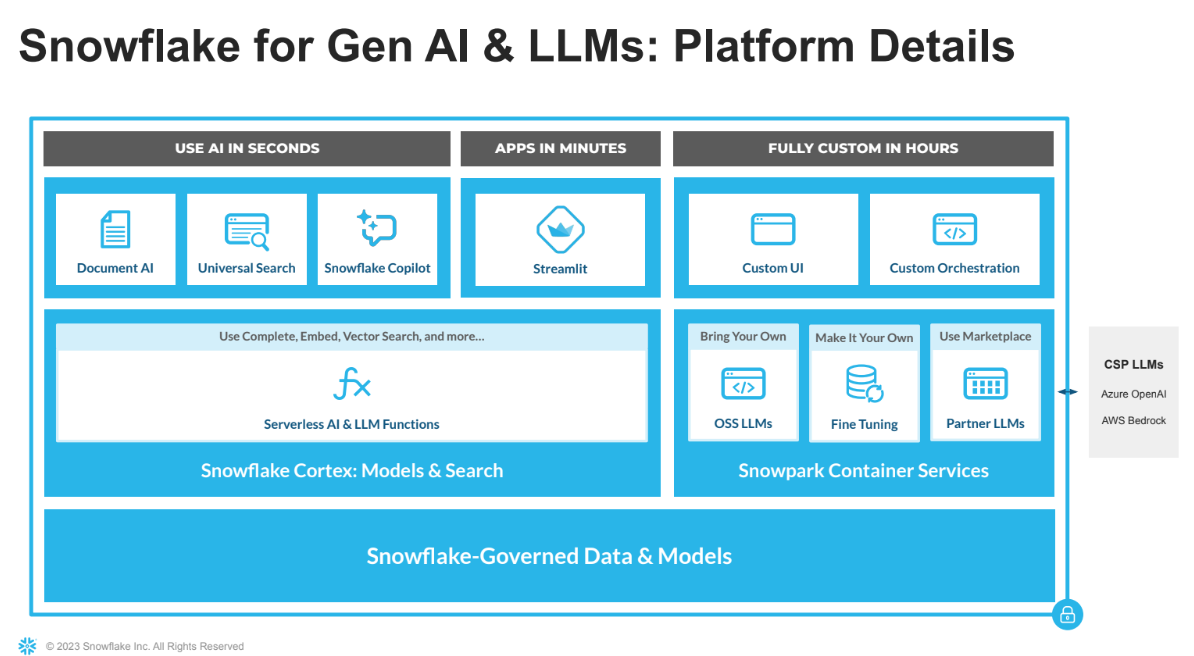
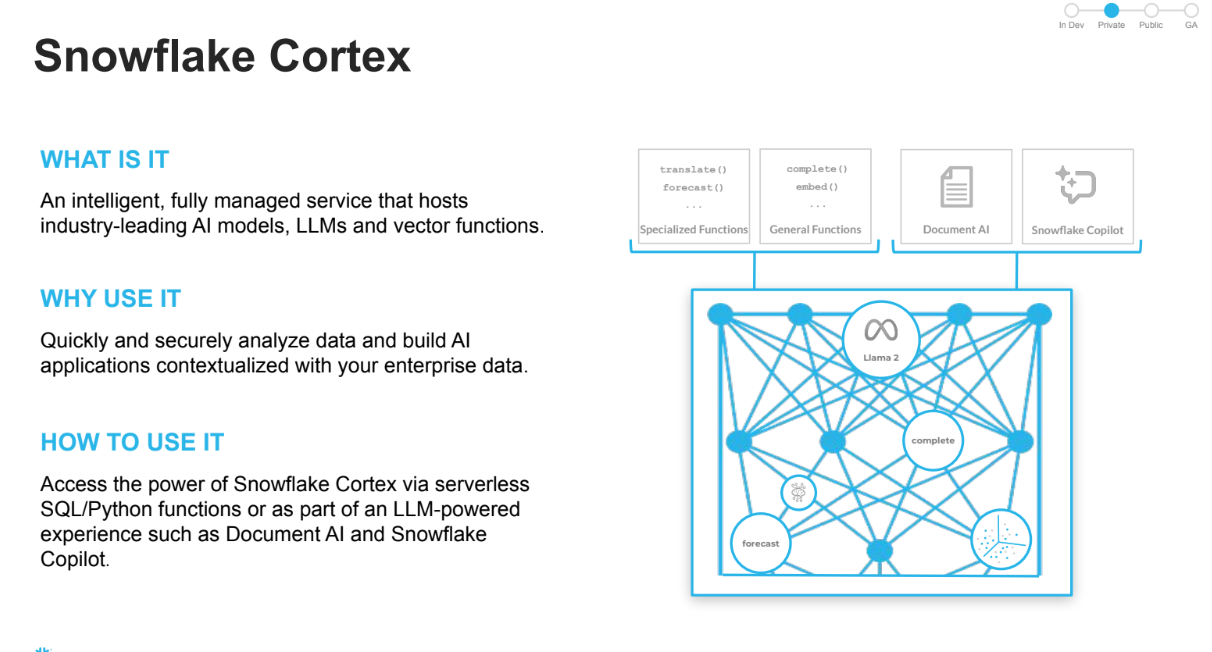
Snowflake consolidated its AI and machine learning efforts with Snowflake Cortex, a managed service that provides access to large language models (LLMs), AI models and vector search in one place and includes Snowflake Copilot, Document AI and Universal Search.

Cortex, announced at Snowflake's Snowday developer conference, is in private preview. Snowflake Cortex will include LLMs including Meta's Llama 2 model as well as task-specific models. For Snowflake, the move to Cortex highlights a vision that revolves around providing AI building blocks without expertise or GPU infrastructure management.

To go with Cortex, Snowflake expanded its Snowflake Horizon built-in governance platform. The company added data quality monitoring, data lineage UI, differential privacy policies, enhanced classification of data and an upcoming Trust Center that will streamline cross-cloud security and compliance modeling.

Snowflake also plans to provide a cost management interface so admins can manage costs in Snowflake.

Related: Snowflake Q2 better than expected | Snowflake launches Snowpark Container Services, linchpin to generative AI strategy | Snowflake, Nvidia team up to enable custom enterprise generative AI apps

Although the announcements are notable for Snowflake customers, it's worth noting that many of these services are in private preview.

Doug Henschen, Constellation Research analyst, provided his take on Snowflake's barrage of announcements and private previews. He said:

"Snowflake is making lots of private preview announcements. Snowflake's general pattern is to make more "heads up it’s coming" announcements during Snowday and more "it's now public preview or GA" at Snowflake Summit in June, but I don't tend to get too get excited about private preview announcements that are six to 12 months from being available to customers.

Horizon and Cortex are, indeed, two of the higher-profile announcements. Horizon is really consolidating everything Snowflake already has and has planned in the way of metadata management, cataloging and governance. It’s partly a response to competitors, like Databricks and Google, that have put cataloging at the forefront with their Unity Catalog and Dataplex offerings, respectively. Snowflake already had a catalog and multiple governance capabilities, but they’re now pulling everything together under the Horizon umbrella and providing a clearer and more comprehensive vision of what’s ahead. Cortex is entirely in private preview but, here too, we're seeing the vision for how GenAI and more conventional AI/ML will be made available on the Snowflake platform."

Research: 

Instead, Henschen said Snowflake customers should focus on things that are closer to launch. Snowflake announced the following additions that are closer to prime time.

  • Snowpark ML Modeling API, which will be generally available soon, will give developers and data scientists tools to simplify model training faster.
  • Snowpark Model Registry, public preview soon, will have expanded support for models from Hugging Face.
  • Snowflake Native App Framework, generally available on AWS soon and in public preview soon on Microsoft Azure.
  • Snowflake Container Services, public preview in select AWS regions.
  • Support for Iceberg Tables, which will be in public preview soon.

Henschen said Snowflake customers need to focus on what's coming within weeks more than months. He added:

"The standouts for me are the things that are entering public preview or that will soon be generally available. Support for Iceberg Tables, for example, is now in public preview, and it promises interoperability of data managed in Snowflake for open access and usability of data for other workloads and applications. It’s a win for customers. Another example is the Snowpark ML Modeling API, which will enable the many customers using Snowpark to more easily tap into Snowflake data for model preprocessing and training.  Similarly, the Snowpark Model Registry, which is going into public preview, will improve support for ML OPS within Snowflake."

The biggest takeaway from Snowflake's Snowpark conference is that the company is consolidating its efforts to provide a unified platform. Snowflake's core themes at Snowpark were to simplify the data foundation, accelerate AI adoption and scale applications.

"It's a good set of announcements, but with so many elements being in private preview, my sense is that both Databricks and Google are ahead of them on having ML/AI and GenAI capabilities internally within the platform and in supporting customers who want to develop their own ML/AI and GenAI capabilities. I’d like to see either a shorter lag time between private preview and public preview stages or a shift by Snowflake towards only announcing capabilities that are nearly ready for public preview. There are capabilities, like Unistore, for example, that were announced at Snowflake Summit 2022 that still aren’t available. In my opinion it’s not a good idea to announce things unless they’ll definitely be available within six to eight months."

Data to Decisions Innovation & Product-led Growth Future of Work Tech Optimization Next-Generation Customer Experience Digital Safety, Privacy & Cybersecurity snowflake AI GenerativeAI ML Machine Learning LLMs Agentic AI Analytics Automation Disruptive Technology Chief Executive Officer Chief Information Officer Chief Technology Officer Chief AI Officer Chief Data Officer Chief Analytics Officer Chief Information Security Officer Chief Product Officer

AMD sees strong data center demand for Q4

AMD sees strong data center demand for Q4

AMD's third quarter financial results were better than expected, but the outlook for the fourth quarter was lighter than expected. AMD CEO Dr. Lisa Su said "our data center business is on a significant growth trajectory" due to its EPYC server processors and Instinct MI300 accelerator shipments.

The company reported third quarter earnings of $299 million, or 18 cents a share, on revenue of $5.8 billion, up 4% from a year ago. Non-GAAP earnings for the quarter were 70 cents a share.

Wall Street was expecting AMD to report third quarter earnings of 68 cents a share on revenue of $5.69 billion.

As for the outlook, AMD projected fourth quarter revenue of $6.1 billion, give or take $300 million. That outlook would equate to 9% revenue growth from the fourth quarter a year ago. Non-GAAP gross margin guidance of 51.5% was in line with expectations. That outlook is based on strong growth in AMD's data center unit and momentum in the client business with lower sales in gaming and embedded markets.

Like Intel, AMD saw stabilization in the PC business. Su said AMD saw record sales of its Ryzen 7000 series PC processors as well as server processors.

Key items from AMD's analyst conference call:

  • "Based on the rapid progress we are making with our AI road map execution and purchase commitments from cloud customers, we now expect Data Center GPU revenue to be approximately $400 million in the fourth quarter and exceed $2 billion in 2024 as revenue ramps throughout the year. This growth would make MI300 the fastest product to ramp to $1 billion in sales in AMD history. I look forward to sharing more details on our progress at our December AI event," said Su. 
  • "We've been planning the supply chain for the last year and we're always planning for success. So certainly, for the current forecast of greater than $2 billion, we have adequate supply. But we have also planned for a supply chain forecast that could be significantly higher than that, and we would continue to work with customers to build that out," said Su. 
  • "Looking at the next couple of quarters, we expect strong growth in our Data Center business, driven by both EPYC and Instinct processors. This growth will be partially offset by softening demand in our Embedded business and lower semi-custom revenue, given where we are in the console cycle," said Su. "As the PC market returns to seasonal patterns, we believe we are well positioned to gain profitable share in the premium and commercial portions of the market based on the strength of our product offerings."
  • Su said the fourth quarter revenue for its Instinct processors will initially be HPC, but then become mostly AI through 2024. "Within the AI space, we've had very good customer engagement across the board from hyperscalers to OEMs, enterprise customers and some of the new AI start-ups that are out there," she said. "From a workload standpoint, we would expect MI300 to be on both training and inference workloads. We're very pleased with the inference performance on MI300, so especially for large language model inference, given some of our memory bandwidth and memory capacity. We think that's going to be a significant workload for us. But I think we would see a broad set of workloads as well as broad customer adoption."

By the numbers for the third quarter:

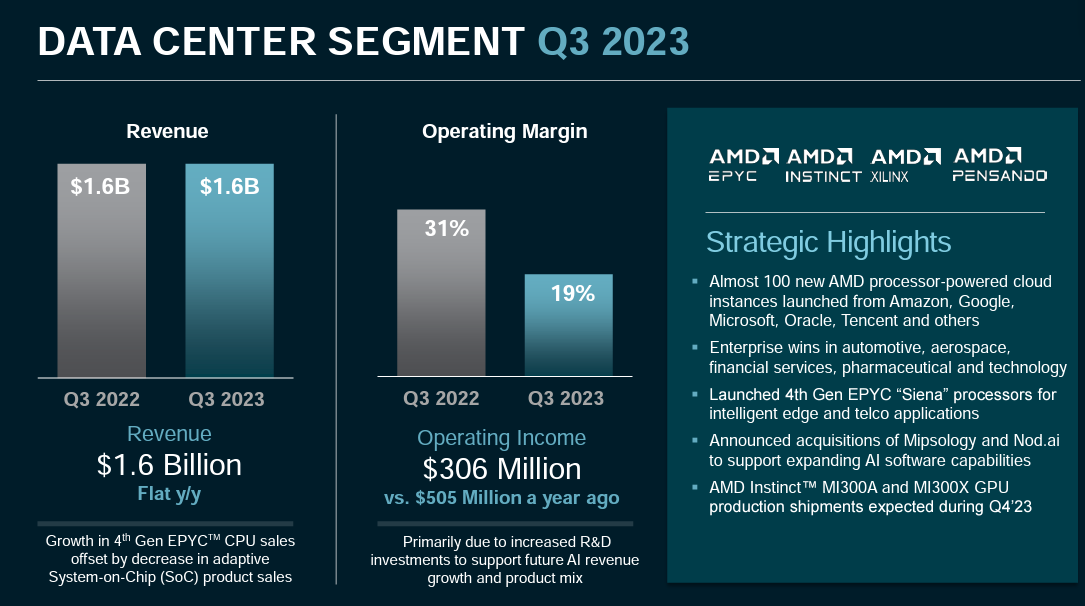
  • Data center revenue was $1.6 billion, flat on a year ago. 4th generation AMD EPYC CPU sales were up 21% sequentially but offset by system-on-a-chip data center products. AMD said it added almost 100 new instances for its AMD EPYC processors across cloud hyperscalers.
  • AMD Instinct MI300A and MI300X GPUs are on track for volume production in the fourth quarter.
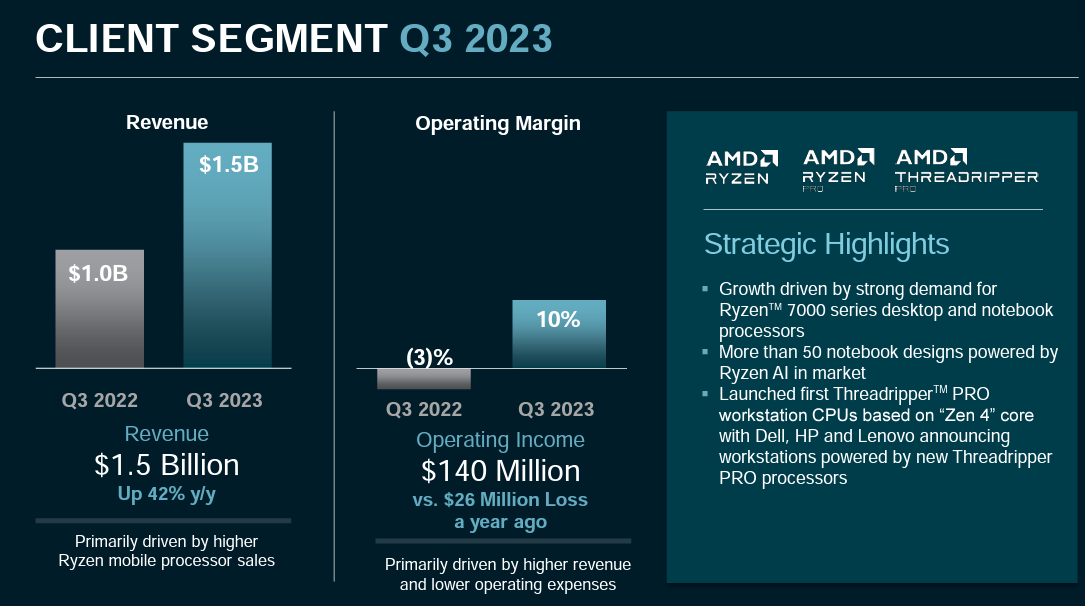
  • Client revenue was $1.5 billion, up 42% from a year ago. AMD Ryzen 7000 Series sales were up 46% from a year ago.
  • Gaming revenue was down 8% from a year ago to $1.5 billion in the quarter.
  • Embedded sales were $1.2 billion, down 5% from a year ago.
  • AMD acquired Nod.ai and Mipsology to build out its AI software offerings.

Tech Optimization Data to Decisions AMD Big Data Chief Information Officer Chief Technology Officer Chief Information Security Officer Chief Data Officer

Cloud customers still optimizing spend and should forever

Cloud customers still optimizing spend and should forever

While generative AI dominated the talking points among the big three cloud hyperscalers--Microsoft Azure, AWS and Google Cloud--there was a term that remained a close second: Optimization.

All three talked about cloud optimization as they have for the past year. CEOs are loathe to say things like cost cutting in the context of cloud, but there is certainly an ongoing tweaking of spending.

My handy conference call analytics--a word count of terms--puts optimization right in the mix as an ongoing theme. Here's what the big three are saying about customers optimizing their cloud spending through the September quarter.

Azure

Microsoft CFO Amy Hood said on the company's first quarter earnings call that "in Azure, as expected the optimization trends were similar to Q4. Higher-than-expected AI consumption contributed to revenue growth in Azure."

Makes you wonder when customers will start optimizing AI consumption too, eh?

For Microsoft's fiscal second half is assuming optimization and new workload trends will continue and Azure will see stable growth due to AI. Hood said:

"We've been very consistent that the optimization trends have been consistent for us through a couple of quarters now. Customers are going to continue to do that. It's an important part of running workloads that is not new. There obviously were some quarters where it was more accelerated, but that is a pattern that is and has been a fundamental part of having customers, both make new room for new workload adoption and continue to build new capabilities."

Optimization was mentioned 9 times on Microsoft's earnings call.

AWS

Amazon CEO Andy Jassy hit a similar theme with optimization on the company's third quarter earnings call. His message was similar to Microsoft's: Optimization is making room for new workloads. Jassy said:

"AWS' year-over-year growth rate continued to stabilize in Q3. And while we still saw elevated cost optimization relative to a year ago, it's continued to attenuate as more companies transition to deploying net new workloads."

According to Jassy, optimization remains a headwind, but the rate of cutting has slowed. He added that AWS is "encouraged by the strength of our customer pipeline."

Other optimization takeaways from Jassy include:

  • Customers aren't shutting down workloads en masse.
  • Many customers are shifting EC2 instances to Graviton processors over AMD and Intel to save money.
  • Customers are also moving from hourly on-demand rates to workloads with 1- to 3-year commitments to save money.
  • Optimization with help from AWS is a long-term customer win.

Jassy added:

"My perspective is that in 2024, I think a lot of the relatively low-hanging fruit on optimization has happened in 2023. It's not to say there won't be any more optimization. It's just that there's more low-hanging fruit when you have very large footprints and you've built a lot of applications on a platform."

Optimization was referenced 19 times on AWS' third quarter earnings call.

More:

Google Cloud

Although Google Cloud's revenue growth of 22% disappointed Wall Street, it's worth noting that the company's conference call featured the word optimization only 3 times and only one comment referred directly to Google Cloud.

Alphabet CEO Sundar Pichai said:

"We had definitely started seeing customers looking to optimize spend. We leaned into it to help customers given some of the challenges they were facing. And so that was a factor. But we are definitely seeing a lot of interest in AI. There are many, many projects underway now, just on Vertex alone, the number of projects grew over 7x. And so, we see signs of stabilization, and I'm optimistic about what's ahead."

What gives? Optimization is probably less of a theme for Google Cloud since it doesn't have the installed base that AWS and Azure enjoy.

My take

Frankly, I hope this cloud cost optimization theme remains forever. While optimization became a big theme a year ago, the reality is that enterprise buyers should always be optimizing.

With any luck enterprise buyers will be optimizing those pricey AI workloads real soon.

If enterprises don't optimize continually, they lose control of costs and more importantly can't hold cloud providers accountable. A continuous threat of optimization will keep both buyers and sellers of cloud compute on their collective toes.

Tech Optimization Data to Decisions Digital Safety, Privacy & Cybersecurity Innovation & Product-led Growth Future of Work Google Google Cloud amazon Microsoft SaaS PaaS IaaS Cloud Digital Transformation Disruptive Technology Enterprise IT Enterprise Acceleration Enterprise Software Next Gen Apps IoT Blockchain CRM ERP CCaaS UCaaS Collaboration Enterprise Service Chief Information Officer Chief Technology Officer Chief Information Security Officer Chief Data Officer Chief Executive Officer

Ba da ba ba ba: McDonald's digital experience efforts paying off

Ba da ba ba ba: McDonald's digital experience efforts paying off

McDonald's said its strong third quarter results were in part driven by digital sales and more than 57 million 90-day active members in its MyMcDonald's rewards program.

The restaurant chain, which handily topped expectations with its third quarter earnings report, highlights how digital customer experiences are building a moat around core franchises. For the third quarter ended Sept. 30, McDonald's reported revenue of $6.7 billion with net income of $2.3 billion, or $3.17 a share. Same store sales in the third quarter were up 8.8%.

In McDonald's top six markets, digital sales were more than 40% of system wide sales. That scale is creating a data flywheel that drives engagement,” said CFO Ian Borden, speaking on the company's earnings conference call. For comparison, Starbucks said August 1 that its 90-day active Starbucks Rewards customers grew to nearly 75 million with 31.4 million in the US. Domino's Pizza and a host of other quick service restaurants are trying to create their own data and digital experience flywheels. 

Borden said:

"We now have over 57 million 90-day active members across these top markets, and our relationship with them continues to grow. We're learning when they visit, how they visit, and what they buy, with more and more of our sales coming through identified channels than ever before."

Borden said that elevating McDonald's digit experience is improving loyalty and "driving those incremental visits that we believe would otherwise go uncaptured."

McDonald's has been deploying digital campaigns across social, streaming and content around core promotions such as Monopoly and big events like FIFA Women's World Cup. The company's plan revolves around providing value to core customers trying to navigate an uncertain economy.

Borden said it will continue to invest in its technology and digital footprint. "We've got a fully modernized estate. We've got a digital platform that's coming to life at a scale that's allowing us to really interact with our consumers on a much more individual basis," said Borden.

Next-Generation Customer Experience B2C CX Chief Information Officer Chief Marketing Officer

Constellation Research's Connected Enterprise 2023: What we learned

Constellation Research's Connected Enterprise 2023: What we learned

This post first appeared in the Constellation Insight newsletter, which features bespoke content weekly.

Constellation Research's Connected Enterprise 2023 has concluded, and this first-time attendee is somewhat fried. The brainpower at CCE is impressive, eclectic, and somewhat frenetic. I have to admit that it was fun being the dumbest person in the room by far.

As my brain recovers, I figured I'd outline some themes from CCE 2023.

What’s next?

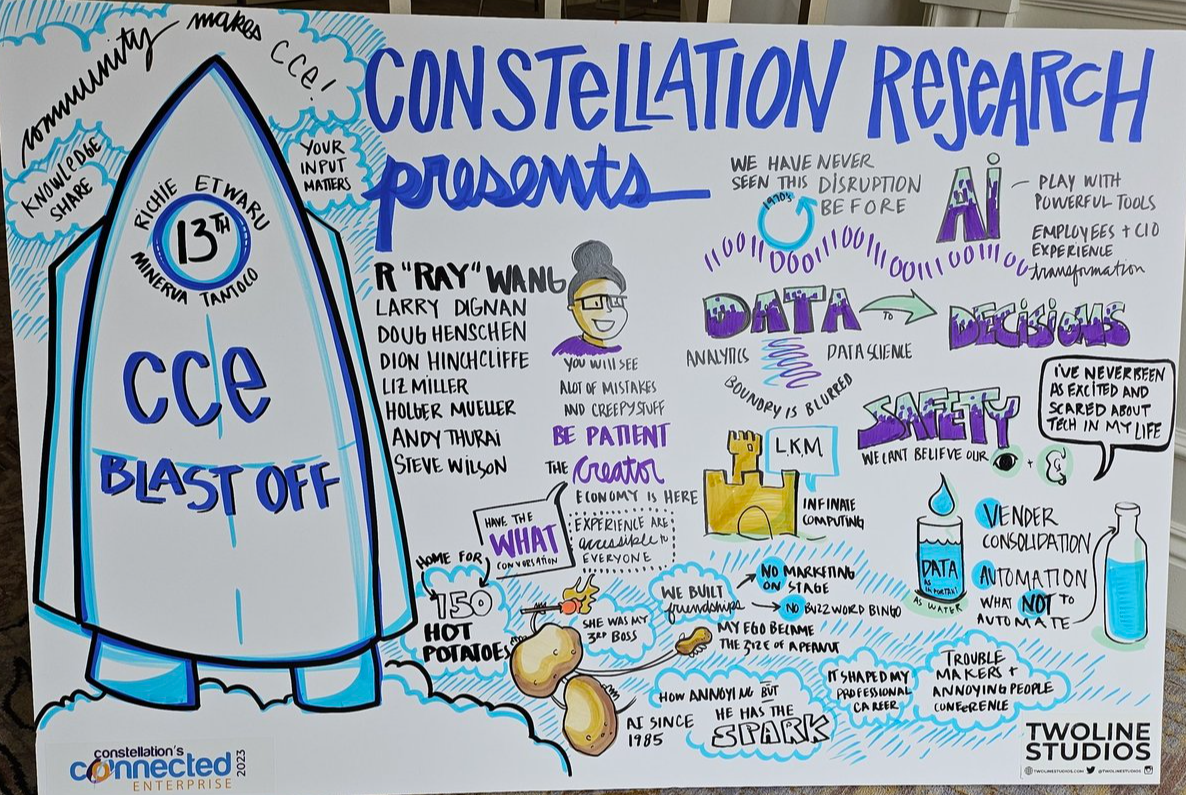
There was a lot of talk about the future on multiple time frames. Naturally, Constellation Research Ray Wang figured it was time to look beyond generative AI and what’s next.

The post-AI business model will revolve around vast unique data sets and collectives that create value chains that monetize new services. The companies that are successful will lead in the future.

Speaking at Connected Enterprise 2023, Wang said: "We don't have enough data to make AI work. Billions of dollars will be wasted on AI implementation without a data strategy."

The issue is that enterprises will need more data to train models so you can trust AI. As a result, companies will start sharing data in collectives and create value chains.

What data will be needed to create this next generation enterprise called Data Inc.

Wang said there will be the following types of data to truly leverage AI:

  • Unique data sets.
  • Network and data.
  • Longitudinal data sets.
  • Derived Data advantage.
  • New classes of data.

Meanwhile, our merry band of analysts also laid out predictions for the years ahead. I stuck with the 18-month time frame. With all those caveats in mind, here are a few of the trends our gang sees ahead.
We also talked about automation, the future of work as well as sustainability.

Other stabs at the future you need to know:

Nuggets to know

  • HR professionals on a panel were concerned about developing young talent in remote and hybrid work environments. Physical presence is necessary for collaboration, but leadership styles should change for the next generation. In addition, the reason why people work has changed. "Young people today work for self-actualization. What they expect is that their experience at work is going to help them self-actualize. We must reimagine work," said Xapa CEO Christine Heckart.
  • Dion Hinchcliffe, Constellation Research analyst, said that there's a lot of pressure to push employees into the office. "Work from anywhere is becoming an endangered species," he said. There's a reason for that: One CXO in attendance said employees need to be in the office. "You can't raise your kids on Zoom. You can't groom the next generation of talent on Zoom either."

More from CCE 2023:

Business value

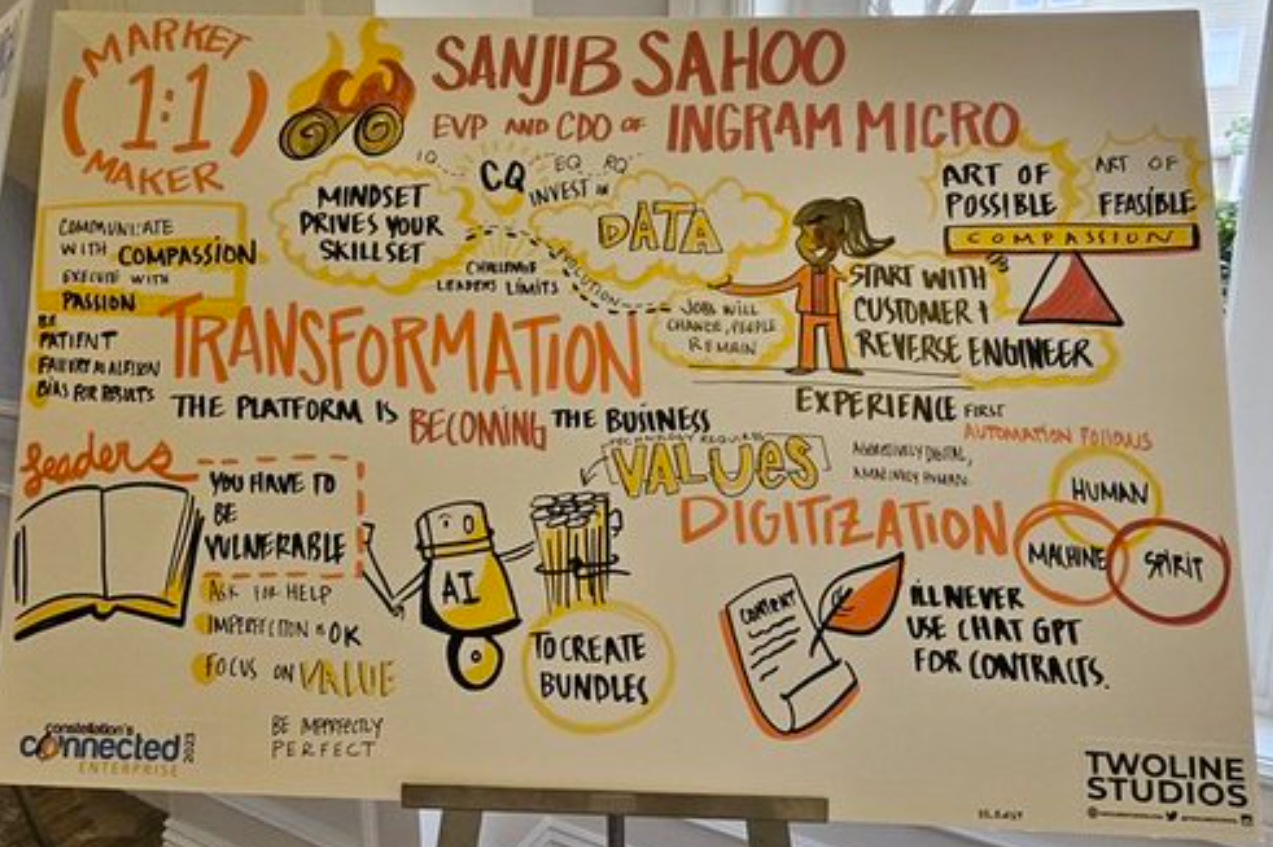
Ingram Micro's Chief Digital Officer Sanjib Sahoo said his company is approaching its transformation through a lens of DigiOps, which should prioritize business value and then looks to technologies to enable it.

This business value twist to digital transformation has to happen. Otherwise, attempts to reinvent businesses will fail because innovation and real returns will be disconnected.

Sahoo's talk covered a lot of ground, but here's the bottom line (like literally).

"Every single release or sprint we do has to create value for customers. Getting to DigiOps is about culture and developing real P&L responsibility. How much operating income am I generating? Am I growing margins? Is revenue growing? Technology is always focused on what's possible. Operational folks say 'that's OK, but here's how to do it.' Otherwise, you build the best technology with no adoption."
After more than a dozen CXO interviews at CCE with BT150 members and Supernova winners and finalists, I can confirm that business value is front and center. Value is also intertwined with business value.

The need to have a mind shift

While IT, transformation, technology and yes generative AI were key topics CCE, one thing that stuck out to me was the need to shift how you think. CxOs have talked about this a bit before, but it's becoming a chorus.

Sahoo talked about this shift in thinking when it comes to not only transforming operations and business value, but convincing employees to go along for the ride. Sahoo talked about compassion and mindsets about people, management and leading in general.

ServiceNow's Brian Solis, Head of Global Innovation, also talked about shifting mindsets. Solis' point was that technology change is accelerating and there's nothing normal about it. What's needed for the next phase of innovation? He said:

"This takes people coming together to actually believe that they do play a role in our future. The mind shift is to get yourself to believe you play a role in it."

Enterprises also need a mind shift to rethink how business runs beyond mere iteration and bolting technologies onto legacy systems. Companies need to look for ways to build for tomorrow. "The main shift I'm talking about is a path to sustainable innovation because right now we do sprints, we jump in, put something up there and we leave," said Solis. "If we do that organizations fail."

And speaking of mind shifts.

Jeremy Utley, Stanford Adjunct, Venture Investor, Co-Author of "Ideaflow: The Only Business Metric That Matters," said in a keynote that people need to think of ideas a natural occurring phenomenon that has a natural distribution. Ordinary ideas take up most of the curve and delightful and dopey ideas are at the ends.

Utley's big takeaway is that you need dopey ideas to get the delightful ones. "Dopey ideas are the price for delightful ones," said Utley. "We make mistakes as leaders when we just want delightful and ordinary ideas. When you chop off dopey you cut off delightful too."

Generative AI

Needless to say, generative AI was a key theme at CCE 2023, and we focused on multiple threads including threats, opportunities, governance and the outright scary. When it comes to generative AI, it's clear we're not there yet (especially on the enterprise side), but there's a lot to think about. Here are a few things that stuck out for me from a series of conversations.

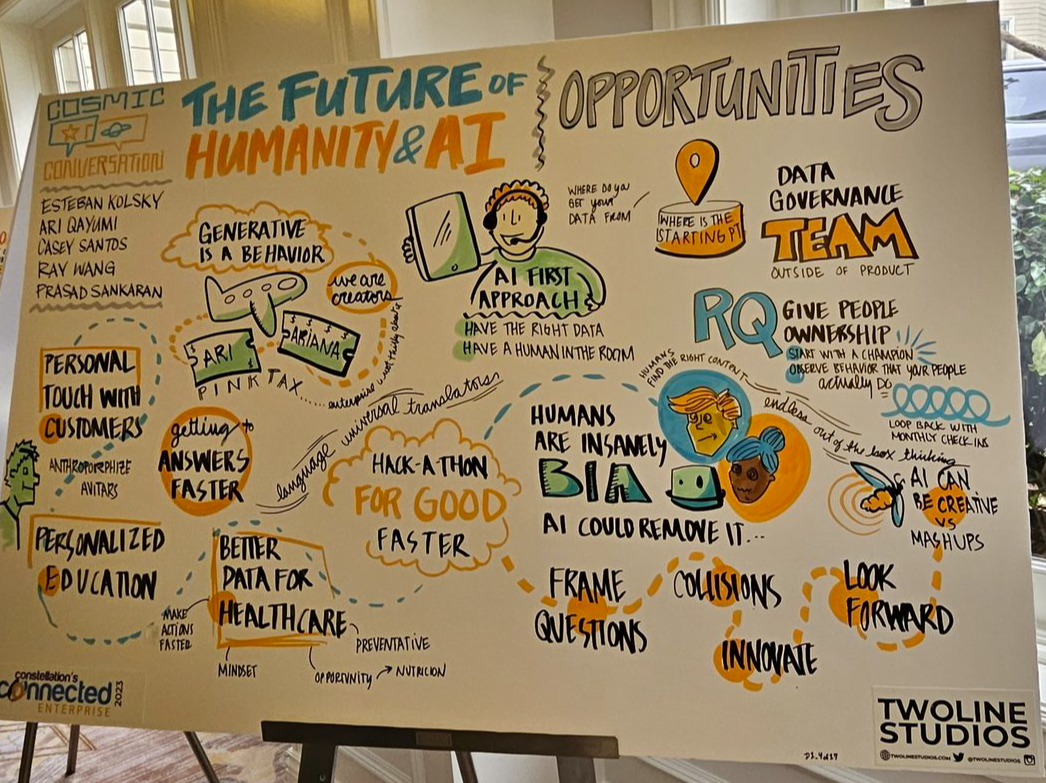
The good...

Divya Chander, Chair of Neuroscience and Faculty in Medicine, Singularity Group, was upbeat about the generative AI and its ability to expand the pie for multiple groups. She said:

"Historically, it’s been very expensive to access these resources. But computing power is just getting cheaper and cheaper. And that's going to enable more people with good ideas to enter the marketplace, just like you can code using English now. The simple fact that we can fit more transistors onto a chip makes it so that anyone can use these things. It's really good for democratization."

Casey Santos, CIO of Asurion, said customer experiences will improve with generative AI and education can be personalized. Healthcare should also drive more value with AI. "This isn't something that will really open up faster diagnoses, faster treatments and better outcomes," she said.

Richie Etwaru, Principal Inventor Mobeus, outlined everything that's going to change. Language, trust, math, industry, learning, liability, labor, laws and even love. He's optimistic overall, but there's a lot of change ahead.
The bad...

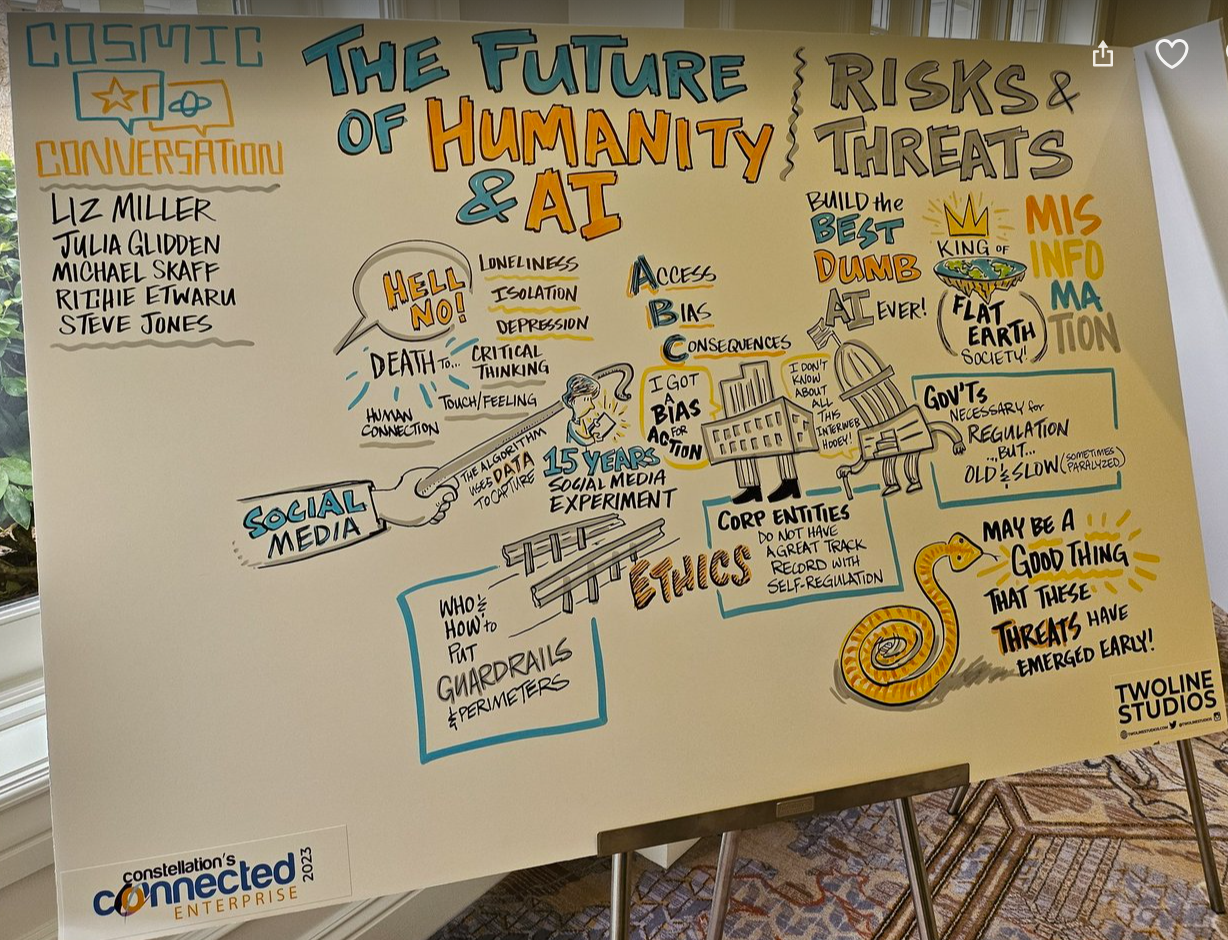
Julia Glidden, Board Chair Pivotl, laid out the case why we all should be damn worried about generative AI. In short, think of the kids. She said:

"The risk is to humanity with the emphasis on human. The human ability to love, to touch, to feel. So, I'm going to ask everybody in this room, something I never did in 30 years of tech to join me in creating, informing, and enforcing a robust legal and regulatory framework for AI.

So, we don't sleepwalk into the next social media. And absolutely, and one of the things that we have to think about is the unintended consequences of the technology."

Glidden continued with the theme on a panel and said generative AI can be a crutch that kills critical thinking. "If we take away children's need to critically think, ingest data and analyze it for themselves it means you don't need to read and you don't need to write. You put in a few prompts in, and it happens. Attention in children's brains will atrophy."

Etwaru noted that this AI wave will go horribly wrong for some: "The Enron of AI is going to happen in the next five years."
The to-do list

Generative AI will require data governance, privacy issues to be solved as well as new models for business. Simply put, everything will be affected by generative AI.

It's about the data strategy not the AI

Boomi CEO Steve Lucas said generative AI is interesting, but noted we still haven't figured out how it will be used throughout an enterprise.

"I know AI will be here when I don't have to hit zero when I call a company," said Lucas, who said AI should be able to know when he's pissed.

Lucas said enterprise AI will be hampered due to data strategy. "Is your data meaningful?" asked Lucas. "We all need to think about what our inputs are in the organization, what's my model in the middle and what's my output."

If you fast forward 10 years there will be too many LLMs and co-pilots, said Lucas. The differentiator will be your stack and your data.

In short, we're not realizing AI's potential yet because companies are still struggling with their data. Lucas said:

"The reality is what information do you have, that coupled with an LLM will create a truly unique high horsepower scenario that will create competitive advantage?"

Software development

One of the primary use cases for generative AI is software development. Speaking at CCE 2023, Aaratee Rao, Managing Director at JP Morgan Chase, noted that cost efficiency always plays well. "How do we automate, automate, automate and use AI using machine learning, and to really make sure we save money," said Rao, who noted that cost optimization and quality improvements all boost customer experience.

Pauline Yang, a Partner at Altimeter Capital speaking on the same CCE panel, laid out the software development economics. Yang said:

"One of the big use cases that we've seen really take off is developer productivity. If you talk to CTOs, they have all these different metrics--how happy their developers are, how much more pull requests are they getting, or how more productive their senior engineers are. We believe that a lot of companies are becoming software companies, even if you're not selling software, and the costs of engineers right now are so high that 40% productivity gains with your engineers is massive and so is happiness of paid developers. All of those gains are economic value."

Infinite computing

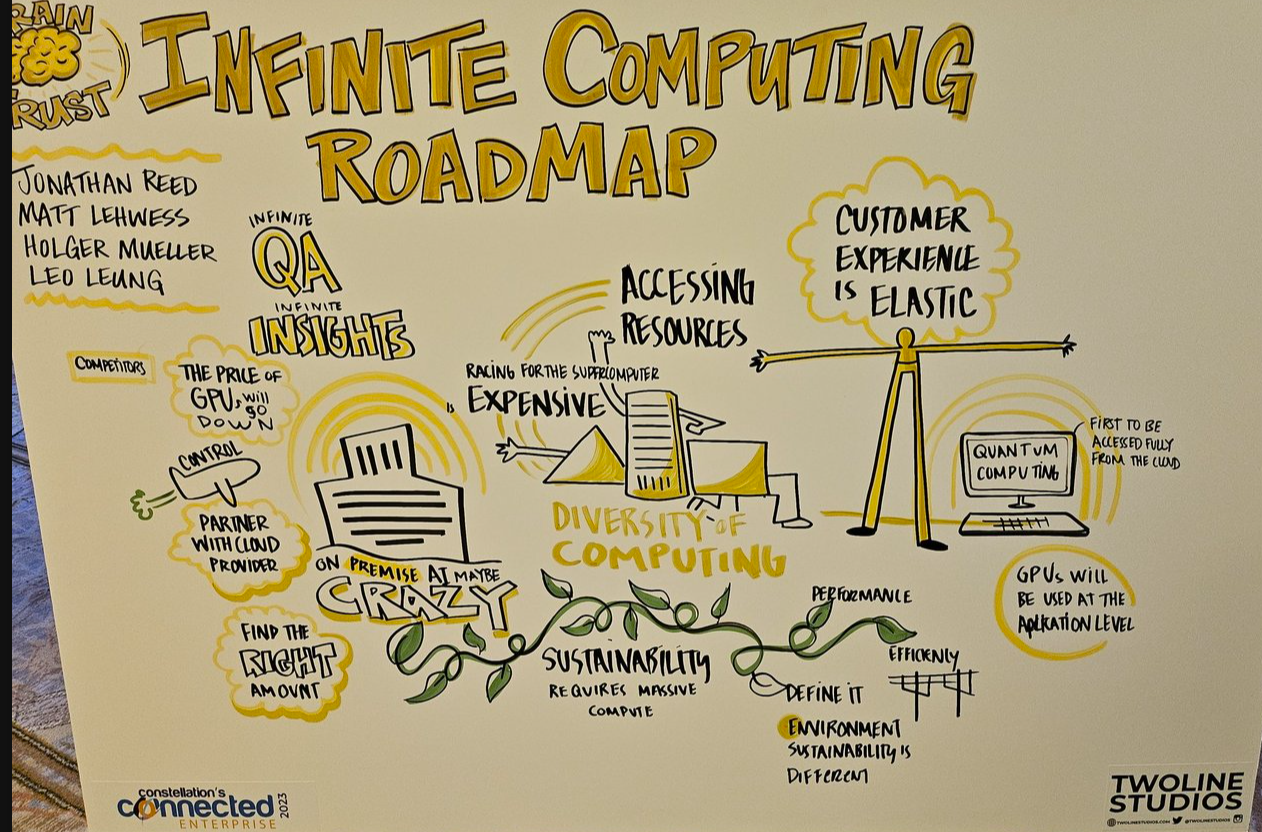
Constellation Research analyst Holger Mueller's 2018 paper on infinite computing was a popular topic given the need to train models on-premises and in the cloud.

Mueller said:

"There's a race for building the supercomputers and building the AI infrastructure. There's a lot of investment going into the compute so larger instances that can do larger workloads."

Cloud providers are in an arms race to build this AI infrastructure and spending billions of dollars to get there.
Sustainability

I had a sustainability chat (that'll be on video soon) with Marie Merle Caekebeke, Sustainability Executive - Strategic Engagement at Baker Hughes. She's a Supernova 2023 winner in sustainability that leveraged C3 AI technology to process unstructured data for Baker Hughes' sustainability materiality reports.

Here are a few highlights from our chat.

Caekebeke was initially an AI skeptic but aimed to run a pilot to parse 3,500 stakeholder documents from a broad range of external stakeholders into more than 400,000 paragraphs.

  • By starting small, she was able to bring stakeholders together to identify trends and data that would find items that would impact materiality scores.
  • The goal was to enable humans to spend more time on strategic initiatives to improve ESG performance instead of manual tasks.
  • Baker Hughes' used natural language processing and machine learning pipelines to ensure consistent scoring and root out bias and find relevant information.

ESG was a topic on multiple panels. The big takeaway is that the bottom line is aligned with sustainability efforts.

I also connected with Nate Melby, CIO at Dairyland Power Cooperative, about edge computing and IoT use cases at utilities as well as sustainability. Simply put, the smart grid didn’t quite happen, but the evolution of the concept will be interesting to watch. Melby said in an interview:

“Sustainability is one of our largest goals. It intersects with technology when we talk about efficiency the data, we need to effectively manage the grid but then there's also this other layer, which is sustainability of our utility for the people that need us. We provide power in rural areas. Our whole mission is to provide that power at the lowest cost possible, but also as efficiently as we can now and into the future with diverse resources. We're seeing this energy transition happen.”

Leadership and Careers

Day 3 at CCE 2023 focused on leadership with topics such as employee engagement, managing hybrid workforces, career paths and serving on boards of directors. Some notable quotes include:

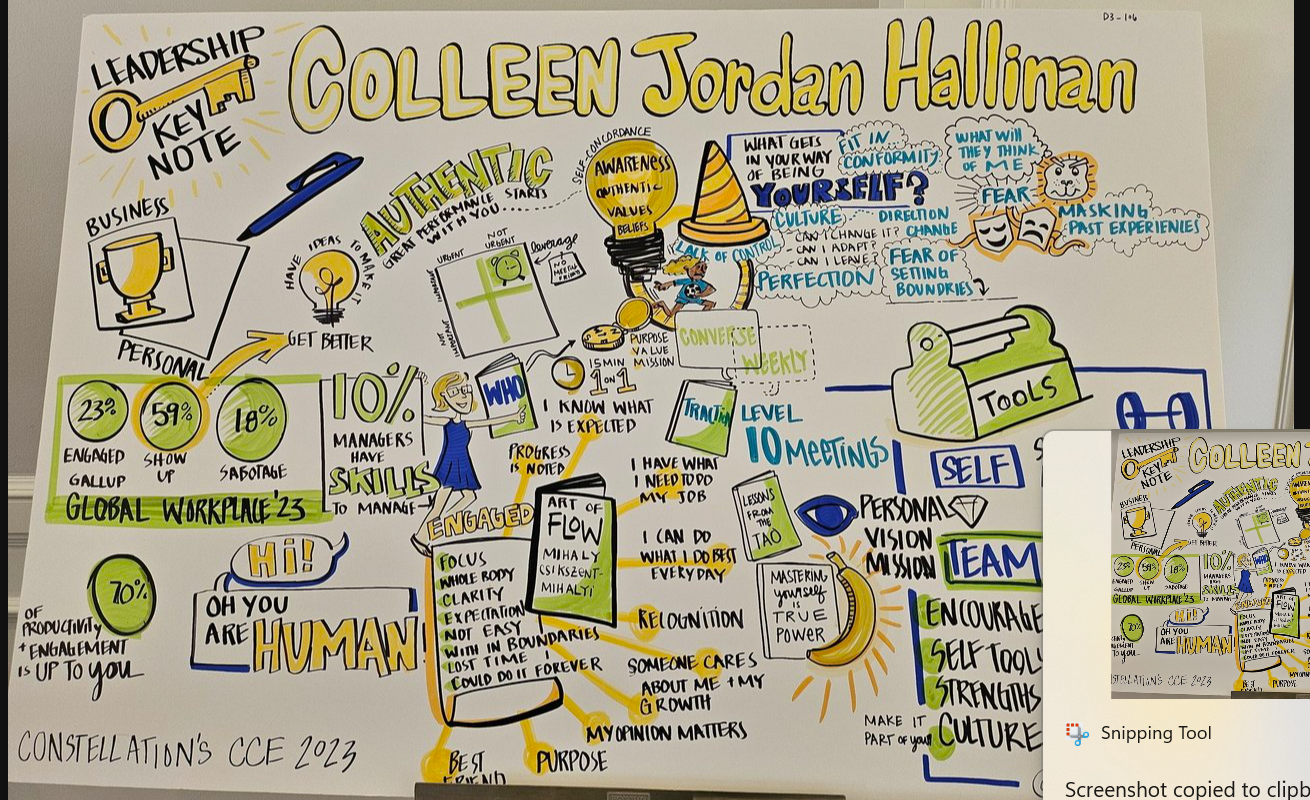
Colleen Jordan Hallihan, founder of Qii Consulting, outlined why authentic leadership is so important:

"If you are truly authentic, meaning that you understand what's really important to you, you know what is going to satisfy you. You are acting upon all of those things on a regular basis. That authenticity gives you results. You can wear many hats competently. It correlates with mental and emotional wellbeing."
The CXO market

Kathryn Ullrich, Managing Partner for Technology, Private Equity and Diversity at DHR Global, said the job market is looking up.

"The market started picking up this summer. I started seeing more searches come in. I've got a lot more leads that have come in. Typically, September, August, September are very slow months, but leads were coming in in October or August through October. I'm hoping that we get to a fourth quarter that's really good and more vibrant."

Yoko Senga, Partner and co-Head of the Product, Data & Technology Practice at True Search, said:

"We've seen a lot of growth in our CEO and CFO practices. That's the first change that a lot of companies make and as the year has gone on, we are now seeing other sea levels opening up."

Hybrid is dying...

Ullrich said most roles aren't hybrid.

"Hybrid is three days in the office, maybe four days in the office, especially if you're in front of teams. That is what we used to have. It's a full-time office job but you get to work from home on a Friday. I've stopped putting hybrid onto the job specs because they really are in the office."

Metaverse out of favor, but you'll need to invest

And you thought the metaverse was dead.

Raffaella Camera, Head of Brands at Epic Games Unreal Engine, said:

"It would be great not to talk about metaverse but more about 3D worlds in general. I think that the name has been confused too much with specific things like VR and AR. We try to come up with premium environments. Forget the world metaverse. Everyone recognizes we're moving from a 2D world to a 3D world to connect with consumers."

There's some metaverse play coming with the help of Apple. You just wait.

Perhaps, there's a new word needed for what we call metaverse today. "The word is not favorable anymore and the gets a bad rap," said Camera.

Alfred Tom, Executive Director of OMA3 Alliance and CEO of Wivity, said:

"The metaverse is what's going to get you to that next generation of consumer. Next-gen consumers are not watching TV and they're not even watching YouTube anymore. They're in Roblox and they're in Minecraft."

Color me skeptical about the idea that the metaverse winter will end anytime soon. "Stop calling it the metaverse and we'll be fine," said Camera.


Data to Decisions Innovation & Product-led Growth Future of Work Tech Optimization Next-Generation Customer Experience Digital Safety, Privacy & Cybersecurity AI GenerativeAI ML Machine Learning LLMs Agentic AI Analytics Automation Disruptive Technology Chief Executive Officer Chief Financial Officer Chief Information Officer Chief Technology Officer Chief AI Officer Chief Data Officer Chief Analytics Officer Chief Information Security Officer Chief Product Officer