Results

Dell Technologies preps new AI servers with Nvidia’s B100, B200, GB200 SuperChip

Dell Technologies preps new AI servers with Nvidia’s B100, B200, GB200 SuperChip

Dell Technologies said it will support Retrieval-Augmented Generation (RAG) with Nvidia systems as it rolled out a set of Dell PowerEdge servers with HGX H200, HGX B100, HGX B200 and GB200 SuperChip.

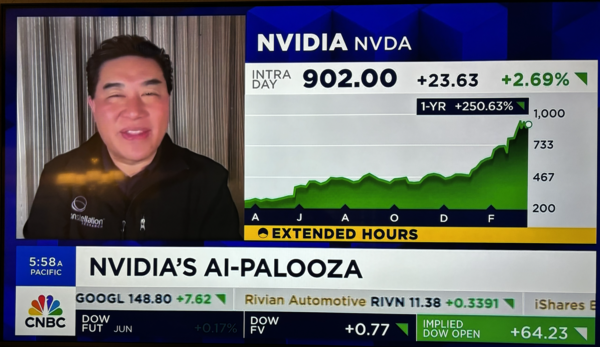
The servers, which include Dell's first liquid-cooling system, headlined a slate of additions for the IT giant. Dell's most recent earnings call highlighted strength in AI-optimized systems and a strong backlog. Dell, HPE and SuperMicro have all seen stock gains as AI-optimized systems start to sell well. Dell outlined its additions following Nvidia CEO Jensen Huang's keynote. 

In addition, generative AI workloads appear to be moving on-premise due to cost, latency and data security.

Varun Chhabra, SVP of Dell's Infrastructure Solutions Group and Telecom units, said: "one of the things that has been coming out loud and clear as we talk to customers is bringing GenAI to the enterprise where customer data is continues to be challenging," said Chhabra, who said data silos, governance, compliance and policies are all trouble spots. "We want turnkey solutions that package up storage, compute, networking, GPUs and a software stack that's easy to understand and consume."
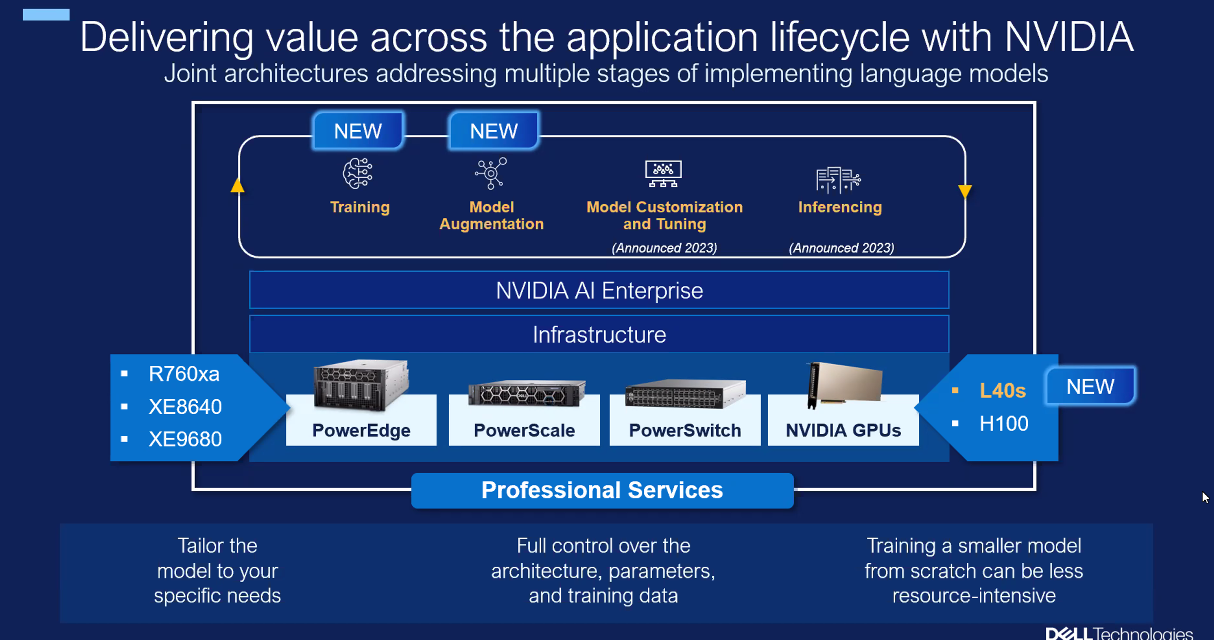
Here's the roundup of what Dell announced in support of Nvidia's GTC launches to cover training to inference.

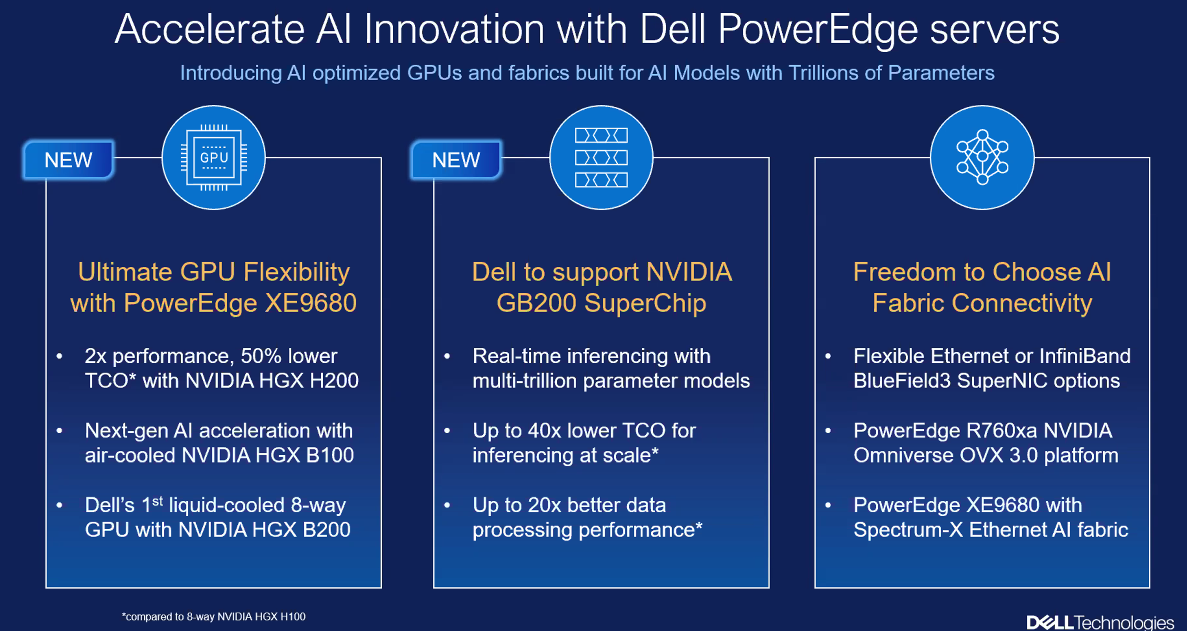
  • PowerEdge XE9680 with 2x performance with Nvidia HGX H200.
  • PowerEdge XE9680 also has options for next-generation AI acceleration with air-cooled Nvidia HGX B100 and Dell's first liquid-cooled 8-way GPU with Nvidia HGX B200.
  • Dell will support Nvidia's GB200 SuperChip, which will feature real-time inferencing with multi-trillion parameter models, 40x lower total cost of ownership compared to Nvidia 8-way HGX  H100 and 20x better processing performance.
  • Systems will support InfiniBand BlueField3 SuperNIC options as well as Spectrum-X Ethernet AI fabric. Dell has supported InfiniBand, but is adding Spectrum-X to the mix.
  • PowerEdge R760xa will support Nvidia's Omniverse OVX 3.0 platform.
  • Dell's system RAG design will have Nvidia microservices via NEMO and embedding framework in PowerEdge, PowerScale and PowerSwitch gear.
  • PowerScale ethernet storage will have Nvidia DGX SuperPOD validation.
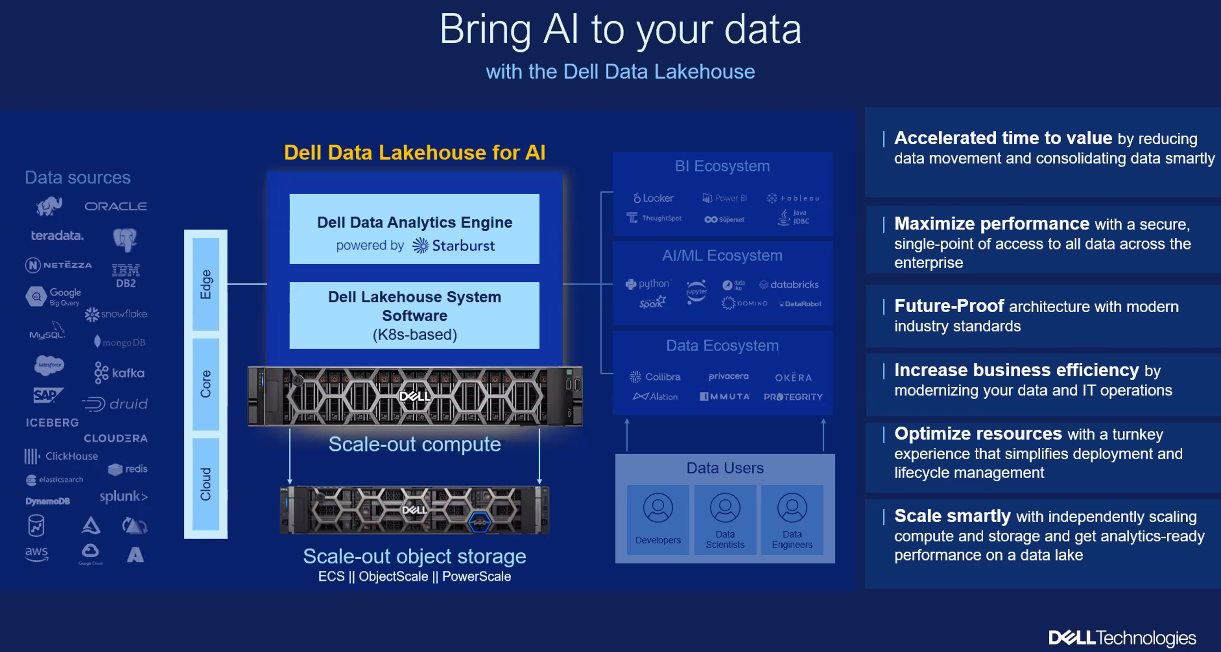
  • Dell Data Lakehouse, which will have an analytics engine powered by Starburst.
With the Dell Data Lakehouse, Greg Findlen, senior vice president of Dell's infrastructure solutions group (ISG), AI and data management solutions, said the data lakehouse effort is designed to connect clusters on-premises and in the cloud. "We want to make it easy to scale on-premises and control cost," said Findlen. "GenAI bills are getting more expensive, and enterprise want to leverage local processing wherever that is."

Ihab Tarazi, CTO AI and Compute, Dell ISG, said enterprises have experimented with models in the public cloud, but are looking on-premises for some workloads. The Dell data lakehouse effort also plays into the company's partnership with HuggingFace.

To tie together the AI-stack and software, Dell has also launched services.
 

Data to Decisions Tech Optimization Innovation & Product-led Growth Future of Work Next-Generation Customer Experience Digital Safety, Privacy & Cybersecurity dell nvidia Big Data ML Machine Learning LLMs Agentic AI Generative AI AI Analytics Automation business Marketing SaaS PaaS IaaS Digital Transformation Disruptive Technology Enterprise IT Enterprise Acceleration Enterprise Software Next Gen Apps IoT Blockchain CRM ERP finance Healthcare Customer Service Content Management Collaboration GenerativeAI Chief Information Officer Chief Technology Officer Chief Information Security Officer Chief Data Officer Chief Executive Officer Chief AI Officer Chief Analytics Officer Chief Product Officer
Nvidia Huang lays out big picture: Blackwell GPU platform, NVLink Switch Chip, software, genAI, simulation, ecosystem

Nvidia Huang lays out big picture: Blackwell GPU platform, NVLink Switch Chip, software, genAI, simulation, ecosystem

Nvidia CEO Jensen Huang said "accelerated computing has reached the tipping point" across multiple industries as the company launched new GPUs including a new platform called Blackwell, NVLink Switch Chip, applications and a developer stack that blends virtual simulations, generative AI, robotics and multiple computing fronts.

Huang laid out Nvidia's lofty goal during his Nvidia GTC 2024 keynote. "The industry of using simulation tools to create products, and it's not about driving down the cost of computing. It's about driving up the scale of computing. We would like to be able to simulate the entire product that we do completely in full fidelity completely digitally. Essentially what we call digital twins. We would like to design it, build it simulated operated completely digitally," said Huang.

A big theme of Huang's talk was Nvidia as a software provider and ecosystem that sits in the middle of generative AI and multiple key categories. And yes, to do what Nvidia wants it's going to take much bigger GPUs. "We need much, much bigger GPUs. We recognized this early on. And we realized that the answer is to put a whole bunch of GPUs together. And of course, innovate a whole bunch of things along the way," said Huang. "We're trying to help the world build things. And in order to help the world building states we gotta go first. We build the chips, the systems, networking, all of the software necessary to do this."

Huang laid out more powerful GPUs and systems in a cadence. The upshot is Nvidia wants to network GPUs together so they can operate as one. "In the future, data centers are going to be thought of as an AI factory. An AI factories' goal in life is to generate revenues and intelligence," he said. 

Nvidia’s GTC conference used to be for developers—and still is by the way—but given the GPU giant’s recent run Wall Street and the tech industry was closely watching Huang’s talk for signs of continuing demand, the roadmap ahead and indicators for generative AI growth. Constellation Research CEO Ray Wang noted that GTC is now the Davos of AI.Also see: Will AI Force Centralized Scarcity Or Create Freedom With Decentralized Abundance? | AI is Changing Cloud Workloads, Here's How CIOs Can Prepare

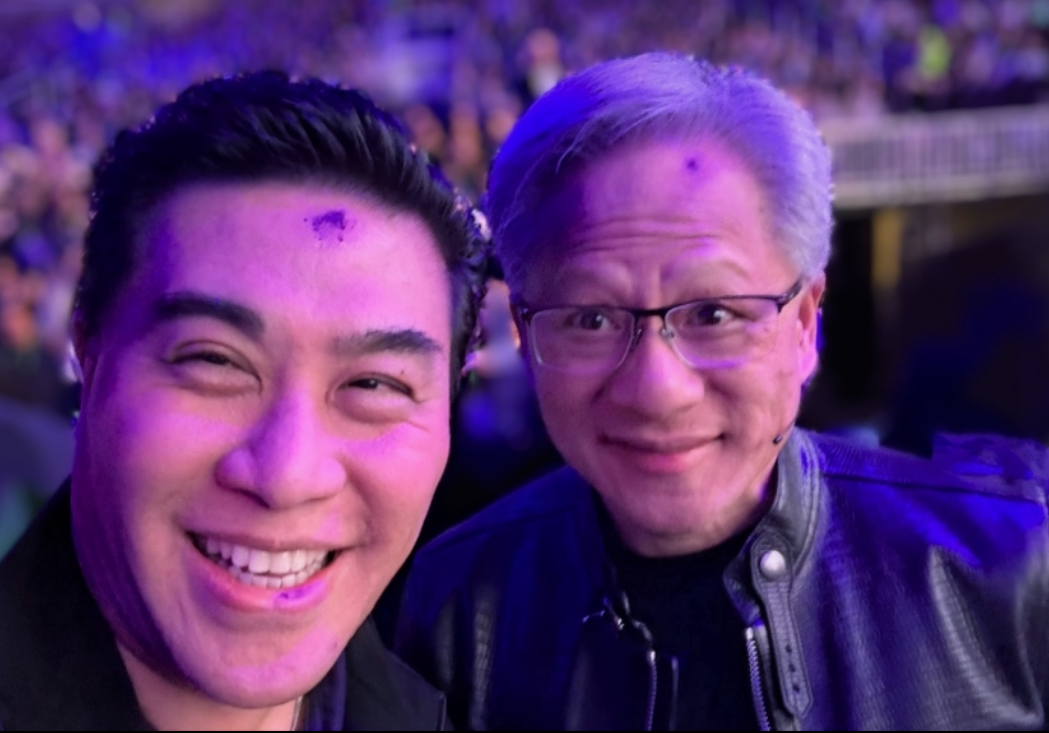
There’s a good reason why analysts were closely evaluating everything Huang said. To date, most of the spoils from the generative AI boom have gone to Nvidia with SuperMicro being an exception. Huang knew about the newfound interest in GTC. He took the stage and joked to the audience that he hoped they realized they weren’t at a concert. Huang warned that folks would here a lot of science and wonky topics.

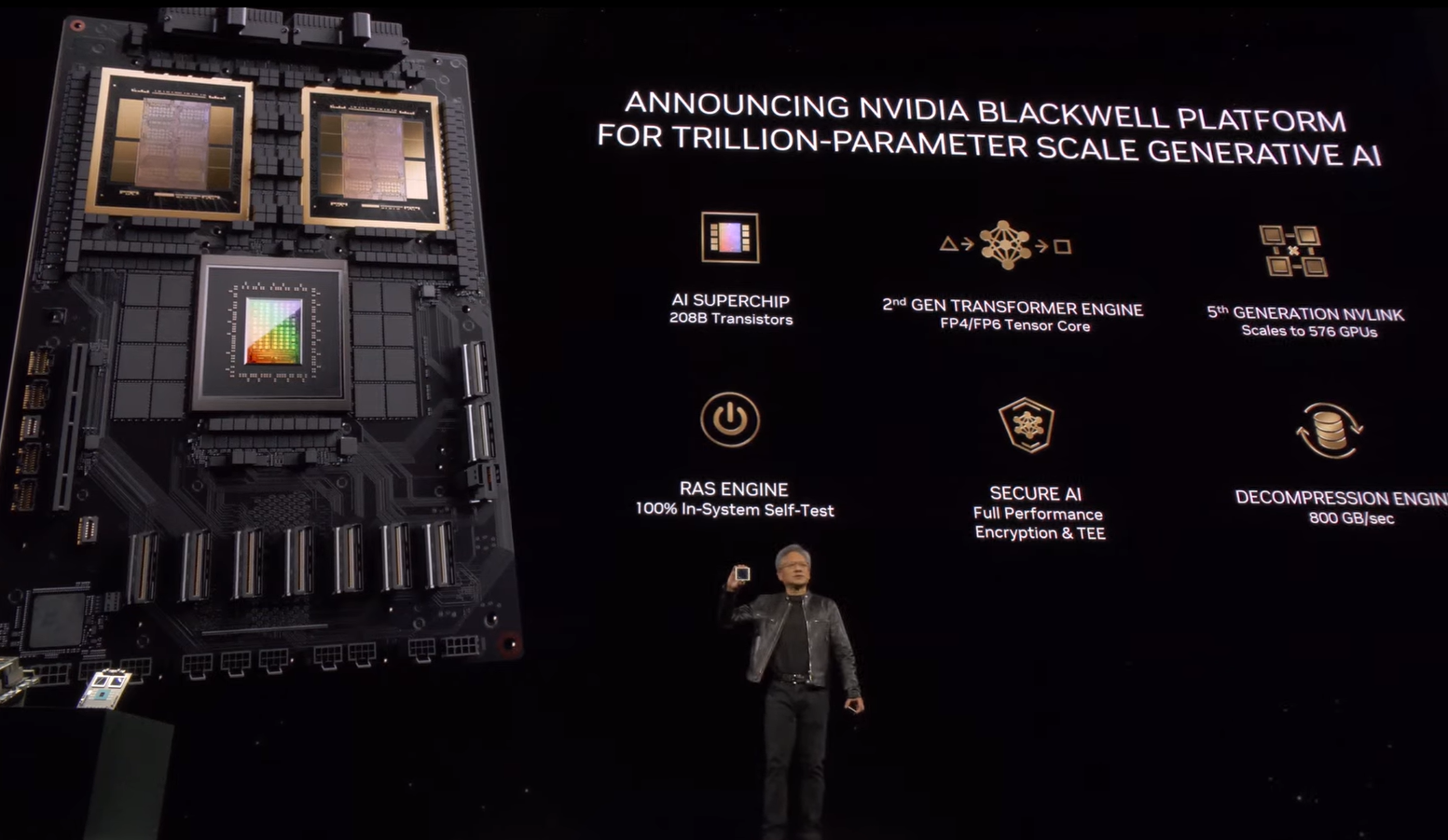
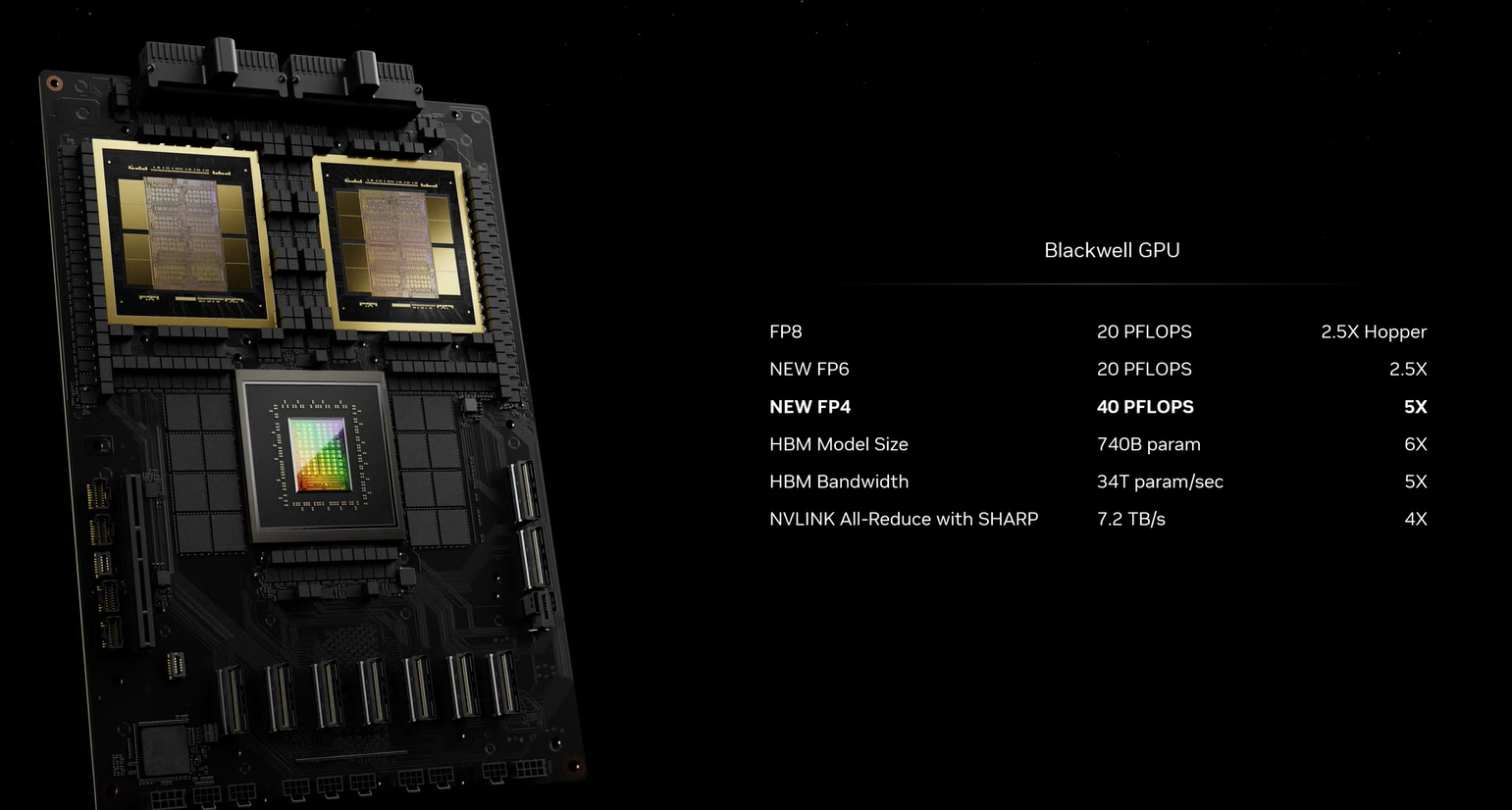
Nvidia’s Blackwell platform is an AI superchip with 208 billion transistors, second generation transformer engine, 5th generation Nvlink that scales to 576 GPUs and other features.

The game here is to build up to full data centers—powered by Nvidia of course.

Key items about the Blackwell platform and supporting cast.

  • Blackwell Compute note has two Grace CPUs and four Blackwell GPUs.
  • 880 petaFLOPs of AI performance.
  • 32TB/s of memory bandwidth.
  • Liquid cooled MGX design.
  • Blackwell is ramping to launch with cloud service providers including AWS, which will leverage CUDA for Sagemaker and Bedrock. Google Cloud will use Blackwell as will Oracle and Microsoft. 

"Blackwell will be the most successful product launch in our history," said Huang. 

Other launches include the GB200 Grace Blackwell Superchip with 864GB of fast memory, 40 petaFLOSs of AI performance. The Blackwell GPU has 20 petaFLOPs of AI performance. Relative to Nvidia’s Hopper, Blackwell has 5x the AI performance and 4x the on-die memory.

To complement those processors, Nvidia has a stack of networking enhancements, accelerations and models to synchronize and have GPUs work together.

Huang said:

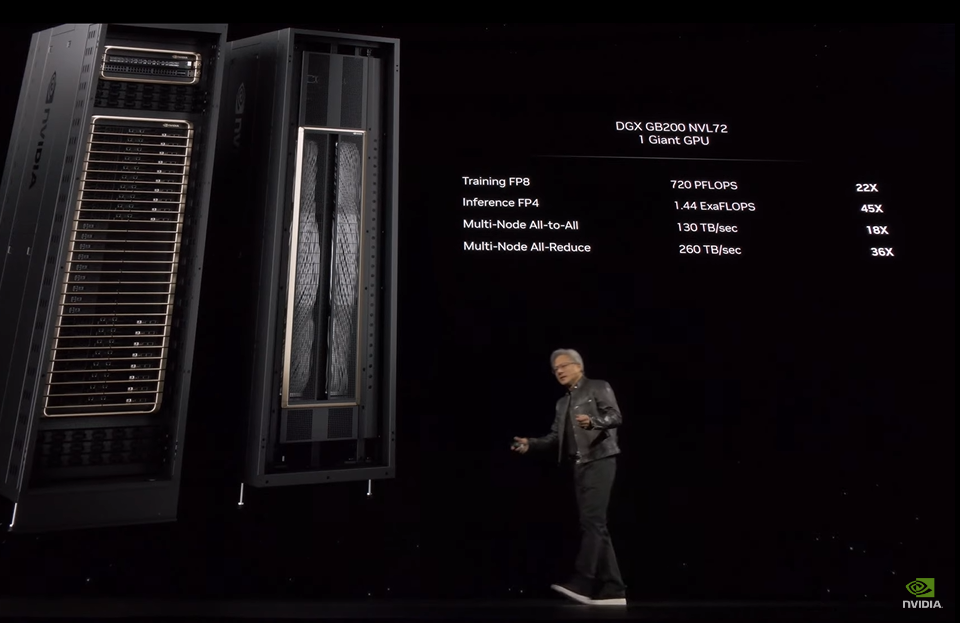
“We have to synchronize and update each other. And every so often, we have to reduce the partial products and then rebroadcast out the partial products that sum of the partial products back to everybody else. So, there's a lot of what is called all reduce and all the all in all gathers. It's all part of this area of synchronization and collectives so that we can have GPUs working with each other. Having extraordinarily fast lakes and being able to do mathematics right in the network allows us to essentially amplify even further.”

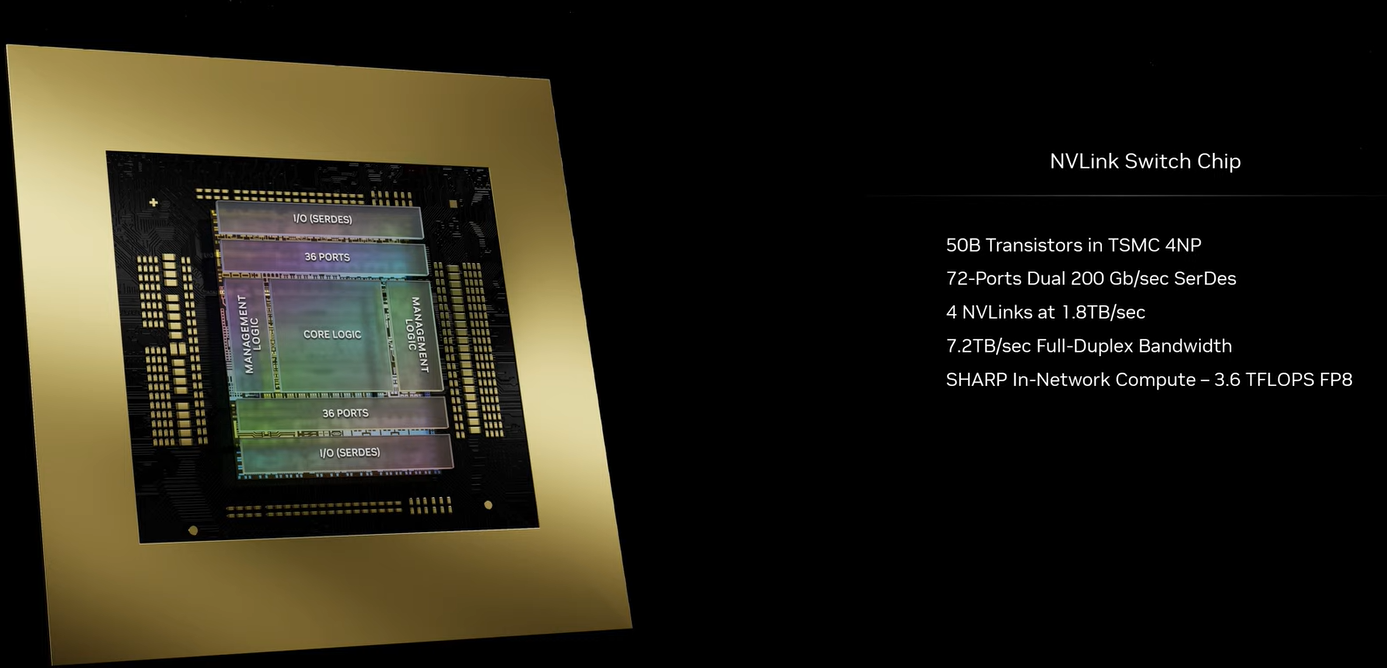
That amplification will come via the NVLink Switch chip that will have 50 billion and bandwidth to make GPUs connect and operate as one. 

Huang made a few jokes about pricing but did note that the company is focusing on the quality of service and balance cost of tokens. Nvidia outlined inference vs. training and data center throughput. Huang argued that Nvidia’s software stack, led by CUDA, can optimize model inference and training. Blackwell has optimization built in and “the inference capability of Blackwell is off the charts.”

Other items:

  • Nvidia said it will also package software by workloads and purpose. Nvidia Inferencing Micro Service (NIMS) will aim to assemble chatbots in an optimized fashion without starting from scratch. Huang said these micro services can hand off to enterprise software platforms such as SAP and ServiceNow and optimize AI applications.
  • Nvidia is working with semiconductor design partners to create new processors, digital twins connected to Omniverse. Ansys is reengineering its stack and ecosystem on Nvidia's CUDA. Nvidia will "CUDA accelerate" Synopsys. Cadence is also partnering with Nvidia.
  • "We need even larger models. We're going to train it with multimodality data, not just text on the internet, but we're going to train it on texts and images and graphs and charts."
  • Huang said he even simulated his keynote. "I hope it's going to turn out as well as I head into my head."
  • Nvidia press releases on switches, Blackwell SuperPod, Blackwell, AWS partnership, Earth Climate Digital Twin, partnership with Microsoft and more.

Data to Decisions Innovation & Product-led Growth Future of Work Tech Optimization Next-Generation Customer Experience Digital Safety, Privacy & Cybersecurity nvidia ML Machine Learning LLMs Agentic AI Generative AI Robotics AI Analytics Automation Quantum Computing Cloud Digital Transformation Disruptive Technology Enterprise IT Enterprise Acceleration Enterprise Software Next Gen Apps IoT Blockchain Leadership VR Big Data Chief Executive Officer Chief Financial Officer Chief Information Officer Chief Technology Officer Chief AI Officer Chief Data Officer Chief Analytics Officer Chief Information Security Officer Chief Product Officer

ServiceNow adds more tuck-in acquisitions to build out industry, operational technology offerings

ServiceNow adds more tuck-in acquisitions to build out industry, operational technology offerings

ServiceNow continues to go shopping. the company said it has acquired 4Industry, a Netherlands company and partner focused on manufacturing, and Smart Daily Management, a connected worker application from EY.

The most recent deals bolster ServiceNow's current portfolio of operational technology offerings that are focused on manufacturing, energy and transportation and logistics.

In February, ServiceNow said it acquired Atrinet's NetACE technology to better focus on telecommunications companies. In December, ServiceNow acquired UltimateSuite for task mining tools.

ServiceNow's broader strategy with these deals is to take apps that are critical to industries and replatform them on its Now platform. For instance, UltimateSuite will be added to its platform. Atrinet NetACE will be replatformed to ServiceNow. And 4Industry, which provides an app with tasks, knowledge base and data for field workers, was already on ServiceNow's platform.

By adding these smaller acquisitions, ServiceNow can integrate them and then launch new products. 4Industry and the Smart Daily Management application will be used to build a new Connected Worker service on the ServiceNow platform in 2025.

Terms of the aforementioned deals weren't disclosed.

Data to Decisions Future of Work servicenow Chief Information Officer

Cisco closes Splunk purchase, previews integrations ahead

Cisco closes Splunk purchase, previews integrations ahead

Cisco closed its $28 billion purchase of Splunk and outlined what'll be a steady drumbeat of product integrations in the months ahead.

In a blog post outlining what's next for customers, Cisco CEO Chuck Robbins and Splunk Executive Vice President and General Manager Gary Steele said the unified company will be heavily focused on security and observability.

With the deal closed, Cisco becomes one of the largest enterprise software companies and retools its business mix. Here's how the product integrations will play out:

  • Cisco's Talos threat intelligence will be embedded into Splunk's cybersecurity offerings.
  • Cisco and Splunk will unify AI assistants for security so there's a common experience across the combined portfolio.
  • Splunk's SIEM and SOAR platforms will leverage Cisco's cloud, network and endpoint analytics.
  • The companies will combine for a full-stack observability platform to work across clouds. The integration will start with a common experience and workflow optimizations across Cisco and Splunk observability offerings.
  • Over time, the combined Cisco and Splunk observability products will include AI-driven root cause enhancements and assistants including Splunk IT Service Intelligence.

Splunk and Cisco will also combine data for networking and AI deployments. More details about the Cisco integration of Splunk will land in June. Cisco Live is June 2-4 and Splunk's .conf24 is June 11-14.

Data to Decisions Digital Safety, Privacy & Cybersecurity Tech Optimization Innovation & Product-led Growth Future of Work Splunk cisco systems Chief Information Officer Chief Information Security Officer

New Analysis: Nvidia GTC 2024 Is The Davos of AI

New Analysis: Nvidia GTC 2024 Is The Davos of AI

Media Name: @rwang0 @cnbc @squawkbox @BeckyQuick @nvidiia #GTC24 shot.png

New Chips, New Business Models Ahead In Accelerated Computing

Nvidia stock is up 267% YoY.  With over 10,000 people in physical attendance and up to 100,000 people virtually attending, this could be the largest AI conference. All eyes on the next wave for AI with CEO Jensen Huang ready to keynote at 1:00 pm PT at the SAP Center in San Jose.  The key things to look for in the keynote:

  • New B100 Chip replacement.  Built by TSMC, the new chips are expected to be advanced 3nm design.  NVIDIA will take advantage of the two dieTSMC's CoWoS-L (Chip-on-Wafer-On-Substrate-L) advanced 2.5D packaging technology to get larger processors.  Should Nvidia move from the monolithic design to a multi-chip module (MCM) approach, the chip maker could create faster derivatives and shorten its product cycle.
  • CUDA advancements. This is the software layer that allows software companies to harness the power of the GPUs
  • Key vertical expansion.  Healthcare, pharma, defense, and public sector consume massive workloads.
  • Partnerships across the AI ecosystem. Expect announcements from partners such as OpenAI, Microsoft, Amazon, and Google, Meta, Micron, Oracle, Super Micro, Dell, Intel, and more.
  • Sovereign AI growth.  Nvidia is focusing beyond data centers and serving governments for sovereign AI.

Chips Are The Foundational First Inning Of A Nine Inning Age Of AI

The winners of the internet weren’t the early infrastructure companies They were the companies that built their business model on the internet as a key distribution channel.  In AI, it will be the companies that take advantage of the full-stack of AI.  Software companies will drive the second inning.  But the third and fourth innings will be the innovative companies who use AI as their core business model.  For example, in the war for refrigeration, it wasn't the appliance manufacturers that won, it was actually Coca Cola that innovated a new market for cold beverages.


Your POV

Will you be ready for Nvidia's new AI chip? Can competitors catch up?

Add your comments to the blog or reach me via email: R (at) ConstellationR (dot) com or R (at) SoftwareInsider (dot) org. Please let us know if you need help with your strategy efforts. Here’s how we can assist:

  • Developing your metaverse and digital business strategy
  • Connecting with other pioneers
  • Sharing best practices
  • Vendor selection
  • Implementation partner selection
  • Providing contract negotiations and software licensing support
  • Demystifying software licensing

Reprints can be purchased through Constellation Research, Inc. To request official reprints in PDF format, please contact Sales.

Disclosures

Although we work closely with many mega software vendors, we want you to trust us. For the full disclosure policy,stay tuned for the full client list on the Constellation Research website. * Not responsible for any factual errors or omissions.  However, happy to correct any errors upon email receipt.

Constellation Research recommends that readers consult a stock professional for their investment guidance. Investors should understand the potential conflicts of interest analysts might face. Constellation does not underwrite or own the securities of the companies the analysts cover. Analysts themselves sometimes own stocks in the companies they cover—either directly or indirectly, such as through employee stock-purchase pools in which they and their colleagues participate. As a general matter, investors should not rely solely on an analyst’s recommendation when deciding whether to buy, hold, or sell a stock. Instead, they should also do their own research—such as reading the prospectus for new companies or for public companies, the quarterly and annual reports filed with the SEC—to confirm whether a particular investment is appropriate for them in light of their individual financial circumstances.

Copyright © 2001 – 2024 R Wang and Insider Associates, LLC All rights reserved.

Contact the Sales team to purchase this report on a a la carte basis or join the Constellation Executive Network


Data to Decisions Digital Safety, Privacy & Cybersecurity Future of Work Marketing Transformation Matrix Commerce New C-Suite Next-Generation Customer Experience Tech Optimization Innovation & Product-led Growth intel AMD meta openai dell Insider Associates nvidia Google SoftwareInsider amazon Oracle Microsoft ML Machine Learning LLMs Agentic AI Generative AI Robotics AI Analytics Automation Quantum Computing Cloud Digital Transformation Disruptive Technology Enterprise IT Enterprise Acceleration Enterprise Software Next Gen Apps IoT Blockchain Leadership VR AR Chief Analytics Officer Chief Customer Officer Chief Data Officer Chief Digital Officer Chief Executive Officer Chief Financial Officer Chief Information Officer Chief Information Security Officer Chief Marketing Officer Chief People Officer Chief Privacy Officer Chief Procurement Officer Chief Revenue Officer Chief Supply Chain Officer Chief Sustainability Officer Chief Technology Officer Chief AI Officer Chief Product Officer Chief Experience Officer
Multi-cloud computing isn't 'a bunch of separate clouds'

Multi-cloud computing isn't 'a bunch of separate clouds'

This post first appeared in the Constellation Insight newsletter, which features bespoke content weekly and is brought to you by Hitachi Vantara.

Oracle CTO Larry Ellison can play multiple roles: Enterprise technology troll, provocateur, visionary and swashbuckling billionaire who will make big bets even when believers are few and far between.

Given that backdrop, Oracle's earnings conference calls are usually worth a listen. Ellison, along with Oracle CEO Safra Catz, did a victory lap as infrastructure-as-a-service revenue was up 49% in the third quarter. Oracle Cloud Infrastructure (OCI) has GPUs from Nvidia and is only lacking capacity to grow faster. To that end, Oracle is building data centers as fast as it can.

Many of those data centers are being built to run OCI Database Services within Microsoft Azure data centers. Oracle is also building out OCI data centers for countries that want to keep their data and large language models (LLMs) in country.

Toward the end of Oracle's conference call, Ellison dropped some knowledge on how multi-cloud environments should work. Apparently, Oracle Database@Azure can be a model for other hyperscalers. I chuckled at the idea since the only reason the Oracle-Microsoft deal works is because both have mutual enemies in Amazon Web Services and Google Cloud and mutual customers.

Ellison's take on multi-cloud is that Oracle's Autonomous Database would be the reason multiple hyperscalers would partner with the company. Ellison said (emphasis mine):

"We expect the multi-cloud initiative to continue to expand amongst other hyperscalers where we build OCI regions inside of and coexisting with their existing cloud infrastructure. We think the era of walled gardens is coming to an end. What customers really want is the ability to use multiple clouds to talk to one another. It is really called cloud computing. It's not called a bunch of separate clouds. We expect multi-cloud to become the norm and Oracle DB to be available everywhere. We think that will preserve our franchise in database because the autonomous database is a unique piece of technology, and there's nothing like it in the world. No one else is working on anything like that. No one else is even trying to duplicate the autonomous database. We think it will be it will become a very successful product. In every cloud."

A few takeaways from Ellison's comments.

  • Walled gardens do need to end, but that doesn't mean they will.
  • Interoperability between all the hyperscalers would be swell.
  • Interoperability would also help blend private cloud infrastructure, which will play a role in AI workloads. Constellation Research analyst Dion Hinchcliffe has argued that AI workloads will fundamentally change cloud economic models.
  • Oracle can prod the likes of AWS and Google Cloud to do Oracle DB deals because the company could always make support more difficult on those clouds.
  • Sure, Ellison is talking up Oracle Autonomous Database, but the technology is unique enough to make strange bedfellows.
  • Customers may demand more interoperability to make it easier to mix and match hyperscale compute.
  • The Oracle Database@Azure model isn't much different than retail store-within-a-store partnerships (Kohl's-Amazon, Kohl's Sephora, Apple in Best Buy etc.).
  • Oracle co-location strategy within other cloud data centers has lower capital expenses and gives the company more coverage. Simply put, Oracle Database@Azure, @AWS and @Google Cloud is damn good strategy and joint customers are everywhere.

Today, multi-cloud really just means there are two or three providers operating in silos. For instance, Equifax uses AWS for Oracle mission critical workloads and Google Cloud for its data layer. Despite "all-in" press releases, most enterprises prefer to have a second cloud provider to keep the primary one honest.

Regulators may also push these hyperscale cloud partnerships between archenemies. AWS recently said it will offer free data transfer for enterprises leaving the cloud. That move follows a similar announcement by Google Cloud. Microsoft Azure matched those announcements. You should check out the fine print on all those announcements.

The Federal Trade Commission has launched an inquiry into cloud computing business practices including data egress fees, software licensing and minimum usage contracts.

It's unclear whether regulators and Ellison will spur hyperscale cloud harmony, but stranger things have happened.

Tech Optimization Microsoft Oracle Chief Information Officer

Chirag Mehta on the intersection of cybersecurity, design thinking and AI

Chirag Mehta on the intersection of cybersecurity, design thinking and AI

New Constellation Research analyst Chirag Mehta outlined his approach to cybersecurity on DisrupTV. Chirag is the former Chief Product Officer at SaaS vendors Zipline and iCIMS and held various leadership roles at Google and SAP.

Here are a few takeaways from his DisrupTV appearance.

The variables in cybersecurity. Mehta said there are three key parts to cybersecurity. First, data driven signals and what a company can infer from them and respond. The second part is the human story. "We human beings are inherently trustworthy," he said. And third, what does the response look like? "We're all going to get breached. How can I respond to the test? What does that incident response kind of system look like?"

Design thinking and cybersecurity. Mehta's previous stints revolved around developing applications and products at enterprise software companies. He focuses on design thinking to humanize cybersecurity for CXOs. "You need to be proactive, more outcome based, and risk based," said Mehta. "I'm passionate about helping CXOs find their way and make their organizations more secure."


AI and cybersecurity. Perimeter and network-based approaches to cybersecurity are often flawed because "your employees are everywhere, and your data is everywhere." As a result, "AI has a role in creating a dynamic perimeter and what's going on in my environment," said Mehta. "The dynamic AI perimeter will happen, and the reason is the rise of AI means all of these problems are not solvable by human beings."

"Sophisticated, AI-driven attacks need a sophisticated response, which is AI-driven," said Mehta.

"You're going to have access to a vast amount of data telemetry, all the signals that you can analyze, and you can actually defend, including the behavior of your end users. You can defend against these attacks," he said.

What is emerging is cybersecurity platforms that use AI to become a cyber operating system.

ROI and cybersecurity. CXOs have said that cybersecurity budgets have been poached in the last year for AI projects. Mehta said that focus on returns is misplaced. He said:

"Security is cost of doing business. If you don't have security, you won't have business, and then you won't have ROI on anything else. It's not very clear to most leaders that they need to invest into foundational technology so that they can actually have a business, invest in generative AI and everything else in the digital transformation journey. Cybersecurity is not an optional thing."

Cybersecurity is a risk-based investment since one mistake can hit your stock price, result in SEC disclosure and harm the business, said Mehta. Enterprises will use AI to model various threat vectors and have a defense for any given situation.

By nature, defenses will have to become more autonomous. "If the idea is that a human has to get involved when there's an attack you're not going to scale," said Mehta.


Data to Decisions Innovation & Product-led Growth Future of Work Tech Optimization Next-Generation Customer Experience Digital Safety, Privacy & Cybersecurity AI GenerativeAI ML Machine Learning LLMs Agentic AI Analytics Automation Disruptive Technology cybersecurity Security Zero Trust Chief Information Security Officer Chief Privacy Officer Chief AI Officer Chief Experience Officer

Ethical Marketing: Navigating the Dark Arts of Paid Marketing & Bot-Driven Metrics in an Age of AI

Ethical Marketing: Navigating the Dark Arts of Paid Marketing & Bot-Driven Metrics in an Age of AI

CRTV SPECIAL EDITION: Ethical Marketing - Navigating The Dark Arts And Temptations Of Paid Marketing And Bot-Driven Metrics In an Age of AI

In this special ConstellationTV live episode, CEO and founder R "Ray" Wang moderates a live panel of industry experts for a complimentary workshop on operating with trust and integrity in today’s #marketing landscape. You won't want to miss insights from the following experts:

  • John Furrier, Cofounder & CEO of SiliconANGLE & theCUBE
  • Crystal G., VP of CX and Ops, ARInsights
  • Molly Lauck, Director of Communications, CMTA
  • Ludovic Leforestier / Founder, Starsight Communications & The IIAR (Institute of Influencer & Analyst Relations) Board Member
  • Larry Dignan, Editor in Chief, Constellation Research, Inc. Insights
  • Liz Miller, VP & Principal Analyst, Constellation Research, Inc.

Topics covered in today's session include:

  • The impact of paid #media vs organic audiences
  • What are sustainable approaches to building influence and audience
  • Where you can go to support independent #analysts and media who participate with integrity
  • What are the leading practices to building an audience with both paid media and organic approaches
  • What are the key marketing metrics in an Age of AI

ConstellationTV is a bi-weekly web series hosted by Constellation analysts, tune in live at 9 AM PT/ 12 PM ET every other Wednesday! Subscribe to our YouTube channel: https://lnkd.in/gSw27hBU

On ConstellationTV <iframe width="560" height="315" src="https://www.youtube.com/embed/Bs8fanTgzOY?si=ySrzAFniHaFQff1Y" title="YouTube video player" frameborder="0" allow="accelerometer; autoplay; clipboard-write; encrypted-media; gyroscope; picture-in-picture; web-share" allowfullscreen></iframe>
Media Name: YouTube Video Thumbnails.png

Adobe: Strong Q1, outlook a bit light, GenAI on deck for Experience Cloud

Adobe: Strong Q1, outlook a bit light, GenAI on deck for Experience Cloud

Adobe delivered a strong first quarter, but its outlook missed expectations.

The company, which recently dropped its plans to acquire Figma, reported first quarter earnings of $1.36 a share on revenue of $5.18 billion, up 11% from a year ago. Non-GAAP earnings in the first quarter were $4.48 a share.

Wall Street was looking for first quarter non-GAAP earnings of $4.38 a share on revenue of $5.14 billion.

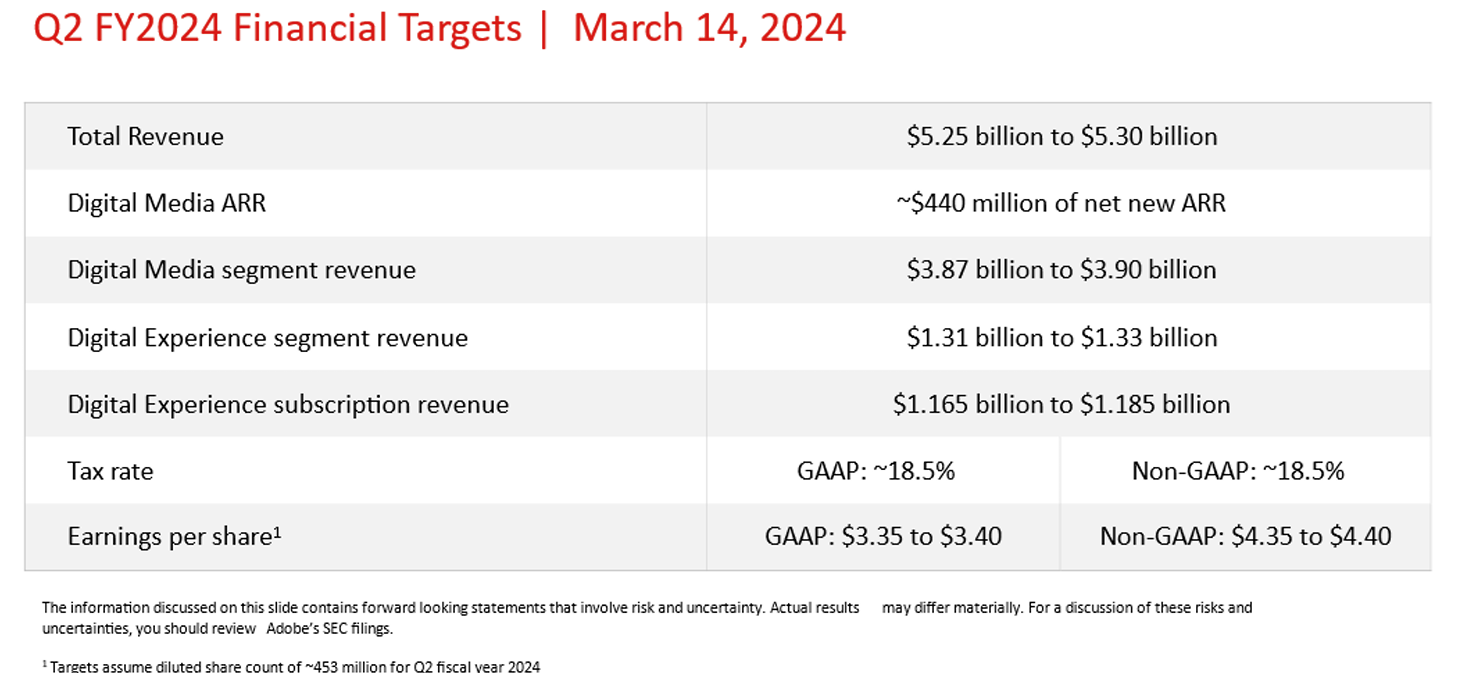
As for the outlook, Adobe projected second quarter revenue of $5.25 billion to $5.3 billion with non-GAAP earnings of $4.35 a share to $4.40 a share. Analysts were looking for $4.38 a share and $5.31 billion in revenue.

For each of its product areas, Adobe posted double-digit percentage growth rates. Digital Media revenue was up 12% from a year ago, Creative revenue was up 11% and Document Cloud posted growth of 18%.

In prepared remarks, Adobe CEO Shantanu Narayen said the company is seeing strong traction with its generative AI rollout across the product portfolio. He said:

"We have innovated by delivering generative AI directly in products—with releases in Adobe Photoshop, Illustrator and Express across both desktop and mobile. AI Assistant in Acrobat and Reader unlocks the tremendous value of the trillions of PDFs around the world. We’re bringing generative AI to Adobe Experience Cloud and will demonstrate our AI Assistant for customer experience management at Adobe Summit."

Marketing Transformation Next-Generation Customer Experience Data to Decisions Innovation & Product-led Growth Future of Work Tech Optimization Digital Safety, Privacy & Cybersecurity adobe ML Machine Learning LLMs Agentic AI Generative AI AI Analytics Automation business Marketing SaaS PaaS IaaS Digital Transformation Disruptive Technology Enterprise IT Enterprise Acceleration Enterprise Software Next Gen Apps IoT Blockchain CRM ERP finance Healthcare Customer Service Content Management Collaboration GenerativeAI Chief Information Officer Chief Executive Officer Chief Technology Officer Chief AI Officer Chief Data Officer Chief Analytics Officer Chief Information Security Officer Chief Product Officer

What if a Trillion PDFs Could Talk?

What if a Trillion PDFs Could Talk?

No matter where you turn these days, you are bound to hear about a little something called generative AI. I’ve said it before…AI is really a “thing” now. Don’t misunderstand my sarcasm: Generative pretrained transformers are not new. Neither is artificial intelligence or the models that power them. But within the last year, we’ve seen leaps and bounds in how these innovations are being brought together in the name of productivity.

Case in point: The AI Assistant in Adobe Acrobat and Reader. That’s right…your PDF just got chattier.

What’s the News Here?

Adobe has launched a beta of an AI Assistant that brings conversational and generative AI capabilities to Reader and Adobe Acrobat. Essentially, this new “conversational engine” can summarize the content of a document supported by Acrobat or Reader, answer questions, and recommend more questions based on the content. The models behind Acrobat Liquid Mode bring responsive reading for PDFs on mobile devices, and Adobe’s unique understanding of different document file formats and structures boosts the quality of responses, output and recommendations.

In researching this post, I have played with the beta, and I have to agree that the responses are accurate, but also noted that often the answers were supplemented with citations and additional summaries and insights from across a couple very lengthy documents. I found that reading a document and also leveraging the AI Assistant got me to dig deeper into some thoughts which was something I wasn’t necessarily expecting from the experience.

In the beta, Adobe Acrobat and Reader now include:

  • AI Assistant: Answers questions directly from users in a highly interactive and conversational manner, recommends and delivered suggested and custom questions based on the content of the document.
  • Generative summary: short overviews of content in easy-to-read format.
  • Intelligent citations: attribution engine and generative AI created citations to verify the source of AI Assistant’s summaries and answers to user questions.

The AI Assistant beta is currently available, allowing Acrobat Reader and Acrobat Individual, Pro and Teams customers to simply open their applications and start chatting with their documents today. There is also a private beta for enterprise customers. New features will be coming over the next several weeks. For the time being, these features are available on desktop and web. English is currently supported, but Adobe notes that other languages are soon to follow. Once out of beta, Adobe plans to release a new add-on subscription plan for the full range of AI Assistant capabilities. Currently, there is no word on how long AI Assistant is expected to be in beta, but there is already an extensive roadmap of future capabilities.

What’s the Impact Here?

Adobe’s AI Assistant brings the summary and productivity power of AI to the gold standard in business documentation. I struggle to think of the last time a white paper, contract or user manual wasn’t delivered in a large, multi-page PDF. Now…those PDFs can talk. Or rather…they can listen and then talk back with these new conversational AI functions. The impact on productivity and usability of documents is unquestionable. Imagine being able to just ask product guide how to troubleshoot, or pinpoint exactly where specific phrases or critical details like pricing are in a document. Imagine being able to ask if there are any differences in that pricing. Teams can start to ask for summaries of trends, send meeting notes or chapter summaries, or ask AI to identify anomalies in documents like contracts.
 

What Makes Me Lean in Here?

While the usability of the AI Assistant is unquestionable, we must think about how we as content marketers and creators need to plan and perhaps even write differently thanks to AI Assistants and copilots like this one from Adobe. As a content marketer, things like chapters, bookmarks, clickable links, sticky notes, and comments are lifeline tools when using a PDF as the delivery mechanism for your thought leadership. Afterall, you don’t just “export as PDF” and call it a day.

In this age of Generative AI, we will need to think differently and create within new mental models. When I launched Adobe Acrobat and opened a recent report I had written, I was greeted by the AI Assistant who “knew me” by name and it said, “I’m here to help you read, understand and work with your documents more efficiently.” I must admit that I was left wondering if I had set up the right phrasing, keywords, summary statements and guides to help the AI Assistant summarize and understand the big takeaways that I intend readers to walk away with. It made me exceedingly aware that I needed to not just think about the thoughts I was conveying but HOW I was structuring those thoughts to work well with generative AI tools like this assistant…was I writing to be seen and summarized?

Generative AI will open a world of content possibilities, even offering to author emails, change tone and tenor, update information based on pricing, product or even brand details. It will also offer to break through my writer’s block and whip up that first draft for me…even offer to edit or tighten up my run on sentence. So how can I be sure that I’m clear in those thoughts or leaving the right breadcrumbs to new thoughts?

Thought leadership content is hard enough to create as it needs to be something truly new with thinking that stands the test of time. Now we must make sure that these new thoughts are understood and summarized as such. We won’t be able to hide from the spotlight generative AI can shine on old ideas masquerading as new big ideas!

Content strategy and an overall understanding of where and how AI is impacting an organization’s capacity to create, contextualize and individualize content has to modernize and change. Understanding how these new AI powered tools are fundamentally shifting the process and operations of content marketing has never been MORE important.

With Adobe’s new AI Assistant, PDFs could be saying a lot more than we ever intended them to say. Are we as content marketers ready for this new conversation?

For more on the new AI Assistant, check out Adobe’s announcement here: https://news.adobe.com/news/news-details/2024/Adobe-Brings-Conversational-AI-to-Trillions-of-PDFs-with-the-New-AI-Assistant-in-Reader-and-Acrobat/default.aspx


Header Image was AI Generated using Adobe Firefly

New C-Suite Marketing Transformation Next-Generation Customer Experience Chief Customer Officer Chief Marketing Officer Chief Digital Officer