Results

Will demographics mitigate the genAI hit to workers?

Will demographics mitigate the genAI hit to workers?

The debate over generative AI and its impact on the workforce is just heating up since the technology hasn't scaled at most enterprises. One of the biggest questions to ponder is whether genAI's impact will be muted by demographics.

Last week, we covered the intersection of tech layoffs, generative AI and middle management, which is taking the biggest hit. The Daily Show's Jon Stewart also had an interesting riff on the "promise of AI."

It's easy to conclude that generative AI is going to take jobs from humans. But there's another argument that genAI will be needed just to maintain and improve productivity levels because there will be fewer workers. There’s a demographic donut hole in the workforce that may be partially ameliorated by genAI.

During Paychex's third quarter earnings call, CEO John Gibson highlighted how small and mid-sized businesses were struggling to find employees. Gibson also noted that the pace of retirements from Baby Boomers is only going to pick up. Meanwhile, generation X doesn't have the numbers to fill the institutional knowledge gap.

This post first appeared in the Constellation Insight newsletter, which features bespoke content weekly and is brought to you by Hitachi Vantara.

According to the Bureau of Labor Statistics, the civilian labor participation rate hasn't recovered from its pre-COVID-19 pandemic rate. And the US Census Bureau said that 16.8% of the population is 65 and older and projected to grow to 22% by 2040.
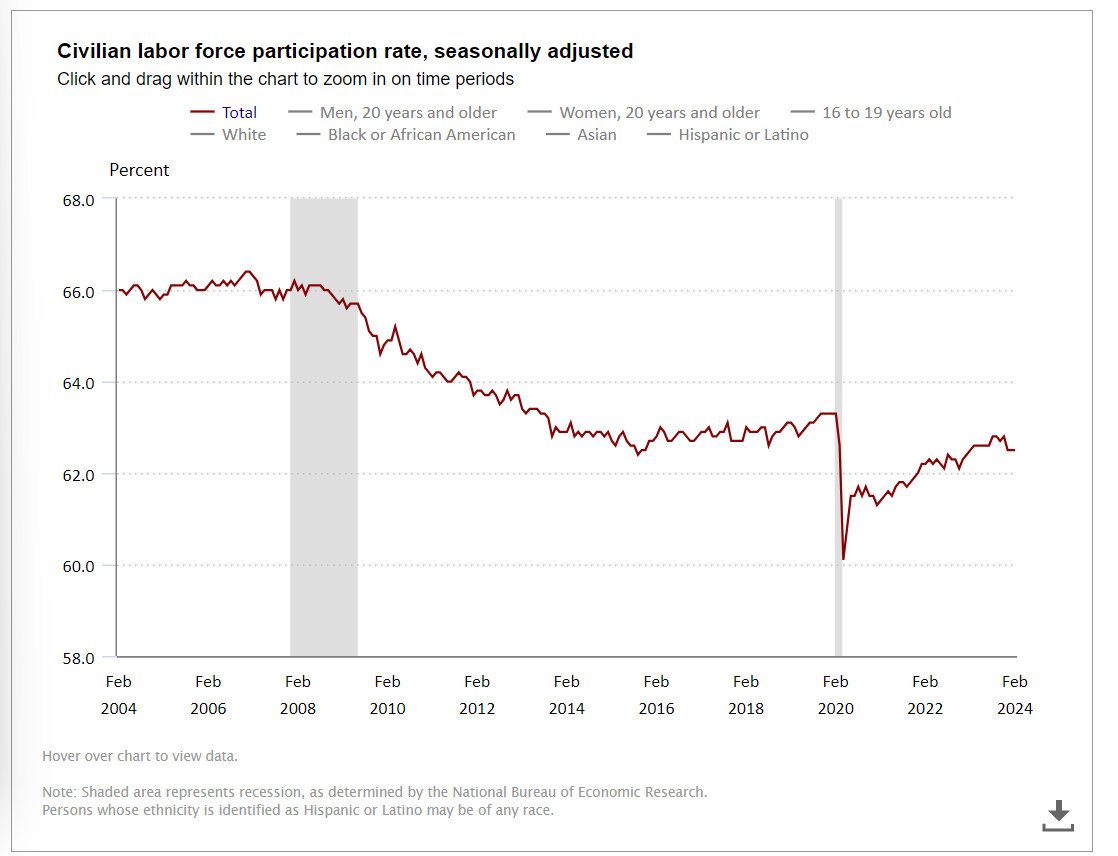
Gibson said Paychex is using AI to drive insights on retention as well as integrations with Indeed. Paychex's partnership with Visier will offer compensation insights.

He added:

"The simple fact is we have a generational change happening in the labor force. Participation rates remain below pre-pandemic levels and it's going to be very difficult given the rate of retirements that we're seeing in Baby Boomers to really see that change. And what you see in the prime age workers were actually at record highs. The problem is not enough prime age people to fill all the opportunities."

"We need to do more to allow businesses to invest in productivity and drive productivity enhancements and that's not going to replace workers. That's going to enable them to get the work done with less workers than are going to exist in the marketplace. I think this is a systemic problem."

Related: Middle managers and genAI | Why you'll need a chief AI officer | Enterprise generative AI use cases, applications about to surge | CEOs aim genAI at efficiency, automation, says Fortune/Deloitte survey

Gibson said there's a productivity gap that'll occur as younger workers replace older ones. The only nuance here is that older workers may not all leave the workforce on schedule.
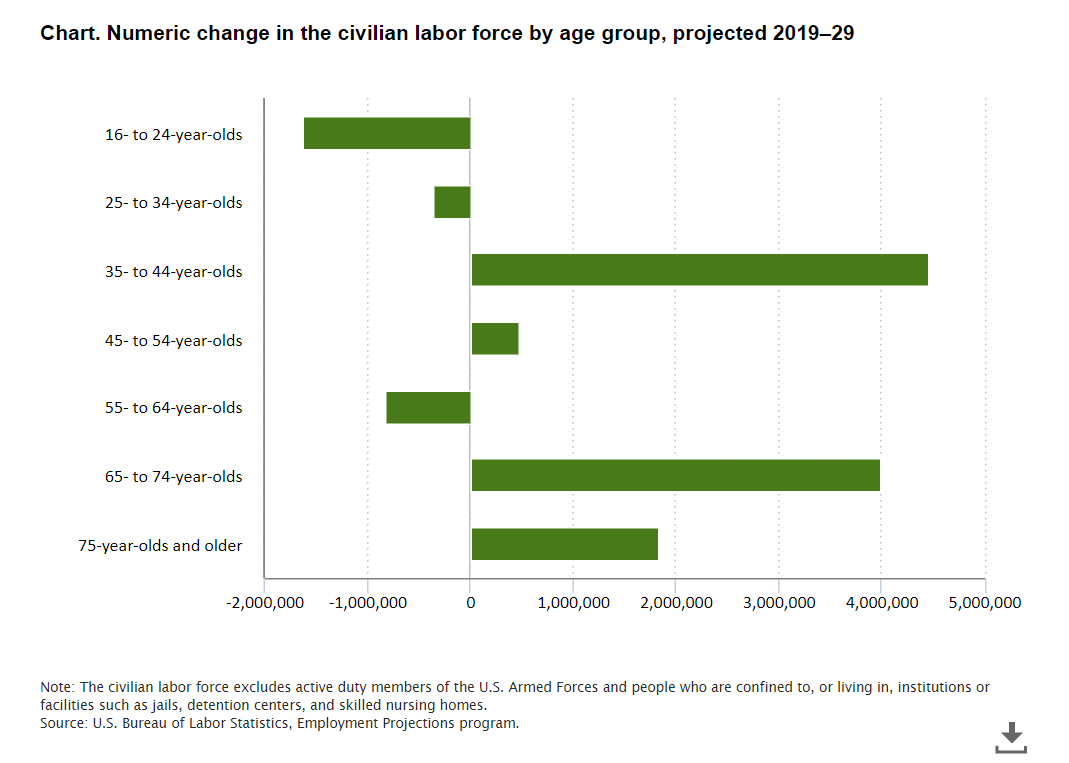
Pew Research found that 19% of Americans ages 65 and older were employed in 2023, nearly double the share from 35 years ago. The typical worker age 65 or older earns $22 an hour.
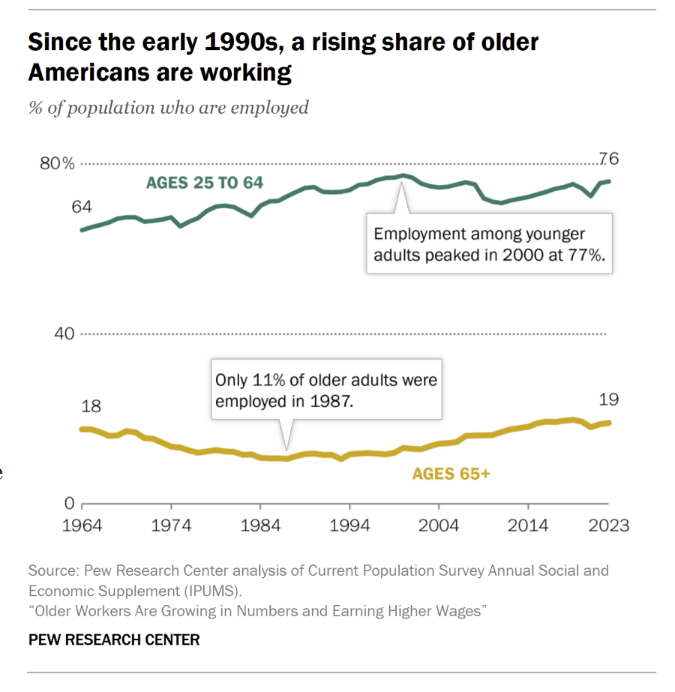
Workers ages 75 and older are the fastest-growing age group in the workforce. Today, 9% of workers that age is employed. Blackrock CEO Larry Fink should be excited about that development given he sounded the alarm bells about retirement funding and noted that one fix to Social Security would be working longer. Living to age 80 isn't terribly uncommon today.

How these workforce dynamics play out is anyone’s guess. Today, it’s hard to reconcile layoffs in technology with rosier IT employment prospects outlined by CompTIA.

Bottom line: The generative AI hit to the workforce is inevitable, but there's a more nuanced position to take amid the doom and gloom. One thing is certain: Generative AI is going to be a public policy issue.

Data to Decisions Future of Work Innovation & Product-led Growth Tech Optimization Next-Generation Customer Experience Digital Safety, Privacy & Cybersecurity AI GenerativeAI ML Machine Learning LLMs Agentic AI Analytics Automation Disruptive Technology Chief Executive Officer Chief People Officer Chief Information Officer Chief Technology Officer Chief AI Officer Chief Data Officer Chief Analytics Officer Chief Information Security Officer Chief Product Officer

Wipro names Pallia CEO to replace Delaporte

Wipro names Pallia CEO to replace Delaporte

Wipro names Pallia CEO to replace DelaporteWipro has named Srini Pallia CEO effective immediately replacing Thierry Delaporte, who stepped down to pursue other interests.

Pallia (right) most recently was CEO for Wipro's Americas 1 unit and has been with the company for more than three decades. Pallia was responsible for Wipro Americas' vision, strategy and industries and was president of Wipro's consumer business and head of business applications services. Delaporte will remain with Wipro through the end of May for the transition to Pallia.
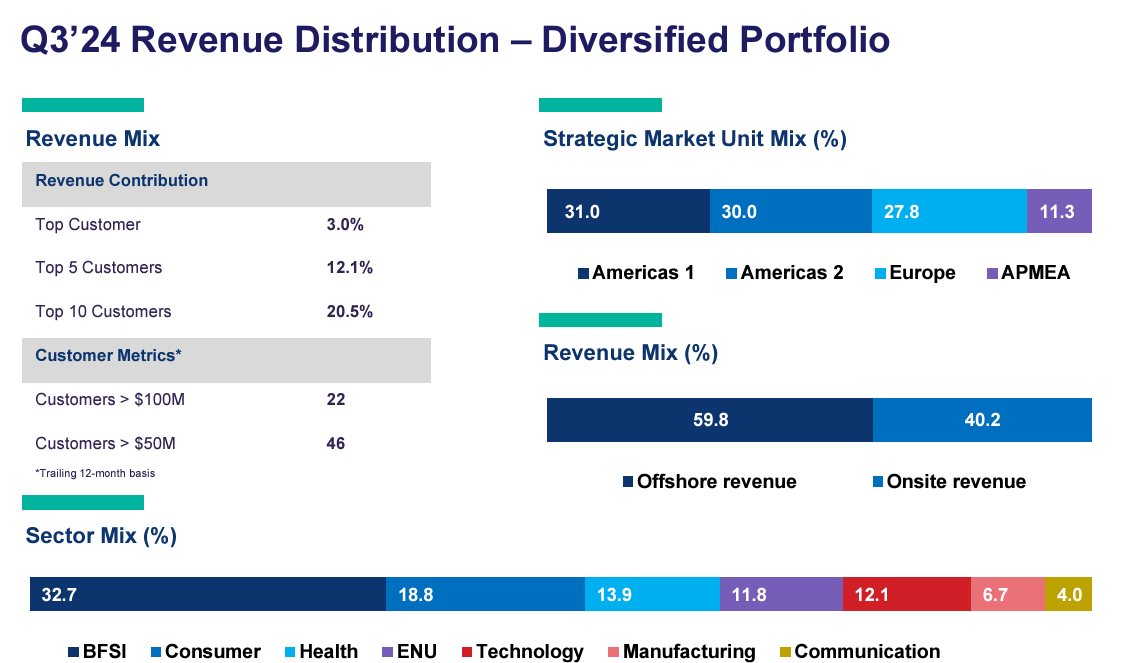

Wipro's Americas 1 unit includes healthcare and medical devices, consumer goods and life sciences, retail, transportation and services, communications, media and information services, technology products and platforms in the US and Latin America. Wipro's Americas 2 division is focused on financial services, manufacturing, technology and energy and utilities in the US and Canada.

The US accounted for 56% of Wipro's fiscal 2023 revenue.

In a statement, Pallia said he was "excited to build on the strong foundation established by Thierry and lead Wipro on its next growth trajectory."

Delaporte led Wipro through a transformational phase in his four years at the helm. The company has launched its ai360 strategy, which revolves around embedding AI throughout its services and offerings.

For the nine months ended Dec. 31, Wipro reported revenue of $8.12 billion with profit of $993 million. Revenue was modestly higher relative to a year ago. For fiscal 2023, Wipro reported revenue of $11 billion, up 14% from 2022, with profits of $1.38 billion.

Tech Optimization wipro Chief Information Officer

Archetype AI raises $13 million in seed funding, launches Newton physical world foundation model

Archetype AI raises $13 million in seed funding, launches Newton physical world foundation model

Archetype AI has raised $13 million in seed funding and launched Newton, a foundational model that is built to understand the physical world via data signals from accelerometers, gyroscopes, radars, cameras, microphones, thermometers and other environmental sensors.

Newton aims to take physical data and combine them with natural language to provide insights about the physical world. Architype AI's funding round was led by Venrock and included Amazon Industrial Innovation Fund, Hitachi Ventures, Buckley Ventures and Plug and Play Ventures.

Archetype AI's Newton highlights how foundational models continue to evolve at a rapid clip. While large language models have focused on language and image patterns, there is plenty of room for more niche use cases. Archetype AI describes Newton as "a first-of-its-kind physical AI foundational model that is capable of perceiving, understanding and reasoning about the world."

Ivan Poupyrev, CEO and co-founder of Archetype AI, said the company's mission is to solve the biggest problems which are "physical, not digital." "Our goal is to encode the entire physical world so we can derive meaning from the signals all around us and create new solutions to problems that we previously couldn’t understand," he said.

Newton is designed to scale across any kind of sensor. In theory, Newton could bring insights to the Internet of things as well as trillions of sensors in multiple industries. Archetype AI is an example of a foundational model company that can work through multiple verticals and use cases.

Speaking at an AWS analyst meetup, Matt Wood, VP of AI at AWS, was asked about whether foundational models would be commoditized quickly. After all, the LLM layer is likely to be abstracted with models being swapped as easily as cloud instances. Wood said foundational models are unlikely to be commoditized. Instead, these models will become more specialized.

Wood said:

"There is so much utility for generative AI. You're starting to see divergence in terms of price per capability, but I think that we're talking about task models, industry-focused models, vertically focused models and more. There's so much utility that I doubt these models are going to become commoditized."

Related: CEOs aim genAI at efficiency, automation, says Fortune/Deloitte survey | Why you'll need a chief AI officer | Enterprise generative AI use cases, applications about to surge

Data to Decisions Innovation & Product-led Growth Future of Work Tech Optimization Next-Generation Customer Experience Digital Safety, Privacy & Cybersecurity AI GenerativeAI ML Machine Learning LLMs Agentic AI Analytics Automation Disruptive Technology Chief Information Officer Chief Executive Officer Chief Technology Officer Chief AI Officer Chief Data Officer Chief Analytics Officer Chief Information Security Officer Chief Product Officer

DataStax acquires Logspace and its Langflow platform

DataStax acquires Logspace and its Langflow platform

DataStax said it will acquire Logspace, which is the company behind Langflow, an open-source framework for retrieval-augmented generation (RAG) applications. Logspace's Langflow team will continue to run independently with a focus on development and community.

Langflow features visual tools to iterate on data flows and build LangChain RAG applications and deploy them in a click.

With the move, DataStax aims to create an integrated generative AI stack to create applications. DataStax will integrate Langflow with its DataStax Astra DB and Python libraries.

Constellation Research analyst Andy Thurai noted that DataStax needed to upgrade its platform for building RAG-based applications. "DataStax had its own version of software to build RAG-enabled applications called RAGStack, which combined LangChain, LLaMaIndex, and more," said Thurai. "RAGSTack was as the best open-source option for implementing RAG, but it was difficult to use."

Thurai added Langflow will give DataStax the ability to create conversation flows with large language models, chatbots and virtual agents without extensive coding.

Doug Henschen, analyst at Constellation Research, said DataStax's purchase of Logspace keeps pace with where the industry is going. He said:

"For DataStax, this acquisition clearly improves DataStax’s ability to support RAG. Other DB services, like MongoDB and DataStax competitor Azure Cosmos DB, have also added support for vector embedding, vector search and RAG, but it’s early days for everybody. Another competitor adding vector embedding capabilities is Amazon with DynamoDB, so they’re clearly heading in the same direction. It takes time to add such capabilities and gain adoption, so the LangFlow acquisition is all about acceleration while AI interest is peaking."

Data to Decisions Chief Information Officer

AWS' Matt Wood on model choice, orchestration, Q and evaluating LLMs

AWS' Matt Wood on model choice, orchestration, Q and evaluating LLMs

Matt Wood, Vice President of AI at AWS, outlined how enterprises will mix and match multiple models depending on use case, the need for orchestration and how regulated industries may have an advantage in adopting genAI.

Wood spoke with industry analysts including me and Doug Henschen at AWS' New York offices. Here are some of the key themes to note.

AWS is differentiating on ensuring customers retain IP and confidentiality. Unlike competitors, Wood says AWS "does not mix training data for models with customer data" and "does not allow any human review" of training data. The key competitor cited was Azure OpenAI.

Wood said:

"There is a schism appearing in some customers' minds, where you have to be willing to give up some level of IP protection or confidentiality or privacy of your data in order to be successful with generative AI. And that just is not the case on AWS. Customers are unwilling to do that in any of the industries, particularly those in regulated industries."

Regulated industries are traditionally known as technical laggards, but these enterprises are all over generative AI. Regulated industries such as financial services, insurance and health care are "moving slightly faster than the average" on generative AI.

Wood said:

"A lot of the regulatory approaches and compliance that those organizations have been working on for the past 20 years actually set them up very well to work with generative AI. All the governance, privacy and security data standards allow you to be able to get to utility and value with generative AI very quickly."

"Companies are starting to develop muscle around model evaluation" and they are "no longer tightly coupling to single models," said Wood. Doug Henschen's take: "That's consistent with what we hear from GCP and even Microsoft, but Wood insists AWS will be "Switzerland" and Bedrock will remain differentiated on model diversity."

Wood said model choice is the only way to go in the long run. "Other providers are very married to a very small subset of models. And what that means is that customers end up having to approach a model a bit like a Swiss Army knife, which sounds great, except If It's a contractor turned up to fix your house and all they had was a Swiss Army knife, you would not be very happy."

Ultimately, enterprises will toggle between speed, use case and cost when managing model portfolios. Wood added that this portfolio management of models is already carrying over to compute. He said if training speed is needed Nvidia GPUs get the call, but if cost is more of a factor AWS' Trainium chip is an option. Wood said interest among the customer base is split about 50/50 between the need for speed and cost.

Model orchestration will become critical. "What we've seen is that a big part of success in the actual broad production use of generative AI is being able to access the right model for the right use case," said Wood. "Different models operate and have different use cases and have different sweet spots. The real kind of superpower for generative AI is the combination of those models and the compounding effect on the aggregate intelligence of the system."

Orchestration of models in Bedrock will evolve over time so enterprises can leverage multiple models. Wood said orchestration of models today requires hardcoded rules to data, but as models improve to handle more tasks generative AI will be able to play point guard better.

Q leverages multiple models based on specialty and use cases. "Amazon Q is the easy button for Generative AI" and it provides all the GenAI many companies want to use, said Wood. He specifically touted "a step-function change" in digital transformation and migration projects, such as Windows to Linux moves. Henschen said cloud migration will be an important use of GenAI and an accelerator and cost saver for customers looking to migrate off legacy platforms and onto modern, cloud platforms.

Wood noted that Q runs on a variety of models via a series of expert agents.

Data to Decisions Innovation & Product-led Growth Future of Work Tech Optimization Next-Generation Customer Experience Digital Safety, Privacy & Cybersecurity amazon AI GenerativeAI ML Machine Learning LLMs Agentic AI Analytics Automation Disruptive Technology Chief Executive Officer Chief Information Officer Chief Technology Officer Chief AI Officer Chief Data Officer Chief Analytics Officer Chief Information Security Officer Chief Product Officer

Palantir will move workloads to Oracle Cloud as both court governments and enterprises

Palantir will move workloads to Oracle Cloud as both court governments and enterprises

Palantir will move its workloads to Oracle Cloud Infrastructure in a partnership that also includes the two companies jointly selling to governments as well as enterprises.

The partnership will combine Palantir's AI platform and Oracle Cloud Infrastructure. The deal has multiple parts to it, but the gist is that the two companies plan to jointly target governments and enterprises with Oracle distributed cloud and AI infrastructure and Palantir's AI Platform (AIP) and Foundry decision support platform.

Both companies are seeing strong growth among governments looking to keep data in-country.

Enterprise generative AI use cases, applications about to surge | Palantir posts strong Q4, sees enterprise traction in US | Palantir's commercial business scales with help of AI boot camps

Here's a look at the moving parts of the partnership:

  • Palantir will move its Foundry workloads to OCI.
  • Palantir's Gotham and AIP will be available in OCI's public cloud as well as Oracle Cloud Infrastructure Dedicated Regions, Oracle Alloy, Oracle EU Sovereign Cloud, Oracle Government Cloud and Oracle Roving Edge.
  • Oracle will workloads and an increase in ongoing cloud revenue.
  • Both companies will jointly sell and support cloud and AI services across government and commercial accounts.

The Oracle and Palantir combination will line up against C3 AI in government and enterprise accounts. C3 AI has partnerships with Microsoft Azure, AWS and Google Cloud.

Data to Decisions Oracle Chief Information Officer

CEOs aim genAI at efficiency, automation, says Fortune/Deloitte survey

CEOs aim genAI at efficiency, automation, says Fortune/Deloitte survey

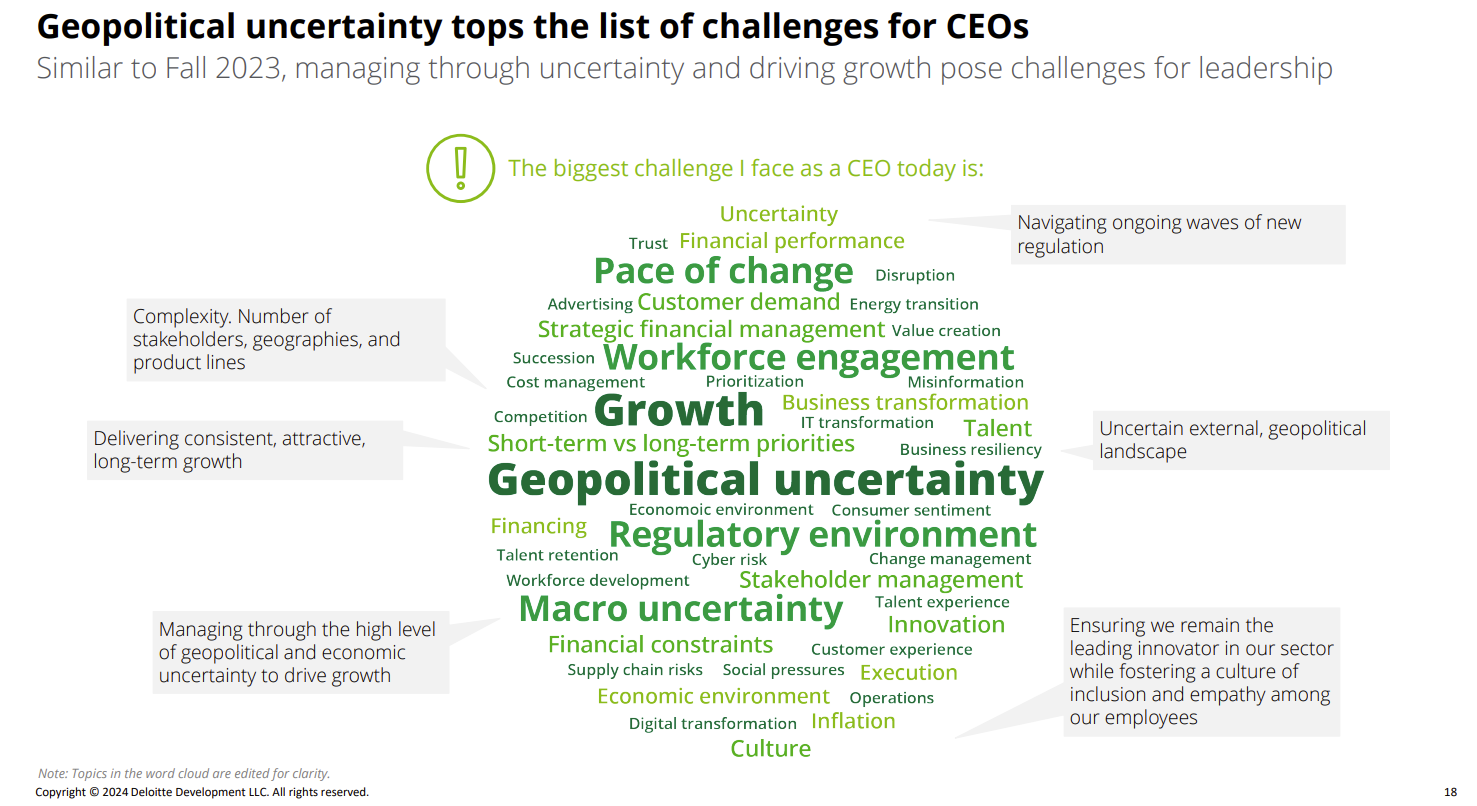
CEOs are ramping up generative AI adoption as they shift from pilots to active usage, according to the Winter 2024 Fortune/Deloitte CEO survey.

The survey, based on 107 CEOs mostly in the US, found 56% of respondents rank efficiency and productivity as the primary benefit. According to the survey, 58% of CEOs say they are already implementing genAI to automate manual tasks, up from 40% in October, and 45% say they are reducing operating costs.

Going forward, CEOs are looking to balance costs and innovation. Fortune/Deloitte said 51% of CEOs are implementing genAI to accelerate innovation.

A few key generative AI adoption stats from the survey:

  • 50% of CEOs say they are using AI to automate content generation.
  • 42% say genAI is writing code.
  • 56% are using genAI to increase efficiencies.

Related: Middle managers and genAI | Why you'll need a chief AI officer | Enterprise generative AI use cases, applications about to surge

Other takeaways include:

  • Geopolitical instability was rated as the primary disruptor by 65% of CEOs surveyed.
  • 27% of CEOs express optimism about the global economy, up from 7% in the fall of 2023.
  • 22% of CEOs have high optimism about their companies.

Data to Decisions Future of Work New C-Suite Innovation & Product-led Growth Tech Optimization Next-Generation Customer Experience Digital Safety, Privacy & Cybersecurity ML Machine Learning LLMs Agentic AI Generative AI Robotics AI Analytics Automation Quantum Computing Cloud Digital Transformation Disruptive Technology Enterprise IT Enterprise Acceleration Enterprise Software Next Gen Apps IoT Blockchain Leadership VR B2B B2C CX EX Employee Experience HR HCM business Marketing Metaverse developer SaaS PaaS IaaS Supply Chain Growth eCommerce CRM ERP finance Social Healthcare CCaaS UCaaS Customer Service Content Management Collaboration M&A Enterprise Service Chief Executive Officer Chief Information Officer Chief Technology Officer Chief AI Officer Chief Data Officer Chief Analytics Officer Chief Information Security Officer Chief Product Officer Chief Digital Officer

Low code platforms will become strategic to CxOs

Low code platforms will become strategic to CxOs

Generative AI and automation will mean low-code coding platforms will become strategic for enterprise transformation efforts. By 2025, Constellation Research estimates more than two-thirds of enterprises will have a standardized low-code tool in house.

That's a big takeaway from Constellation Research analyst Holger Mueller, in a recent published report Key Trends for Low Code in 2024 and Beyond. Mueller wrote:

"Enterprises need to own their digital transformation destiny by creating software assets that enable what matters. Enterprise Acceleration is an all-encompassing enterprise strategy that aligns people and technology so they can become more agile and move faster. The emergence of generative artificial intelligence (GenAI) only exacerbates the need for low-code platforms that enable enterprises to build the next-generation platforms they need in order to be winners in the era of digital transformation."

In many ways, low-code platforms will be critical as a bridge between human built code and code via software robots and agents.

Mueller outlined the following CxO considerations when thinking about low code strategies this year and beyond.

  • Begin with a low-code mindset. Enterprises can't ignore the importance of low-code platforms as an enabler to digital transformation effort.
  • Standardize low-code platforms, but make sure governance is so restrictive that it hampers developers.
  • Select low-code platform vendors that can leverage generative AI because processes are going to be automated at a rapid rate.
  • Know how low-code platforms interact with your standard applications. CxOs will have to balance enterprise application platforms and low-code offerings.
  • Understand your total cost of ownership with low-code platforms to avoid higher software portfolio costs.

More low code platform resources and news:

Next-Generation Customer Experience Tech Optimization Chief Information Officer Chief Technology Officer

The Ins and Outs of Confidential Computing | Interview with Steve Wilson

The Ins and Outs of Confidential Computing | Interview with Steve Wilson

Constellation analyst Steve Wilson sits down with Editor-in-Chief Larry Dignan to explain the definition, importance, and future of confidential computing for enterprise technology.

On ConstellationTV <iframe width="560" height="315" src="https://www.youtube.com/embed/eziYReRFkPQ?si=5z_wXZ8S9G5uyAVB" title="YouTube video player" frameborder="0" allow="accelerometer; autoplay; clipboard-write; encrypted-media; gyroscope; picture-in-picture; web-share" referrerpolicy="strict-origin-when-cross-origin" allowfullscreen></iframe>

Databricks LLM, Confidential Computing, Zoho Software | ConstellationTV Episode 77

Databricks LLM, Confidential Computing, Zoho Software | ConstellationTV Episode 77

🎬 ConstellationTV episode 77 is here! Watch co-hosts Doug Henschen and Dion Hinchcliffe analyze the latest #enterprise tech news with Larry Dignan (AT&T data dump, Microsoft security pledge, Databricks new open-source LLM). 

Then Constellation analyst Stephen Wilson explains the concept of confidential #computing and Doug hears from Kris James of Sparex Limited about his experience using Zoho #technology. Watch until the end for bloopers!

0:00 - Introduction
1:12 - #Enterprise tech news coverage (AT&T data dump, Microsoft security pledge, Databricks new open-source #LLM)
19:50 - The Ins and Outs of Confidential Computing
30:44 - #ZohoDay2024 interview with Kris James, Sparex
38:18 - Bloopers!

ConstellationTV is a bi-weekly Web series hosted by Constellation analysts, tune in live at 9:00 a.m. PT/ 12:00 p.m. ET every other Wednesday!

Data to Decisions Digital Safety, Privacy & Cybersecurity Future of Work Marketing Transformation Matrix Commerce New C-Suite Next-Generation Customer Experience Tech Optimization
On ConstellationTV <iframe width="560" height="315" src="https://www.youtube.com/embed/cpTcU6qkIkY?si=_juSSahccZViRotC" title="YouTube video player" frameborder="0" allow="accelerometer; autoplay; clipboard-write; encrypted-media; gyroscope; picture-in-picture; web-share" referrerpolicy="strict-origin-when-cross-origin" allowfullscreen></iframe>
Media Name: YouTube Video Thumbnails.png