Results

How Platformization Applies to Cybersecurity

How Platformization Applies to Cybersecurity

Platformization is the buzzword du jour in cybersecurity circles. The general idea is that enterprises are consolidating vendors and will ultimately bet on one platform to solve for cybersecurity.

But we've seen this movie before. Platformization isn't exactly new. It's a strategy that has been deployed in enterprise software for decades and mainframes before that. The benefit is customers get one throat to choke. The downside is you bet on a platform and lose your negotiation leverage.

With that backdrop, Editor in Chief Larry Dignan caught up with Constellation Research analyst Chirag Mehta, who noted the potential risks of platformization. Here are some of the topics we cover...

- Two perspectives of platformization (vendor and customer)
- When platformization bites back
- Open platforms matter
- The importance of data in cybersecurity

On Insights <iframe width="560" height="315" src="https://www.youtube.com/embed/r7E6DTD2ynE?si=0LKRaRp-ofVHOGCs" title="YouTube video player" frameborder="0" allow="accelerometer; autoplay; clipboard-write; encrypted-media; gyroscope; picture-in-picture; web-share" referrerpolicy="strict-origin-when-cross-origin" allowfullscreen></iframe>

Cybersecurity platformization: What you need to know

Cybersecurity platformization: What you need to know

Platformization is the buzzword du jour in cybersecurity circles. The general idea is that enterprises are consolidating vendors and will ultimately bet on one platform to solve for cybersecurity.

Palo Alto Networks earlier this year set off the debate with a plan to bet that it could be the leading cybersecurity platform. Although the company said it has seen strong interest from customers, it's far too early to say the debate is settled. After all, CrowdStrike and a bevy of others also have platform plans.

But we've seen this movie before. Platformization isn't exactly new. It's a strategy that has been deployed in enterprise software for decades and mainframes before that. The benefit is customers get one throat to choke. The downside is you bet on a platform and lose your negotiation leverage.

With that backdrop, I caught up with Constellation Research analyst Chirag Mehta, who noted the potential risks of platformization in a Wall Street Journal article.

Here are some of the takeaways.

Two perspectives of platformization (vendor and customer). "Platformization is not something new. The word sounds new, but it's been in existence for many years," said Mehta. "A vendor tries to create a single platform where it can control the experience that end users get since data is shared across applications without requiring explicit integrations. The platform shares the common fabric. You can think about the operating system as a platform."

And the customer gets more simplicity. "From a customer perspective it's a best of breed versus best of suites approach. Best of breed is specific niche vendors who provide functionality that you really care about. And you have many of those, and some of them talk to each other. Some of them don't talk to each other. Best of suite you trust one vendor to do many, many different things and you expect that the vendors roadmap will align with your business needs."

When platformization bites back. Mehta said the issue with platformization occurs when you bet on a vendor that doesn't meet your needs. For instance, the enterprise resource planning space had multiple vendors, but the industry has consolidated. There aren't ERP startups to drive innovation. "It's very difficult to compete against a best of suite vendor," said Mehta. "It becomes difficult for a CXO to make a business case to buy something outside of the best of suite. You might see benefits in the short term because you are consolidating multiple applications on one platform, but in the long run it always costs more and limits the choices you have."

Mehta added:

"You want to be really careful if you are going down the road of platform migration because of how much influence you're going to have on that platform, what your roadmap is, and how open that platform is, and whether it works with some of the other solutions that you have today, or you might consider in the future."

Is the cybersecurity industry maturing enough to bet on one platform? The short answer from Mehta is no. He said:

"Cybersecurity is far from mature when it comes to the business processes, categories, specific functionalities or use cases. It's still a very specialized domain and fragmented landscape. If you look at the innovation that is happening there are many startups doing amazing things. At the same time, there are few large vendors but there are very few of them. There are many midsized vendors. So, the domain is not mature. And the processes are not mature at all."

Open platforms matter. Mehta said CXOs should evaluate platforms based on how open they are. "I'm not against platform isolation, but openness is key," said Mehta. "Many operating systems have been open. You can go build applications. If the platform is not very easy to plug into--technology, ecosystem and commercial advantage--you can be in a difficult situation. If you are going to have multiple systems, spend the time and energy to make sure the platform is actually open."

The importance of data in cybersecurity. Mehta said the importance of data in cybersecurity from telemetry is critical. Any bet on a platform has to be able to integrate data from multiple systems. "More data and more information from different systems actually improves your security posture," said Mehta. "If and when you decide to go down the platformization route make sure you understand how it fits into your overall landscape."

Digital Safety, Privacy & Cybersecurity Security Zero Trust Chief Information Officer Chief Information Security Officer Chief Privacy Officer

The real reason Windows AI PCs will be interesting

The real reason Windows AI PCs will be interesting

Microsoft and its merry band of PC makers launched AI PCs at scale. The launch of Copilot+ PCs, ahead of Microsoft Build 2024, was notable for a host of reasons once you get past how executives were a bit obsessed with outperforming Apple's MacBook.

Consider:

  • The first Copilot+ PCs will launch with Qualcomm's Snapdragon X Elite and Snapdragon X Plus processors. The rollout of AI PCs is big for Qualcomm and the Arm PC ecosystem.
  • Microsoft did say that it will have AI PCs powered by AMD and Intel paired with Nvidia and AMD GPUs. AMD CFO Jean Hu said at an investor conference that the chipmaker will outline its AI PC processors in "coming weeks." "It's a very exciting product and very competitive to power the AI applications in the PC market. We do believe AI PC is a very significant inflection point. It will potentially help refresh the PC market," said Hu.
  • Businesses can easily add AI PCs to the mix with the same controls they do today. Copilot+ PCs are billed as a productivity and collaboration booster.
  • Copilot+ PCs have neural processor units (NPUs) capable of more than 40 trillion operations per second. In other words, a lot of inferencing work can be done on the edge.
  • During his Build 2024 keynote, Microsoft CEO Satya Nadella said there are 40 models included into Copilot+ PCs including its new Phi-3 models, OpenAI's GPT-4o and other small language models as well as large ones. "We have 40 plus models available out of the box including Phi-3 Silica, our newest member of our small language family model designed to run locally on Copilot+ PCs to bring that lightning-fast local inference to the device. The copilot library also makes it easy for you to incorporate RAG (retrieval-augmented generation) inside of your applications on the on-device data,” said Nadella.
  • Features like Recall, which makes your PC a recorder of all of the information, relationships and associations. Recall can help you remember items to create individual experiences. Cocreator and Live Captions are additional AI-driven features.

Add it up and CIOs are going to start testing these Copilot+ PCs and pondering their refresh cycles. Perhaps there's a future of work or productivity play to be had. The reality is that CIOs probably have more business transformation projects with higher priority rankings.

This post first appeared in the Constellation Insight newsletter, which features bespoke content weekly and is brought to you by Hitachi Vantara.

But what's surprising is how the big picture was glossed over with the Copilot+ PC launch. If these AI PCs scale, you're going to have a lot of computing power at the edge that can be used for inferencing and potentially even training.

Think peer-to-peer networked model inference. Smartphones are increasingly building in the capacity for AI models. Now you add in PCs. Generative AI can be decentralized from the AI factory vision that's popular today. Generative AI requires costly computing infrastructure. Why wouldn't you offload some of that work to the nodes on the edge?

For businesses, this emerging distributed AI computing system could mean using the PC to run models for personal identifiable information (think mortgage applications) and build personalized apps on the fly. You could automate any process that touches a customer using that person's compute power.

Are we there yet? Not really since these AI PCs just launched and it's doubtful any of these features are going to cause a buying frenzy. But PCs are already past their normal shelf life so the refresh cycle will drive some demand.

And the economic incentives are there to figure out a more peer-to-peer computing approach. At some point, enterprises are going to grow weary of paying up for AI compute. Finding a way to leverage AI PCs in the field could be a salve. There's a reason Dell Technologies considered AI PCs as part of its AI factory vision.

More on genAI:

Data to Decisions Future of Work Tech Optimization Innovation & Product-led Growth Next-Generation Customer Experience Digital Safety, Privacy & Cybersecurity AI GenerativeAI ML Machine Learning LLMs Agentic AI Analytics Automation Disruptive Technology Chief Information Officer Chief Executive Officer Chief Technology Officer Chief AI Officer Chief Data Officer Chief Analytics Officer Chief Information Security Officer Chief Product Officer

Everything you need to know about Qiskit 1.0

Everything you need to know about Qiskit 1.0

#QuantumComputing holds significant potential for transforming industries but requires robust and user-friendly #development tools. That's why IBM designed Qiskit 1.0, a comprehensive, open-source #software stack to streamline the journey into #quantum computing.

At IBM #Think2024, Constellation analyst Holger Mueller talks with Blake Johnson, Quantum Engine Lead at IBM Quantum about Qiskit 1.0's key advantages for quantum computing:

📌 Complete #software stack for streamlined development
📌 Enhanced performance and stability for complex computations.
📌 Intuitive, user-friendly design for constructing quantum #applications.
📌 Open-source accessibility and easy installation.

🔎 To learn more about IBM Qiskit 1.0, visit: https://lnkd.in/gcHEKZkf

On ConstellationTV <iframe width="560" height="315" src="https://www.youtube.com/embed/ft_7I6KfOso?si=k_s1-2CECaSwGfp8" title="YouTube video player" frameborder="0" allow="accelerometer; autoplay; clipboard-write; encrypted-media; gyroscope; picture-in-picture; web-share" referrerpolicy="strict-origin-when-cross-origin" allowfullscreen></iframe>

Quantum Use Cases 2024 & Beyond

Quantum Use Cases 2024 & Beyond

With all the hype around #AI advancements, it's easy to overlook the opportunity in #quantum computing. But quantum #technology addresses complex computational problems far beyond the reach of classic computing, and its use potential is only beginning to be realized.

At IBM #Think2024, Constellation analyst Holger Mueller talks with Heather Higgins, Partner of Industry and Technical Services at IBM Quantum about...

💡 Why quantum is important for the #enterprise
💡 Relevant #customer use cases
💡 How #quantumcomputing can fit into existing enterprise systems

Watch the full interview below ?

🔎 For more resources on quantum, access the IBM Quantum Decade Book: https://lnkd.in/d2Qz4Bgc

On ConstellationTV <iframe width="560" height="315" src="https://www.youtube.com/embed/c_yFge6Eeq0?si=WeUBASpyAtqABduJ" title="YouTube video player" frameborder="0" allow="accelerometer; autoplay; clipboard-write; encrypted-media; gyroscope; picture-in-picture; web-share" referrerpolicy="strict-origin-when-cross-origin" allowfullscreen></iframe>

Intuit sees 'green shoots' from its generative AI strategy

Intuit sees 'green shoots' from its generative AI strategy

Intuit CEO Sasan Goodarzi said generative AI is increasing the company's total addressable market as TurboTax users flocked to its data, AI and virtual expert platform. Now the company has learned from its genAI efforts, Intuit will double down on what's working. 

"TurboTax live revenue is expected to be $1.4 billion representing approximately 30% of total consumer revenue growing at a significant scale. This gives us confidence that we can digitize a very manual, disaggregated and high price assisted category," said Goodarzi on Intuit's third quarter earnings call.

Under Goodarzi, Intuit has built out its data platform on AWS and then scaled into generative AI. He said genAI financial assistance played a big role in the TurboTax experience. Goodarzi added that 24 million customers used intuitive AI to explain refunds, answer questions and check for accuracy.

Customer story: Intuit’s Bet on Data, AI, AWS Pays Off Ahead of Generative AI Transformation

"GenAI is working at scale for both our customers and our AI powered experts. I'm excited about what we're working on for next season to accelerate innovation and deliver even more customer benefit," he said.

Now that Intuit has one tax season of generative AI enhancements in the books, it can revamp experiences and add new models as needed via Amazon Bedrock and other services. The current generative AI models are much more advanced than a year ago. 

Goodarzi said Intuit is looking to AI to reinvent customer experiences and drive revenue growth. He reiterated the big bets for genAI on TurboTax and QuickBooks.

"To increase our investments in the outline focus areas given the green shoots we're observing, we are taking a hard look at what we can stop doing and where we can reallocate investments to accelerate top line growth while remaining committed to delivering operating margin expansion in fiscal year 2025 and beyond," said Goodarzi.

Goodarzi's remarks were on Intuit's third quarter earnings call. The company reported third-quarter revenue of $6.7 billion, up 12% from a year ago, with earnings per share of $8.42 a share. Non-GAAP earnings were $9.88 a share.

As for the outlook for the fiscal year, Intuit expects TurboTax Live revenue to grow 17% to $1.4 billion and average revenue per return to increase 10%.

Overall, Intuit said its fiscal 2024 revenue will be between $16.16 billion to $16.2 billion, up 13%. Non-GAAP earnings will be $16.79 a share to $16.84 a share. Small business and self-employed group revenue will be up 18% and consumer revenue up 7% to 8%.

More on genAI:


Data to Decisions Innovation & Product-led Growth Future of Work Tech Optimization Next-Generation Customer Experience Digital Safety, Privacy & Cybersecurity AI GenerativeAI ML Machine Learning LLMs Agentic AI Analytics Automation Disruptive Technology Chief Information Officer Chief Executive Officer Chief Technology Officer Chief AI Officer Chief Data Officer Chief Analytics Officer Chief Information Security Officer Chief Product Officer

Workday reports strong Q1, says 25 generative AI use cases on roadmap

Workday reports strong Q1, says 25 generative AI use cases on roadmap

Workday reported a strong first quarter as the company leveraged AI within its platform and continued to become more efficient.

The company reported first quarter net income of 40 cents a share, non-GAAP earnings of $1.74 a share and revenue of $1.99 billion, up 18.1% from a year ago. Wall Street was expecting Workday to report earnings of $1.58 a share on revenue of $1.97 billion.

Workday said its 12-month subscription revenue backlog was $6.6 billion, up 17.9% from a year ago. Total subscription revenue backlog was $20.68 billion, up 24.2% from a year ago.

Carl Eschenbach, Workday's CEO, said customers are looking to manage through the "shifting talent landscape, and pressure to realize operational efficiencies."

According to Workday, the company has more than 50 AI use cases in production and 25 generative AI use cases on the roadmap. Workday also expanded a partnership with AWS and formed a partnership with Google Cloud.

Workday CFO Zane Rowe said the "we were pleased with our progress across key growth initiatives in Q1, which help build a foundation for long-term growth." He added: "Our updated subscription revenue guidance reflects the elevated sales scrutiny and lower customer headcount growth we experienced during the quarter."

As for the outlook, Workday projected fiscal 2025 subscription revenue of $7.7 billion to $7.725 billion, up 17%, with non-GAAP operating margins of 25%. For the second quarter, Workday projected subscription revenue of $1.895 billion, up 17%, with non-GAAP operating margins of 24.5%.

Insights:

On a conference call with analysts, Eschenbach said the first quarter is typically Workday's slowest. He said Workday outperformed in healthcare, public sector and financials. 

"When purchase decisions are being made, our win rates remain strong but within the quarter, we experience increased deal scrutiny as compared to prior quarters. And we are seeing customers committing to lower headcount levels on renewals compared to what we had expected," he said. "We expect these dynamics to persist in the near term, which is reflected in our revised FY 25 subscription revenue guidance. While we can't control the macro, we are focusing on what's in our control. And that is innovation, scaling our go to market engine and partner ecosystem and delivering customer value."

Workday executives also said they are often selling full platform plays and that sales cycle is longer. 

Related Research:

Eschenbach said more than 90% of the company's nearly 2,000 financial customers also have HCM. 

On AI, Eschenbach said:

"We've built AI into the core of our platform, which means AI features and functionality are embedded natively in all of our applications. And with more than 65 million users generating more than 800 billion transactions per year on our platform, the volume of clean, trusted data that workday and our ecosystem can leverage for AI is truly unmatched. We continue to make significant investments to further enhance our leadership in this area in deliver trusted and responsible AI innovations that drive meaningful business results. We now have more than 50 ai use cases live in production in 25 generative AI use cases on our roadmap."

These use cases are primarily content generation, job descriptions and knowledge base articles as well as insights for things like payroll and talent optimization.

Eschenbach said Workday is building out its partner ecosystem and go-to-market efforts. Workday is also building out its ecosystem via Extend, a marketplace for Workday platform applications. Workday's AI marketplace will go live next month with AI tools from the company and third parties. 

Constellation Research's take

Constellation Research analyst Holger Mueller said:

"Workday had a good first quarter, just missing the $2 billion overall revenue milestone by $10 million. And with that it grew itself back to a profit compared to last year's quarter. But margins are tight, with net income of just over $100 million. The good news is that Workday keeps innovating, with generative AI use cases coming soon, as well as the addition of Australia with native payroll. Now all eyes are on Q2. Can Workday keep growing, break the $2B in revenue and control costs?"


Future of Work Data to Decisions Tech Optimization workday AI Analytics Automation CX EX Employee Experience HCM Machine Learning ML SaaS PaaS Cloud Digital Transformation Enterprise Software Enterprise IT Leadership HR Chief Financial Officer Chief People Officer Chief Information Officer Chief Customer Officer Chief Human Resources Officer

Epicor Prism and AI Announcements | Live Interview from Epicor Insights 2024

Epicor Prism and AI Announcements | Live Interview from Epicor Insights 2024

Constellation Research R "Ray" Wang sits down with Arturo Buzzalino, VP of Products and Innovation at Epicor, to talk through AI announcements from Epicor Insights 2024 and their new product Epicor Prism.

On ConstellationTV <iframe width="560" height="315" src="https://www.youtube.com/embed/LMUkqHg4Tv4?si=6zNTa2cW8tgasRwR" title="YouTube video player" frameborder="0" allow="accelerometer; autoplay; clipboard-write; encrypted-media; gyroscope; picture-in-picture; web-share" referrerpolicy="strict-origin-when-cross-origin" allowfullscreen></iframe>

A creative response to Generative AI

A creative response to Generative AI

With Generative AI being used to imitate celebrities and authors, the question arises, is your likeness a form of intellectual property (IP)? Can you copyright your face or your voice?

These questions are on the bleeding edge of IP law and may take years to resolve. But there may be a simpler way to legally protect appearances. On my reading of technology-neutral data protection law — widespread internationally and now rolling out across the USA — generating likenesses of people without their permission could be a privacy breach.

Let’s start with the generally accepted definition of personal data as any data that may reasonably be related to an identified or identifiable natural person.

Personal data (sometimes called personal information) is treated in much the same way by the California Privacy Rights Act (CPRA), Europe’s General Data Protection Regulation (GDPR), Australia’s Privacy Act, and the new draft American Privacy Rights Act (APRA).

These sorts of privacy laws place limits on how personal data is collected, used and disclosed. If personal data is collected without a good reason, or in excess of what’s reasonable for the purpose, or without the knowledge of the individual concerned, then privacy law may be breached.

Technology neutrality in privacy law means it does not matter how personal data is collected. In plain language, if personal data comes to be in a storage system, then it has been collected.  Collection may be done directly via forms, questionnaires and measurements, or indirectly by way of acquisitions, analytics and algorithms.

To help stakeholders deal with the rise of analytics and Big Data, the Australian privacy regulator has developed additional guidance about indirect collection of personal data:

“The concept of ‘collects’ applies broadly, and includes gathering, acquiring or obtaining personal information from any source and by any means. This includes collection by ‘creation’ which may occur when information is created with reference to, or generated from, other information” (emphasis added; ref: Guide to Data Analytics and the Australian Privacy Principles, Office of the Australian Information Commissioner, 2019).

How should privacy law treat facial images and voice recordings?

What are images and voice recordings? Simply, these are data (‘ones and zeros’) in a file which represent optical or acoustic samples that can be converted back to analog to be viewed or heard by people.

Now consider a piece of digital text. That too is a file of ones and zeros, this time representing coded characters, which can be converted by a printer to be human readable. If the words thus formed are identifiable as relating to a natural person, then the file constitutes personal data.

So if any data file can be rendered as an image or sound which is identifiable as relating to a natural person (that is, the output looks like someone) then the file is personal data about that person.

Under technology neutral privacy law, it doesn’t matter how the image or sound is created. If data generated by an algorithm is identifiable as relating to a natural person (for example, by resembling that person) then that data is personal data, which the Australian privacy commissioner would say has been collected by creation. The same sort of interpretation would be available under any similar technology-neutral data protection statute.

If a Generative AI model makes a likeness of a real-life individual Alice, then we can say the model has collected personal information about Alice.

I am not a lawyer but this seems to me to be easy enough to test in a ‘digital line up’. If a face or voice is presented to a sample of people, and an agreed percentage of them say it reminds them of Alice, then the evidence would suggest that personal data of Alice has been collected.

In any jurisdiction with technology-neutral privacy law, that might be a breach of Alice's rights.

Digital Safety, Privacy & Cybersecurity Data to Decisions Innovation & Product-led Growth Future of Work Tech Optimization Next-Generation Customer Experience Distillation Aftershots ML Machine Learning LLMs Agentic AI Generative AI Robotics AI Analytics Automation Quantum Computing Cloud Digital Transformation Disruptive Technology Enterprise IT Enterprise Acceleration Enterprise Software Next Gen Apps IoT Blockchain Leadership VR Security Zero Trust business Marketing SaaS PaaS IaaS CRM ERP finance Healthcare Customer Service Content Management Collaboration Chief Executive Officer Chief Information Officer Chief Technology Officer Chief AI Officer Chief Data Officer Chief Analytics Officer Chief Information Security Officer Chief Product Officer Chief Privacy Officer

Nvidia Q1 shines, splits stock 10-for-1 amid data center boom

Nvidia Q1 shines, splits stock 10-for-1 amid data center boom

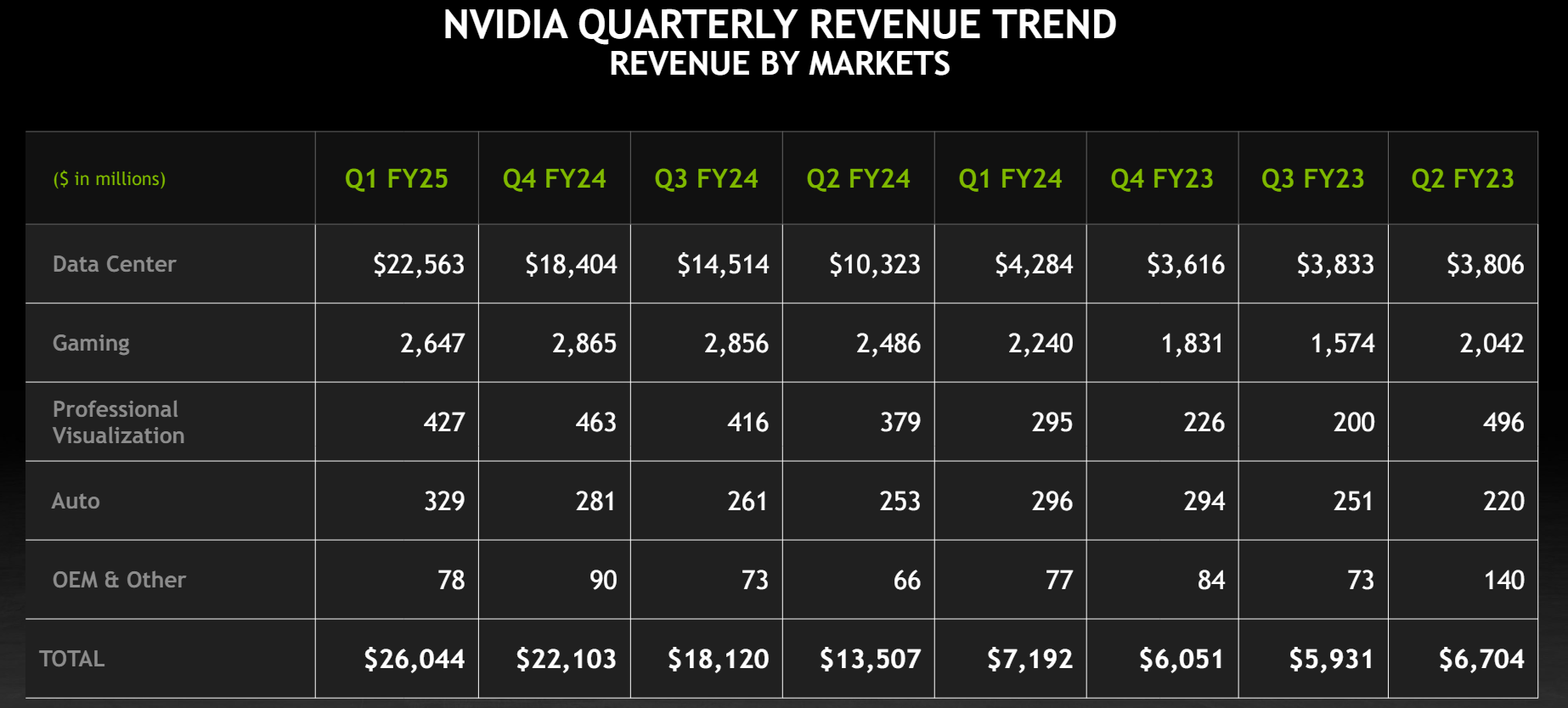
Nvidia reported first quarter sales growth of 262% from a year ago, reported record quarterly data center revenue and split its stock 10-for-1 effective June 7.

The company reported first quarter earnings of $5.98 a share on revenue of $26 billion. Non-GAAP earnings were $6.12 a share. Wall Street was expecting Nvidia to report first quarter earnings of $5.54 a share on revenue of $24.6 billion.

CEO Jensen Huang said the AI factory upgrade cycle has begun. He said:

"Our data center growth was fueled by strong and accelerating demand for generative AI training and inference on the Hopper platform. Beyond cloud service providers, generative AI has expanded to consumer internet companies, and enterprise, sovereign AI, automotive and healthcare customers, creating multiple multibillion-dollar vertical markets."

During the quarter, Nvidia lined up a bevy of partnerships including one with Dell Technologies that advances the AI factory concept. Nvidia CEO Jensen Huang said Dell Technologies AI factory effort will be the largest go-to-market partnership the GPU maker has. "We have to go modernize a trillion dollars of the world's data centers," said Huang.

As for the outlook, Nvidia projected second quarter revenue of $28 billion with non-GAAP gross margins of 75.5%, an outlook that indicates Nvidia has pricing power.

By the unit, data center revenue surged 23% from the first quarter and 427% from a year ago. Gaming and AI PC revenue in the first quarter was $2.6 billion, up 18% from a year ago. Professional visualization revenue in the first quarter was up 45% from a year ago and automotive and robotics sales were up 11%.

In prepared remarks, CFO Colette Kress said:

"Data Center compute revenue was $19.4 billion, up 478% from a year ago and up 29% sequentially. These increases reflect higher shipments of the NVIDIA Hopper GPU computing platform used for training and inferencing with large language models, recommendation engines, and generative AI applications. Networking revenue was $3.2 billion, up 242% from a year ago on strong growth of InfiniBand end-to-end solutions, and down 5% sequentially due to the timing of supply. Strong sequential Data Center growth was driven by all customer types, led by Enterprise and Consumer Internet companies. Large cloud providers continued to drive strong growth as they deploy and ramp NVIDIA AI infrastructure at scale, representing mid-40% of our Data Center revenue."

Constellation Research's take and conference call takeaways

Constellation Research analyst Holger Mueller said:

"Nvidia had another blow out quarter with surreal YoY comparisons. If you want to see the AI boom in a financial statement – look up the Nvidia earnings.  But all things come to an end – Nvidia is only guiding to <10% QoQ growth, which half of this quarter's QoQ growth. The question is what is slowing Nvida down – demand or supply? It could also be cloud vendors holding their CAPEX spend in anticipation of Blackwell. One thing is clear for Nvidia to be Nviida – it needs Blackwell to be a success."

Key items from the conference call include:

  • Inferencing is in the mid-40s as percent of data center revenue. 
  • Nvidia is speaking to total cost of ownership, which AMD is actively discussing. Kress said: "Training and inferencing AI on NVIDIA CUDA is driving meaningful acceleration in cloud rental revenue growth, delivering an immediate and strong return on cloud provider's investment. For every $1 spent on NVIDIA AI infrastructure, cloud providers have an opportunity to earn $5 in GPU instant hosting revenue over four years."
  • Those cloud returns also pay off for end customers. Kress said cloud rentals remain the lowest cost way to train models as well as inferencing workloads. 
  • Enterprises are showing strong demand with Meta and Tesla cited as key customers for Nvidia infrastructure. 
  • Sovereign AI is expected to drive revenue in the "high single-digit billions this year."
  • H200 was sampled in the first quarter with shipments in the second. Huang said production shipments will ramp in the third quarter with data centers stood up in the foruth quarter. OpenAI got the first system. "We will see a lot of Blackwell revenue this year," said Huang. 
  • Kress again cited cost benefits with Nvidia HGX H200 servers: "For example, using Llama 3 with 700 billion parameters, a single NVIDIA HGX H200 server can deliver 24,000 tokens per second, supporting more than 2,400 users at the same time. That means for every $1 spent on NVIDIA HGX H200 servers at current prices per token, an API provider serving Llama 3 tokens can generate $7 in revenue over four years."
  • Grace Hopper Superchip is shipping in volume. 
  • Blackwell systems are reverse compatible so the transition from H100 to H200 will be seamless. That said supply will remain an issue. Huang said: "We expect demand to outstrip supply for some time as we now transition to H200, as we transition to Blackwell. Everybody is anxious to get their infrastructure online. And the reason for that is because they're saving money and making money, and they would like to do that as soon as possible."
  • We're 5% into the AI data center buildout. Huang said: "We're in a one-year rhythm. And we want our customers to see our roadmap for as far as they like, but they're early in their build-out anyways and so they had to just keep on building. There's going to be a whole bunch of chips coming at them, and they just got to keep on building and just, if you will, performance average your way into it. So that's the smart thing to do. They need to make money today. They want to save money today. And time is really, really valuable to them."
  • Ethernet networking a growth market for Nvidia. Huang said: "For companies that want the ultimate performance, we have InfiniBand computing fabric. InfiniBand is a computing fabric, Ethernet is a network. And InfiniBand, over the years, started out as a computing fabric, became a better and better network. Ethernet is a network and with Spectrum-X, we're going to make it a much better computing fabric. And we're committed -- fully committed to all three links, NVLink computing fabric for single computing domain to InfiniBand computing fabric, to Ethernet networking computing fabric. And so we're going to take all three of them forward at a very fast clip." 
Data to Decisions Tech Optimization Innovation & Product-led Growth Future of Work Next-Generation Customer Experience Digital Safety, Privacy & Cybersecurity nvidia AI GenerativeAI ML Machine Learning LLMs Agentic AI Analytics Automation Disruptive Technology Chief Information Officer Chief Executive Officer Chief Technology Officer Chief AI Officer Chief Data Officer Chief Analytics Officer Chief Information Security Officer Chief Product Officer