Results

5 technology lessons from Boston's pro sports team CIOs

5 technology lessons from Boston's pro sports team CIOs

Sports teams have unique technology requirements, vendor relationships and the challenge of melding digital and physical experiences. In the end, running the technology infrastructure is the ultimate customer service and relationship game.

DisrupTV caught up with the CIOs from the Boston Red Sox, Bruins, Celtics and New England Patriots this week.

Here are some of the takeaways from Michael Israel, CIO New England Patriots, Josh Carley, VP, Technology, TD Garden & Boston Bruins, Brian Shield, SVP, CTO Boston Red Sox and Jay Wessland, CTO Boston Celtics.

Melding the customer and digital experiences. Shield said the challenge for a ballpark like Fenway is building out technology while keeping the ballpark's legacy and appeal intact. Behind the scenes, the Red Sox want to be as predictive as possible. Shield said:

"You want to know everything that is happening at concessions and attendance, but the way we're delivering the data is much different. In the past you'd put it in a report or dashboard. Today you want AI to predict what's happening."

Wessland said technology in the NBA has moved well beyond video into every part of operations. As a result, you have to pick projects selectively with smaller teams.

Carley said that technology has to provide value to the guests. "From a leadership perspective I've had to differentiate fandom from the business. Once you disconnect them you have to reconnect them somehow for engagement," said Carley. "I want  a ring just as much as the guys on the ice do."

Learning to juggle. Israel runs IT for Gillette Stadium as well as the businesses of the Kraft Group, which includes the Patriots. Fan and customer engagement, point-of-sale experiences and how technology is used are all on the to-do list during an event. "I don't think I've watched 15 minutes of a football game in the time, I've been here," said Israel.

Shield said a sports team CIO has to blend multiple skills together including digital leadership, software engineering, product engineering and customer service.

Building teams. All of the CIOs from the Boston sports teams have relatively small staffs relative to other enterprises. As a result, team building is critical. Staff development is critical and as a team you want a core technology group, some free agents via consultants and contractors, a few hall of famers and all stars. Player development is critical. "I will meet you halfway if you're going to invest in yourself and I will be investing in you and that has been throughout my career," said Israel.

Collaboration. Sports team CIOs have unique challenges and the four leaders across the Boston sports teams frequently meet up to talk shop. That collaboration has moved down the hierarchy to staff. "There are a lot of things that apply to the average business, but there are a lot that's unique," said Wessland.

The information exchange among the teams is critical when staying ahead of emerging trends and how they would apply to the fan experience.

Vendor management and strategy. The Boston sports CIOs said they lean heavily on vendors to be more strategic partners.

"We have a lot of vendors and we're trying to make sure that we're always best of breed, and evaluating them against one another," said Shield. "It's thinking about it as sports franchise as a service across Fenway Sports Group."

Requirements for a sports franchise technology vendor include the following:

  • Implementation help in the sales process as well as usage. Implementing a tool that has 50 features and you're using three doesn't work.
  • Post sales services. Sports CIOs expect an ongoing relationship. The marriage experience has to be better than the courtship.
  • Ability to scale projects in a time frame. Sports CIOs said that the offseason is the season for technologies projects and upgrades.
  • Realizing sports teams are unique. Technology vendors often view sports teams as big wins, but it's an opportunity and a threat. The Boston sports team CIOs all noted that executives throughout the leagues all talk. If a vendor is doing a great job it can go from one club to 20 clubs quickly. If a technology vendor doesn't deliver for one team it isn't going to expand to others because all of the CIOs talk.

Wessland summed it up:

"The one rule I have about vendors is that everybody makes mistakes, everything gets into trouble. Everybody screws up. Good vendors know how to correct mistakes, get themselves out of trouble and move forward and go on. That's a partnership. A bad vendor gets into trouble and can't get themselves out. Those are the vendors you can't work with. We have vendors that are also sponsor partners and all of those combinations. The expectations are the same from a vendor standpoint. They have to be a good vendor. It's got to be good relationship."
New C-Suite Marketing Transformation Next-Generation Customer Experience Data to Decisions Innovation & Product-led Growth Future of Work Tech Optimization Digital Safety, Privacy & Cybersecurity Leadership ML Machine Learning LLMs Agentic AI Generative AI AI Analytics Automation business Marketing SaaS PaaS IaaS Digital Transformation Disruptive Technology Enterprise IT Enterprise Acceleration Enterprise Software Next Gen Apps IoT Blockchain CRM ERP finance Healthcare Customer Service Content Management Collaboration Chief Information Officer Chief Experience Officer Chief Executive Officer Chief Technology Officer Chief AI Officer Chief Data Officer Chief Analytics Officer Chief Information Security Officer Chief Product Officer

MongoDB cuts second quarter outlook

MongoDB cuts second quarter outlook

MongoDB cut its second quarter and fiscal 2025 outlook as the company said it saw slower than expected demand for Atlas consumption and new workloads.

The company's outlook came amid a solid first quarter. The company reported a net loss of $80.6 million, or $1.10 a share, on revenue of $450.6 million, up 22% from a year ago. Non-GAAP earnings in the first quarter were 51 cents a share.

MongoDB was expected to report non-GAAP earnings of 37 cents a share on revenue of $439.91 million.

The problem for MongoDB is that the first quarter growth for its Atlas platform was slower than expected even though it was up 32% from a year ago. In addition, MongoDB's outlook was light in the previous quarter too. 

CEO Dev Ittycheria said, "we had a slower than expected start to the year for both Atlas consumption growth and new workload wins, which will have a downstream impact for the remainder of fiscal 2025." He elaborated on the earnings call:

"Atlas consumption growth was below our expectations in the first quarter. We saw less seasonal improvement than expected, and this dynamic was true with customers across tenure, industry, size, and geography. We believe this indicates a more challenging macro environment than expected at the beginning of the year. A new dynamic we saw in Q1 was the growth rate of more recently acquired workloads started to slow down earlier than expected. While the macro environment had an impact, we also believe this is probably due to the go-to-market changes we instituted last year."

Ittycheria said MongoDB still had a large opportunity to gain share and become a standard and that it will be "a substantial beneficiary of this next wave of application development" revolving around AI.

As for the outlook, MongoDB projected second quarter revenue between $460 million and $464 million with non-GAAP earnings of 46 cents a share to 49 cents a share. Analysts were modeling revenue of $471.54 million with non-GAAP earnings of 57 cents a share.

Fiscal 2025 revenue will be between $1.88 billion to $1.90 billion with non-GAAP earnings of $2.15 a share to $2.30 a share.  Wall Street expected fiscal year revenue of $1.94 billion with non-GAAP earnings of $2.43 a share.

Earlier this month, MongoDB outlined its product and business strategy. The general idea is that MongoDB aims to become a standard and a platform for AI application development. That vision is on track, but enterprises are moving slower than anticipated.

MongoDB outlined a few areas it will fix. 

  • The company is focusing on workload acquisition across new and existing customers. 
  • MongoDB will increase investments in its enterprise channel. 
  • It will focus on large accounts that drive the most return. 
  • Build out the MongoDB ecosystem. The company landed Accenture as its first system integrator to join the MongoDB AI Application Program.
  • MongoDB will invest in the high-end in the market and said it was optimistic about companies accelerating legacy app modernization with AI. "We recently completed the first two Gen.AI powered modernization pilots, demonstrating we can use AI to meaningfully reduce the time, cost, and risk of modernizing legacy relational applications," said Ittycheria. "We see that AI can significantly help with analyzing existing code, converting existing code, and building unit and functional tests. Based on our results from our early pilots, we believe that we may be able to reduce the effort needed for app modernization by approximately 50%. We have a growing list of customers across different industries and geos who want to participate in this program."

Ittycheria was asked about the broader software slowdown across categories. He said:

"I have been through multiple cycles. With every cycle, when you go back all the way to the mainframe, to client server, to the internet, and now cloud and mobile, the cost of building applications went down. You saw an explosion of more apps and consequently more data. With AI, you're going to see a step-fold increase in the number of apps  being built to run businesses. But that's going to take some time. As with any new adoption cycle, the adoption happens to what people commonly refer to as S-curves. And I think we're going through one of those S-curves when I see the macro environment. Partly it's related to this technology transition, but partly it's also related that the macro environment is not great.

What we talk about in macro, remember, ultimately we're a database or a data platform and the usage of our platform is directly or very tightly correlated to the performance of the end-customer's business. If they're selling 100 widgets a week and all of a sudden now they're selling 80 widgets a week, that will mean that they're using the database less intensely. So when we see broad-based slowdown across different customer cohorts of different sizes, across different industries and across different geos, that strikes us as pretty much a macro issue.

We have close to 50,000 customers, so we have a pretty good feel for what's happening right now. And that's why we feel that there's definitely a macro element to it. With regards to AI essentially crowding out new business, we definitely think that that's plausible."
 

Data to Decisions Innovation & Product-led Growth Future of Work Tech Optimization Next-Generation Customer Experience Digital Safety, Privacy & Cybersecurity mongodb AI GenerativeAI ML Machine Learning LLMs Agentic AI Analytics Automation Disruptive Technology Chief Information Officer Chief Executive Officer Chief Technology Officer Chief AI Officer Chief Data Officer Chief Analytics Officer Chief Information Security Officer Chief Product Officer

Dell Technology sees Q1 AI-optimized server demand surge

Dell Technology sees Q1 AI-optimized server demand surge

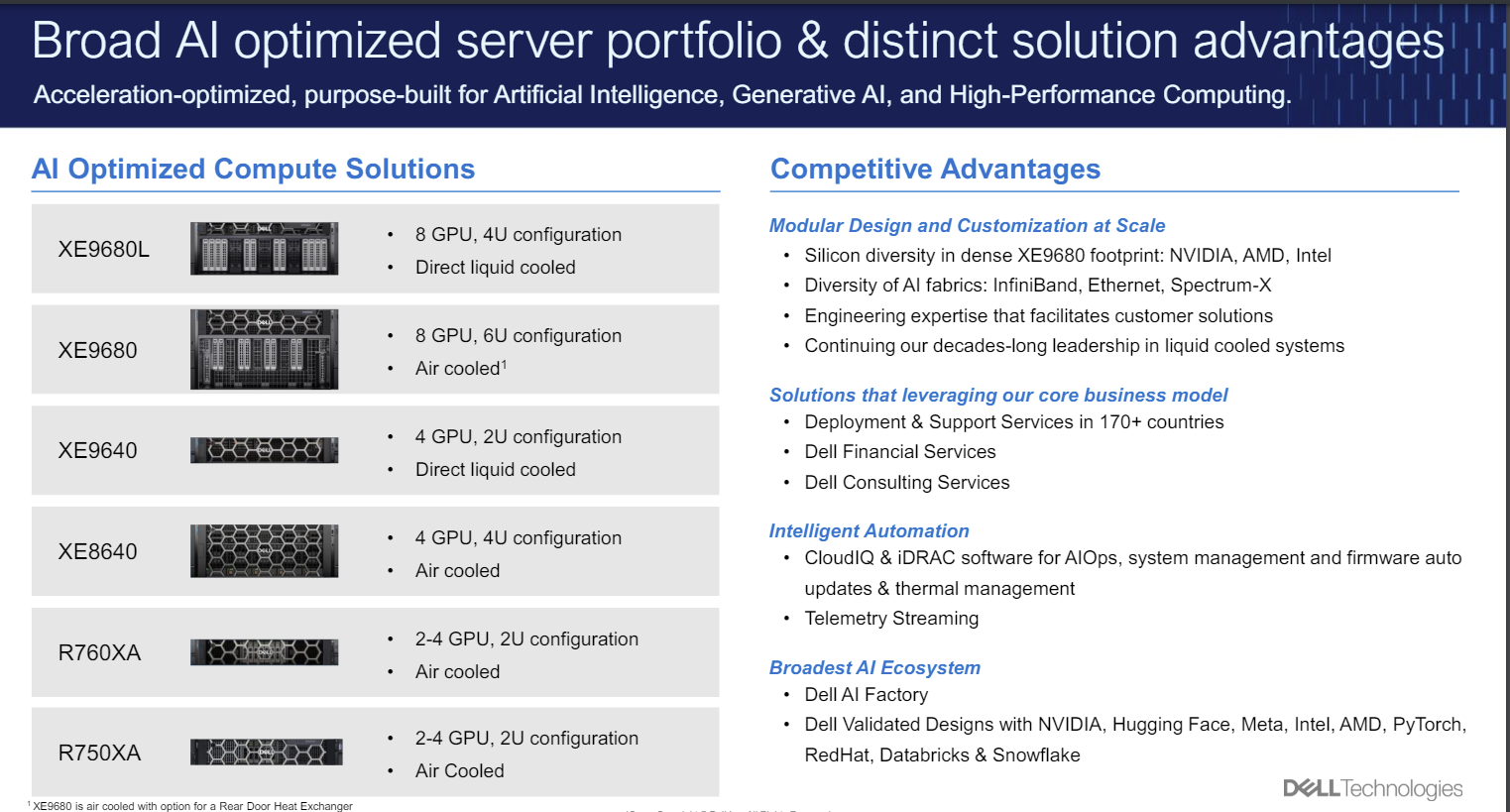
Dell Technology reported better-than-expected first quarter results and said it saw strong demand across traditional and AI optimized servers.

The company reported first quarter net income of $955 million, or $1.32 a share, with revenue of $22.24 billion, up 6% from a year ago. Non-GAAP earnings in the first quarter were $1.27 a share.

Dell was expected to report first quarter earnings of $1.26 a share (non-GAAP) on revenue of $21.64 billion.

Dell Technologies goes all-in on AI factories

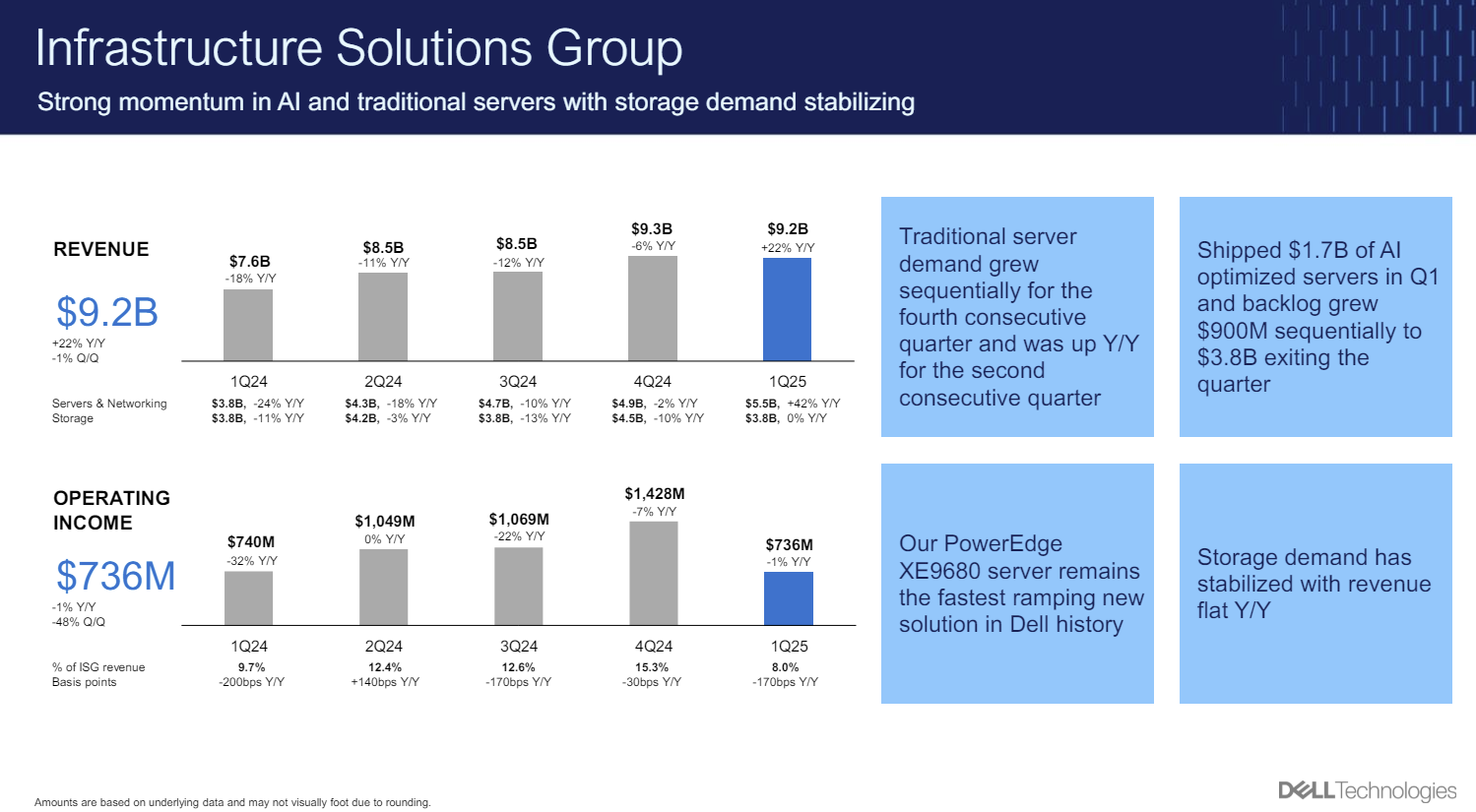
By unit, Dell said its infrastructure solutions group (ISG) had revenue of $9.2 billion, up 22% from a year ago. Server and networking revenue was a record $5.5 billion, up 42% from a year ago. The company said that it saw strong demand for AI and traditional servers. Storage revenue was flat at $3.8 billion.

ISG had first quarter operating income of $732 million.

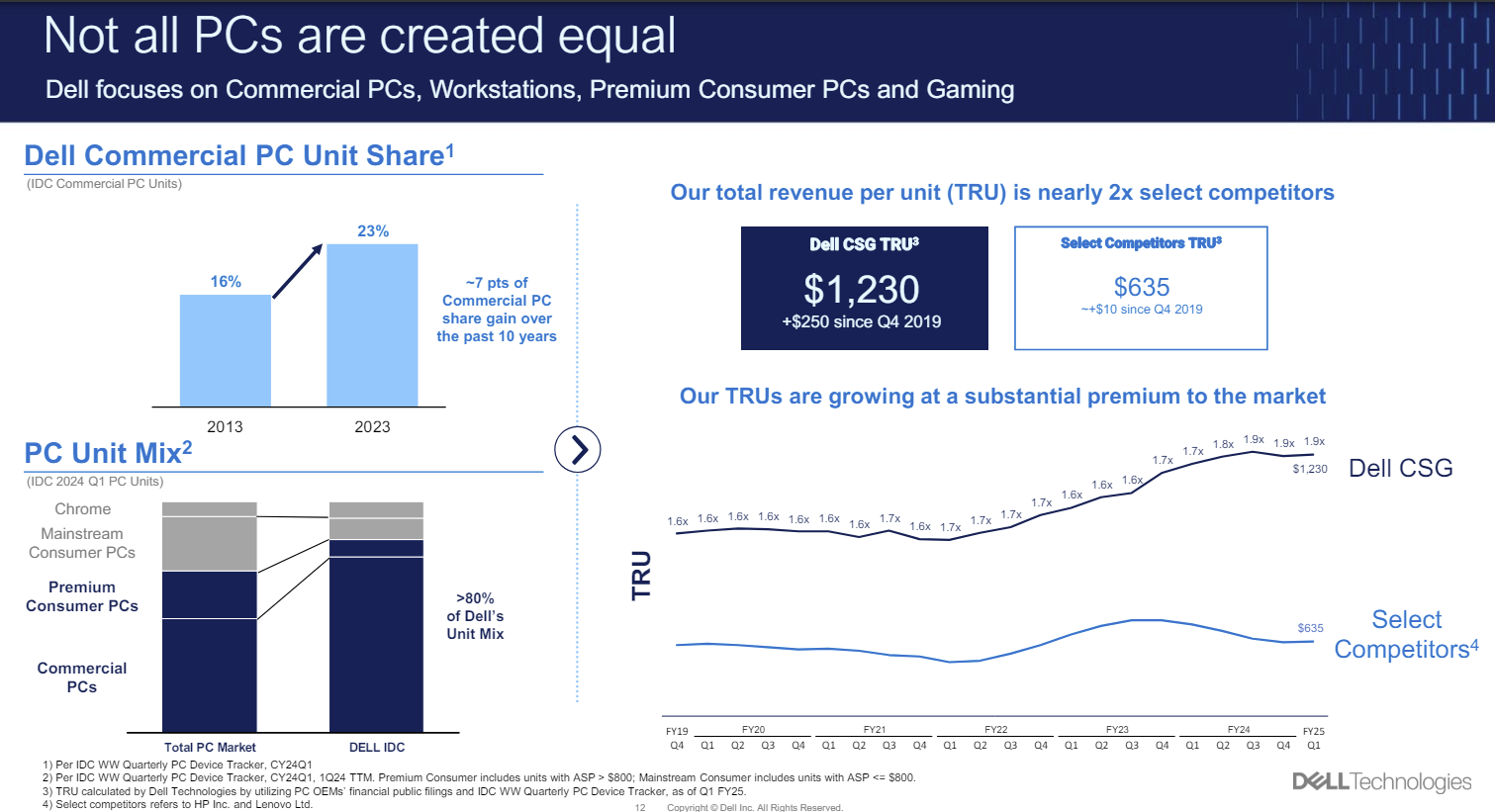
For the PC unit, Dell reported first quarter revenue of $12 billion, flat from a year ago. Commercial revenue was $10.2 billion, up 3% from a year ago, and consumer sales were $1.8 billion, down 15%. Operating income in the quarter was $732 million.

Jeff Clarke, Chief Operating Officer, said AI-optimized server orders were $2.6 billion with shipments up more than 100% to $1.7 billion. Dell added that backlog for AI-optimized servers were up 30% in the first quarter to $3.8 billion.

In prepared remarks, Clarke said the company has "seen an expansion in the number of enterprise customers buying AI solutions." He added that commercial PC demand has stabilized.

The company gave a mostly in-line outlook for the second quarter and fiscal year:

  • AI momentum will continue and modular AI optimized servers are scaling with customers. 
  • "The macro environment is still dynamic" and "indicators point toward a stabilization."
  • Dell sees fiscal 2025 revenue between $93.5 billion and $97.5 billion, up 8% at the midpoint. 
  • Infrastructure solutions group revenue will grow more than 20%. 
  • Non-GAAP earnings for fiscal 2025 will be about $7.65 a share, give or take 25 cents a share. 
  • For the second quarter, Dell projected revenue between $23.5 billion and $24.5 billion with non-GAAP earnings of $1.65 a share, give or take 10 cents a share. 
     

Speaking on the earnings call, Clarke said the AI-optimized servers for now are mostly Nvidia-based systems. He said:

"The lead times on our product varies and is complicated. We have product transitions from H100 to H200, outselling GB200 and B200. Those are customer allocated. So to say that there's an average lead time for our product is very dependent on the customer, what technology we're talking about. But in average, if it was just looking at the availability of parts, the H100 lead time is better. Those products are in full production. NVIDIA is meeting demand, and they'll have availability of the H200 on schedule towards the second or the latter part of Q2. So it's in production, as is the B200. So that's where the backlogs slash lead times are. When you look at the composition of our backlog, it's primarily NVIDIA-based."

Clarke also said that each AI-optimized server sold will drive revenue for Dell Technologies' other products. That halo effect hasn't played out just yet though. 

"We think there's a large amount of storage that sits around these things. These models that are being trained require lots of data. That data has got to be stored and fed into the GPU at a high bandwidth, which ties in network. The opportunity around unstructured data is immense here, and we think that opportunity continues to exist. We think the opportunity around NICs and switches and building out the fabric to connect individual GPUs to one another to take each node, racks of racks across the data center to connect it, that high bandwidth fabric is absolutely there and needed. We think the opportunity to extend in doing deployment of the rack itself is an opportunity, installing whether that's cables, heat exchangers, rear door heat exchangers, cooling units, power units, et cetera, the cabling. We think the deployment of this gear in the data center is a huge opportunity."

There are also a bevy of services Dell can sell to implement, manage and scale systems.

Data to Decisions Tech Optimization dell Big Data Chief Information Officer Chief Technology Officer Chief Information Security Officer Chief Data Officer

Nvidia's 10Q filing sets off customer guessing game

Nvidia's 10Q filing sets off customer guessing game

Nvidia filed its first quarter 10-Q and set off the customer guessing game.

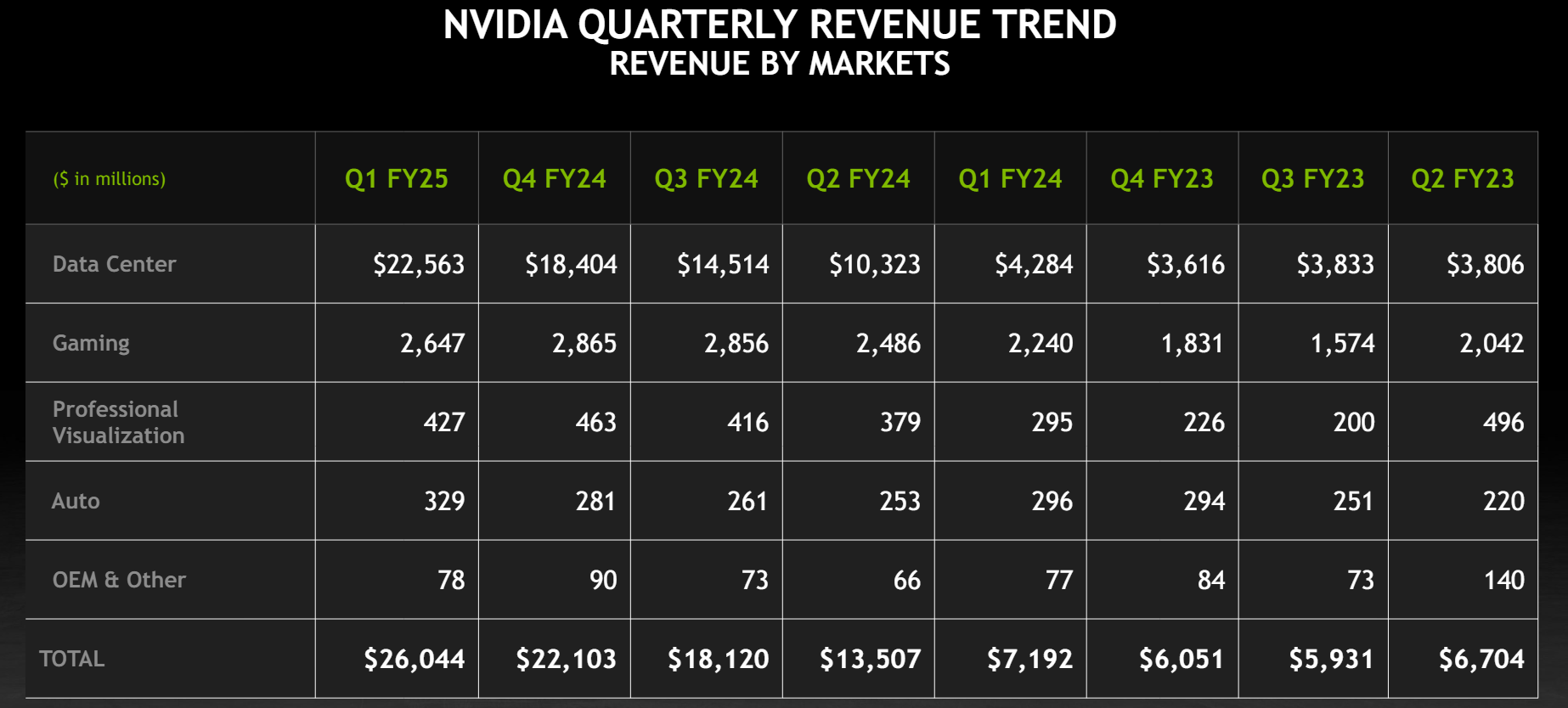
Nvidia counts two types of customers. A direct customer is an original equipment manufacturer, system integrator, original device manufacturer and distributors. The other type of customer is indirect and buy through direct customers. Indirect customers are public cloud providers, consumer internet companies, enterprises, public sector and startups.

In the filing, Nvidia said one direct customer was 13% of revenue in the first quarter and another direct customer was 11% of sales. If I'm going to guess, I'm thinking Dell Technologies and Supermicro are in the running with perhaps HPE in the mix somewhere. It's obvious that Nvidia and Dell are tight partners.

Two indirect customers were 10% or more of total first quarter revenue each. This cohort could be a bevy of players, but my two favorite guesses would be Microsoft and Facebook. Other big indirect customers could include AWS, CoreWeave, which has raised billions of dollars in funding, and maybe Google or Oracle.

Nvidia also noted that one of the two indirect customers bought through the second direct customer that was 11% of sales.

The company's first quarter revenue was $26 billion. 

Data to Decisions Tech Optimization nvidia Chief Information Officer

Nutanix winning deals vs. VMware, but Broadcom punching back with pricing

Nutanix winning deals vs. VMware, but Broadcom punching back with pricing

Nutanix is learning that larger deals--including the wins from Broadcom's VMware--take longer to nail down and implement due to CXO approvals and Broadcom discounting when business is at stake. Nevertheless, Nutanix appears to have the tools required to win in the trenches vs. VMware.

The company's third quarter financial results and comments from Nutanix CEO Rajiv Ramaswami didn't often address VMware. But it's clear VMware was the elephant in the room. Ramaswami noted that Nutanix won an eight-figure deal with a North American Fortune 50 financial services company. It also won a North American Fortune 500 consumer packaged goods company.

Nutanix product additions, partnerships designed to capitalize on VMware customer angst | What VMware customers are doing through the lens of Nutanix

Ramaswami said:

"This customer, whose data center footprint has historically been split between Nutanix and a competitor was looking to standardize their automation and self-service capabilities on a single platform.

Going forward, this customer plans on swapping out the competitive software in their existing footprint and also utilizing Nutanix cloud platform for all of their expansion needs. We see these wins as a testament to our ability to both land significantly and expand within the largest companies. And we are encouraged by the substantial increase in the number of customers and partners engaging with us, including some of the world's largest companies.

However, these larger opportunities tend to have longer sales cycles, can involve aggressive competitive responses and exhibit great availability with respect to timing and outcome."

Translation: Nutanix is winning VMware customers, but don't expect the wins to be quick or easy. 

Nutanix reported a fiscal third quarter net loss of $15.6 million, or 6 cents a share, on revenue of $524.6 million, up 17% from a year ago. Non-GAAP earnings were 28 cents a share. Wall Street was looking for third quarter earnings of 17 cents a share.

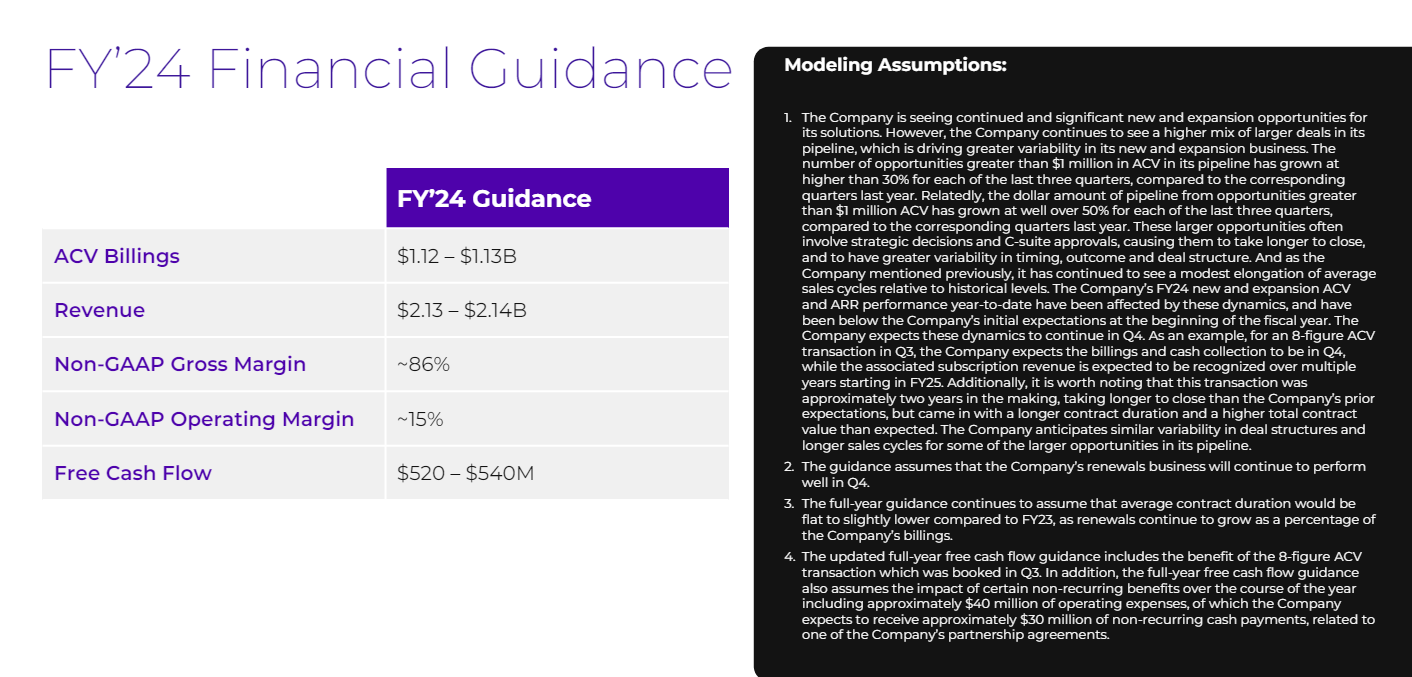
As for the outlook, Nutanix projected fourth-quarter revenue of $540 million to $540 million. For the fourth quarter, analysts were modeling earnings of 16 cents a share on revenue of $548.12 million. For the fiscal year, Nutanix projected revenue of $2.13 billion to $2.14 billion.

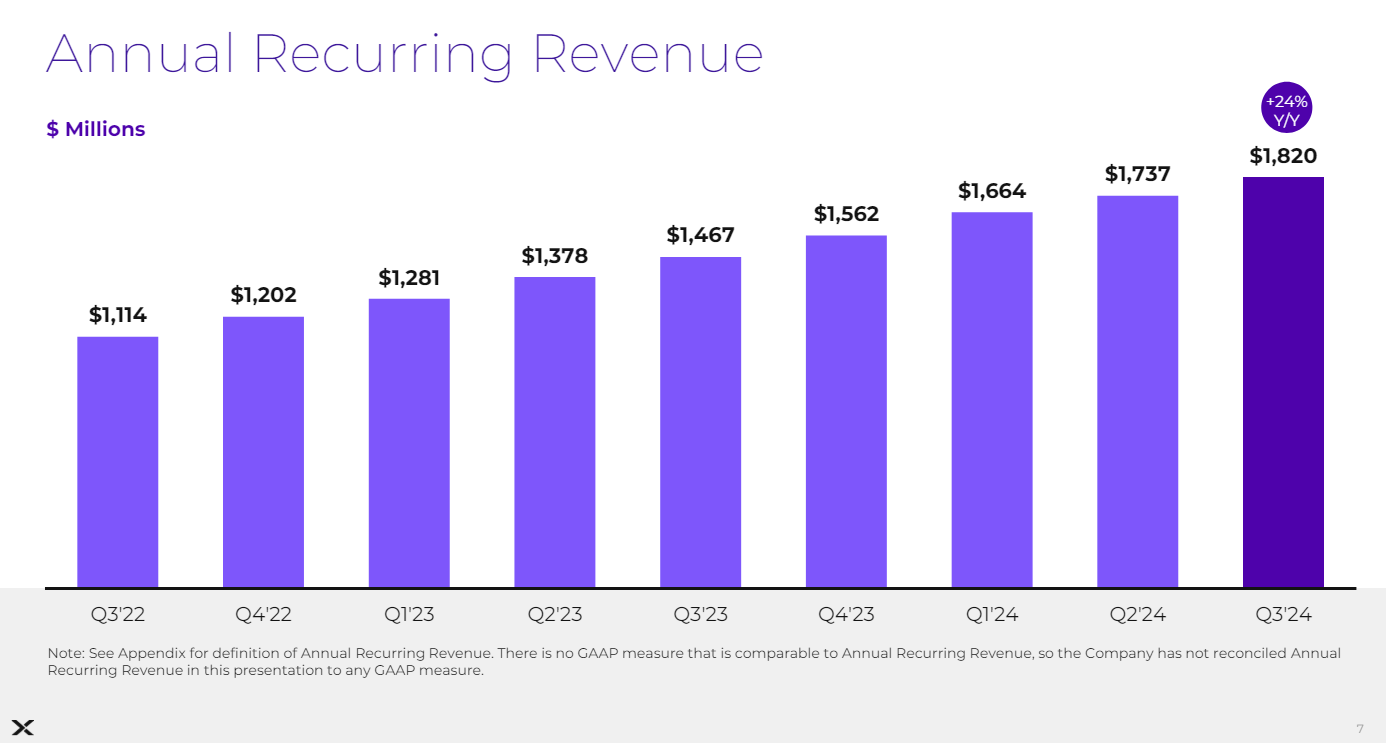
Nutanix said its annual recurring revenue (ARR) in the third quarter was $1.82 billion, up 24% from a year ago.

The results come a week after Nutanix launched a series of products to make it easier for enterprises to adopt generative AI. The most notable announcement from Nutanix .NEXT was a partnership with Dell Technologies. Nutanix will be sold via Dell Technologies hyper-converged systems later this year. Nutanix already has a big partnership with Cisco.

The battle

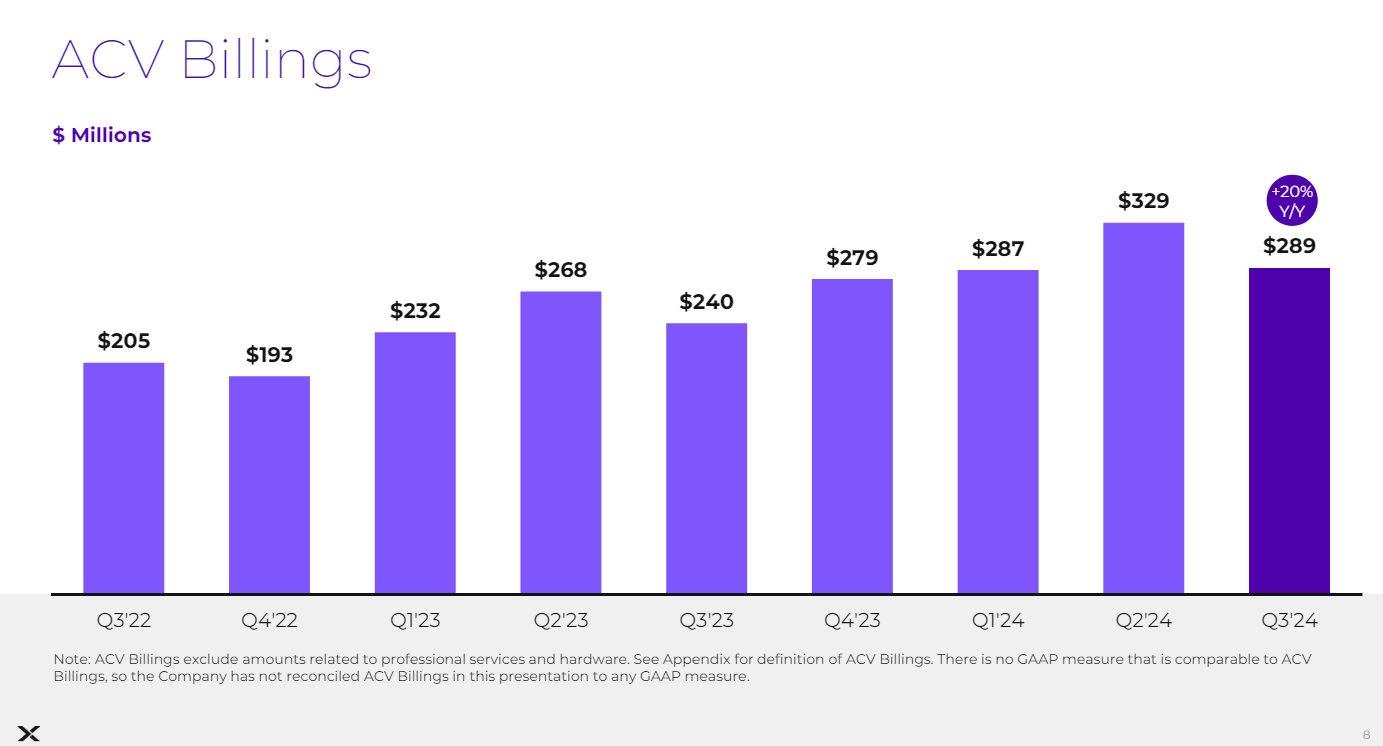
Nutanix CFO Rukmini Sivaraman said the company continues to see "continued and significant new and expansion opportunities" as well as opportunities greater than $1 million in ACV.

The problem? "These larger opportunities often involve strategic decisions and C-suite approvals, causing them to take longer to close and to have greater variability in timing, outcome and deal structure," said Sivaraman. "And as we mentioned previously, we have continued to see a modest elongation of average sales cycles relative to historical levels."

For instance, that eight-figure deal landed in the quarter will have billings and cash collection in the fourth quarter with subscription revenue recognized in fiscal 2025 and beyond. That deal also took two years to land. 

Ramaswami said Nutanix has deals that take longer to close, but interest from enterprises and partners is surging. Nutanix is now more strategic as a vendor.

The battle with VMware will take a while. Ramaswami noted that VMware customers have signed multiple year deals before the Broadcom purchase. The installed base also requires a hardware refresh. And VMware will cut prices to keep customers.

Ramaswami noted:

"We've seen Broadcom display a lot of flexibility with respect to their pricing, they are packaging changes, especially when they are faced with the probability of losing some of their larger customers are responding to push back from the market and from the customer base."

The short version: Broadcom has raised VMware's prices in many respects, but will discount heavily if large customers are at risk.

"The situation with respect to what Broadcom is doing is also evolving rapidly. They've tried a bunch of things. They're stepping back on some of the things that they've tried. Of course, for the competitive situation, this is quite dynamic on that front."

The timeline since Broadcom closed its VMware purchase features a good bit of turmoil.

My take

This Nutanix vs. VMware battle will go on for years for all of the reasons stated above. The other reality is that migrations take years. If you want a crystal ball into how this will play out for VMware it's worth looking at an example of Broadcom's purchase of CA. CA is a smaller mainframe software provider, but the Broadcom playbook is roughly the same.

I caught up with a CIO this week to chat about a migration away from mainframes. Initially, I thought the migration would be about better access to data, modernization and prepping for generative AI applications. But the migration was really driven by Broadcom’s CA unit squeezing more revenue out of this large enterprise.

In negotiations with CA, it became clear that costs were going to go higher to manage legacy infrastructure. Costs were going to go high enough that it made sense to leave mainframes entirely because there are only so many options to choose from (CA, BMC, IBM).

Sound familiar VMware customers? Today, enterprise buyers are noticing the Broadcom software playbook because VMware is more visible. Turns out all we had to do was look at CA’s approach post Broadcom acquisition to know what would happen.

VMware customers are seeing more options as they evaluate their next moves, but these migrations take time. Rimini Street said it will offer support to VMware customers and Nutanix launched a series of updates that add up to poaching VMware customers.

Tech Optimization Data to Decisions Future of Work Innovation & Product-led Growth New C-Suite vmware ML Machine Learning LLMs Agentic AI Generative AI Robotics AI Analytics Automation B2B B2C CX EX Employee Experience HR HCM business Marketing Metaverse developer SaaS PaaS IaaS Supply Chain Quantum Computing Growth Cloud Digital Transformation Disruptive Technology eCommerce Enterprise IT Enterprise Acceleration Enterprise Software Next Gen Apps IoT Blockchain CRM ERP Leadership finance Social Healthcare VR CCaaS UCaaS Customer Service Content Management Collaboration M&A Enterprise Service Chief Information Officer Chief Executive Officer Chief Technology Officer Chief Data Officer Chief Digital Officer Chief Analytics Officer Chief Financial Officer Chief Operating Officer Chief Marketing Officer Chief Revenue Officer

Salesforce's Q2 outlook disappoints, Q1 mixed

Salesforce's Q2 outlook disappoints, Q1 mixed

Salesforce’s second quarter outlook missed expectations, but the company said it is still early innings for generative AI demand. Nevertheless, Salesforce is projecting single-digit growth for the quarter ahead.

The company projected second quarter revenue of $9.2 billion to $9.25 billion, up 7% to 8%, with non-GAAP earnings of $2.34 a share to $2.36 a share. Wall Street was expecting earnings of $2.40 a share on revenue of $9.35 billion.

For fiscal 2025, Salesforce said sales will be between $37.7 billion and $38 billion, lower than the $38.05 billion estimate. The company said non-GAAP earnings for the year will be $9.86 a share to $9.94 a share, above the $9.80 s share.

Salesforce launches Einstein 1 Studio, Data Cloud enhancements | Salesforce Reinvents Itself Again With Einstein 1

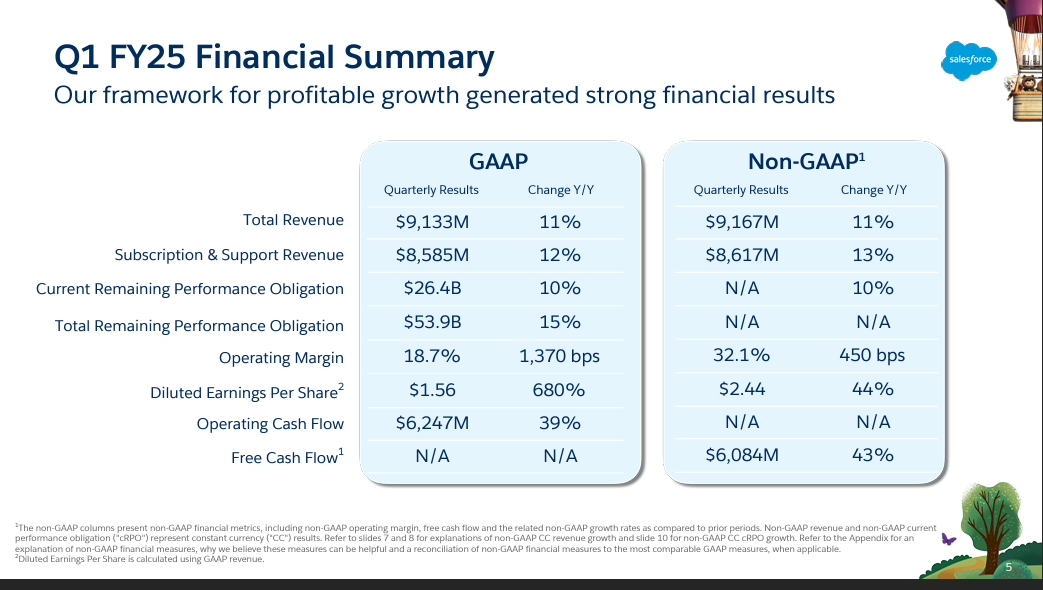
That outlook followed a mixed first quarter. Salesforce reported non-GAAP earnings of $2.44 a share on revenue of $9.13 billion. GAAP earnings in the first quarter were $1.56 a share. Wall Street was expecting Salesforce to report first quarter earnings of $2.37 a share on revenue of $9.15 billion.

CEO Marc Benioff said the company is “at the beginning of a massive opportunity for our customers to connect with their customers in a whole new way with AI.” The company’s remaining performance obligations in the first quarter were $52.9 billion, up 15% from a year ago.

Amy Weaver, CFO of Salesforce, said the company was disciplined with expenses and its capital return program.

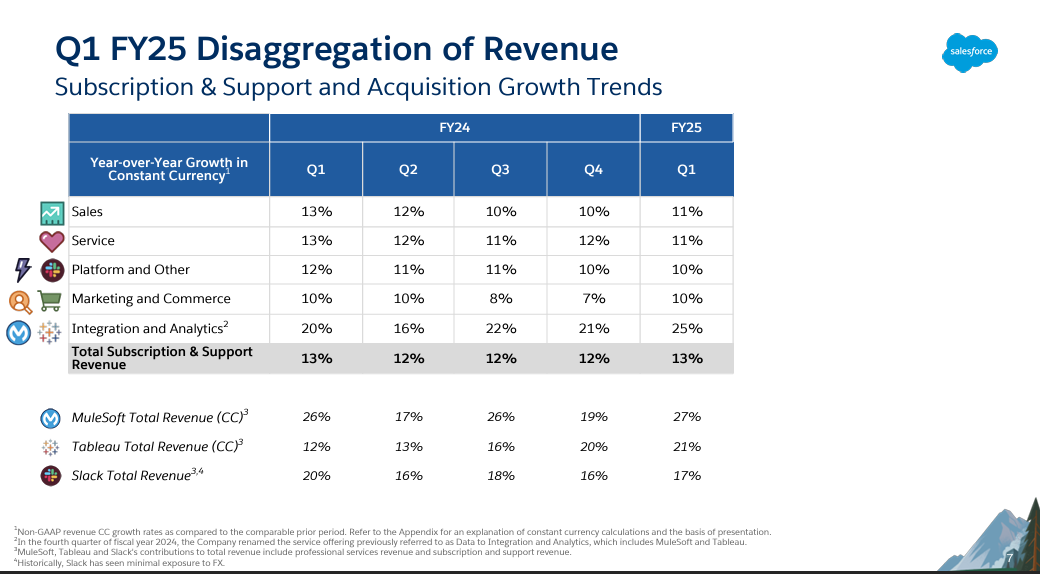
By cloud, Salesforce’s Sales Cloud revenue was up 11% in the first quarter as was Service Cloud. Platform and other and Market and Commerce had revenue growth of 10% each. Integration and Analytics (Tableau and Mulesoft) saw revenue growth of 25%.

On a conference call with analysts, Benioff put a positive spin on the outlook and first quarter results. He said large language models (LLM) are becoming a commodity and the enterprise value will be customer data and metadata. He noted that Salesforce manages more than 250PB of customer data. 

Benioff said:

"Every company in the world across every industry is being transformed by AI in the next few years. And when you look at the power of AI, you realize the models and UI are not the critical success factors. There are 1,000s of these models, some open source and some closed source models. Most of these will not survive. They're just commodities now. They don't know anything about a company's customer relationships. Each day hundreds of petabytes of data are created that AI models can use for training and generating output. But the one thing that every enterprise needs to make AI work is their customer data, as well as the metadata that describes the data. Customer data and metadata are the new gold for these enterprises."

The Salesforce CEO, who seemed a bit wound up by the aftermarket reaction to the results, touted Data Cloud, the uptake of multiple clouds by customers and partnerships with Amazon, Databricks, Snowflake and other players. "Customers can access this live data from anywhere in data cloud without copying or moving it. It's the engine of our future growth and this is the engine of our future artificial intelligence growth as well," said Benioff. 

Brian Millham, Salesforce's operating chief, said the company did see longer sales cycles. He said:

"We continue to see the measured buying behaviors similar to what we experienced over the past two years and with the exception of q4, where we saw stronger bookings, the momentum we thought q4 moderated in q1 and we saw elongated deal cycles do compression and high levels of budget scrutiny. In Q1 as part of our ongoing transformation, we made some intentional changes in our go to market organization to drive long term productivity and create better customer experiences."

Executives asked about whether genAI was taking budget from other software platforms. Benioff said genAI will drive software growth in the future, but many customers were focusing on data. Millham followed up:

"GenAI benefit will come from the front office and we're really feeling that right now. I do think customers are getting their data estate in order as a precursor to leveraging AI capabilities. We're seeing that with the growth of Data Cloud right now. I think it's actually a step process for many of our customers."

Benioff was also asked about acquisitions amid the Informatica rumors. He said:

"We will continue to look at products inorganically. But as we've committed to you, if we're looking at a large scale acquisition, we're going to make sure that it is not dilutive and has the right metrics. And we're also going to be quick to walk away from things that we are not totally confident in."

But yes, Salesforce will go shopping if it fits into its framework. 

Marketing Transformation Matrix Commerce salesforce Chief Information Officer

CR CX Convos: When Marketing Strategy Meets AI

CR CX Convos: When Marketing Strategy Meets AI

Welcome to another CR CX Convo! Constellation analyst and CRTV host Liz Miller talks through AI's role in marketing strategy with special guest Tara DeZao, Product Marketing Director at Pegasystems.

In this convo, you'll learn:

📌 How AI is reshaping marketing and customer experience (CX) strategies.
📌 The practical applications of AI in automating creative processes and enhancing campaign effectiveness.
📌 Real-world examples of how generative AI is used to optimize marketing efforts.
📌 The importance of integratig AI across different functional areas within an enterprise
📌 How to overcome fear and hesitation some companies have towards adopting generative AI.

Liz and Tara also tackle myths surrounding AI, explore the future of marketing, and emphasize the need for trust and adaptive analytics. Whether you're a marketing professional, a CX enthusiast, or simply curious about AI, listen to this convo!

On CR Conversations <iframe width="560" height="315" src="https://www.youtube.com/embed/Px0WeIaUybA?si=gGj0-xIRdksg2lXC" title="YouTube video player" frameborder="0" allow="accelerometer; autoplay; clipboard-write; encrypted-media; gyroscope; picture-in-picture; web-share" referrerpolicy="strict-origin-when-cross-origin" allowfullscreen></iframe>

Arm launches compute subsystems optimized for AI for edge devices

Arm launches compute subsystems optimized for AI for edge devices

Arm is launching CSS (Compute Subsystem) for Client, an integrated set of technologies that aims to optimize AI workloads on edge devices.

The effort reflects how more AI workloads are going to be distributed to edge devices such as PCs and smartphones. Microsoft and its various PC partners launched a series of AI PCs and touted the ability to run models privately with no latency.

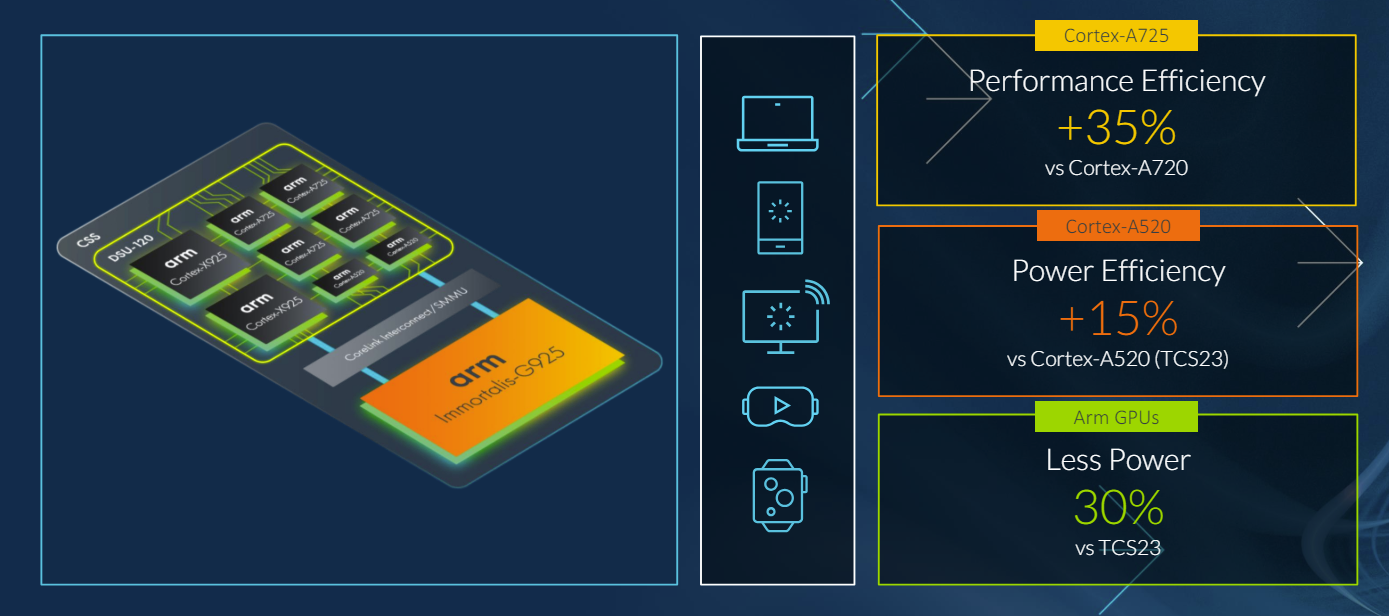
Arm CSS for Client plays to that theme. In a briefing, Chris Bergey, SVP & GM, Client Line of Business at Arm, said CSS for Client includes Armv9.2 architecture, the new Cortex-X CPU and its Immortalis GPU. The integrated software and hardware stack is designed to give developers the ability to accelerate machine learning, AI and generative AI.

Also: The real reason Windows AI PCs will be interesting | Arm's data center takeover: A lumpy revolution | GenAI trickledown economics: Where the enterprise stands today

"AI is pushing the limits of compute in an additional direction and creating a whole host of new applications. We much now expose the power of CSS for Client to both these new applications and the software platforms on which they depend," said Bergey.

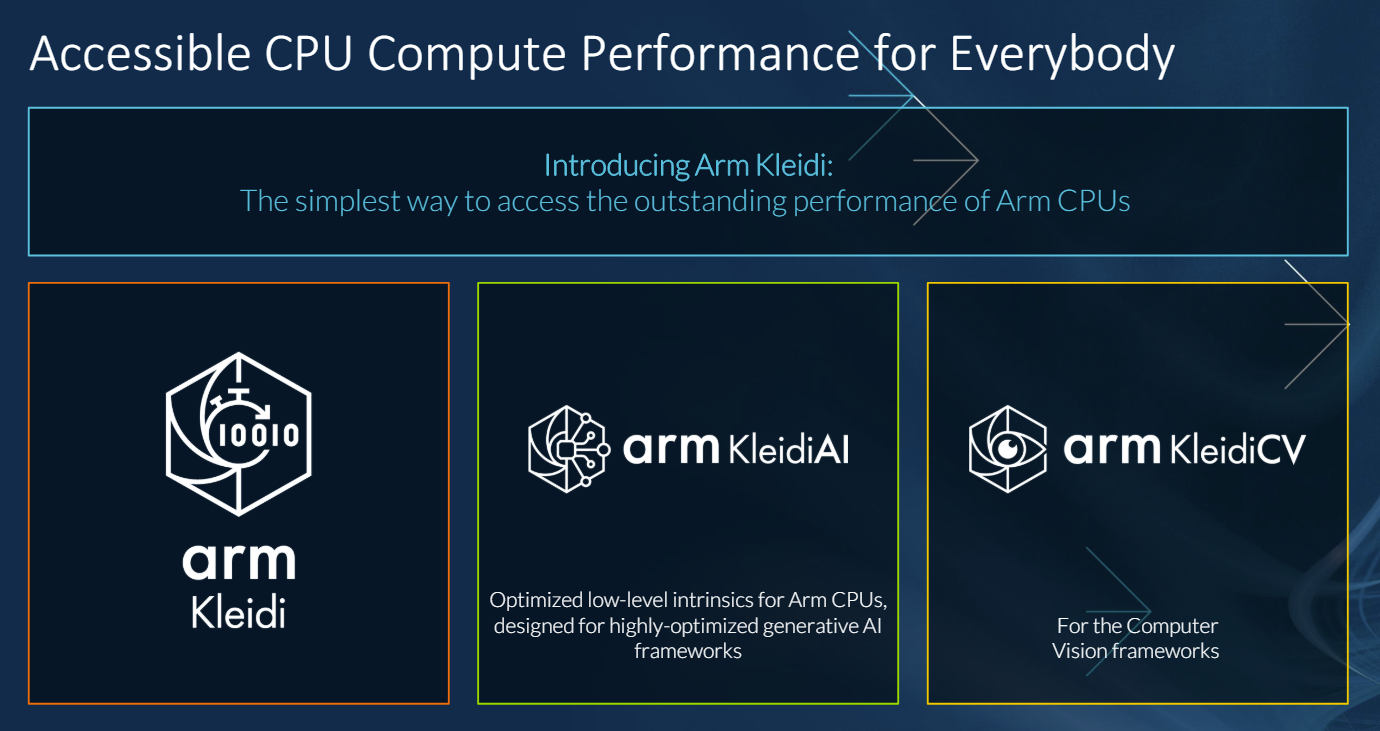
To go with CSS for Client, Arm also announced Kleidi libraries, a new set of software assets that can be embedded to unlock CSS for Client's compute capabilities. Kleidi will have two versions Kleidi AI and Kleidi CV (computer vision).

Here's a look at the components for CSS for Client:

  • Arm's Cortex-X925 CPU, which has double digit increases for instructions per clock cycle from a year ago.
  • Arm is offering three different CPI microarchitectures depending on the device with Cortex-A725 and Cortex-A520. 
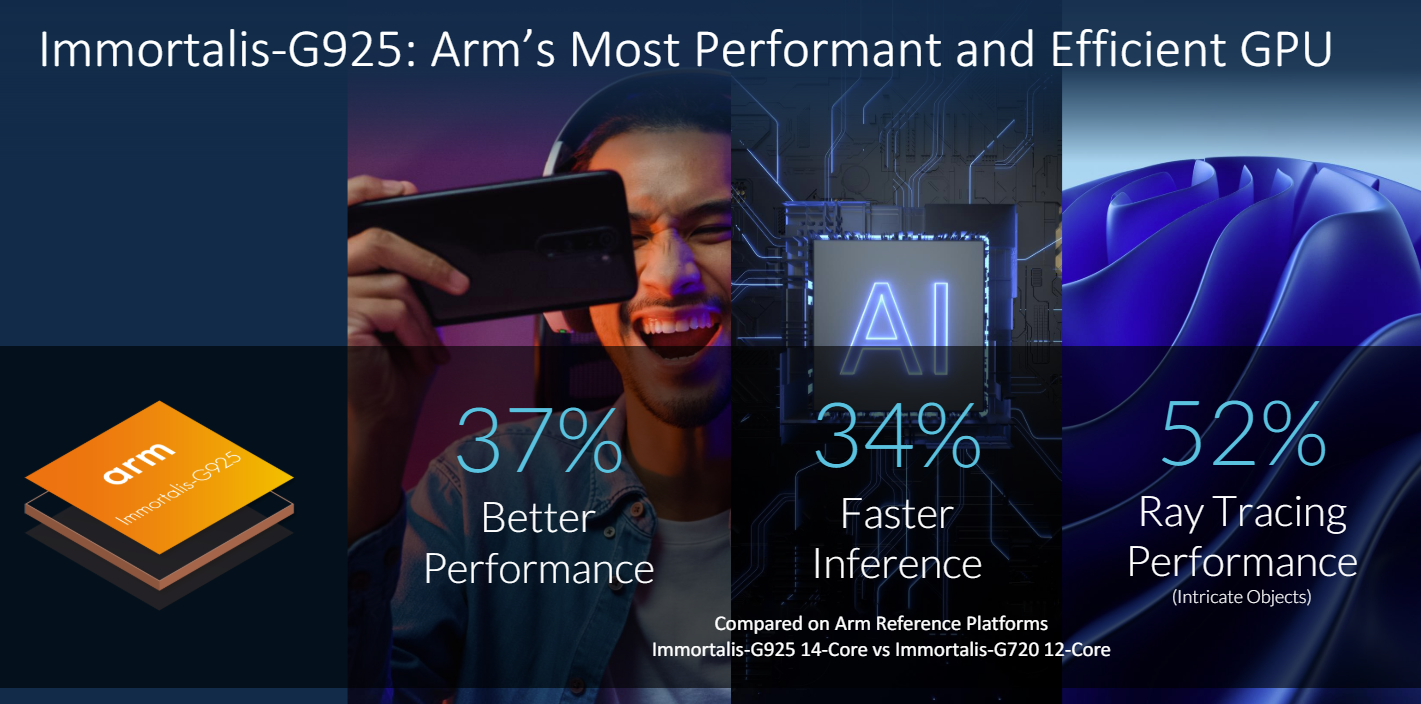
  • Immortalis-G925, which has gains in GPU performance and efficiency, including 37% more performance for graphics applications and 34% over AI and machine learning networks.

  • System interconnect and system memory management units (SMMUs) that optimize the compute path to memory and other parts of the system on a chip.
  • A set of optimized layouts for CPUs and GPUs.
  • The Kleidi libraries.

Geraint North, Arm's vice president of developer platforms, said the integrated stack of CSS for Client can increase performance of browsers, applications used widely in the enterprise and video.

Wai Ming Wong, CFO of Lenovo, said he was bullish about Arm's plans for PCs and other edge devices. Speaking on a conference call last week, Wong said:

"We are optimistic about the evolution of Arm. I think we are happy to see there will be a X86 world and Arm world. And definitely, we'll see going forward, which one will have the better performance, but definitely Arm's has the advantages thermal battery life, several advantages. On x86, Intel and AMD are also striking to get more performance with less battery consumption. So I think will be an interesting race among the two."


Data to Decisions Future of Work Tech Optimization Innovation & Product-led Growth Next-Generation Customer Experience Digital Safety, Privacy & Cybersecurity AI GenerativeAI ML Machine Learning LLMs Agentic AI Analytics Automation Disruptive Technology Chief Information Officer Chief Executive Officer Chief Technology Officer Chief AI Officer Chief Data Officer Chief Analytics Officer Chief Information Security Officer Chief Product Officer

Amazon Bedrock integrated into SAP AI Core, SAP to use AWS chips

Amazon Bedrock integrated into SAP AI Core, SAP to use AWS chips

Amazon Bedrock from AWS will be embedded into SAP's generative AI hub as the two companies expanded a long-running partnership. SAP will also use AWS Graviton3, Trainium and Inferentia chips for SAP HANA Cloud and SAP Business AI workloads.

Ahead of SAP Sapphire, Amazon Web Services said Amazon Bedrock will be integrated into SAP AI Core so joint customers can mix and match large language models (LLMs) with corporate data.

Enterprises frequently run SAP on top of AWS infrastructure. For its part, SAP is trying to make it easier for customers to migrate to S4/HANA and cloud applications via its RISE with SAP program.

The AWS and SAP expanded partnership has multiple pieces, but the integration of Amazon Bedrock into the SAP platform is the most noteworthy. The integration will give SAP customers more options for foundational models and enable them to swap as genAI improves.

Among the key parts of the integration:

  • Models within Bedrock can be used for embedded use cases within RISE with SAP as well as SAP Business Technology Platform.
  • Bedrock tools will be available in SAP's generative AI hub across the application portfolio.
  • Use cases will cover finance, product lifecycle management and other areas. 

AWS annual revenue run rate hits $100 billion as growth accelerates | Constellation ShortList™ Global IaaS for Next-Gen Applications | Constellation ShortList™ Artificial Intelligence and Machine Learning Cloud Platforms

In addition, the companies said SAP will use AWS Graviton3 chips for its SAP HANA Cloud. SAP said Graviton3 on AWS EC2 instances have improved cost, performance and carbon footprint. AWS and SAP will also collaborate on the next generation of Graviton4 for SAP workloads.

"SAP plans to use AWS Graviton to support SAP solutions and applications such as SAP BTP, SAP Datasphere, SAP Analytics Cloud, and the SAP Cloud ALM solution," the companies said.

SAP added that it will use AWS Trainium and Inferentia chips for AI and machine learning workloads in future SAP Business AI offerings. SAP engineers have already built out proof of concept projects to train and tune LLMs.

And finally, Amazon Project Kuiper will join other business units running on SAP for supply chain and other applications.

More on genAI:

Data to Decisions Tech Optimization Digital Safety, Privacy & Cybersecurity Innovation & Product-led Growth Future of Work Next-Generation Customer Experience amazon SAP AI GenerativeAI ML Machine Learning LLMs Agentic AI Analytics Automation Disruptive Technology Chief Information Officer Chief Technology Officer Chief Information Security Officer Chief Data Officer Chief Executive Officer Chief AI Officer Chief Analytics Officer Chief Product Officer

Box's Q1 offers insights to its long-term content, AI vision

Box's Q1 offers insights to its long-term content, AI vision

Box is seeing customers upgrade to its enterprise content management suite to get access to Box AI and there's a big opportunity in mining unstructured data, workflows and vertical use cases. But the payoff to Box will take time.

To say Box CEO Aaron Levie is enthusiastic about what generative AI can do for unstructured data and content management is an understatement. The company launched Box AI recently, acquired Crooze and has an architecture that allows it to add new models--including OpenAI's GPT-4o. It doesn't hurt to have partnerships with the likes of Nvidia and ServiceNow either.

During Box's first quarter earnings call, Levie said the company is seeing an increasing number of customers upgrade to its Enterprise Plus plan for Box AI. Demand has been across multiple industries. For instance, a commercial real estate company is using Box AI to find trends across leases, analyze client dynamics and generate marketing content.

Levie said:

"All of the insights necessary to create better business decisions and smoother business processes are living inside of an enterprise's content. It's the key data points inside of contracts that help businesses close new deals. The assets that create a major new ad campaign, the manufacturing and R&D files that enables the next breakthrough product to ship on time and the financial documents that help close the books smoothly. Yet for as important as all of this unstructured data is, and it makes up 90% of our corporate information, we've never been able to fully extract all of the value from it."

Box's bets revolve around AI transformation bets on workflow and collaboration. Box AI for Hubs, which is rolling out to Enterprise Plus customers, users can ask questions across multiple documents and give enterprises retrieval augmented generation use cases from the content repository.

Levie is also bullish on content metadata.

"With Box AI, customers will soon be able to extract metadata from a large number of document and content types within their enterprise. Once you have metadata on content, you can automate almost any workflow in the enterprise, from invoice processing and contract management to digital asset management and clinical trial management. This is why we acquired Crooze back in December, and we are working aggressively to natively integrate Crooze's no code application building and metadata features into Box to support powering content centric workflows on Box."

Box, which has integrations with all of the primary players in the enterprise stack, is looking to be an abstraction layer connecting AI models to content. "We are at a major moment as an industry. With AI, the role of unstructured data in enterprises has exploded," said Levie. "We will look back on this as a defining period for how work was shaped for decades to come."

What’s the problem?

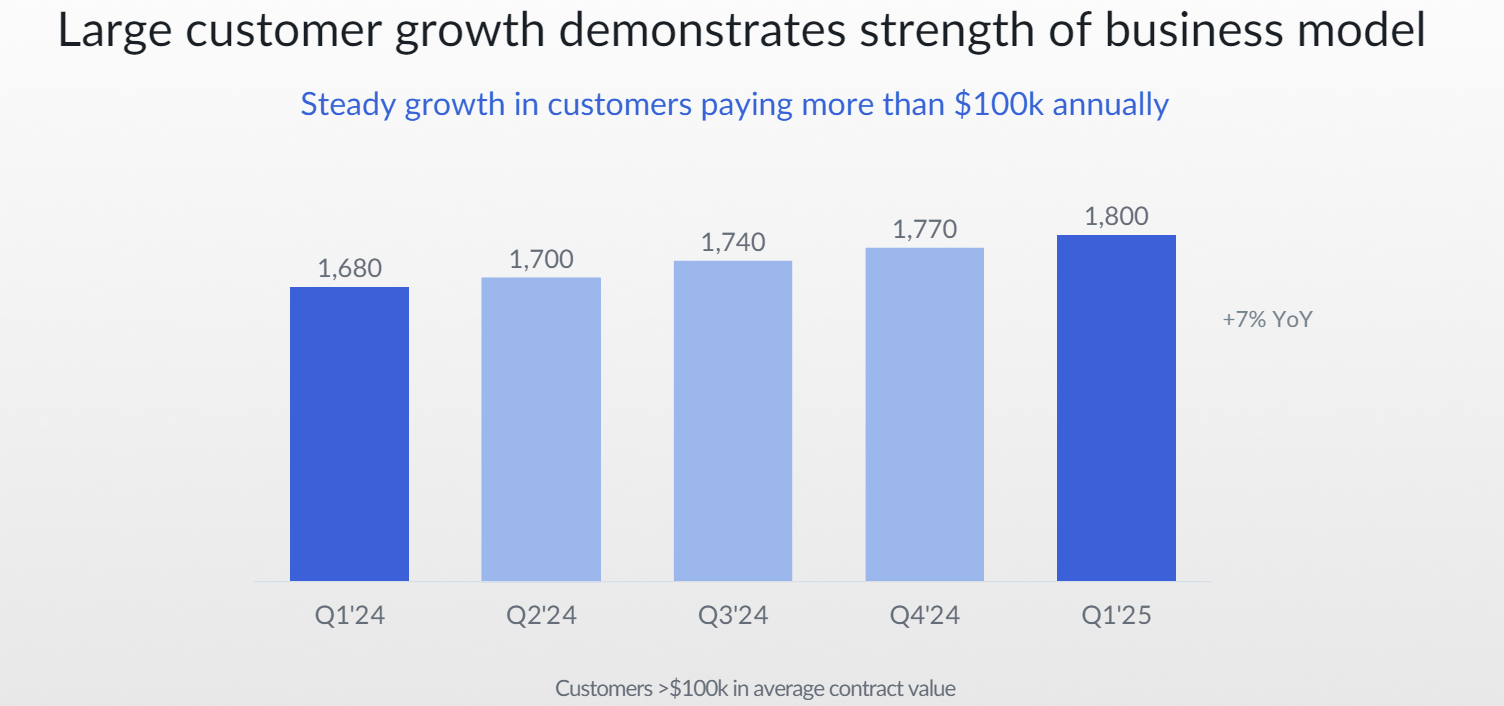
Box's vision is on target, but its growth isn't showing it. In the first quarter, Box had revenue of $265 million, up 5% from a year ago. The company has about 1,800 customers paying more than $100,000 annually. The attach rate for suites on those large deals was 85%. Box Suites is 56% of Box's revenue. Earnings per share were 39 cents a share, 3 cents a share better than estimates.

The company also raised its fiscal 2025 outlook with adjusted earnings of $1.54 a share and $1.58 a share on revenue of $1.075 billion and $1.08 billion, up 4%.

Constellation Research analyst Holger Mueller said:

"Box is doing all things on the R&D side from a growth perspective – and should grow well in the teens if not twenties. The question remains if it is customer loss or commoditization of basic capabilities that does not allow the whole industry to show growth that is in line with the growth of business relevant electronic information that is growing 30-40% every year. The reality is that the Future of Work for knowledge workers is filled with a lot of “blood sweat and tears” from manual labor around documents."

To drive growth Box will have to expand its market. Levie noted that customer spending on Box still largely comes from the IT budget. AI spending is moving beyond IT and into other business units, but that movement is still early. Levie said:

"If we maybe fast forward a year or two from now, I could see that the budget increases when you look at line of business that will be able to drive more efficiency because of AI, that we're only in the earliest days of what that looks like. But certainly, as AI really drives workflow automation and more business process transformation, I think you'll see even increased budget that opens up for AI use cases around content."

With Hubs just launching in beta, it's unclear how demand and interest will shape up into revenue growth.

Box's master plan for AI and its "scaffolding, abstraction layer and platform services" vision makes sense since every model needs content access. How long this vision takes to play out remains to be seen.

Data to Decisions Future of Work Tech Optimization Marketing Transformation box Marketing B2B B2C CX Customer Experience EX Employee Experience AI ML Generative AI Analytics Automation Cloud Digital Transformation Disruptive Technology Growth eCommerce Enterprise Software Next Gen Apps Social Customer Service Content Management Collaboration Chief Information Officer Chief Marketing Officer