Results

Alibaba's Qwen picking up momentum

Alibaba's Qwen picking up momentum

DeepSeek's family of large language models (LLMs) may have put the spotlight on China's AI ambitions, but Alibaba and its Qwen efforts may win out.

Alibaba's Qwen3 launched and its flagship model, Qwen3-235B-A22B, is competitive with DeepSeek-R1, OpenAI's o1, o3-mini, Grok 3 and Gemini 2.5 Pro.

Two mixture of expert models, Qwen3-235B-A22B and Qwen3-30B-A3B, were open weighted and there are six other models under Apache 2.0 licenses.

Qwen3 introduces a hybrid approach to problem solving and support a thinking mode, where the model takes time to reason step by step, and non-thinking mode for quick answers for simple questions.

What that hybrid approach means is that users control how much thinking the model has to use. The hybrid approach can also work well with budgets and compute resources. The models also support 119 languages and dialects. In addition, Qwen3 was trained on about 36 trillion tokens.

A diagram of a process

AI-generated content may be incorrect.

In the short term, Qwen3 is the latest development in the LLM race in an almost daily game of leapfrog. In the long run, Qwen3 has a few built in advantages. First, the LLMs are backed by Alibaba. Second, Qwen3 seems to be popular on Hugging Face and has some open source heft. And finally, Qwen is easily accessible on Alibaba Cloud, which is one of the dominant cloud providers to enterprises in Asia.

Add it up and Qwen has some Alibaba ground game advantages that may be more relevant to enterprises.

Data to Decisions Innovation & Product-led Growth Next-Generation Customer Experience Future of Work Tech Optimization Digital Safety, Privacy & Cybersecurity ML Machine Learning LLMs Agentic AI Generative AI AI Analytics Automation business Marketing SaaS PaaS IaaS Digital Transformation Disruptive Technology Enterprise IT Enterprise Acceleration Enterprise Software Next Gen Apps IoT Blockchain CRM ERP finance Healthcare Customer Service Content Management Collaboration Chief Information Officer Chief Executive Officer Chief Technology Officer Chief AI Officer Chief Data Officer Chief Analytics Officer Chief Information Security Officer Chief Product Officer

RSAC 2025: AI agents dominate new security features

RSAC 2025: AI agents dominate new security features

The AI agents are marching in on the RSA Conference as CrowdStrike launched a set of agents to its Charlotte AI platform. Rest assured that more agentic AI layers will be added to security platforms. Google Cloud, IBM, SentinelOne, Cisco and others all made plays to make their security operations workflows and analysis more autonomous.

RSAC kicks off in San Francisco this week and cybersecurity vendors are outlining a bevy of agentic AI and automation tools on their respective platforms.

CrowdStrike announced Charlotte AI Agentic Response and Charlotte AI Agentic Workflows, two security operations tools that are designed to go with Charlotte AI Agentic Detection Triage.

With a portfolio of AI agents for the Charlotte AI platform, CrowdStrike is looking to offer autonomous reasoning for first- and third-party data. Just as cybersecurity vendors are looking to consolidate platforms they are jockeying to be that automation layer.

CrowdStrike CEO George Kurtz said the goal is to "shift from reactive to proactive security." CrowdStrike announced the following:

  • Charlotte AI Agentic Response, which automatically asks and answers questions a security analyst would. The tool also analyzes root causes and guides next steps on investigations.
  • Charlotte AI Agentic Workflows, which use large language models in workflows to drop into automated playbooks based on policies.
  • Falcon Complete with Charlotte AI, which uses agents to triage alerts.
  • Charlotte AI Agentic Triage for Identity is added to Falcon Identity Protection.

What's unclear at this point is whether these AI agents are truly autonomous or speed up reasoning and response.

A screen shot of a computer

AI-generated content may be incorrect.

Other RSAC items of note:

  • Google Cloud launched Google Unified Security that integrates threat intelligence, security operations, cloud security, secure enterprise browsing and Mandiant intelligence into one package. The company said the integrated stack will "simplify workflows, reduce toil, and empower analysts." In addition, Google Cloud outlined its vision for agentic AI powered security operations center. Mandiant's M-Trends report based on 450,000 hours of incident investigations in 2024 was also released.

A diagram of security data security

AI-generated content may be incorrect.

  • Cisco launched new threat detection and response tools for Cisco XDR and Splunk Security. Cisco XDR gets Instant Attack Verification, which integrates data from the Splunk platform and then uses AI agents to carry out plans and responses. The company also launched XDR Forensics for visibility into endpoint activity and XDR Storyboard to visualize attacks. The company also said Splunk Enterprise Security and Splunk SOAR 6.4 can be combined with Cisco XDR for enhanced network visibility and detection.
  • SentinelOne launched its Athena release of its Purple AI platform. The new release features agentic AI to offer orchestration, reasoning and analysis that a security analyst would. In addition, Purple AI Athena will open up the platform to third party security platforms and data lakes. Purple AI Auto Triage is also generally available. SentinelOne is looking to automate workflows across platforms by connecting to multiple data sources and embedding AI agents throughout. 
  • Minimus, an application security startup, launched its platform that's designed to eliminate 95% of CVEs from software supply chains. The company raised $51 million in a deed round from YL Ventures and Mayfield.
  • NetRise also is focused on software supply chain security launched NetRise ZeroLens, which uses AI to summarize and remediate compiled code for weaknesses.
  • Bedrock Security announced its Model Context Protocol (MCP) Server, which will complement its Bedrock Metadata Lake Copilot. The idea is to secure AI agents and enterprise data as enterprises adopt the technology. Bedrock Security is providing a standardized gateway to data for AI agents with MCP Server.
  • IBM launched Autonomous Threat Operations Machine (ATOM), an AI agent system for threat triage, investigation and remediation. IBM also launched the new X-Force Predictive Threat Intelligence (PTI) agent for ATOM, which uses industry focused AI models for threat insights. 

Constellation Research's take

Chirag Mehta, a Constellation Research analyst at event, said:

"RSAC 2025 marked a noticeable shift in the cybersecurity conversation from experimentation to execution. Across briefings and discussions, CISOs consistently highlighted the challenge of operational scale: too many tools, too much data, and not enough capacity to turn signals into timely decisions. As a result, the focus this year moved toward simplifying security operations, improving interoperability across platforms, and reducing friction caused by fragmented workflows.

There was also a clear maturation in how enterprises are approaching AI in security. The discussion has moved beyond curiosity and pilots toward practical questions around trust, governance, and measurable outcomes. Security leaders are prioritizing use cases that improve response time, reduce analyst fatigue, and strengthen foundational controls rather than chasing novelty. Identity security, exposure management, and data security emerged as core priorities, reinforcing that many security failures still originate from misconfigurations, unmanaged assets, and credential abuse.

Overall, RSAC 2025 reflected a more pragmatic market. Buyers are demanding accountability, clarity, and demonstrable impact. Vendors that can translate innovation into operational value, without adding complexity, are the ones most likely to earn long-term trust."

Data to Decisions Digital Safety, Privacy & Cybersecurity I am Team Leader at the Nominee Organization (no vendor self nominations) Distillation Aftershots Security Zero Trust Chief Information Officer Chief Information Security Officer Chief Privacy Officer

Palo Alto Networks acquires Protect AI, aims to secure AI ecosystems

Palo Alto Networks acquires Protect AI, aims to secure AI ecosystems

Palo Alto Networks acquired Protect AI to expand its reach into securing AI and machine learning applications, launched Prisma AIRS to secure enterprise AI apps, agents and models and updated its Cortex securities operations platform.

The three-pack of announcements landed as the RSA Conference kicked off in San Francisco.

According to Palo Alto Networks, the purchase of Protect AI will broaden its reach into securing the multiple layers involved with AI-driven applications including models, agents, infrastructure, tools and APIs.

Terms of the deal weren't disclosed, but Geekwire put the price tag at $500 million or so. The deal is expected to close in the first quarter of Palo Alto Networks first fiscal quarter.

Palo Alto Networks said the acquisition of Protect AI boosts its vision for Prisma AIRS. The company announced Prisma AIRS along with the Protect AI acquisition.

Prisma AIRS includes:

  • AI model scanning for vulnerabilities and risks including model tampering, malicious scripts and deserialization attacks.
  • Posture management to assess risks in enterprise AI ecosystems.
  • AI red teaming to discover exposure.
  • Runtime security to protect against threats such as prompt injection, malicious code and sensitive data leaks.
  • AI agent security to protect against emerging threats.

Separately, Palo Alto Networks outlined Cortex XSIAM 3.0, its next-gen security operations platform. Updates include:

  • Cortex Exposure Management, which surfaces vulnerabilities, prioritizes them and then remediates.
  • Cortex Advanced Email Security, which uses AI and analytics to detect advanced phishing and email threats.

The next generation of Cortex XSIAM will be available in the fourth quarter of Palo Alto Networks fiscal fourth quarter.

Data to Decisions Digital Safety, Privacy & Cybersecurity I am Team Leader at the Nominee Organization (no vendor self nominations) Distillation Aftershots Innovation & Product-led Growth Future of Work Tech Optimization Next-Generation Customer Experience palo alto networks Security Zero Trust AI GenerativeAI ML Machine Learning LLMs Agentic AI Analytics Automation Disruptive Technology Chief Information Officer Chief Information Security Officer Chief Privacy Officer Chief Executive Officer Chief Technology Officer Chief AI Officer Chief Data Officer Chief Analytics Officer Chief Product Officer

Agentic AI: Everything that’s still missing to scale

Agentic AI: Everything that’s still missing to scale

Agentic AI is entering its next phase of hype as vendor conference season unfolds. Pick an enterprise vendor and you'll hear a keynote that revolves around AI agents.

It's AI agents everywhere. If we created a drinking game every time "agent" was uttered we'd be hammered. The big idea behind agentic AI will come to fruition, but there are more than a few missing elements that need to fall in place.

Here's what is missing from the agentic AI stack today.

Standards. If AI agents live in one platform and focused on one function such as CRM, HR, service, sales they can be useful. However, there are few workflows that live in one data store in control of one vendor. The reality is that these AI agents are going to have to communicate, negotiate, form workflows and execute tasks on their own.

That reality is why Anthropic created Model Context Protocol (MCP), an open standard for connecting AI assistants to systems where data lives. OpenAI and a bevy of others are backing MCP. The need for standards is why Google Cloud also launched Agent2Agent, a communications standard that also has some big backers. These efforts are a nice step toward connecting agents across the AI workflow chain, but more is needed.

Constellation Research CEO R "Ray" Wang noted that AI agent interoperability needs to model itself after HL7 (Health Level 7), which is a set of international standards for exchanging electronic health information.

Another question worth asking via Constellation Research analyst Holger Mueller: Will these AI agent communication and automation standards be based on natural language or API calls or both?

Multi-agentic cross platform agents. That requirement is a mouthful, but without standards in place and vendors focused on agentic AI within their platforms true agents working across platforms remain more about theory. If agentic AI is going to work they have to be horizontal.

There's a reason why early agentic AI use cases and development have thrived at integrators relative to vendors. Integrators core business is working across platforms. Vendors not so much.

What we need to see is interoperability across MCP, Google Cloud's A2A and platforms from the likes of Boomi. In some ways agentic AI is like email back in the day--at first email only worked within a company. Once multiple companies could email new collaboration was opened up.

The end of agent washing. Vendors hopped on the agentic AI bullet train in a hurry. Everything is now agentic. But there's a downside to this marketing bonanza as surfaced by our BT150 CxOs. The downside? CxOs are glazing over at the AI agent claims. These BT150 veterans, who have seen cloud washing, followed by AI washing, followed by agentic AI washing, are noting that RPA may get the job done and note that there are a lot of APIs masquerading as AI agents these days.

A white t-shirt with black text

AI-generated content may be incorrect.

Horizontal use cases that can go vertical. While vendors have focused on AI agents that revolve around their go-to-market efforts, the natural progression for enterprises may be horizontal use cases that can form and then deconstruct based on what needs to be done.

Minimized agent sprawl and lock-in risk. Those realities point to a horizontal approach and CxOs are likely to look to their hyperscale cloud providers as well as cross-system vendors like ServiceNow to orchestrate agents. The value will be in the orchestration layer and neutral vendors are going to be valued.

Data products that are autonomous and can work with agents. To date, the prerequisite of agentic AI is to get your data all in one place--or just a few places. Perhaps that means you'll have just one or two data lakehouses instead of the six you have now.

Here's the problem: Enterprises have been chasing the one data store to rule them all strategy and it hasn't worked. Constellation Research’s Mueller has said enterprises need to get down to a few primary data stores and it's likely you'll still have a data estate that includes SAP, Databricks, Salesforce Data Cloud, Snowflake and hyperscale cloud platforms. If that lineup still sounds like a lot consider that just having four data platforms is way better than the 10 you have now. Congrats!

NextData, a startup led by Zhamak Dehghani, who created the data mesh concept, launched the NextData OS, a platform for building and operating autonomous data products. The idea is that these data products are decentralized and enable you to scale with agents without uprooting your infrastructure. "I hope to change this paradigm and frame of thinking that we have to have the data in one place because the moment you get there it's out of date," said Dehghani. "We want to have one way of getting access to data in a standard way."

Dehghani's company is young, but an abstraction layer and operating system for data that works well with agents and multiple modes of access is on target. NextData's launch webinar featured Mars and Bristol Myers Squibb as customers.

An end to agentic AI storyline that obsesses about humans. To date, agentic AI has been pitched as a way to scale labor. These digital labor pools will complement humans, but also restrain hiring.

Microsoft's annual report on the state of work envisions management roles that emerge to coordinate human and digital labor. Under these constructs, AI agents are mapped to human roles.

That AI agent-as-human thinking may be misplaced. Wang argues that the focus for agentic AI has to revolve around decision trees and automated decision-making. Mapping AI agents to human roles just scales what enterprises do today.

A diagram of automation

AI-generated content may be incorrect.

Process knowhow. AI agents are a handy way to handle the process flows that drive ROI. Order-to-cash, procurement, supply chain and other core processes move the returns the most for enterprises.

What's lacking in a lot of these agentic AI pitches is process automation, process mining and intelligence. I've noted before that agentic AI is going to flop without a hefty dose of process.

The focus on process is needed because the biggest question facing enterprises is where do you insert the human in agentic AI workflows? That issue is what unlocks ROI. If you see AI agents as a human labor replacement, you're missing the big process picture.

In the end, enterprises are a collection of human and digital processes that can be optimized and continually improved. Flashy agentic AI marketing isn't going to change that fact.

Data to Decisions Future of Work Next-Generation Customer Experience Innovation & Product-led Growth Tech Optimization Digital Safety, Privacy & Cybersecurity ML Machine Learning LLMs Agentic AI Generative AI Robotics AI Analytics Automation Quantum Computing Cloud Digital Transformation Disruptive Technology Enterprise IT Enterprise Acceleration Enterprise Software Next Gen Apps IoT Blockchain Leadership VR GenerativeAI Chief Information Officer Chief Executive Officer Chief Technology Officer Chief AI Officer Chief Data Officer Chief Analytics Officer Chief Information Security Officer Chief Product Officer

Intel Q1 a start, but no quick fixes ahead

Intel Q1 a start, but no quick fixes ahead

Intel's first quarter results were better-than-expected and new CEO Lip-Bu Tan said the company will undergo a restructuring to improve "execution and operational efficiency while empowering our engineers to create great products."

The chipmaker, which has been walloped by Nvidia and AMD, said it will aim to lower operating expenses in 2026 to $16 billion from $17 billion in 2025. Operating expenses in 2025 were previously projected to be $17.5 billion. The company didn't disclose a headcount figure for layoffs.

Intel reported a first quarter loss of 19 cents a share on revenue of $12.7 billion, flat with a year ago. Non-GAAP earnings were 13 cents a share. Intel was expected first quarter earnings of a penny a share on revenue of $12.3 billion.

As for the outlook, Intel projected second quarter revenue of $11.2 billion to $12.4 billion with break even non-GAAP earnings. It's possible that demand was pulled forward in the first quarter due to tariff concerns.

Tan said there are no quick fixes for Intel.

"The first quarter was a step in the right direction, but there are no quick fixes as we work to get back on a path to gaining market share and driving sustainable growth. I am taking swift actions to drive better execution and operational efficiency while empowering our engineers to create great products. We are going back to basics by listening to our customers and making the changes needed to build the new Intel."

CFO David Zinsner said that the "current macro environment is creating elevated uncertainty across the industry, which is reflected in our outlook."

By the numbers:

  • Intel's client computing group had revenue of $7.6 billion, down 8% from a year ago.
  • Data center and AI revenue was $4.1 billion, up 8% from a year ago.
  • Intel Foundry revenue was $4.7 billion, up 7% from a year ago.

Intel's AI strategy is emerging and Tan said the company will be focused on multiple workloads with a hefty dose of edge use cases. Stay tuned for the plan. Here's what Tan said on Intel's conference call:

  • "There are many areas we need to improve, and there's no quick fixes. We must remain laser focused on execution," said Tan. "We need to fundamentally transform our culture and the way in which we operate. Organizational complexity and bureaucracies have been suffocating the innovation and agility we need to win. It takes too long for decisions to get made. New ideas and people who generate them have not been given the room or resources to incubate and grow. The unnecessary silos have led to bad execution."
  • "We continue to identify ways to operate our manufacturing network more efficiently, I have directed our teams to find additional $2 billion of savings in our growth CapEx, taking our target for this year to $18 billion. We will continue to take closer look at our existing factory footprint to ensure that we are making the most efficient use of our in-store capacity before committing to any additional spending," said Tan.
  • "We are taking a holistic approach to redefine our portfolio to optimize our products for new and emerging AI workloads. We are making necessary adjustments to our product roadmap, so that we are positioned to make the best-in-class products while staying laser focused on execution and ensuring on time delivery," he said.
  • "Success in foundry business requires more than process technology manufacturing capabilities alone. It is first and foremost a customer service business, built on foundational principle of trust. And we need to instill customer service mindset across our foundry business," said Tan.

Holger Mueller, an analyst at Constellation Research, said:

"Intel does not manage to catch a break – though the management team has been able to deliver to guidance, which in itself is an achievement. New CEO Lip-Bu Tan is taking a page from the classic acceleration playbook – cut layers and elevate the value creators (for Intel its R&D, avoid unnecessary meetings, change OKRs, and also ask everybody to be in the office for 4 days a week). But the problem remains that Intel’s Client Computing Group keeps shrinking, and the growth of its Data Center and AI group cannot make up for it as it operates at a smaller base. Intel needs new growth and Tan needs to find it."


Data to Decisions Tech Optimization Big Data Chief Information Officer Chief Technology Officer Chief Information Security Officer Chief Data Officer

Alphabet allays Q1 worries over Google ads, Google Cloud revenue up 28%

Alphabet allays Q1 worries over Google ads, Google Cloud revenue up 28%

Alphabet handily topped first quarter estimates as Google's advertising business held up well and Google Cloud revenue checked in at $12.26 billion.

The company reported first quarter net income of $34.54 billion, or $2.81 a share, on revenue of $90.23 billion, up 12% from a year ago. Wall Street was looking for first quarter earnings of $2.01 a share on revenue of $89.17 billion.

Sentiment headed into Alphabet's results was weak due to worries about advertising amid economic uncertainty. Here's the breakdown by unit.

  • Google search and other revenue was $50.7 billion.
  • YouTube ad revenue in the first quarter was $8.93 billion, up from $8.09 billion a year ago.
  • Google Cloud revenue was $12.26 billion, up 28% from $9.58 billion a year ago, with operating income of $2.18 billion.

A graph of a growing companyAI-generated content may be incorrect.

CEO Sundar Pichai said the quarter was solid with promise in Google's AI efforts. He said search AI overviews had 1.5 billion users per month. YouTube and Google One led subscription revenue as the company topped 270 million paid subscriptions in the first quarter.

Google Cloud Next coverage:

Other items in Alphabet's report:

  • Capital expenditures in the first quarter were $17.2 billion, up 43% from a year ago.
  • Alphabet had trailing 12-month cash flow of $74.88 billion.
  • The company ended the quarter with 185,719 employees, up from 180,895 from a year ago.

A close-up of a graphAI-generated content may be incorrect.

Items from the conference call:

  • Pichai said Google Cloud is offering the widest range of TPUs and GPUs and will "continue to invest in next generation capabilities."
  • All 15 of products with more than half a billion users are using Gemini models. 
  • Circle to search usage was up 40% in the first quarter compared to a year ago. Monthly Lens visual searches are up by 5 billion since Octover. 
  • Philipp Schindler, chief business officer of Google, said YouTube's revenue growth was driven by direct response over brand ads. 
  • Schindler said AI overview monetization is similar to traditional search results. 
  • Anat Ashkenazi, CFO, said search gains was "once again broad based across verticals led by financial services, due primarily to strengthen insurance followed by retail."
  • Ashkenazi said growth in Google Cloud was across core and AI services. Workspace revenue was driven by increasing average revenue per seat. Google Cloud operating income was driven by improvements in productivity, efficiency and utilization. 

Ashkenazi said that Google Cloud capacity remains constrained. 
"In cloud, we're in a tight demand supply environment, and given that revenues are tied to the timing of deployment of new capacity, we could see variability in cloud revenue growth rates depending on capacity deployment. Each quarter we expect relatively higher capacity deployment towards the end of 2025."
 

A graph of red columnsAI-generated content may be incorrect.

Constellation Research analyst Holger Mueller said:

"Alphabet had a good quarter showing strong ad revenue. Overall Alphabet grew and became more profitable.  Google Cloud did well in the sense of growing 28% YoY now clearly being in the double digit billions of dollars in revenue. Google announced substantial AI innovations at Google Cloud Next, which reaffirms its leadership in AI, with a lead of 3-4 years over the cloud competitors. Now it only has to make sure that CxOs notice and bring in Google Cloud workloads. On the regulatory side, it remains a cliff hanger with Alphabet and its Department of Justice trial. But in the case of splitting up the company, it may bring more focus to the separate entities, so there's nothing investor should worry about – at least from what we know today."


Data to Decisions Matrix Commerce Next-Generation Customer Experience Tech Optimization Digital Safety, Privacy & Cybersecurity Innovation & Product-led Growth Future of Work Google Cloud Google SaaS PaaS IaaS Cloud Digital Transformation Disruptive Technology Enterprise IT Enterprise Acceleration Enterprise Software Next Gen Apps IoT Blockchain CRM ERP CCaaS UCaaS Collaboration Enterprise Service Chief Information Officer Chief Technology Officer Chief Information Security Officer Chief Data Officer

AI, Decision Velocity, and the Future of Marketing | CR CX Convo

AI, Decision Velocity, and the Future of Marketing | CR CX Convo

Don't miss that latest CR #CX Convo between Rob Walker of Pegasystems and Constellation analyst Liz Miller about #AI reshaping enterprise strategy, operations, and customer engagement...

Here are 4?? covered topics you'll want to know more about:

🔍 AI as a productivity multiplier: Intelligent assistants that double output — not just in theory, but in execution.

🎨+📊 The convergence of creative and statistical AI: #GenerativeAI is no longer just for content — it's driving #data-informed creativity across functions.

🏢 Becoming AI-native is a strategic imperative: Firms that don’t consciously evolve risk falling behind. AI-native isn’t a buzzword — it’s a business model shift.

💡 The Future of Marketing: Hyper-personalized content at enterprise scale, AI avatars engaging with customers in real time, and a complete rethinking of traditional campaign models.

Watch the full interview for a peek at the future of enterprise tech.

On CR Conversations <iframe width="560" height="315" src="https://www.youtube.com/embed/qPmkOMbTFB0?si=ilFIakFEooHc3mKj" title="YouTube video player" frameborder="0" allow="accelerometer; autoplay; clipboard-write; encrypted-media; gyroscope; picture-in-picture; web-share" referrerpolicy="strict-origin-when-cross-origin" allowfullscreen></iframe>

ServiceNow makes its CRM ambitions crystal clear

ServiceNow makes its CRM ambitions crystal clear

ServiceNow is hellbent on being a big CRM player, relegating established giants like Salesforce to the legacy infrastructure bin and running its platform playbook repeatedly.

For those of us watching ServiceNow closely, CEO Bill McDermott's CRM play isn't that surprising. After all, ServiceNow has dabbled in CRM workflows for years, but the recent acquisitions of Moveworks and Logik.ai telegraph the move.

And if you needed more evidence that ServiceNow sees itself as a CRM disruptor consider this: On a strong first quarter earnings call, the acronym "CRM" was mentioned 35 times. Geopolitical and some flavor of economy was mentioned 10 times. Pro Plus, ServiceNow's AI agent tier, was noted 16 times. AI agents were mentioned 11 times. How's that for priorities?

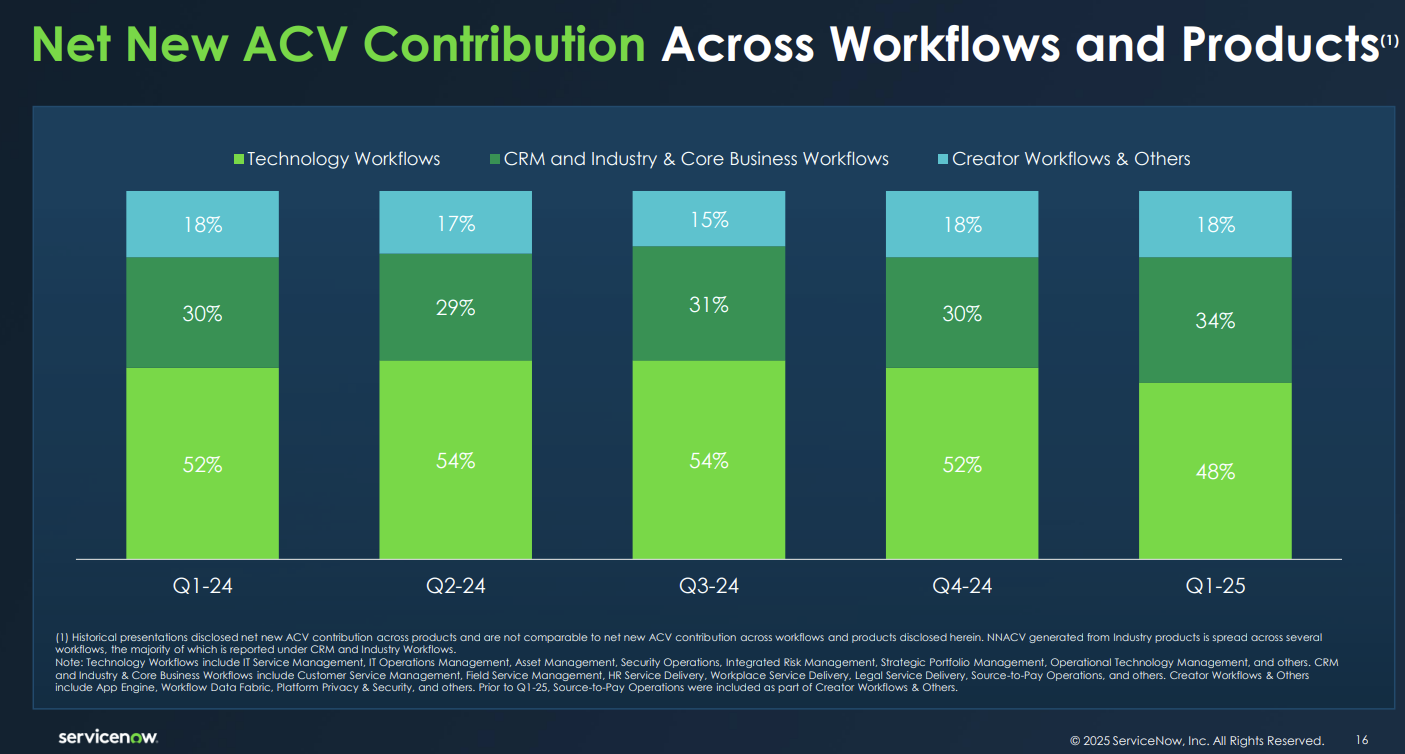
McDermott noted that ServiceNow CRM and industry workflows are "already ServiceNow's fastest growing business." He added that Logik.ai will be used to drive AI powered selling.

"This will be a natural step forward in ServiceNow CRM strategy, building on our core strengths of connecting functional teams and powering simple, efficient workflows.

Configure, price, quote, sell, fulfill, service on one fully integrated architecture with native built AI agents to take automation to the next level. There's not a day that passes when we don't hear from customers who are dissatisfied with their status quo. For a long time, I've been saying no one has to lose for us to win. Our customers have now adjusted me. They want someone else to lose, so they can continue to invest more in ServiceNow."

The numbers are highlighting ServiceNow momentum and it’s very clear that the company sees itself on a collision course with Salesforce, which is unifying its platform with Agentforce. ServiceNow has plenty of room to run in CRM as it expands its total addressable market. CRM and industry workflows were in 16 of the company's top 20 deals and nine of them had more than $1 million in ACV.

McDermott was asked about ServiceNow's CRM strategy since it doesn't sound like the company is going to be satisfied being a connector of workflows. In fact, ServiceNow is getting closer to the core system of record.

Note the nuance from McDermott:

"We regard the CRM system of record as an important data source. It's fine. But you're right. Our ambitions supersede a database. We believe strongly that our massive capabilities have emboldened us to go after a CRM in a differentiated way. And for one example, when you just talk about sales and order management and that solution, we're just super excited about how we're going to reimagine it. If you talk to a high-tech manufacturer today and they have to put together a supercomputer, the complexity of configuring it, pricing and quoting it could be days. So anything that's complicated, we're going to do in minutes or seconds. And we're delivering a fully integrated AI powered front office. That's going to connect sales and service, streamline operations and dramatically improve time to revenue."

McDermott said enterprises want to get away from "the fragmented legacy CRM stacks" and want a unified platform to take advantage of AI and AI agents. "It would be super tactical to add an agent to one instance of a disconnected CRM system from all the other processes I just mentioned. So we're going to make CRM faster. We're going to make it smarter and it's going to be purpose-built for modern business," said McDermott.

ServiceNow's Amit Zavery also noted that customers are having a difficult time modernizing workflows with AI with legacy systems. It's about process reinvention for CPQ, sales order management and customer service as much as CRM.

Indeed, McDermott said he was talking to one company that had 175 different instances of a CRM system and looking at ServiceNow to consolidate them.

The other takeaway is that ServiceNow leaders see their platform as deflationary to the broader enterprise software space. "No one says I'm going to use my ERP to cut across all systems and drive productivity. And that same goes for a CRM standalone or an HCM standalone. But they do say that about ServiceNow," said McDermott. "We put it all together in an enterprise grade AI workflow. So now you're taking advantage of AI, you're taking advantage of the data, and you're taking advantage of integrating processes at mass scale to get big business outcomes. It just so happens that CRM is one that we intend to be the leader in."


Data to Decisions Next-Generation Customer Experience Future of Work Innovation & Product-led Growth New C-Suite Marketing Transformation Digital Safety, Privacy & Cybersecurity servicenow Chief Information Officer

IBM maintains Q2 outlook, reports better-than-expected Q1

IBM maintains Q2 outlook, reports better-than-expected Q1

IBM reported better-than-expected first quarter results and maintained its outlook in what CEO Arvind Krishna called a "fluid" macroeconomic environment.

Big Blue also said that its generative AI book of business is now more than $6 billion to date and up more than $1 billion in the quarter.

IBM reported first quarter earnings per share of $1.12 a share on revenue of $14.5 billion, up 1% from a year ago. Non-GAAP earnings were $1.60 a share.

Wall Street was expecting IBM to report first quarter earnings of $1.40 a share on revenue of $14.4 billion. Krishna said:

"We remain bullish on the long-term growth opportunities for technology and the global economy. While the macroeconomic environment is fluid, based on what we know today, we are maintaining our full-year expectations for revenue growth and free cash flow."

  • Software revenue of $6.3 billion was up 7% in the first quarter compared to a year ago. Growth was led by Red Hat with first quarter growth of 12% and automation, up 14%.
  • Consulting revenue in the first quarter was $5.1 billion, down 2% from a year ago.
  • Infrastructure revenue was $2.9 billion in the quarter, down 6%.

A screenshot of a computer screen

AI-generated content may be incorrect.

As for the outlook, IBM projected 2025 revenue growth of at least 5%. Second quarter revenue will be between $16.4 billion and $16.75 billion.

Krishna said:

"Technology remains a key competitive advantage allowing businesses to drive cost efficiencies, productivity and preserve the balance sheets. In the near term, uncertainty may cause clients to pause and take a wait and see approach. However, the value of hybrid cloud automation, data sovereignty and on premise solutions becomes even more critical in volatile windows. Recent conversations that I've had with clients reflect this view of the current environment."

He also touted AI's role. 

"The AI portfolio we have built is designed to give clients a comprehensive set of tools to deploy AI within their enterprise. AI agents will accelerate the ability of many enterprises to turn the promise of generative AI into real value. Consulting is helping clients design and deploy AI strategies and use cases." 

Other items from the call:

  • Krishna said infrastructure is playing a bigger role with the new z17 mainframe and first installment of IBM Quantum System Two in Spain.
  • CFO James Kavanaugh said IBM is leveraging AI to improve its own productivity. "We remain laser focused on accelerating our productivity initiatives. We are transforming our enterprise operation, leveraging technology and embedding AI across more than 70 workflows, such as HR IT support, procurement, finance, quote to cash and more," he said. 
  • IBM has decreased its vendor spend by more than $1 billion by optimizing supply chain and service delivery and right-sizing infrastructure. 
  • IBM has little tariff exposure in the US as goods imported outside of the US represent less than 5% of the overall spend. 
Data to Decisions IBM Chief Information Officer

ServiceNow eases worries with strong Q1 earnings, Q2 outlook

ServiceNow eases worries with strong Q1 earnings, Q2 outlook

ServiceNow's first quarter should alleviate a bevy of emerging concerns in enterprise technology. The company landed multiple Pro Plus AI deals in the quarter and grew its US public sector business by more than 30% amid macroeconomic uncertainty.

For the first quarter, ServiceNow reported earnings of $460 million, or $2.20 a share, on revenue of $3.088 billion. Non-GAAP earnings in the first quarter were $4.04 a share.

Wall Street was looking for earnings of $3.94 a share on revenue of $3.09 billion.

The company has expanded more into CRM and revamped its business model so AI agents are activated on its platform and enterprises pay by consumption. ServiceNow's ground game is also strong as the company shined in manufacturing and healthcare and life sciences.

In addition, ServiceNow outlined new partnerships along with its results. ServiceNow said it has partnered with Aptiv to provide edge device intelligence across multiple industries. ServiceNow also said it will launch an AI service management suite with Vodafone Business. The company also said it will partner with Devoteam in a bid to land CRM projects in Europe and the Middle East.

CEO Bill McDermott said the company is driving value for customers and playing a big role in transformation projects. CFO Gina Mastantuono said ServiceNow is driving efficiencies via AI and reducing costs. ServiceNow ended the first quarter with 508 customers with annual contract values topping $5 million.

As for the second quarter outlook, ServiceNow said it was benefiting from a weaker US dollar and it exceeded the high end of its subscription revenue guidance. Nevertheless, it said it “only flowing through part of those benefits” in its outlook to account for economic uncertainty. ServiceNow projected subscription revenue of $3.03 billion to $3.035 billion, up 19% to 19.5%. For 2025, ServiceNow is projecting revenue between $12.64 billion and $12.68 billion, up 18.5% to 19%.

On a conference call, McDermott said:

"While it's true there are some unknowns out there, this is far from the first macro disruption we have encountered. You don't build a defining company by surrendering to uncertainty. You do it by seeing challenges as opportunities. We have zero interest in anything less than outperforming."

He added that customers are focused on taking out costs, modernizing tech stacks and leveraging AI. McDermott also talked up ServiceNow's US government business.

CFO Mastantuono said: "We went through a very rigorous analysis of our business and its exposure to areas that could potentially be impacted by the current geopolitical. Federal is a piece of it and enterprise, of course. What I'll tell you is that demand remains strong. The customers we're talking to are absolutely focused on the future and growth in and cost out. ServiceNow platform remains a deflationary tool that customers are leaning into in times of uncertainty."

Constellation Research analyst Holger Mueller said ServiceNow put up a strong quarter. He said:

"ServiceNow breaks two key milestones, $10 billion projected revenue for the fiscal year and $3 billion in revenue for the quarter. For the longest time it was not clear where future growth will come from, but Bill McDermott and team have expanded their total addressable market going into CRM and HCM. Both markets make sense as they are characterized by unstructured processes and fragmented automation islands. But next quarter will show as ServiceNow is making new enemies."  

Other key items:

  • "CRM and industry workflows continued its momentum in 16 of our top 20 deals, with nine deals that were over a million core business workflow," said McDermott. 
  • McDermott said it is expanding its addressable market with CRM and supply chain. "There's not a day that passes when we don't hear from customers who are dissatisfied with the status quo," said McDermott. 
  • ServiceNow said RaptorDB, the company's next-gen database, saw annual contract value sequential gains and had five deals worth more than $1 million.  

A screenshot of a computer

AI-generated content may be incorrect.

The company noted that Paul Smith is resigning as the company’s president of global customer and field operations. He is succeeded by Paul Fipps.

Data to Decisions Future of Work Next-Generation Customer Experience Innovation & Product-led Growth Tech Optimization Digital Safety, Privacy & Cybersecurity servicenow AI GenerativeAI ML Machine Learning LLMs Agentic AI Analytics Automation Disruptive Technology Chief Information Officer Chief Executive Officer Chief Technology Officer Chief AI Officer Chief Data Officer Chief Analytics Officer Chief Information Security Officer Chief Product Officer