Results

Tom Hogan Joins Kony

Tom Hogan Joins Kony

Thomas-E-Hogan

Siebel veteran Thomas E. Hogan has been appointed chief executive officer of Kony, an enterprise mobile applications tools provider.  At Siebel Hogan was Senior Vice President of Global Sales and Operations.  Before joining Kony, Hogan served as executive vice president of Software at HP. Prior to joining HP, Hogan served as the president of Vignette, a publicly held software company specializing in enterprise content management.  Hogan started his career at IBM, where he  held a variety of executive posts. In his new role, Hogan will help Kony drive sales execution, achieve operational excellence, maintain product leadership, and facilitate geographical expansion.

“With more than 900 percent growth during the last three years, Kony is uniquely positioned in the enterprise mobility market,” said Raj Koneru, founder and chairman, Kony. “To capitalize on the opportunity it was time to bring in a new CEO to help scale the company.”

“It is a honor to succeed Raj Koneru as chief executive officer,” said Hogan.

Kony provides s cloud platform to support the mobile application software development lifecycle. The company’s customers include Fortune 1000 global banks, healthcare payers and providers, automotive, manufacturing, travel, hospitality and retail organizations, as well as a large global network of more than 150 partners.

The company has over 600 apps live, serving over 20 million end users in 45 countries. The Kony tools help define, design, develop, test, deploy, and manage multi-channel applications from a single codebase.

The company has an opening for a creative director on the careers page of its site.

Tech Optimization Chief Information Officer

New Analysis - Another week another Billion - Cisco Intercloud - A different approach to cloud – better late than never

New Analysis - Another week another Billion - Cisco Intercloud - A different approach to cloud – better late than never

Cisco entered the public cloud market today with announcing the world’s largest Intercloud (a new term – surprise).


Let’s look at the press release – and read between the lines a bit:

As businesses increasingly embrace private, public, and hybrid clouds to cost-effectively and quickly deliver business applications and services, Cisco today announced plans to build the world’s largest global Intercloud – a network of clouds – together with a set of partners. The Cisco global Intercloud is being architected for the Internet of Everything, with a distributed network and security architecture designed for high-value application workloads, real-time analytics, “near infinite” scalability and full compliance with local data sovereignty laws. The first-of-its-kind open Intercloud, which will feature APIs for rapid application development, will deliver a new enterprise-class portfolio of cloud IT services for businesses, service providers and resellers.

MyPOV – It’s easy to coin a new term ‘Intercloud’ – harder to explain it and then maintain it. Cisco explains it as the Intercloud being a network of clouds, fair enough, but what is it. The Latin ‘inter’ refers to between – so it’s the network between the clouds – powered in the cloud? It’s harder to make a new term stick – so we will see who else may pick up the new buzzword. Cisco deserves kudos for making this a pretty rich cloud announcement – as it includes security, real time analytics, is compliant with local data sovereignty laws (very interesting), supports RAD and is offered together with partners. The data sovereignty is an interesting feature to keep an eye on – and begs questions – who will create and maintain the legislative rules, who will enforce them and what does it mean for the applications running in the Intercloud?

Cisco expects to invest over $1 billion to build its expanded cloud business over the next two years. Its partner-centric business model, which enables partner capabilities and investments, is expected to generate a rapid acceleration of additional investment to drive the global scale and breadth of services that Cisco plans to deliver to its customers.

MyPOV – There we go – $1 billion – so stretched through 2 years and we will have to see how much partner investment it will trigger.

The company plans to deliver Cisco Cloud Services with and through Cisco partners. The following organizations, which are either planning to deliver Cisco Cloud Services or have endorsed Cisco’s global Intercloud initiative, represent a sampling of the kinds of global partners Cisco expects to work with to build its cloud business: leading Australian service provider Telstra; Canadian business communications provider Allstream; European cloud company Canopy, an Atos company; cloud services aggregator, provider and wholesale technology distributor Ingram Micro Inc.; global IT and managed services provider Logicalis Group; global provider of enterprise software platforms for business intelligence, mobile intelligence, and network applications MicroStrategy, Inc.; enterprise data center IT solutions provider OnX Managed Services; information availability services provider SunGard Availability Services; and leading global IT, consulting and outsourcing company Wipro Ltd.

MyPOV – It’s a first to launch a cloud service with so many partners. But it looks more of a collection of the weak than the strong. Orchestration will be a predictable challenge. Let’s measure what these partners will put up in investment in the coming quarters though, let’s give Cisco and them the benefit of the doubt. The biggest problem – none of the partners mentioned – with the exception of MicroStrategy may bring significant work load with them – and that’s what cloud get cost effective with. So where will the load come from?

[…]
The Cisco OpenStack-enabled Intercloud is designed to allow organizations and users to combine and move workloads – including data and applications – across different public or private clouds as needed, easily and securely, while maintaining associated network and security policies. It will also utilize Cisco Application Centric Infrastructure (ACI) to optimize application performance and to make rolling out new services much faster. Cisco will improve application security, compliance, auditing and mobility by using ACI’s centralized, programmable security policy to enable fine-grained control and isolation at scale; suitable for private and public cloud environments.

MyPOV – No surprise – this will be another OpenStack powered cloud, with the promise to combine workloads that we need to see delivered first in the real world before we fully believe it. No surprise ACI is being used – the question is how much work will partners and customers have to do adopt ACI and how willing will they do that – given other public clouds may not ask them to do that step. And building an ACI compliant application / load may hinder its transport to other OpenStack clouds – though hopefully not the Intercloud operating partners.

[…]
Cisco Cloud Services expand on the Cisco industry-leading cloud portfolio, which already includes SaaS offerings, such as WebEx®, Meraki® and Cisco Cloud Web Security; differentiated cloud services, such as hosted collaboration and cloud DVR; and technologies and services to build public and private clouds, such as the Cisco Unified Computing System™ (Cisco UCS®), integrated infrastructure solutions such as VCE Vblock™ Systems and NetApp FlexPod, and Cisco Application Centric Infrastructure (ACI).

MyPOV – Cisco brings already some applications to the offering, the WebEx product probably being the most popular – but that will not be enough load – despite being the most popular load used by enterprises. Would be nice not to see the download of the WebEx applet every time a session runs with a server on a different version. And then Cisco throws in pretty much all products it can claim for the cloud, including the result of the VMware partnership around VCE Vblock and NetApp Flexpod.

Cisco is expanding the Cisco Powered™ program to include Cisco Cloud Services. Cisco will sell these new services through channel partners and directly to end customers. Partners who develop Cisco Powered services can offer more cloud offerings faster, with lower up front development costs, and operate at cloud speed and scale. […]

MyPOV – This is the most interesting and differentiating area with a number of unique / significant capabilities. A RedHat OpenShift based PaaS, SAP HANA to run UCS, WebEx, DaaS (Cisco, VMware and Citrix) are the most interesting one and a bunch of more technical Cisco services. Collaboration as a Service (CaaS) struck me as one of the more unusual terms – but Cisco likes to call things a little different than the rest of the industry.


Overall POV

Cisco certainly comes late to the game, albeit with a different angle, the Intercloud. Certainly a fair angle for the leading network provider, who fittingly also announced a whole new set of networking equipment. But all public clouds need management between their data centers and that is what Cisco is really after. It’s unclear where all the Cloud Services will run – e.g. will WebEx run in the Intercloud (operated by who) or (only) in connected partner cloud (or both). So lots of questions remain. Also existing cloud providers may go an order Cisco network gear with a little more consideration going forward.

On the bright side, Cisco deserves credit to come out today, catch the early lead in what shapes to be a key week for the cloud (Google on Tuesday, Amazon on Wednesday and Microsoft on Thursday) – so better late than never. And the services are rich and differentiating. But lots of questions on the hybrid and partner based approach to cloud remain.


New C-Suite Tech Optimization Innovation & Product-led Growth Data to Decisions Future of Work Digital Safety, Privacy & Cybersecurity softlayer cisco systems SAP vmware Google IBM amazon Oracle SaaS PaaS IaaS Cloud Digital Transformation Disruptive Technology Enterprise IT Enterprise Acceleration Enterprise Software Next Gen Apps IoT Blockchain CRM ERP CCaaS UCaaS Collaboration Enterprise Service Chief Information Officer Chief Technology Officer Chief Information Security Officer Chief Data Officer Chief Executive Officer

Event Report - BI2014 and HANA2014 takeaways – It’s all about HANA & Lumira - but is that enough?

Event Report - BI2014 and HANA2014 takeaways – It’s all about HANA & Lumira - but is that enough?

I had the opportunity to attend the keynote presentation at the SAP BI2014 / HANA2014 conference in Orlando, organized by Wispubs. This used to the BusinessObject event and has slowly morphed into a SAP BI event – and this year – nor surprisingly – a HANA event. With 1800 guests attending it is a key event for the SAP BI community.


So here are my top 3 takeaways from the keynote:


  • The disruption message has arrived and (of course) HANA solves it – The red thread of Steve Lucas keynote was all around business disruption triggered by technology. And of course how SAP technology helps companies to be a disruptor and how that on the flipside can help them to be disrupted. But then I am sure SAP will also be happy to help enterprises that have been disrupted – granted they can still come up with the payment for the new software technology.

    Lucas laid out how companies like Uber, WhatsApp and AirBnB have disrupted conventional businesses and achieve amazing valuations. Few observers may have noticed that WhatsApp has disrupted SAP’s Sybase 365 customers on the messaging side – but kudos for the openness and WhatsApp is certainly a poster child story not to be missed. Unfortunately the disruptive element came short in the customer stories presented in the keynote – with New South Wales Police and Fire, Velux and SpiritAero. We asked the same question in the analyst Q&A and Amit Sinha came back with a valid example of Italian tire manufacturer Pirelli selling tire usage data with the help of HANA. Definitively innovative and potentially disruptive for the competition.

The SAP HANA Platform

  •  Lumira looms – The not so brilliantly named SAP BI product is making good progress – being used in two of the keynote demos. First to visualize the brackets of the current NCAA basketball tournament, a good actual high involvement example, that of course only jelled well with a North American audience aware of the tournament. We also saw new infographic capability in Lumira, which is a nice addition of functionality to enable storytelling. It’s a first version –e .g. we missed annotations – but a promising start. Now we can only hope SuccessFactors and Lumira developers will speak and cooperate and use common assets of Lumira Storytelling and SuccessFactors Presentations functionality. The combination is a high potential solution.

    And Lumira is becoming more and more the replacement and go to product for older, former Business Objects products – as new functionality (e.g. Design Studio) is being built here – replacing e.g. the still popular Xcelsius.


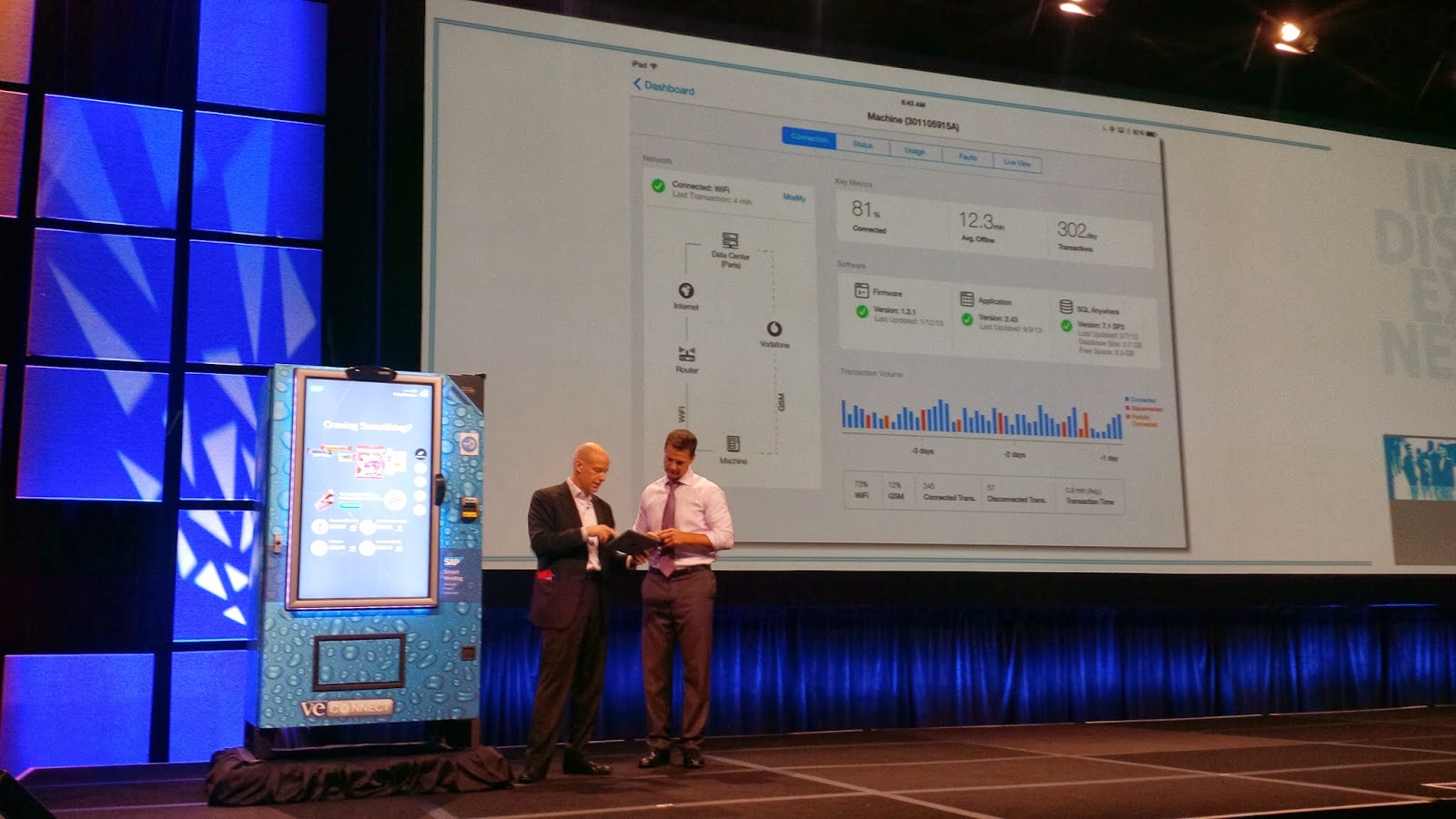
Lucas and colleagues in the midst of IoT demo


  • HANA dominates – As expected – it is virtually impossible to get a new product from SAP or to build an innovative solution – without getting to use HANA. And as Lucas shared, this is to a certain point by design. If you want to build a mobile solution, well in the backend you will have HANA – like t or not. This certainly makes sense for SAP from a sales perspective – and even from a technology re-use perspective – but not all use cases of innovative applications require an in memory database. Just think of Hadoop based BigData scenarios. Mobile apps extending legacy. Social apps (probably Jam is HANA free at this point). Etc. SAP needs to be careful not to limit growth of some of its technology products for the sake of HANA integration.


SAP did a good job showing an Internet of Things (IoT) demo – tying together huge data volumes with personalization and predictive delivery and maintenance. Nice showcase.


MyPOV

A good start to the BI2014 / HANA2014 event that confirms HANA’s pivotal role. Lumira is getting better and I expect it to soon replace all former BO products, not that SAP is saying that officially any time soon. The general concerns I have around HANA (elasticity, programming language) are not addressed, but Sapphire is the event for that, not BI2014. It looks like the SAP technology products (+/- 50% of the SAP license revenue) are doing well. My concern is that SAP did not bring the full platform package – the HANA Cloud Platform (HCP) to this event – but enterprises want to build rich analytical applications. A missed opportunity. And not surprisingly – the HANA vs Hadoop relationship remains in the field of unknown forces avoiding each other.

I am still onsite for another 24 hours and will follow up with another post around more briefings and meetings setup here at BI2014 / HANA2014.


Tech Optimization Data to Decisions Digital Safety, Privacy & Cybersecurity Innovation & Product-led Growth Future of Work SAP Hadoop SaaS PaaS IaaS Cloud Digital Transformation Disruptive Technology Enterprise IT Enterprise Acceleration Enterprise Software Next Gen Apps IoT Blockchain CRM ERP CCaaS UCaaS Collaboration Enterprise Service ML Machine Learning LLMs Agentic AI Generative AI AI Analytics Automation business Marketing finance Healthcare Customer Service Content Management Chief Information Officer Chief Technology Officer Chief Information Security Officer Chief Data Officer

ManageEngine Launches Siebel Application Performance Monitoring

ManageEngine Launches Siebel Application Performance Monitoring

Manageengine

ManageEngine is expanding its portfolio of performance management tools to include Siebel. Its Applications Manager product will add support for Oracle Siebel, providing operational data to Siebel Administrators to ensure high availability and performance of Siebel applications.

ManageEngines-dashboardThe company will also be announcing new versions of its other products  OpManager, a network
and data center infrastructure management solution; Desktop Central, a desktop and mobile device management (MDM) solution; as well as Applications Manager.

ManageEngine will be exhibiting its new products along with the rest of its portfolio in booth 2327 at Interop Las Vegas being held March 31–April 4, 2014, at Mandalay Bay Convention Center in Las Vegas.

Worldwide, the company claims 90,000 customers — including most of the Fortune 500 — use its products to ensure the optimal performance of their critical IT infrastructure, including networks, servers, applications, and desktops. Another 300,000 plus administrators use the free editions of ManageEngine products. ManageEngine is a division of Zoho. To date, Zoho.com has launched 25+ online applications — from CRM to Mail, Office Suite, Project Management, Invoicing, Web conferencing .With offices in CA, Austin, Chennai, Yokohama and Beijing, Zoho Corporation serves the technology needs of more than 9 million customers worldwide.

The company can be followed on Twitter at @ManageEngine.

Tech Optimization Oracle Chief Information Officer

Most Wearable Devices Will Fail and the Name of the Category Will Change From Wearables to Sense-ables

Most Wearable Devices Will Fail and the Name of the Category Will Change From Wearables to Sense-ables

1

If you were at CES, you could not have missed a new category of computing called "wearables." This category of devices can be described as the FitBit gone mad. Wearables currently come in three main categories: health trackers, watches and glasses. In each of these categories some if not all devices are pivoting to solving the world's biggest health problems.

Almost daily, I see a new wearable device launched, and while they all are minimally viable products, they continually get sillier and sillier. We are seeing everything from wearable necklaces (like necklaces were never wearable) earrings, shoes, clothing and many other bodily accruements being outfitted with small computers/biosensors, low voltage needs and high connectivity. Like clockwork, every new device no matter how silly, calls out to the world with press releases, tweets, YouTube videos and multiple pounds of the manufacturing firm's proverbial digital chest reckoning how disruptive some new wearable product is.

My observation is that we have bastardized the word disruption. Most wearables are disturbing mankind under the once well-intended charter of disruption.

While a minority of humans continue to wear these devices past the first few months of purchase, most folks (like myself) stop wearing after the nostalgia has worn off. I gave up my FitBit after about six months, my pebble watch in about six days and my Google GLASS, well I got over that bad boy in about six hours. I got over them the same way I got over my first CASIO watch, which doubled as a calculator in high school; said watch plus calculator was disturbing my life. Disruption does not have to disturb.

Good disruption is change without disturbance.

The hypothesis is simple, wearing something on my body that is not confortable, fashionable and delivering more value than it disturbs me is not a sustainable value proposition. So the big question is what will become of wearables? Clearly the movement of computing to the edge of the network will continue, and the connecting of things/biosensors that are not computers (Internet of Things) will continue. Wearables currently position themselves as trying to solve health's biggest problems.

Well, do I need to wear the solution to health's biggest problems 24/7, or can the solution simply sense me daily/weekly?

The solutions will become sensible, and may be called sense-ables

Just recently, Singularity University wrote on Forbes.com about the "new generation of revolutionary biosensors that contain the power of clinical lab instruments in packages that are light, small, wireless and highly efficient." The Human API calls for "Sensoring" all suggesting it is the sensing and sensors that matter, not where or how they are embedded/worn/adorned.

During a Hacking the Future episode, John Nosta from Forbes.com and I landed on the construct of "implantables" or more eloquently as John coined it "dermals." Implantables and/or dermals will do the complete opposite of what current wearables do, instead of "disrupting/disturbing" they will be dormant, unnoticeable, behind the scenes and sensing passively. Experts will argue that the problem with sense-ables are they do not provide a "stream" of 24/7 health information, instead they will probably provide a single point of time (SPOT) measure of health.

Here are some examples of sense-ables.


  • Cars -- the steering wheels, the seats.

  • Bathrooms -- mirrors, toilets, toothbrushes, shower drains (for heavens sake we have scales in there already).

  • Bedrooms -- pillows, mattresses, sheets.

  • Offices -- chairs, pens.

  • Pharmacies -- think about a "sensing room" where you go in and submit your data in 2-5 minutes.


So what about "streaming health" thought?

More and more we incorrectly call out for a "stream" of health information. I am guilty of this as well, here is an outdate version of my thinking around "streams" of health information. But do we need health data to "stream" to solve health's biggest problems? Are we over-solving? Over-engineering?

We are getting the data part of heath completely wrong.


  1. For most, a stream of personal health information from a clinical perspective is only marginally more valuable than a SPOT read of your vitals daily, or weekly (unless you need ICU type monitoring). This means embedded sensors that can sense me daily or weekly are enough to improve health exponentially without me having to "wear" a lab on me designed to stream my health.

  2. More data does not automatically mean more likely personalized medicine. Yes, we are seeing the call for me-dicine, but outside of some therapeutic classes such as oncology and a handful of others, we may never get to personalized medicine; we may never need to. We may get to personalized medicine for groups, demographics, genders, age and body types, but the commercial investment to make a pain killer designed with my "health fingerprint" in mind is just silly.

  3. The data from the human body is imperfect, and we need to focus on developing cognitive computing that "heals" the health data from human bodies before we can use it to make clinical conclusions. Otherwise, we will have false diagnosis driving global hypochondria. Until then, where the power of data from the sick can be beneficial, is where we can study health data from crowds (or in crowds) and use analytics to extrapolate from crowds (or of crowds). We will only benefit from an "index of health data" from a crowd over a stream from a person until we develop cognitive computing to heal imperfect health information sourced from imperfect human bodies.

  4. Innovations that see massive adoption eventually driving revolutions are those that help the lion's share of society. The mobile phone drove a revolution of hyper-adoption because it is difficult to debate that it does not improve every human life it touches. My CASIO watch plus calculator from high school never drove a revolution because its adoption was ring-fenced to a small population. Most human beings will live exactly the same lives we live today, even if they wore a hundred wearable devices daily, the value of wearing a lab on the body to stream health information for exponential health value is ring-fenced to a small (but albeit unfortunately unhealthy or sick) population of society. Most of us only need SPOT measures of our health to improve our health outcomes exponentially.


There are simply too many simpler ways to solve the problem wearables are all trying to solve -- which is capturing a stream of imperfect health information and hoping for personalized medicine as a result for every human, and too many holes in the argument that they will drive a revolution. Fad for sure.

Be sensible -- build a sense-able, not a wearable.


New C-Suite Innovation & Product-led Growth Google Chief Customer Officer Chief Marketing Officer

Briefings this week: March 24 - 28

Briefings this week: March 24 - 28

1

Here's who I'm speaking with this week:

Monday

Tuesday - Wednesday

Friday

  • BearingPoint
  • LittleBird

As a reminder, I'm interested in hearing from companies that enable customer experience management, provide marketing services (including agencies and consultancies) and support innovation agenda items.

If you are interested in briefing Constellation Research on your marketing technology, visit the Contact Us form.


Marketing Transformation Chief Executive Officer Chief Marketing Officer

Research Report: Digital ARTISANs - The Seven Building Blocks Behind Building A Digital Business DNA

Research Report: Digital ARTISANs - The Seven Building Blocks Behind Building A Digital Business DNA

Shift to Digital Businesses Requires A Transformation Of Leadership And Organizational DNA

The discussion about digital business often goes deep into the five pillars of digital technologies.  In fact, the convergence of these pillars have spawned the latest and trendiest iterations of technology from enabling the sharing economy to 3D printers to wearables that drive sensor and analytical ecosystems.  As organizations contemplate how these broad based digital business trends will disrupt existing business models, leaders can apply Constellation’s Futurist Framework and consider dimensions from the political, economic, societal, technological, environmental, and legislative (PESTEL) angles.  However, even after much planning, astute CXO’s from market leading and fast follower organizations quickly realize that technology and process alone is not enough to transform their organization’s DNA inside the organization.

It’s Still The People, Stupid!

Despite robots potentially taking over by 2020 (snark), people still play a key role in the success of digital business transformation.  In the shift from selling products and services to promising outcomes and experiences, information flows faster.  Every node and person in the digital network must react more quickly, yet also needs to be more intelligent.  Success comes faster but so does failure.  Thus, both the seduction of massive success and the fear of facing massive failure provides a great catalyst to design, influence, infuse, or transplant the proper digital DNA.

The DNA Of Digital Artisans Blend The Intelligence Of Quant Jocks With The Co Innovation Skills Of The Creative Class

Organizations must assess their innate ability to thrive in a digital business environment.  These skills go not only beyond the quant jocks who deliver hard science and engineering prowess, but also beyond the creative class who can co innovate and co-create on demand.  Consequently, organizations are rethinking the attributes a digital business should employ and embody.

The Bottom Line: Rise Of Digital Artisans Required For Organizational Transformation

Short of having every leader emerge as the Chief Digital Officer, the new war for talent will focus on attracting, developing, and retaining digital artisans.  Concurrently, a market will develop for  those who can spread the digital business gospel and infuse digital artistry into organizations.  While there are many attributes a digital business should embody, seven building blocks behind digital ARTISANS embody the digital DNA required for success:

  • (A) Authentic: stay true to the organization’s mythology and brand
  • (R) Relevant: deliver contextual personalization at scale
  • (T) Transparent: operate with an understanding that everything eventually becomes public
  • (I) Intelligent: adapt to self learning, smart systems, that anticipate need
  • (S) Speedy: infuse responsiveness in digital time
  • (A) Analytical: democratize decision making with all types of data
  • (N) Non-conformist: espouse disruptiveness in the creation and innovation of new ideas

Your POV.

Ready for digital disruption?  Do you have a digital artisan DNA?  How did you get there? Add your comments to the blog or reach me via email: R (at) ConstellationR (dot) com or R (at) SoftwareInsider (dot) org.

Please let us know if you need help with your Digital Business transformation efforts. Here’s how we can assist:

  • Developing your digital business strategy
  • Building a Digital ARTISAN program
  • Connecting with other pioneers
  • Sharing best practices
  • Vendor selection
  • Implementation partner selection
  • Providing contract negotiations and software licensing support
  • Demystifying software licensing
Resources

Reprints

Reprints can be purchased through Constellation Research, Inc. To request official reprints in PDF format, please contact Sales .

Disclosure

Although we work closely with many mega software vendors, we want you to trust us. For the full disclosure policy,stay tuned for the full client list on the Constellation Research website.

* Not responsible for any factual errors or omissions.  However, happy to correct any errors upon email receipt.

Copyright © 2001 -2014 R Wang and Insider Associates, LLC All rights reserved.
Contact the Sales team to purchase this report on a a la carte basis or join the Constellation Customer Experience


Data to Decisions Future of Work Marketing Transformation Matrix Commerce New C-Suite Next-Generation Customer Experience Tech Optimization Innovation & Product-led Growth Revenue & Growth Effectiveness SoftwareInsider Leadership ML Machine Learning LLMs Agentic AI Generative AI Robotics AI Analytics Automation B2B B2C CX EX Employee Experience HR HCM business Marketing Metaverse developer SaaS PaaS IaaS Supply Chain Quantum Computing Growth Cloud Digital Transformation Disruptive Technology eCommerce Enterprise IT Enterprise Acceleration Enterprise Software Next Gen Apps IoT Blockchain CRM ERP finance Social Healthcare VR CCaaS UCaaS Customer Service Content Management Collaboration M&A Enterprise Service Chief Customer Officer Chief Executive Officer Chief People Officer Chief Information Officer Chief Marketing Officer Chief Digital Officer Chief Technology Officer Chief Data Officer Chief Analytics Officer Chief Financial Officer Chief Operating Officer Chief Revenue Officer Chief Information Security Officer Chief Experience Officer

Roundup Of Cloud Computing Forecasts And Market Estimates, 2014

Roundup Of Cloud Computing Forecasts And Market Estimates, 2014

1

By 2018, CIOs expect it to play a critical role in enabling their organizations strategic vision according to IBM’s latest study, Moving from the back office to the front lines – CIO insights from the Global C-suite Study. The IBM study and recent cloud computing forecasts and market estimates illustrate how quickly CIOs’ roles are changing.

CIOs in high performance enterprises are increasingly seeing the world much more like their CEO counterparts.  Both are now focusing more on how cloud computing can improve customer engagement and operational performance while anticipating market and macro-economic factors.  IBM’s study provides a glimpse into their Institute for Business Value’s 1,600 face-to-face conversations with CIOs from 70 countries and 20 industries worldwide.

Here are the key take-aways from the report including an infographic summarizing key points of the study:

  • Cloud computing has rapidly accelerated from 30% of CIOs mentioning it as a crucial technology for customer engagement in 2009 to 64% today.
  • 67% of CIOs IBM interviewed are actively looking into how cloud technologies can better serve and collaborate with customers.
  • 84% of CIOs are focusing on mobility solutions to support closer customer engagement, 83% are evaluating business analytics and optimization and 64%, cloud computing.   The following graphic shows a comparison of how priorities have changed between 2009 and 2013.

ibm study

  • CIOs in outperforming enterprises are nearly twice as likely as their peers (59% versus 31% for underperformers) to have a cohesive strategy for uniting the digital and physical elements of their businesses.  One respondent CIO from a banking firm in The Netherlands stated that “We want to create an integrated, 24/7 customer experience across channels and services.”  The following infographic summarizes key points of the analysis.

infographic  on CIOs new boss

  • Cloud-related tech spending by businesses is forecast to triple from 2011 to 2017 according to IHS Technology.  By 2017, enterprise spending on cloud computing will amount to a projected $235.1B, triple the $78.2B spent in 2011 according to the research firm’s analysis.  In 2014, global business spending for infrastructure and services related to the cloud will reach an estimated $174.2B, up 20% from the amount spent in 2013. Source: Cloud- Related Spending by Businesses to Triple from 2011 to 2017.  

cloud spending soars

  • Centaur Partners predicts that total SaaS revenue will shift from just over 10% of the total enterprise software market in 2010 to just over 16% by 2015, and predict that SaaS and cloud-based business application services revenue will have grown from $13.5B in 2011 to $32.8B in 2016.  The following graphic is from their latest SaaS Market Overview presentation.

centaur partners

cloud focus of investment

Cisco cloud traffic

  • Bain & Company predicts that direct spending on hardware, software and services could top $70B by 2017 based on the proliferation of the Internet of Things (IoT).  The research brief, Is your company ready for the Internet of Things? predicts that companies that can capitalize on mobility, analytics and cloud computing will have the highest probability of success.  Bain & Company also presented their taxonomy of market growth by enterprise spending category below, projecting software and applications will generate $180B in sales by 2017.

Bain & Company Taxonomy

  • IDC is predicting that the cloud software market will surpass $75B by 2017 attaining a five year compound annual growth rate of 22% in the forecast period. IDC also found that current organizations using the cloud expect to spend 53.7% of their IT budget on cloud-based applications and platforms in the next 24 months.  Major benefits of the cloud for IT operations include reducing the size of the IT budget, improving IT staff productivity, and simplifying and standardizing IT infrastructure.  For other departments, benefits include improved resource utilization, enabling business units to control IT solutions more directly, and launch revenue generating services faster with more efficient time-to-market strategies. These findings are from the Cisco infographic based on IDC research data titled Midsize Enterprises Leading The Way With Cloud Adoption.

Accenture infographic


New C-Suite Tech Optimization Innovation & Product-led Growth SaaS PaaS IaaS Cloud Digital Transformation Disruptive Technology Enterprise IT Enterprise Acceleration Enterprise Software Next Gen Apps IoT Blockchain CRM ERP CCaaS UCaaS Collaboration Enterprise Service Chief Information Officer Chief Technology Officer Chief Information Security Officer Chief Data Officer Chief Executive Officer

News Analysis: Gainsight Spring 2014 Release Targets Large Enterprises Making The Transition To #DigitalBiz

News Analysis: Gainsight Spring 2014 Release Targets Large Enterprises Making The Transition To #DigitalBiz

Customer Success Management Pioneer Adds Key Functionality For March 2014 Release

On March 18th, Mountain View, CA based Gainsight announced the Spring 2014 release of its customerssuccess management platform.  Led by CEO Nick Mehta, the cloud software vendor has received over $29M in funding from key investors such as Bain Capital, Battery Ventures, Capital Innovators, Cultivation Capital, Silicon Valley Bank, and Summit Partners.  In addition to the latest release, the company added two industry veterans Sherif Botros from SAP as Chief Data Scientist and Puja Ramani from Facebook as Director of Product Management and Analytics.

Five key features designed for the largest of enterprises were announced for the Gainsight Spring 2014 release and include:

  • Support for sponsor tracking with LinkedIn and InsideView. New feature takes contacts listed in a client's CRM system and monitors status changes in InsideView and Linkedin.  Known as Gainsight Sponsor Tracking, the feature also adds relevant news, events, and CRM intelligence.  These additional, external data points factor into a holistic customer health score that includes usage, support, engagement, and and other relationship health metrics..

    Point of View (POV): A top root cause for churn is an executive sponsor's departure.  The automated system serves as an early warning indicator when status changes for key contacts to help provide the advantage of time and insight when protecting renewals and future upsell.  The feature also locates potential advocate or customers to on board.
  • Delivery of a Salesforce1 mobile app .  The Gainsight Salesforce1 Mobile App integrates natively with Salesforce (see Figure 1).   The Gainsight offering allows users access on Android and iOS phones and tablets.  Alerts, tasks, customer health data, and survey feedback are integrated with Salesforce system data.

    (POV): Mobility tops this year's list of key enabling digital technologies in almost every Constellation survey.   Customers can take advantage of in-between and wait times to update customer health and fill notes via the application.  Many existing customers expect that this feature will improve team productivity from 10 to 25%.

Figure 1. Gainsight Delivers a Native Integration To Salesforce1

  • Release of  Gainsight Success Snapshots. As a new data visualization publishing feature, the solution helps clients build and publish data filled presentations, executive updates, and QBR reports.  Users can populate presentations with customer queries or templated reports.

    (POV): Customers seek not only good reporting tools, but also consumer grade user experience and ease of use. Data visualization tools play a key role in effectively democratizing the data to decision process among stakeholders championing customer success.
  • Introduction of Gainsight Home. The personalized dashboard aggregates relevant information and enables team collaboration (see Figure 2). Gainsight Home allows customer success managers to configure relevant data and workflow views.

    (POV): Gainsight Home provides personal analytics for the customer success manager.  Reports and dashboards can be customized.  Upcoming tasks can be tracked and monitored.  The system enables the benchmarking of performance and customer success manager career development and advancement.

Figure 2. Gainsight Home Provides Personalized Dashboards

  • Launch of enterprise permissions to support collaboration. Gainsight Enterprise Permissions allows admins to define role based security.  Key permissions include create, edit, delete, and publish for objects such as customer and company data, surveys, and blended data reports.

    (POV): The capability provides an initial step to delivering enterprise class security.  Organizations having to address compliance now have a baby step towards risk mitigation.  More enterprise class features will be needed going forward as the customer success manager role expands into the enterprise.

The Bottom Line: The Recurring Revenue World Depends On Top Notch Customer Success Management

The customer success management movement gains traction as the shift from traditional business models to digital business models requires leaders to prioritize efforts to grow recurring revenue.  Top notch customer success management automates the monitoring of key factors driving churn risk, provides the predictive analytics to anticipate risks, and shares best practice playbooks to improve success.  Organizations must successfully master customer success management in order to drive down churn, build up-sell and cross-sell opportunities, and successfully engage customers across a continuum of customer experience.

Your POV.

Ready to add customer success management?  Have you improved outcomes with a forma Customer Success Management program.  Are you embarking on a digital business transformation?  Let us know how it’s going!  Add your comments to the blog or reach me via email: R (at) ConstellationR (dot) com or R (at) SoftwareInsider (dot) com.

Please let us know if you need help with your Customer Centricity and Digital Business transformation efforts.  Here’s how we can assist:

  • Assessing customer centricity readiness
  • Developing your digital business strategy
  • Connecting with other pioneers
  • Sharing best practices
  • Vendor selection
  • Implementation partner selection
  • Providing contract negotiations and software licensing support
  • Demystifying software licensing

Related Research:

Reprints

Reprints can be purchased through Constellation Research, Inc. To request official reprints in PDF format, please contact Sales .

Disclosure

Although we work closely with many mega software vendors, we want you to trust us. For the full disclosure policy, stay tuned for the full client list on the Constellation Research website.

* Not responsible for any factual errors or omissions.  However, happy to correct any errors upon email receipt.

Copyright © 2001 -2014 R Wang and Insider Associates, LLC All rights reserved.
Contact the Sales team to purchase this report on a a la carte basis or join the Constellation Customer Experience


Marketing Transformation Next-Generation Customer Experience Innovation & Product-led Growth Tech Optimization Future of Work Data to Decisions New C-Suite Digital Safety, Privacy & Cybersecurity intel SoftwareInsider B2C CX Next Gen Apps Customer Experience Marketing B2B EX Employee Experience AI ML Generative AI Analytics Automation Cloud Digital Transformation Disruptive Technology Growth eCommerce Enterprise Software Social Customer Service Content Management Collaboration Machine Learning LLMs Agentic AI Robotics HR HCM business Metaverse developer SaaS PaaS IaaS Supply Chain Quantum Computing Enterprise IT Enterprise Acceleration IoT Blockchain CRM ERP Leadership finance Healthcare VR CCaaS UCaaS M&A Enterprise Service Chief Customer Officer Chief Marketing Officer Chief Information Officer Chief Technology Officer Chief Information Security Officer Chief Data Officer Chief Executive Officer Chief Digital Officer Chief Analytics Officer Chief Financial Officer Chief Operating Officer Chief Revenue Officer Chief People Officer Chief Human Resources Officer Chief Experience Officer

Ceridian makes a lot of progress – but the road(map) is long

Ceridian makes a lot of progress – but the road(map) is long

We had the opportunity to catch up with the Ceridian executive team for a full day of briefings. And it was packed full of information – in an interactive format, with Dave Ossip emceeing and the executive team sharing their respective parts on the progress since the last user conference of July 2013 in Orlando.


Here are my top 3 takeaways from the briefings:

  • Steady roadmap execution – It is 2 years ago now that Ceridian acquired Workbrain and with that a very good workforce management product and a talented management and product development team. And those 2 years have been used well – Dayforce today is a complete HR Core system, with very good payroll support for Canada, UK (here through its Horizons product) and USA, maintaining and extending its strong Workforce Management DNA.

    Moreover, Dayforce now has a good first version of recruiting, with all the benefits of being integrated with its core HR system. More importantly even, Ceridian has delivered what it promised last year, a key achievement to create confidence in the market and its install base that the transformation from a venerable payroll and benefits player to a global HR application vendor is in full progress.

    Ceridian also deserves kudos to share the roadmap of Dayforce till 2016 – a common best practice in the enterprise software market – but no other vendor has given that long of an insight into their plans. The main additions between now and 2016 will be functional deepening (e.g. Absence Management for HR Core) of all modules, more global support (e.g. adding Payroll support for more countries), and the addition of all Talent Management functions (next to Recruiting, Performance Management, Compensation Management, Succession Management and Career Pathing).

    Additionally Ceridian plans to add a fully statutory compliant Document Management capability for HR purposes, an improved Business Intelligence product and (very soon) an improved user interface. So the work is carved out for the next two handful of calendar quarters.
     
  • Payroll Innovation – Less than a handful of payrolls have been built from scratch in the 21st century – and Dayforce is one of them. The interesting news is, that Ceridian did not go for a simple re-write but put a lot of experience and some of the Workforce Management DNA into the new product. So payroll runs instantly, whenever e.g. time data changes. It can run on end user request, interactively. Dossip even mentioned the vision to change payday loans. All important payroll innovations for the more flexible, project based workforce that will be key for the 21st century are with that considered in the foundation of the Ceridian payroll. Additionally incentivizing work decisions (e.g. do people want to take a shift when they see what they have earned till today – or not) becomes possible.

    It is always exciting to see when enterprise software capability exceeds current practice requirements. But only what not is - can be, and in this use case I think Ceridian is very close to future payroll best practices.
     
  • Global Focus – While Ceridian was always known to work beyond North America, e.g. with a strong presence in the UK – there is now a clear ambition to go beyond these countries, with a goal to reach 15 priority countries. Ceridian is confident to be able to tackle more complex European payrolls such as Germany and France in a matter of few months. Thanks to object oriented inheritance mechanisms as part of the inherent payroll (and overall system) architecture on the technical side and a slowly increasing standardization by the European Union on the business side - there is a good chance Ceridian can deliver to this.

    Beyond the priority countries Ceridian will do what all vendors do once the product coverage is exhausted – partner with the payroll aggregators and local payroll vendors. The company seems committed to some best practices – as e.g. always having at least two partner options per country. And in the global team, close to 50% of resources are only dealing with selecting, managing and testing partner solutions. Kudos to Ceridian to go after these markets – as it pits them against larger and more established competitors beyond its traditional three strong markets. The market dynamics around adding local payroll support and global payroll capabilities is only unfolding now. 

It’s is important to notice that Ceridian is more than a HCM software vendor – as it provides not only its traditional payroll and tax services, but also benefits and EAP, Work-Life products. That makes Ceridian a vendor with interesting co-opetition relationships in the market place, something to keep in mind when looking at Ceridian.

Time ran out to quiz Dossip and team around programming language, customizing options, end user configurability, localization, databases uses, scalability and data center strategy – all topics that Ceridian needs to master successfully in order to keep executing successfully. All not trivial challenges. More briefings and reports back to you to come – hopefully soon.


MyPOV

Remarkable progress by Ceridian in the last three quarters. The company keeps deepening existing functionality and has established its first functional beachhead into Talent Management with a solid Recruiting module. That is timely as the fight for talent has heated up for most enterprises and competitive talent acquisition is a key selection and operating criteria for HCM enterprise products. Kudos to Ceridian for delivering and for presenting a roadmap to complete Talent Management and adding some differentiating products like (PII and other HR legal statutory compliant) Document Management by 2016.

If Ceridian executes equally well on refreshing its user interface and on the global functional and infrastructure extension – it will be an even more formidable competitor and a very attractive partner for HCM executives - than it already is today. Ceridian’s strong WFM DNA in Dayforce should play into its hands with expected changes in the future of work – moving to more project based, hourly engaged, often contingent workforce.


Also on Ceridian


  • Ceridian transforming itself and with that the game – read here


And unrelated to Ceridian - but how important payroll can be for HCM innovation:


  • Could the paycheck reinvent HCM - yes it can - read here
  • And suddenly... payroll matters again - read here


Future of Work Tech Optimization Matrix Commerce Innovation & Product-led Growth New C-Suite Next-Generation Customer Experience Revenue & Growth Effectiveness Digital Safety, Privacy & Cybersecurity Data to Decisions Marketing Transformation SuccessFactors workday Oracle AI Analytics Automation CX EX Employee Experience HCM Machine Learning ML SaaS PaaS Cloud Digital Transformation Enterprise Software Enterprise IT Leadership HR Chief Executive Officer Chief People Officer Chief Information Officer Chief Customer Officer Chief Human Resources Officer Chief Technology Officer