Principal Analyst and Founder
Constellation Research
R “Ray” Wang is the CEO of Silicon Valley-based Constellation Research Inc. He co-hosts DisrupTV, a weekly enterprise tech and leadership webcast that averages 50,000 views per episode and blogs at www.raywang.org. His ground-breaking best-selling book on digital transformation, Disrupting Digital Business, was published by Harvard Business Review Press in 2015. Ray's new book about Digital Giants and the future of business, titled, Everybody Wants to Rule The World was released in July 2021. Wang is well-quoted and frequently interviewed by media outlets such as the Wall Street Journal, Fox Business, CNBC, Yahoo Finance, Cheddar, and Bloomberg.
Short Bio
R “Ray” Wang (pronounced WAHNG) is the Founder, Chairman, and Principal Analyst of Silicon Valley-based Constellation Research Inc. He…...
Here's why Cognizant was named to Constellation's 2025 Digital Transformation Services (DTX) ShortList ðŸ…
Cognizant is driving AI-powered transformation, innovation, and thought leadership. With over 50 publications from the Cognizant AI Lab and 75+ patents, Cognizant is shaping the future of business and technology. Hear R "Ray" Wang’s perspective on Cognizant as an industry leader and explore the ShortList to see who is leading digital transformation and AI trends.
Access the DTX ShortList here: https://www.constellationr.com/research/constellation-shortlist-digital-transformation-services-dtx-global-4
Editor in Chief of Constellation Insights
Constellation Research
Larry Dignan is Editor in Chief of Constellation Insights at Constellation Research, where he leads editorial coverage focused on enterprise technology, digital transformation, and emerging trends shaping the future of business. He oversees research-driven news, analysis, interviews, and event coverage designed to help technology buyers and vendors navigate complex markets with clarity and context. ...
Cisco announced prototype quantum networking software that aims to network quantum computers together more quickly.
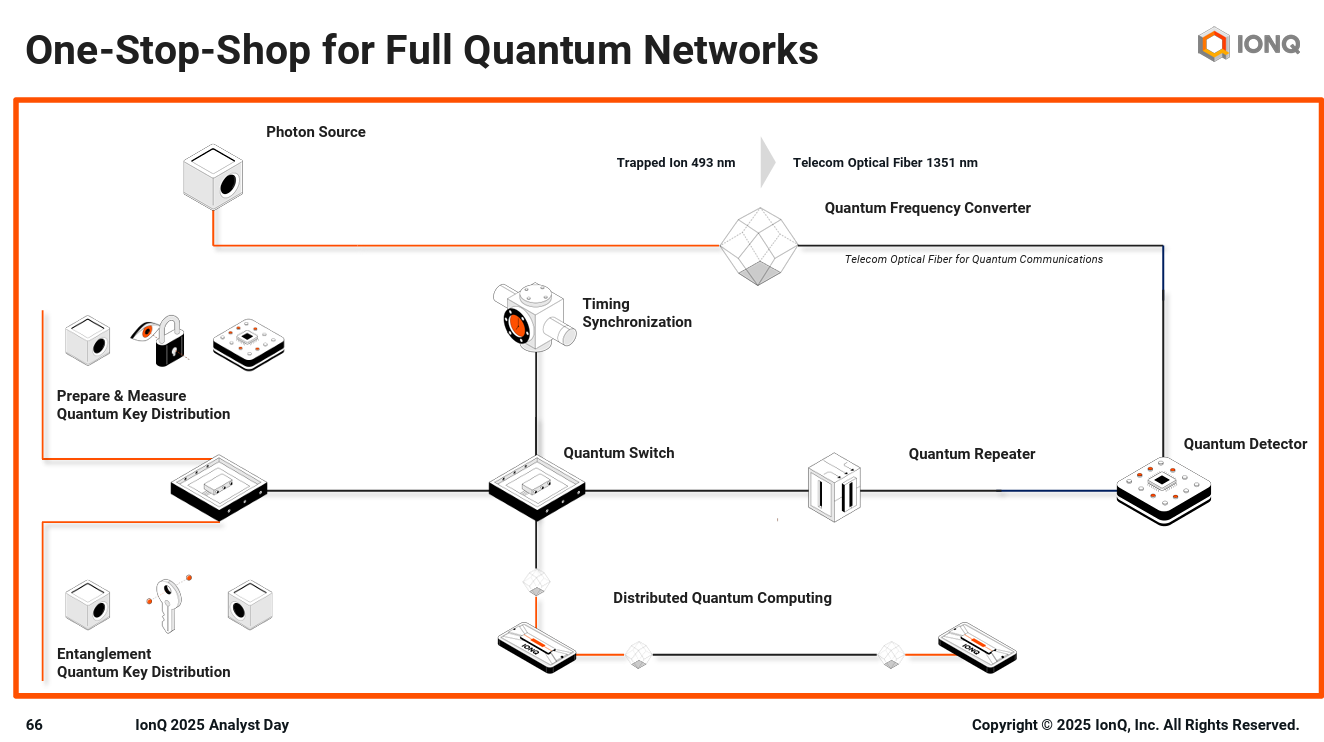
The quantum networking software is part of Cisco's plan to create a unified quantum networking software stack. In some ways, Cisco is also validating IonQ's big push into quantum networking via a series of acquisitions.
In a blog post, Vijoy Pandey, Senior Vice President of Cisco's Outshift unit, said it will release three research prototypes next week at its virtual Quantum Summit. The prototypes include a Quantum Compiler, Quantum Alert, which aims to ensure quantum security, and Quantum Sync, a decision coordination app.
Pandey said Cisco is taking a systems approach to quantum network and is "building a full networking stack from the ground up: developing a quantum networking chip, control software including protocols and controllers for managing the network, and quantum networking applications that solve problems in the quantum and classical worlds."
Cisco's quantum software stack has three layers including applications designed for quantum and classical use cases, a control layer with quantum networking protocols and algorithms and a devices layer that'll connect to physical devices.
The Quantum Compiler prototype will be released next week. The compiler is focused on the scale out of circuits across multiple processors in a quantum data center. The big takeaway is that Cisco's quantum compiler supports distributed quantum error correction.
Cisco's post landed a few days after IonQ outlined its quantum networking strategy during its investor day and threw some shade at larger rivals such as IBM and Microsoft. During the presentations, IonQ outlined its networking strategy just as much as it talked about quantum computing.
Niccolo de Masi, IonQ's CEO, said the company aims to be the Nvidia of quantum computing and compared its networking acquisitions of Oxford Ionics and Lightsync to Nvidia's purchase of Mellanox. de Masi said "we believe we have a 5-year lead on our technical road map over any competitor."
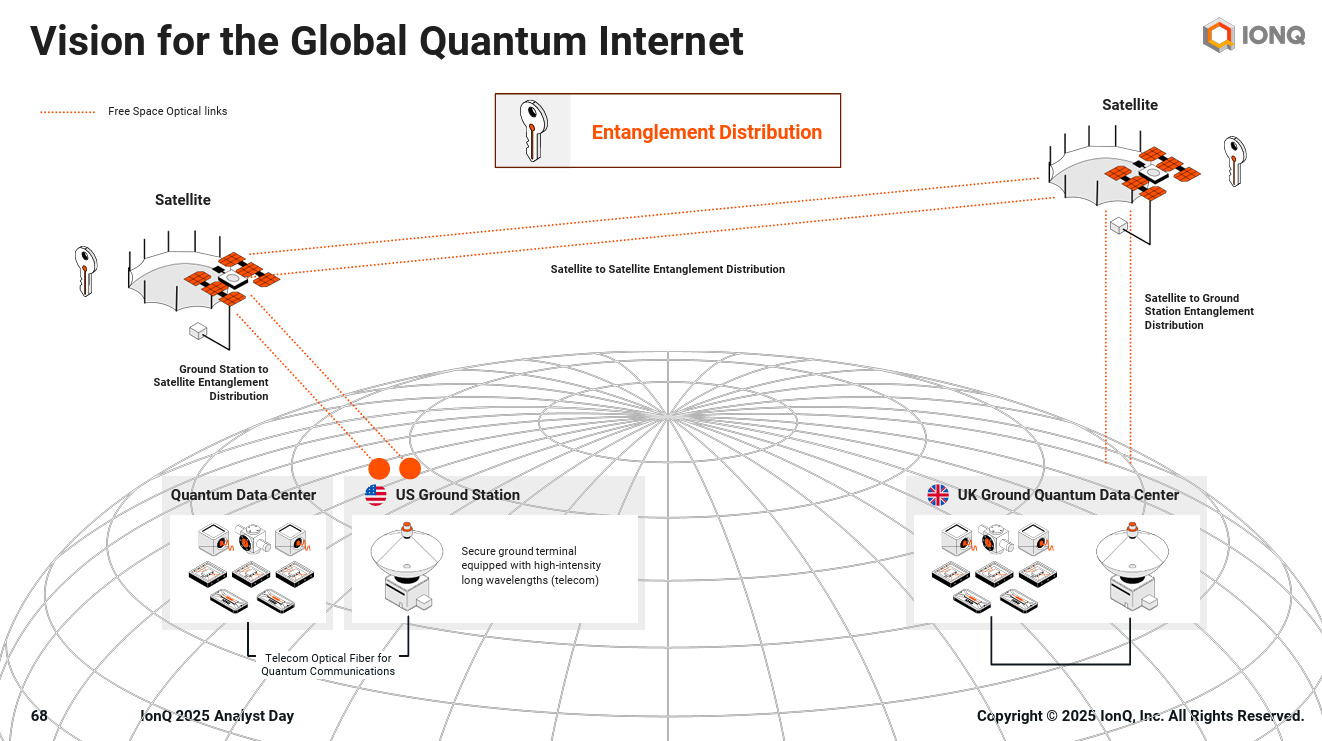
"Quantum distribution and quantum networking is not just something for the future. It's something for today because classical cybersecurity challenges only continue to be nastier," said de Masi, who argued that quantum security is going to need a quantum network. IonQ is even planning a ground to space, space to space and space to ground quantum network.
Mihir Bhaskar, IonQ's head of distributed computing and CEO of Lightsync, said quantum networking can scale quantum computing in data centers.
Bhaskar said:
"Quantum computers and networks really synergize. It is one big network, it is one big computer when you're building a data center. And so, with the ability to build and link quantum computers at a fast enough speed, I think coming together between IonQ and Lightsync is really the Nvidia Mellanox moment that's going to allow us to take the quantum computing technology and enable it to scale."
IonQ's Jordan Shapiro, president and general manager of quantum networking at IonQ, said IonQ's quantum networking gear is interoperable with classical networking gear and that's why it's a one-stop shop for quantum networking. IonQ announced a milestone in quantum networking with the Air Force Research Lab.
"Quantum networks are here. They're already here. They're securing the world's most sensitive data and IonQ is building the foundation for the world's connected data in the future," said Shapiro.
Principal Analyst and Founder
Constellation Research
R “Ray” Wang is the CEO of Silicon Valley-based Constellation Research Inc. He co-hosts DisrupTV, a weekly enterprise tech and leadership webcast that averages 50,000 views per episode and blogs at www.raywang.org. His ground-breaking best-selling book on digital transformation, Disrupting Digital Business, was published by Harvard Business Review Press in 2015. Ray's new book about Digital Giants and the future of business, titled, Everybody Wants to Rule The World was released in July 2021. Wang is well-quoted and frequently interviewed by media outlets such as the Wall Street Journal, Fox Business, CNBC, Yahoo Finance, Cheddar, and Bloomberg.
Short Bio
R “Ray” Wang (pronounced WAHNG) is the Founder, Chairman, and Principal Analyst of Silicon Valley-based Constellation Research Inc. He…...
Is your organization’s legacy “plumbing” holding back innovation and growth? Constellation founder R "Ray" Wang discusses why outdated systems are no longer just an IT problem—they’re a business risk. From hard-coded pricing to fragmented spreadsheets, the pain is real across every department.
Forward-thinking CXOs lead the way by replacing legacy infrastructure with modern platforms that support agility, scalability, and business transformation. It’s time to move beyond duct-taped solutions.
Watch to learn how you can empower your teams to focus on what’s next.
Editor in Chief of Constellation Insights
Constellation Research
Larry Dignan is Editor in Chief of Constellation Insights at Constellation Research, where he leads editorial coverage focused on enterprise technology, digital transformation, and emerging trends shaping the future of business. He oversees research-driven news, analysis, interviews, and event coverage designed to help technology buyers and vendors navigate complex markets with clarity and context. ...
Vice President and Principal Analyst
Constellation Research
Martin Schneider has had a unique career that has spanned both analyst and marketing practitioner roles, focused on high technology and related industries. The unifying factor has always been both a keen analysis of go-to-market trends, while also having achieved success as a marketing leader.
Schneider started his career as a journalist covering B2B technologies, and quickly transitioned into a leading analyst covering application software for the 451 Group in NYC, where he specialized in CRM, marketing automation, and business intelligence/analytics technologies. After analyzing various go-to-market strategies of dozens of technology vendors, Schneider made the move to the vendor side, where he led successful go-to-market teams for several startups and established tech providers,…...
In ConstellationTV episode 114, co-hosts Martin Schneider and Larry Dignan break down the latest enterprise technology news -- Oracle’s new co-CEO structure, the rise of #agenticAI in #enterprise apps, and Thoma Bravo’s $1.4B acquisition of PROS.
Next, Larry sits down with Alex Franco, a Supernova Award finalist and Chief Risk & Tech Officer at Jeito, to discuss how the Brazilian #fintech is utilizing AI and alternative data to expand credit access.
Finally, Martin shares his latest research on #HubSpot, exploring how #AI, composability, and new pricing models are reshaping #CRM for SMBs.
Editor in Chief of Constellation Insights
Constellation Research
Larry Dignan is Editor in Chief of Constellation Insights at Constellation Research, where he leads editorial coverage focused on enterprise technology, digital transformation, and emerging trends shaping the future of business. He oversees research-driven news, analysis, interviews, and event coverage designed to help technology buyers and vendors navigate complex markets with clarity and context. ...
OpenAI launched a new benchmark that grades large language models (LLMs) on real-world work tasks and enterprises need to take note as they ponder AI agents.
OpenAI unveiled GDPval, a system that grades LLMs on tasks that humans currently do. Yes, we know (since vendors tell us repeatedly) that AI is collaborative with humans and not a replacement. But if you were to look to AI as a human labor replacement, OpenAI's GDPval is likely to be handy.
In a blog post, OpenAI noted that GDPval is "a new evaluation designed to help us track how well our models and others perform on economically valuable, real-world tasks."
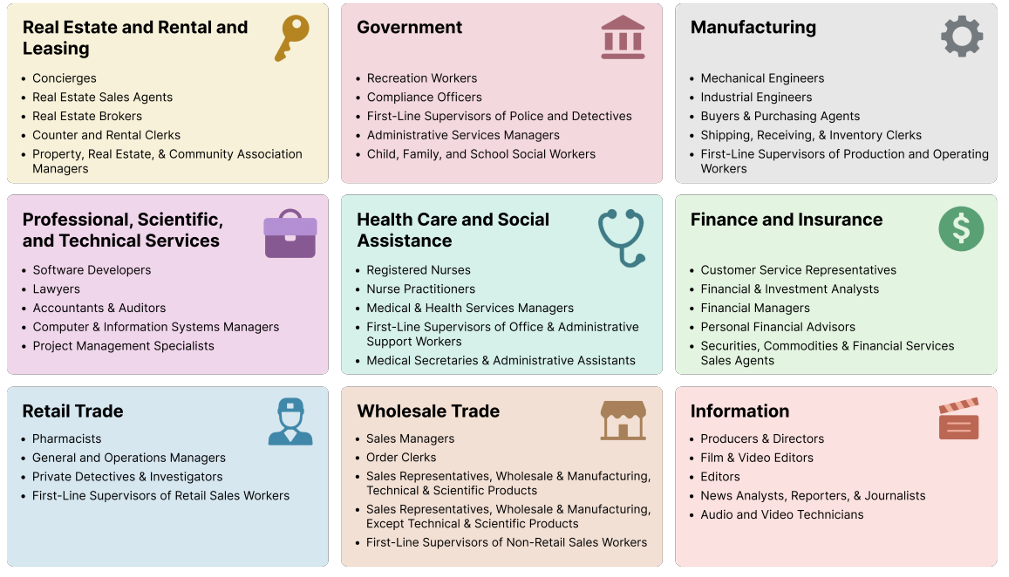
Why GDPval? OpenAI started with Gross Domestic Product (GDP) as an economic indicator and took tasks from the occupations and sectors that contributed the most to GDP.
Here's a look at the occupations and tasks in GDPval.
The win for enterprises is that CxOs can use GDPval to better align models for use cases. The win for the rest of us is that we can now compare models on real-world tasks instead of math exams and other benchmarks that are abstract for most people.
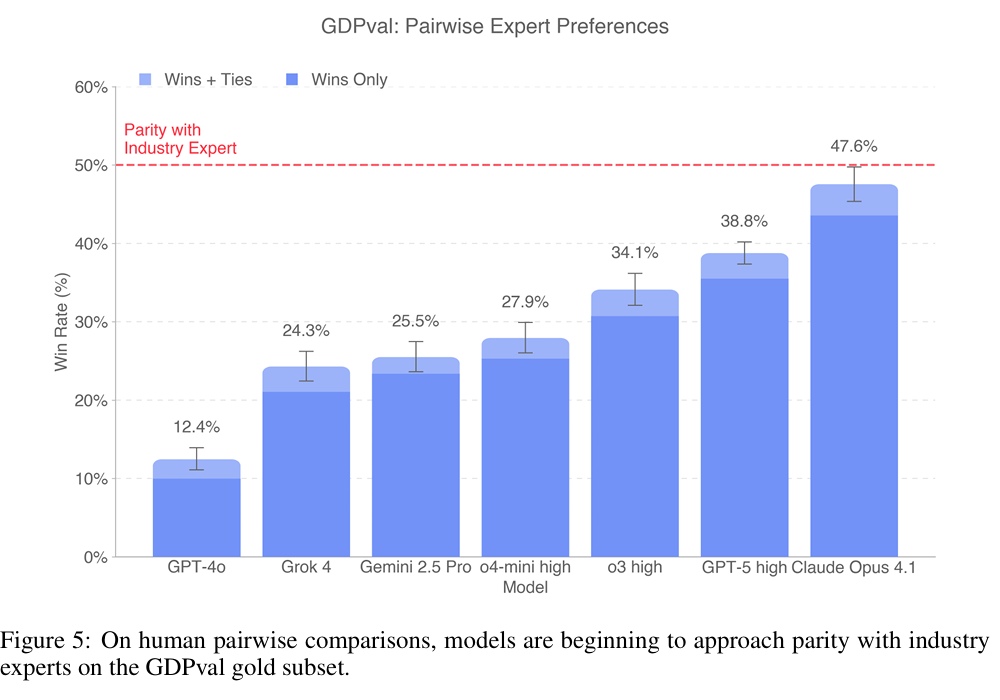
Based on GDPval's topline figures, Anthropic's Claude Opus 4.1 is the leader for work tasks followed by GPT-5.
OpenAI said:
"People often speculate about AI’s broader impact on society, but the clearest way to understand its potential is by looking at what models are already capable of doing. History shows that major technologies—from the internet to smartphones—took more than a decade to go from invention to widespread adoption. Evaluations like GDPval help ground conversations about future AI improvements in evidence rather than guesswork and can help us track model improvement over time."
As for returns, OpenAI also noted:
"We found that frontier models can complete GDPval tasks roughly 100x faster and 100x cheaper than industry experts. However, these figures reflect pure model inference time and API billing rates, and therefore do not capture the human oversight, iteration, and integration steps required in real workplace settings to use our models. Still, especially on the subset of tasks where models are particularly strong, we expect that giving a task to a model before trying it with a human would save time and money."
A few thoughts on how CxOs may approach GDPval:
GDPval can make it easier to compare digital and human labor costs. For instance, a model that can deliver good work in one shot is more beneficial than one that requires a lot of back-and-forth since that drives compute costs up.
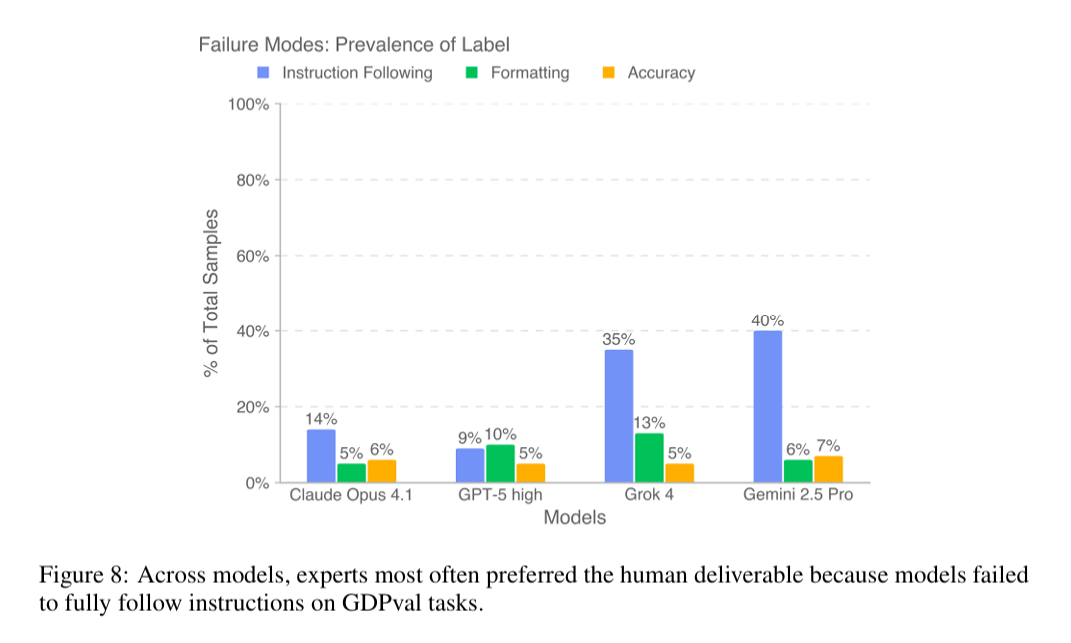
OpenAI's GDPval paper also includes failure modes and the reasons why. Failure rates are going to be critical for proper evaluation.
The benchmark also provides an opportunity to think about workflows and processes before humans work on the task. OpenAI's point about using AI to get a task partly to the finish line is valid. However, it's also worth noting what Harvard Business Review just reported on sloppy AI work.
Humans in the loop during a process is probably the most important decision to make in using AI to automate processes. GDPval gives you a jumping off point for discussion.
Editor in Chief of Constellation Insights
Constellation Research
Larry Dignan is Editor in Chief of Constellation Insights at Constellation Research, where he leads editorial coverage focused on enterprise technology, digital transformation, and emerging trends shaping the future of business. He oversees research-driven news, analysis, interviews, and event coverage designed to help technology buyers and vendors navigate complex markets with clarity and context. ...
Accenture CEO Julie Sweet said the company is seeing an inflection point with companies adopting artificial intelligence enterprise-wide and scaling use cases.
"We're also starting to see early signals of an inflection point with more clients looking for true enterprise-wide plans and activation and seeking out our successful experience with scaling in enterprises and at Accenture. Two years into this AI journey, we also are seeing a pattern in how AI can expand our opportunities with our clients."
Sweet said many of these AI projects also require AI readiness, which means more transformational work. Those chores include data modernization to go along with digital operations and cloud deployments. She cited a financial services client that is using Accenture to modernize the data estate, but that also requires retiring legacy systems and more foundational work.
"We're seeing more stories like this across our portfolio, where AI is extending across the enterprise and adjacent work is following," said Sweet. "Building the digital core remains our biggest growth driver."
Banking is one of the main industries revamping the data stack. Sweet added that Ecolab is redesigning processes and then scaling into AI agents. "Ecolab is on a path to deliver an estimated 5% to 7% sales growth and 20% operating income margin without increasing costs at the same pace," said Sweet.
Accenture reported fourth quarter earnings of $2.25 a share on revenue of $17.6 billion, up 7% from a year ago. Accenture recorded new bookings of $21.3 billion in the fourth quarter and $1.8 billion of that sum was generative AI. GenAI bookings doubled for fiscal 2025 to $5.9 billion and revenue tripled to $2.7 billion.
For fiscal 2025, Accenture reported earnings of $12.15 a share on revenue of $69.7 billion.
As for the outlook, Accenture said it expects fiscal 2026 revenue growth of 2% to 5% in local currency. Earnings will grow at a 9% to 12% clip.
Other takeaways from Accenture's fourth quarter:
Sweet added that many of Accenture's customers are enterprises that tried do-it-yourself AI but ran into roadblocks scaling projects. "We've had lots of clients who have started things on their own and then come to us who've got good proof of concept that their team was able to do but then just can't scale it," said Sweet.
AI savings are being reinvested. "AI absolutely boosts efficiency in areas like coding or operations. But those savings don't disappear. They're being reinvested into new priorities. The list of what our clients want to do with technology is truly virtually unlimited. And so, when we can save them money by delivering our services with advanced AI, that frees up their budget to do the next things on their list," said Sweet.
Companies are held back by change management and process reinvention.
AI strategy includes growth and savings. "Almost every CEO that I've talked to says they pivoted way too far towards productivity and not enough to growth," said Sweet.
Editor in Chief of Constellation Insights
Constellation Research
Larry Dignan is Editor in Chief of Constellation Insights at Constellation Research, where he leads editorial coverage focused on enterprise technology, digital transformation, and emerging trends shaping the future of business. He oversees research-driven news, analysis, interviews, and event coverage designed to help technology buyers and vendors navigate complex markets with clarity and context. ...
Watch this exclusive interview with Octavian Tanase, Chief Product Officer at Hitachi Vantara, and Larry Dignan, Editor in Chief of Constellation Research, as they explore the future of AI in the enterprise.
Discover how Hitachi Vantara is integrating autonomous AI, leveraging edge computing, and forming strategic partnerships to deliver comprehensive, sustainable solutions for data-driven businesses. Don’t miss these insights on the evolving AI landscape and what’s next for enterprise technology.
Editor in Chief of Constellation Insights
Constellation Research
Larry Dignan is Editor in Chief of Constellation Insights at Constellation Research, where he leads editorial coverage focused on enterprise technology, digital transformation, and emerging trends shaping the future of business. He oversees research-driven news, analysis, interviews, and event coverage designed to help technology buyers and vendors navigate complex markets with clarity and context. ...
Databricks said OpenAI's foundational models will be available in the Databricks Data Intelligence Platform and Agent Bricks natively in a partnership worth $100 million.
The deal highlights how OpenAI is expanding the distribution for its ChatGPT family of models beyond Microsoft and direct access.
Databricks said OpenAI models, including GPT-5, are available to more than 20,000 customers. GPT-5 will also be the flagship model for all Databricks customers.
By offering OpenAI models natively, Databricks customers will be able to build AI agents closer to where data lives with no extra movement.
Key points about the Databricks-OpenAI deal:
Databricks can get OpenAI models via SQL or API.
Databricks customers have access to high-capacity processing across the latest OpenAI models.
Agent Bricks will tune and optimize GPT-4 and gpt-oss for accuracy.
Databricks Unity Catalog will provide governance and observability for OpenAI models.
The two companies will optimize OpenAI models for enterprise use case.
Databricks said GPT-5, GPT-5 mini and GPT-5 nano will be available natively in Databricks across AWS, Microsoft Azure and Google Cloud in the near future.
Holger Mueller, an analyst at Constellation Research, said the OpenAI-Databricks partnership appears to be a win-win situation.
"This partnership emancipates Databricks from the cloud providers who have already partnered with OpenAI - and takes a differentiator for the cloud vendors away. Cloud vendors' data lake houses work seamlessly with their AI frameworks. CxOs now have options on how to build their AI powered next-gen apps.
If Databricks plays this well it becomes the multi cloud data and LLM foundation for enterprises. Being multi cloud has ways paid off at any level of the stack - and there is no reason for it not to work for Databricks. What is unique is that this touches more layers of the stack."
Editor in Chief of Constellation Insights
Constellation Research
Larry Dignan is Editor in Chief of Constellation Insights at Constellation Research, where he leads editorial coverage focused on enterprise technology, digital transformation, and emerging trends shaping the future of business. He oversees research-driven news, analysis, interviews, and event coverage designed to help technology buyers and vendors navigate complex markets with clarity and context. ...
The European Commission has formally opened an investigation of SAP and its maintenance and support practices for on-premises deployments in Europe.
In a statement, the EC said it has started an investigation into whether SAP "may have distorted competition in the aftermarket for maintenance and support services" for its on-premises ERP applications.
SAP's requirement that customers seek maintenance and support from the company for on-premises ERP under the same pricing for all software and preventing enterprises from mixing and matching services from other suppliers.
Preventing customers from terminating maintenance and support for unused software licenses.
SAP systematically extending the duration of the initial term of on-premises ERP licenses so customers can't terminate maintenance and support.
SAP charging back-maintenance fees to customers that subscribe to SAP maintenance and support after a period of absence.
"These proceedings address some areas of our on-premise maintenance and support policies, which are based on long-standing standards that are common across the global software sector. SAP believes that its policies and actions are fully in line with competition rules. However, we take the issues raised seriously and we are working closely with the EU Commission to resolve them.
We do not anticipate the engagement with the European Commission to result in material impacts on our financial performance."
Editor in Chief of Constellation Insights
Constellation Research
Larry Dignan is Editor in Chief of Constellation Insights at Constellation Research, where he leads editorial coverage focused on enterprise technology, digital transformation, and emerging trends shaping the future of business. He oversees research-driven news, analysis, interviews, and event coverage designed to help technology buyers and vendors navigate complex markets with clarity and context. ...
Hitachi Vantara is embedding AI agents throughout its storage systems, seeing customers embrace more hybrid cloud and on-premise AI architectures and betting on AI at the edge and sovereign AI as growth markets.
Those are some of the takeaways from Octavian Tanase, Chief Product Officer at Hitachi Vantara.
Constellation Insights caught up with Tanase at Hitachi Vantara's Analyst Live 2025 event in Arlington, VA. At the analyst meeting, Hitachi Vantara highlighted its strategy, customer enterprise AI and industrial AI use cases, hybrid cloud and AI efforts, collaboration with partners including Cisco and Nvidia and how its storage and data platform is leveraging the One Hitachi strategy. Here's a look at the takeaways from the conversation with Tanase.
Enterprise AI adoption. "We see a lot of demand from enterprises looking to get insights out of that data, and use AI to improve productivity," he said. "There's a rush right now to build autonomous modules that will take a business workflow and solve and anticipate problems in an enterprise. Customers are looking to bring in a large language model and train and fine tune with enterprise data before they deploy for inference."
Integrated software with hardware. "We've always seen ourselves as a systems company that builds both software and systems for storage and data management. Storage has been commoditized, and there is more value that can be delivered in software to use not only the data for an application, but to run analytics on that data to get more insights from the data. This is an area of investment for us," said Tanase.
Hitachi Vantara's agentic AI strategy. Tanase said Hitachi Vantara is using AI agents internally for productivity and within the products leveraging it for more autonomy. "We are in the business of providing infrastructure for AI data pipelines that include storage, compute, networking, security and so forth. We are embedding capabilities around the data reduction or data tiering or data classification. These are all areas where one could create an agent and transform a task that required the control and the input of a person into something autonomous," said Tanase.
Customer use cases. "We see a lot of use cases around analytics. A lot of times people will make two or three copies of data. Enterprises are looking to run analytics on data and use AI to do that and coordinate large data sets from heterogeneous data sources," said Tanase.
On-premise and hybrid AI evolution. Tanase said most enterprises started with AI in the cloud because GPUs-as-a-service doesn't require a massive initial investment. What's happening now is enterprises are looking to put AI infrastructure closer to the data. "If the data source is in the traditional data center or being brought from an edge device, enterprises are building AI infrastructure where the data is," said Tanase. "It's too expensive to correlate multiple data silos and move that to the cloud. Customers are sometimes better off building a data lake into their traditional enterprise and then deploying training and inference closer to the data."
Edge computing's importance. "I am a firm believer that there is more data being created at the edge and in the cloud than the data center," said Tanase. "AI will give the power to analyze the data as its created and perhaps enable customers to become more discerning about their data and understand what they need to keep and protect. I'm hoping many of these capabilities in the future are autonomous."
The product roadmap. "Going forward, AI is fundamentally changing everything. The market is moving fast and the standardization of MCP (model context protocol) and other protocols are enabling AI modules to talk to each other," said Tanase. "In order to be relevant in this market, you have to act with agility in a way many companies have not experienced before. Time to market, constant innovation and the reality that no one vendor can do it all are critical."
Tanase added that customers will see integrated systems from Hitachi Vantara and a wide range of natural partners including Nvidia, Cisco, Supermicro, Hammerspace and Commvault to name a few.
Sovereign AI. Tanase said sovereign AI infrastructure is becoming a big market. "AI has become a matter of national security for many countries or provinces, and there is a lot of need to integrate and build sovereign AI," said Tanase. "We live in a very polarized world, and I can see states, governments, and provinces building sovereign AI infrastructure. It's a part of what everybody does in order to compete in the 21st century."
Final word. Tanase said Hitachi Vantara has earned the right to play in the AI space and is being used for critical business applications leveraging structured and unstructured data via VSP 360 and a wide range of systems. "We know our customers. We want to save them time. We invest a lot of tools to enable automation, and we believe that's critical, because people want repeatable results," he said. "Automation is top of mind. We're a leader in infrastructure sustainability and sustainable products save customers money in terms of floor in the data center, cooling power and overall cost of ownership."