The CMO Club and Oracle Deliver New Solution Guide to Help CMOs Transform Their Marketing Organization
The CMO Club and Oracle Deliver New Solution Guide to Help CMOs Transform Their Marketing Organization

Role: Vice President and Principal Analyst focusing on the IOT of Customer Experience and how the cloud is driving more flexible, agile, and robust customer service and customer experiences. In-app or in device customer service is the future. Coverage Areas: Next Generation Customer, Digital Marketing Transformation Bio: As a Vice President and Principal Analyst at Constellation Research, Inc, Petouhoff works with Fortune 100 and 500’s Senior Leadership teams to create strategic customer experience (marketing, sales and service) solutions which engage customers, build brands and grow businesses. Combining her experience as a former Forrester software analyst, PWC systems integrator and change management consultant, Petouhoff leads executive workshops to discuss to not only…...
Read moreThe complexity of marketing has increased exponentially. The question on many CMO’s mind’s range from:
- Do I have the right technology?
- Am I using what I have well?
- What else do I need?
- Are my processes efficient and effective to take advantage of the technology?
- Do my people have the right skills, mindsets and capabilities to deliver on all the various aspects marketing has expanded into – from SEO, to demand gen, to lead conversion, to e-commerce, to branding, storytelling and brand personas, to email, social and digital marketing…?
- Are my strategies going to create the kind of lead conversion rates that will enable to expansion of my team and the respect that they should garner from the senior leadership team?
- Do I have the right customer analytics strategy and can I execute on the data and data warehouses that are required to really know my customer and service real-time information where (channels & devices) when they need it?
To help CMOs meet skyrocketing customer and boardroom expectations, The CMO Club, along with Oracle, released “The CMO Solution Guide for Building a Modern Marketing Organization.” The guide, which is based on interviews with CMOs and digital marketing leaders from major brands including Dow Chemical, JetBlue Airways, MasterCard, PayPal, Quiznos, The Hershey Company and Viking River Cruises, includes insights and best practices that CMOs can apply to build customer-first marketing teams that drive measureable results.

To help marketers successfully manage this transformation, the new CMO Solution Guide provides practical advice from 20 in-depth interviews with CMOs and digital marketing leaders from organizations of various sizes and different industries.
Pete Krainik, CEO, The CMO Club said, “While the number of tools and amount of data available to marketers continues to multiply, the age old challenge of capturing and leveraging the right data to create engaging customer experience across all channels still exists. The first step they must take is to establish the appropriate organizational alignment to successfully create this type of customer experience. While no organization is exactly the same, this guide helps provide easy-to-implement changes that any marketer can use to drive transformation.”
While there is no organizational model that fits every company universally, four key themes emerged during the course of the interviews that informed the organizational decisions that CMOs make: Acumen, Alignment, Agility and Accountability. More on those below:
- Acumen: To become more effective modern marketers, respondents reported that enhancing the skills within their department has become a top priority. From developing valuable customer insights through data mining to investing in content creation and the need for greater evaluative analytics, leading marketers are investing heavily in helping their teams learn new skills.
- Alignment: From top to bottom and across all functions, the guide shows that it is critical for all departments to follow the same processes and company culture in order to effectively engage customers across all touchpoints.
- Agility: To meet consumer demands for exceptional customer experience, the guide noted how important it is for businesses to have strong cross-functional teams and the flexibility to pilot something new to test and learn best practices.
- Accountability: To demonstrate marketing’s impact on the bottom line, the guide recommends establishing the right measures from the outset and instilling a culture of personal accountability around those parameters.
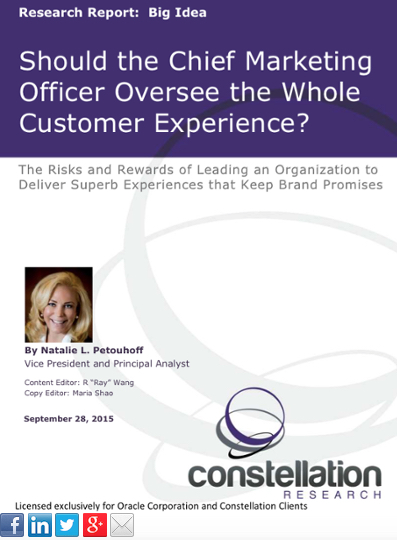
Along those lines is a larger question that looms in most organizations. That question is who should be the general manager of the overall customer experience? CMO’s are well positioned to be that person, but there are risks as well as rewards in taking on that responsibility. I’ve outlined some of them in a new report Should the Chief Marketing Officer Oversee the Whole Customer Experience? And I look forward presenting the accompanying webinar coming up later 2016.
While most brands may not realize it, they are competing on one important variable: customer experience. With all other things being equal, we are in a service economy and there’s nothing that is more important than the experience customers have with companies. And it’s not the brand promise creating by marketing that makes up that customer experience, but also the experience customers have with sales, service and back office operations. It’s not an easy question, but one that must be answered by every senior leadership team and their board of directors. That is what digital disruption is all about and companies not understanding this will go out of business or be acquired or merged for their customer list and cash flow. Poor customer experience, no business. Period. It’s that simple.
@DrNatalie, VP and Principal Analyst, Constellation Research
Covering Customer Facing Capabilities of Organizations to Deliver on Better Customer Experiences




 trends, are all making stores matter again. Most significantly the redefinition of the store’s role allows traditional retail to tackle the pure eCommerce players. 2016 will continue to see this evolution of the store. Gaining improved inventory visibility, empowering store associates with greater information, enhanced operational data to allow more business processes to be tested and adopted are all areas where retailers will be seeking appropriate solutions. Look for retailers to lean on their solution and service providers to bring them the necessary technology and business processes that can allow retailers to continue to transform their physical assets. Solution and service providers must work with their retail clients to not only provide technology or business process solutions, but to also offer strategic insights and ideas. Technology is not the panacea but the enabler for new ideas and processes.
 technology giants Amazon and Google continue to push on how to leverage these machines to address last mile delivery. Additive manufacturing will continue to play a role in the manufacturing process, but will also create new business models. Companies such as Lowes are already experimenting with





 Apple iOS 6 as well as Android, suggesting that this cannot be too difficult to achieve). The notion of Cardboard goggles may seem a little weird, even whacky, but the principle of creating highly affordable mass market Virtual Reality could well become achievable by this approach.