Results

7 Key Takeaways for Digital Leaders from #MSIgnite #MSEnvision 2017

7 Key Takeaways for Digital Leaders from #MSIgnite #MSEnvision 2017

Microsoft's largest combined event of the year, Microsoft Ignite and Envision, are currently the pre-eminent industry showcases for the sprawling breadth and depth of the technology giant's extensive portfolio of platforms, tools, applications, and other enterprise capabilities.

Making sense of the 1000+ sessions, the evolution of dozens of products, as well as the shifting/maturing of the company's vision for digital transformation, digital workplace, and customer/worker/partner experience is a truly daunting task these days. Yet it's also necessary because the company remains perhaps the single most important overall technology vendor to the enterprise, with its platforms running the end-user computing devices, front office, back office, and cloud/edge infrastructure -- in some combination -- of virtually every organization in the world today.

2017 marks a watershed year for Microsoft, with a continuing sense of renewal in the company's fortunes under CEO Satya Nadella, whose new book Hit Refresh describing the reorientation and rebooting of the entire company during his leadership went on sale this week during Day 2. His keynote on the opening day was perhaps the most succinct strategic overview of what's new in Microsoft's strategic vision, which included some innovative and unexpected ones, as we'll see.

Microsoft's Foundation for Digital Transformation of Business: Azure, Office 365, Dynamics 365, LinkedIn, Microsoft Graph

Microsoft's Demonstrates Increasingly Fast Pace for Products

The evidence for this renewal shows: The company's many product lines are evolving faster than they ever have before. For once, enterprises are no longer waiting for the company to innovate (a once common complaint.) Instead, they are now being propelled along by a steady stream of rapid product development by the software giant. This breakneck cadence is one that VP of Office, OneDrive, and SharePoint Jeff Teper has been helping orchestrate for several years now. This has aided the company in catching up in numerous areas, and in many cases pulling ahead, of its competition.

Thus, Microsoft's pace today is one of a fast-moving and nimble startup more than a technology juggernaut: Microsoft's flagship cloud offering, the rapidly growing Azure platform, is doing better than ever, and has arguably become the #1 enterprise cloud platform by some estimates, while wide global adoption of the popular and fast-evolving Office 365 cloud suite and other factors almost certainly makes Microsoft the overall largest cloud vendor in terms of enterprise sales.

Now it's up to organizations to decide how to strategically apply Microsoft's capabilities in their journey towards becoming fully transformed digital businesses. Answers to important questions will be key for momentous decision points of digital leaders over the next few years: Where is Microsoft actually going to take its customers in the next few years? Is the firm genuinely preparing organizations to reach an effective and unique disruptive posture, or are they largely raising every organizations' boat in the same way? More importantly, what are the irreversible business decisions (one way changes that cannot readily be undone) that would be made today by using Microsoft as a primary technology provider, especially with its newest offerings?

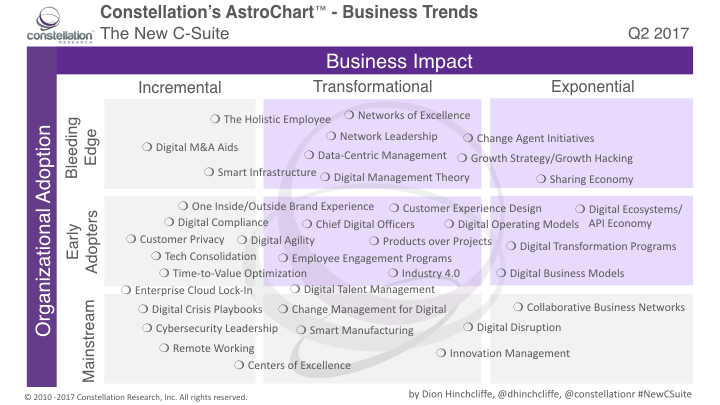
In other words, when looking at the strategic emerging technology landscape which IT and business executives simply must navigate successfully -- please see our 2017 Tech AstroChart for The New C-Suite -- and key business trends for digital -- consult our 2017 Business Trends AstroChart for The New C-Suite -- how can Microsoft best help today?

To assist digital leadership (CIO, CDO, CMO, CHRO, CCO, COO, CEO, digital-ready boards, and other IT/LOB executives) in answering these questions via analysis of the enormous volume of information coming out of Ignite and Envision, I've elaborated below on what I believe the key takeaways in a digital leadership context, based on all the news here in Orlando this week:

Seven Strategic Takeaways from Microsoft Ignite and Envision 2017

  • Microsoft's vision for the front and back office works far better when fully adopted; but enterprises must beware of implication of such commitment. Most digital decision makers prefer to hedge their vendor bets by bringing together multiple providers whenever possible. However, the growing integration between individual applications offers great advantages, but at considerable cost if you have to integrate everything yourself. In an ambitious enterprise data architecture strategy likely to change the status quo, Microsoft's underlying graph model for Office 365, Dynamics, and LinkedIn was showcased prominently in the main keynote at Ignite and Envision, demonstrating a clear path forward for analytics, cognitive technologies, customer experience, and even master data management to be vitally served by bringing together application data onto a single common connected fabric. This has genuine potential to unleash and put to work the entire digital knowledge of an organization to create value for stakeholders and has competitively significant potential. As Nadella pointedly noted during his keynote, every act of using Microsoft apps now enriches the enterprise graph for everyone in the organization continuously. This is the inherent power and advantage of a single deeply integrated cloud platform. Bottom Line: Digital leadership must be aware this value also comes in exchange for the not-inconsequential risk of enterprise cloud lock-in, a major cautionary signpost on this year's New C-Suite Business Trend AstroChart.
  • As a digital workplace reality, Microsoft has become the leading player, yet is still making major changes. Workforce experience and even employee engagement can be greatly impacted and improved by digital tools, such as Microsoft's new F1 offering for front line workers. The many different roadmaps shown at the two events for its flagship Office 365 platform show that Microsoft plans to continue a sustained and very fast-paced evolution for the large -- and some would say increasingly bulky -- set of front office digital capabilities, from office productivity to collaboration and engagement. But Microsoft's digital workplace vision tends to be highly tech-centric and focused on producing digital artifacts or enabling communication. Higher order functions like talent management, employee engagement, and orchestrating strategic change programs and change agents are still not well-represented, even as they are priorities of digital leaders today. A little more sobering was perhaps one of the most impactful announcements of either event: The announcement that Microsoft will phase out Skype for Business in favor of the new -- albeit exciting and future-facing -- Microsoft Teams for most unified communications functions (voice, video, chat, etc.) This was a brave move that is likely to be ultimately shown to be the right decision in my analysis, yet it will give headaches to IT teams everywhere as they scramble to deal with the implications, cost, deployment, and mass retraining of workers and support staff. Bottom line: Most organizations can now bet on Microsoft's fast evolving digital workplace as a vision and roadmap with a strong future, but only if they are prepared to deal with significant changes of direction as the company seek to quickly find the right path(s) forward.
  • Microsoft has become capable as a full-strength and combined business and technology partner for digital transformation. Citing Maersk, Rolls-Royce, Ford, and a long list of recognizable corporate names, Microsoft is currently enabling some major digital transformations on a global scale. Judson Althoff has been an effective spokesperson on this topic for the company for a while now and had a prominent keynote on Day 1 at Envision, which I attended. I've analyzed Judson's take on this topic before and found it credible, as Microsoft is preparing now to be as much a business partner as a technology company in helping companies lead the reimagining of their business. The Rolls-Royce case example was a good one, and was presented at length. Bottom line: The Microsoft vision and strategy for enabling digital transformation for its customers is broad, compassing, and increasingly proven through case examples, though it appears more bespoke than blueprint based as others are.
  • In vital emerging enterprise technologies, such Internet of Things (IoT), blockchain, and artificial intelligence (AI), Microsoft is competent but largely remains tactical. Enterprises usually seek a partner that can stay ahead of where the market is and incorporate new disruptive technologies into the IT platforms that businesses have strategically adopted, as they emerge in the market. In this regard, Microsoft is staying competitive with SAP and IBM with its Azure IoT suite, Azure Cognitive Services (for artificial intelligence), as well as their emerging blockchain capabilities. I also had several conversations at Microsoft Ignite with Microsoft's cognitive product experts and was given a favorable impression that they are heading in the right direction overall. However, they remain focused on more foundational use cases and are only now considering the more strategic enterprise picture. Cognitive services, Internet of Things, and blockchain -- combined with supporting analytics -- all have the potential to remake our businesses in key enterprise activities like strategic decision making, forecasting, risk management, and compliance. However, the company does not yet deliver IoT, AI, or blockchain technologies for these types of functions as yet, though they do appear to be on the radar in my conversations. Bottom line: Though much of the vision is there, Microsoft needs more time to mature and up-level the business capabilities for the current crop of emerging tech that has high disruptive potential. Certainly some startups are well ahead here and will likely remain so for a while. (Please see my enterprise tech to watch in 2017 for a full list of disruptive tech.)
  • While big software suites are still the go-to choice for many digital leaders, Microsoft is enabling an increasingly modular, take-what-you-need services-based approach. Time and again in briefings with product managers and experts at Envision and Ignite, PowerApps was cited as a way for end users to shape IT into what they need, often by just taking a fraction of the Microsoft product that they need to solve a given problem. While user-defined IT is a candidate for my yearly tech trends list, the approach has as much to do with the microservices trend that has risen to the level of the C-Suite in many parts of the industry. Why is this important? Because it heralds Microsoft realization that IT must be able to go to the customer in whatever form, mode, and channel is best. To do this, Microsoft is attempting to make its IT solutions as consumable as possible in a multi-vendor and an increasingly federated/hybrid/decentralized IT world. This is actually fairly visionary and makes them a strong partner in many important and future-enabling ecosystem strategies, if they can sustain this as an initiative. Bottom line: Microsoft is becoming a much more digital-savvy and native company -- or least its heading in the right direction for now -- further strengthening it as a strategic business and technology partner.
  • As large and extensive as its capabilities are, Microsoft cannot by itself tackle the full set of priorities of The New C-Suite. The extensive announcements and elaborate roadmaps around so many existing products as well as the arrival of new ones at Ignite and Envision still belie the complexity of today's digital world. As rapid as Microsoft appears to be pushing on the accelerator to speed up product development and innovation, the digital world is still evolving faster, and enterprises must find ways (and partners) to manage the change velocity. Even though it's now arguable at the company's pace is one of the fastest overall in the industry, there's simply too much to do today to be satisfied by one vendor, no matter the size. Although there's been a recent wave of large organizations moving to becoming largely Microsoft shops, federated IT landscapes are actually becoming more the norm as apps and Shadow IT (for better or worse) proliferate. Bottom line: Microsoft can serve as the anchor IT provider, but a large and growing constellation of play-nice 3rd parties is required to succeed in digital transformation today.
  • Companies looking for a truly disruptive technology partner, can start to look at Microsoft anew. This is perhaps best demonstrated by the unexpected and surprising to many announcement of early quantum computing support in Azure, available later this year. While I'll complete my analysis shortly of why the quantum computing announcement at Ignite was potentially such major news, the fact that no other major enterprise vendor is announcing anything in this area, much less pre-announcing commercial cloud services shows that Microsoft is willing to take significant risks in a real way today, both with products and reputationally. Given the nascent state of the quantum computing market, this is a early and significant move that has the potential to both confuse customers as well as potentially lead them into the future. Bottom line: With this and other bold announcements of late, Microsoft is clearly willing to make significant bets. Digital leaders can certainly opt not to follow, but have more access to the major cutting edge technologies from Microsoft now than in years past.

While the news was largely incremental except for a few big announcements (quantum computing, hybrid Azure, and the shift away from Skype), the amount of house-being-put-in-order, refining, and detailing out of Microsoft's cloud offerings for the enterprise was both tangible and impressive in its own right. There was palpable buzz and excitement at Ignite in particular, as Microsoft exuded a message that it knew what it was about and was delivering on it. That said, Microsoft now has the scope and breadth of a vast product set, along with a vision that may be hard to stick to as a commercial company, especially in terms of modularizing its offerings (good for customers but it can certainly lowers sales potentially) and creating a comprehensive set of APIs that opens up data for integrating and ecosystem use (also good for customers, but is a path for migration away from Microsoft.) If they can keep this direction, and sustain a fast growing business out of it (which every sign shows it the case at the moment), Microsoft and its customers have a solid near future ahead of them given what transpired in Orlando this week.

Additional Reading

Microsoft Ignite & Envision 2017 Announcements and Analysis by Holger Mueller

Microsoft Stresses Choice, From SQL Server 2017 to Azure Machine Learning by Doug Henschen

Data to Decisions Future of Work New C-Suite Next-Generation Customer Experience Tech Optimization Innovation & Product-led Growth Marketing Transformation Microsoft AI ML Machine Learning LLMs Agentic AI Generative AI Analytics Automation B2B B2C CX EX Employee Experience HR HCM business Marketing Metaverse developer SaaS PaaS IaaS Supply Chain Quantum Computing Growth Cloud Digital Transformation Disruptive Technology eCommerce Enterprise IT Enterprise Acceleration Enterprise Software Next Gen Apps IoT Blockchain CRM ERP Leadership finance Social Healthcare VR CCaaS UCaaS Customer Service Content Management Collaboration M&A Enterprise Service Customer Experience Chief Customer Officer Chief Information Officer Chief Marketing Officer Chief Digital Officer Chief Data Officer Chief Technology Officer Chief Analytics Officer Chief Information Security Officer Chief Executive Officer Chief Operating Officer

Event Report - Microsoft Ignite / Envision 2017 - Broad push - few highlights

Event Report - Microsoft Ignite / Envision 2017 - Broad push - few highlights

We had the opportunity to attend Microsoft’s combined Ignite and Envision events held in Orlando, taking place from September 24th till 28th2017. It was the first time Microsoft merged the two events, resulting in a conference that was attended by almost 30k people. As usual with Microsoft, analyst, influence and press attendance was massive.
 
A video shows more than a 1000 words, so if you prefer to watch: (if the video doesn’t show up, check here)
 
 
No time to watch – here is the 1 slide condensation (if the slide doesn’t show up, check here):
 
Want to read on? Here you go: Always tough to pick the takeaways – but here are my Top 3:
 
Microsoft is serious about Quantum – During Nadella’s keynote, the Microsoft CEO unveiled the vendor’s ambition in the field of quantum computing. Not too specific on what and when will be available hardware wise, but clear enough that Microsoft is serious on the investment. The most tangible parts of the overalls strategy that materialized in Orlando were with Visual Studio and Azure. Microsoft will provide a new programming language to build Quantum applications – and with that position itself early in the Quantum programming race. Likely this will not get enterprises to soon to build them, but the early platform will help Microsoft in research and academia. On the Azure side, Microsoft will provide a simulator for up to 30 Qubits, system wise that would be the largest system / simulated system out there as of now.

 
Microsoft Ignite Envision 2017 Holger Mueller Constellation Research
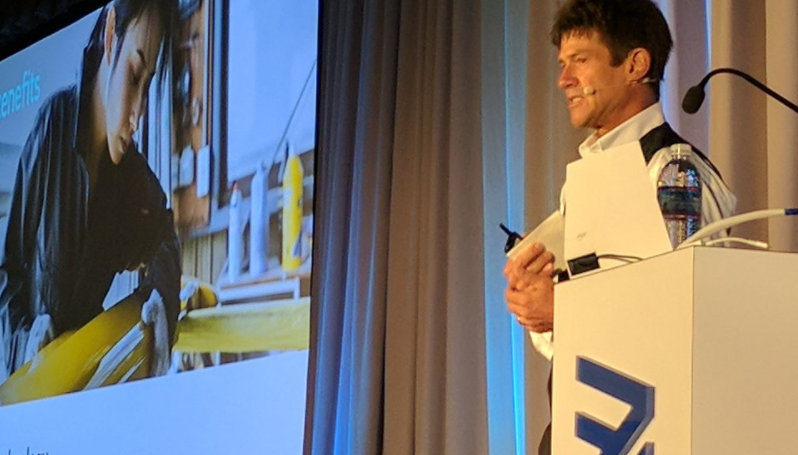
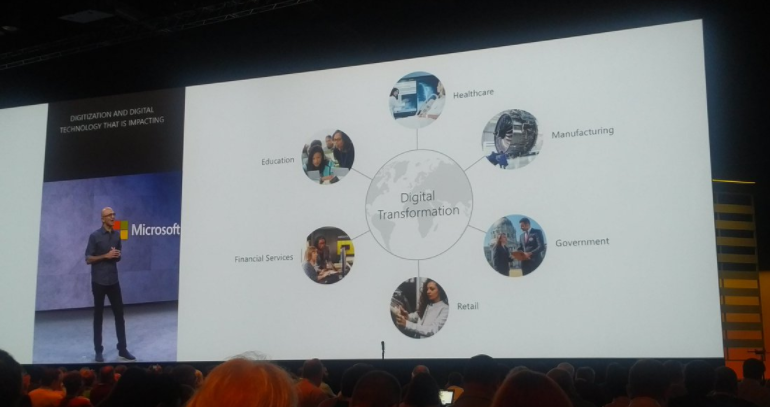
Nadella talks Digital Transformation
Cosmos DB gets air time – Cosmos DB, the former DocumentDB, got a lot of air time in the keynotes. And the database has a lot to offer: Easy setup, admin, data migration, global consistency and now   has access to Azure functions to build serverless applications. A key component to consider for global next gen applications, with a strong NoSQL profile.
 
Microsoft Ignite Envision 2017 Holger Mueller Constellation Research
The three graphs at Microsof
Visual Studio gets a push – Though Ignite and Envision are not developer conferences, there was plenty of attention and airtime for Visual Studio. Not only does Visual Studio support a brand-new programming language for Quantum applications, it’s remains the developer platform for building next generation applications in the Microsoft ecosystem. That means that Microsoft is making it easier for developers to access the interesting innovative technologies of these days – speech recognition and machine learning. The bot framework is now well integrated and makes it easier for developers to build bot / chat based applications. The inherent fear of developers to be left behind, be eclipsed by other functions (e.g. Data Scientists. AI Pros etc.) is being addressed this way. And of course, Microsoft plays the DevOps, CI / CD and now – continuous innovation game. Putting more intelligence (and automation) in the development process will certainly be welcome by developer as well as enterprises. And Microsoft keeps building out capabilities that it has acquired with Xamarin, probably one of the best acquisitions Microsoft has made with a direct impact in developer and enterprise productivity.
Microsoft Ignite Envision 2017 Holger Mueller Constellation Research
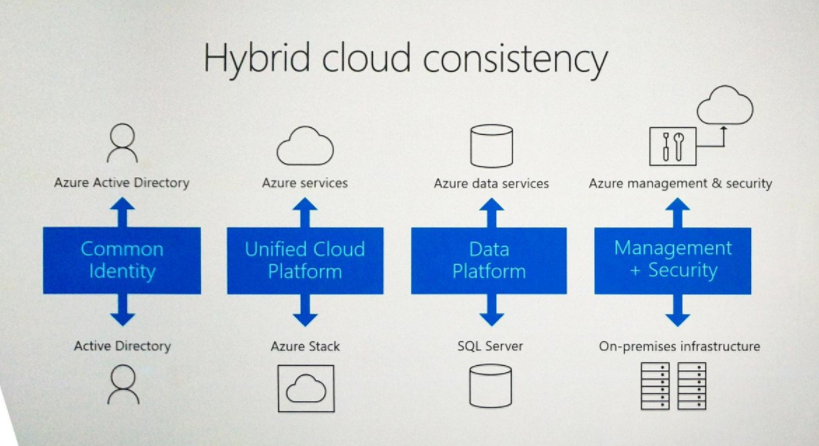
Microsoft Hybrid Cloud Pillars
Azure Stack is now GA -  After a pivot from own hardware to partner hardware, Azure stack is now (finally) available for enterprises. The over one-year delay is a proof how complex the traditional architecture and technology roll out in the partner model is. But now Azure stack can be offered (alphabetically) by Cisco, Dell, HP and Lenovo. And with that Microsoft has the partners that are still planning to make substantial revenue on premises, and are grateful for Microsoft to offer Azure Stack. Likewise, are enterprises who still want / need to deploy on premises … with the option to move some or all that load to the (Azure) cloud later.
 

MyPOV

A good event for Microsoft, that showed Microsoft’s broad push across all its products. Customers will welcome that more pieces fit together (for instance CosmosDB and Azure Functions – even the brand-new ones in this case) and that existing products are strengthened (e.g. Visual Studio). But the even lacked the very big announcements, maybe because Build earlier in this year was announcement rich. Maybe because even the GA of major achievements, like GA of Azure Stack get consumed with continuous talk and announcements. Good to see Microsoft being early and laying a foundation for Quantum computing. This architecture is likely going to be the first computing architecture that will no be deployed in the enterprise - at all possibly. Key for all IaaS providers to have it early in the arsenal, especially given the novelty and challenges of Quantum computing. 
 
On the concern side Microsoft took an even more notable timeout on the Hololens side. And despite making key announcements that matter to customers (for instance support for Kubernetes, Tensorflow, CloudFoundry), these partnerships were all mentioned in the keynotes but not shown in demos (I may have missed them) or announced in roadmaps. Instead a lot of innovation on Docker came to light, e.g. SQL Server 2017 can run in… a Docker container. The biggest challenge enterprises have with Microsoft is the absence of a holistic PaaS strategy. Microsoft has a strong element with Visual Studio, components with Flow and others, but needs to tie it all together to compete with the other PaaS offerings out there. On the flipside, Microsoft is solving massive problems when it comes to synthesizing the three graphs it has now - the Microsoft, Office and LinkedIn graphs. That takes time to sort out properly. 
 
But for now – substantial progress – it cannot always be fireworks. Product development takes time and sometimes event schedules and product cycles don’t align. The good news is – customers are waiting and genuinely excited about the progress that Microsoft is making. Stay tuned.
 
Want to learn more? Checkout the Storify collection below (if it doesn’t show up – check here). A Storify of Scott Guthrie's keynote can be found here

Find more coverage on the Constellation Research website here and checkout my magazine on Flipboard and my YouTube channel here. 
Tech Optimization Innovation & Product-led Growth Event Report Microsoft Executive Events Chief Information Officer

Digital Transformation Digest: Microsoft Lays Out Quantum Computing Vision, SAP Acquisition Underscores GDPR Urgency, Amazon's India Retail Play

Digital Transformation Digest: Microsoft Lays Out Quantum Computing Vision, SAP Acquisition Underscores GDPR Urgency, Amazon's India Retail Play

Constellation Insights

Microsoft sets out quantum computing vision: While Microsoft has been investing in quantum computing research for more than a decade, it took a significant step forward during this week's Ignite conference, unveiling a new progamming language aimed at quantum computers that is fully integrated with its Visual Studio developer environment.

Microsoft is also releasing quantum computing simulators that can be run on local machines or on Azure. The language and tools will be available at no charge by the end of this year.

"We set out with a goal of not just achieving a few scientific milestones, but rather what would it take to build a truly scalable quantum computer," Microsoft CEO Satya Nadella said during a keynote.

While classical computers are binary, storing bits as either a one or a zero, quantum systems leverage the behavior of subatomic particles, which can hold multiple states. This phenomena, which is known as superposition, stands to give quantum systems vast amounts of processing power. 

For his part, Nadella referred to that favorite fall tradition, corn mazes, to explain the difference. While a traditional computer would solve the by "brute force," checking one possible path through after another, a quantum computer introduces "amazing parallelism" and could take every path in the corn maze simultaneously, he said.

POV: Microsoft has made major investments in people for its quantum research, bringing on the likes of Fields Medal-winning mathemetican Michael Freedman. He and other Microsoft quantum researchers representing math, phsyics and computer science disciplines joined Nadella onstage for a roundtable discussion aimed at explaining how quantum computing works at a conceptual level, and showcasing Microsoft's advancements, which include a new chip.

Microsoft may have been working on quantum computing for more than 10 years, but is a bit behind the likes of IBM and Google overall. IBM has said it will have commercial quantum systems in the market within a few years. It launched Quantum Experience, which allows developers to interact with an IBM quantum computer through its cloud, in 2016. Google, among others, is close to achieving "quantum supremacy"—the development of a quantum computer than can complete a task faster than the world's fastest supercomputers.

Notably, Microsoft made no announcements regarding the future availability of quantum computing services. But it's a safe bet that when they are available, the vast majority will be procured through Azure. General-purpose quantum computers are years away, but in the meantime, Microsoft is making a smart play by introducing a quantum software stack delivered through the familiar Visual Studio environment. Getting its vast developer community skilled up on its flavor of quantum is a good way to seed the future market.

SAP buys Gigya for customer identity management: Mass personalization at scale is a key goal of any customer engagement strategy. To that end, SAP has acquired customer identity and access management vendor Gigya for a reported $350 million. SAP's Hybris omnichannel e-commerce division had already partnered with Gigya since 2013. Here are the key details from SAP's announcement:

Gigya’s customer identity and access management platform helps companies build digital relationships with their customers. Its platform allows companies to manage customers’ profile, preference, opt-in and consent settings, with customers maintaining control of their data at all times. Customers opt in and register via Gigya’s registration-as-a-service, which addresses changing geographical privacy issues and manages compliance requirements such as the upcoming General Data Protection Regulation (GDPR). Gigya currently manages 1.3 billion customer identities in order to build identity-driven relationships for its enterprise clients.

POV: While referred to almost as an afterthought in SAP's announcement, GDPR-readiness is a hugely important and pressing task for companies in or which do business in the European Union. The strict new privacy framework goes into effect in May 2018 and will be vigorously enforced. Companies in violation can be fined up to 4 percent of their annual revenue and the EU is expected to collect billions in fines during the first year of its enactment.

Amazon expands brick-and-mortar presence in India: For a mere $28 million, Amazon is gaining a presence in 80 Indian brick-and-mortar locations. That sum has given Amazon a 5 percent stake in Shoppers Stop, a national department store chain. Amazon will open "experience centers" in the stores, where shoppers can try out products that are available online. In turn, Shoppers Stop plans to open an additional 20 stores.

POV: The deal is a pittance compared to the $5 billion Amazon CEO Jeff Bezos has pledged to spend in India overall, but on a strategic basis has some echoes with Amazon's partnership with Kohl's in North America.

One difference is that while Kohl's has developed a strong omnichannel commerce plan, the vast majority of Shoppers Stop's revenue comes from in-store sales, particularly when it comes to clothing. Shoppers Stop represents a chance for Amazon to figure out the best way to convert the chain's loyal shoppers to online buyers, and in the process gain valuable insights about the Indian market overall.

Data to Decisions Future of Work Marketing Transformation Tech Optimization Chief Customer Officer Chief People Officer Chief Information Officer Chief Digital Officer

Digital Transformation Digest: MongoDB Files to Go Public, Microsoft and Facebook's Massive Undersea Fiber Line Completed, and More

Digital Transformation Digest: MongoDB Files to Go Public, Microsoft and Facebook's Massive Undersea Fiber Line Completed, and More

Constellation Insights

MongoDB goes public: NoSQL database vendor MongoDB has submitted its long-anticipated filing to go public with the U.S. Securities and Exchange Commission. The S-1 form includes a wealth of information about the company's current business standing and future plans. Here's a look at the highlights.

  • Long popular with developers, MongoDB's filing supplies a figure that bears it out: There have been more than 30 million downloads of its Community Server freemium edition. MongoDB is also popular with corporations, with more than 4,300 customers overall and among them greater than 50 percent of the Fortune 500.
  • MongoDB says its architecture "combines the best of both relational and non-relational databases," and this is helping it poach workloads. During its fiscal 2017, about 30 percent of new business "resulted from the migration of applications from relational databases."
  • The company was formed in 2007 as 10gen but changed its name to MongoDB in 2013. While based in the U.S., 35 percent of its revenue now comes from outside the country, according to the filing.
  • MongoDB rolled out Atlas, its DBaaS (database as a service) cloud offering, in June 2016. As of July 31, it accounted for 5 percent of overall revenue. While describing MongoDB Atlas as a key component of its growth strategy, the company's filing also acknowledges it is still figuring out how best to market the service.
  • The company now has about 820 employees, with 211 in research and development compared to 324 in sales and marketing, as of July 31.
  • MongoDB has been tabbed a tech "unicorn" with respect to its high valuation, which is around $1.6 billion. But it has incurred net losses in every quarter since its inception, and was in the red $45.8 million for the six months ended July 31. The company expects its operating expenses to "increase significantly" after it goes public.

Microsoft, Facebook complete new undersea US-to-EU cable: A milestone for next-generation networking was reached this week with the completion of Marea, an undersea telecommunications cable that runs between Virginia and Spain. Marea's capacity is enormous, as described by Microsoft, who partnered with Facebook and Telefonica on its construction:

At more than 4,000 miles (6,600 kilometers) long and almost 10.25 million pounds (4.65 million kilograms) — or about the weight of 34 blue whales — the Marea cable is a feat of engineering, collaboration and innovation. The cable can transmit up to 160 terabits of data per second. That’s more than 16 million times faster than the average home internet connection, making it capable of streaming 71 million high-definition videos simultaneously.

POV: Google has set the pace for this type of investment among major Internet companies, building out an extensive undersea cable network over the past few years. But Marea is said to be the largest-capacity undersea cable built to date.

Moreover, any existing cables emanate from the New York area; by locating Marea further south, Facebook and Microsoft will gain latency benefits, since both companies have extensive data center operations there.

Finally Marea was built with an "open" design that will allow it to more easily take advantage of future innovations in networking, Microsoft says.

Legacy watch: How not to do procurement: In 2011, the Canadian government hired IBM to install PeopleSoft at a number of departments and agencies. The first stage of the project was contracted for $5.7 million, but through a series of contract amendments the total has ballooned to $185 milllion, the Canadian Broadcasting Company reports.

As it stands today, the project, dubbed Phoenix, will cover more than 100 departments. Since going live in 2016, it has been wracked by performance issues and there are 1,000 identified bugs remaining to be fixed, the CBC report says.

Sources quoted in the story suggest that scope creep, that familiar IT project management bugbear, was an issue. But it appears the Canadian government made a serious misstep when it agreed to one particular contract term, as former Treasury Board analyst Roman Klimowicz told the CBC:

The request for proposal details the government's right to extend the terms of the Phoenix maintenance and support contract "for a period of up to approximately 20 years."

Klimowicz wonders if it was a good idea to give IBM so much control over defining the project, implementing and operating it — and now attempting to fix it."There appears to be a conflict potentially," said Klimowicz, who was never involved in the Phoenix contract. "The statement of requirement could leave loopholes, could leave escape avenues in it … then IBM basically has an open bag of money to help themselves to."

Zenefits Shift 2017 - Another pivot and even more software

Zenefits Shift 2017 - Another pivot and even more software

We had the opportunity to attend Zenefits’ Shift 2017 event in San Francisco, held at the Metreon on September 21st, 2017. The conference was well attended, though less in audience  than the Z2 launch 12 months ago. But the main objective was to get an online viewership, and Arianna Huffington delivered, during her keynote / interview the online viewership spiked beyond 60k+.
Zenefits Shift17 Constellation Research Holger Mueller
 
A video shows more than a 1000 words, so if you prefer to watch: (if the video doesn’t show up, check here)
 
 
No time to watch – here is the 1 slide condensation (if the slide doesn’t show up, check here):
 

Always tough to pick the takeaways – but here are my Top 3:

Zenefits does another pivot: From disrupting to powering brokers. The original idea of Zenefits was to disrupt both software and brokerage. Use the brokerage commissions and make the software free. Last year, at Z2, Zenefits pivoted to more software, starting to charge the SMB clientele for software and services. At Shift 2017 the vendor communicated even more of a move to software, reducing its own brokerage function and adding the capability to help brokers run more efficiently. Likely Zenefits is productizing internal assets, my speculation here, a strategy that would make sense. Oh, and Zenefits unveiled also a new logo – but never talked about it… what a difference to Z2.
 
Zenefits Shift17 Constellation Research Holger Mueller
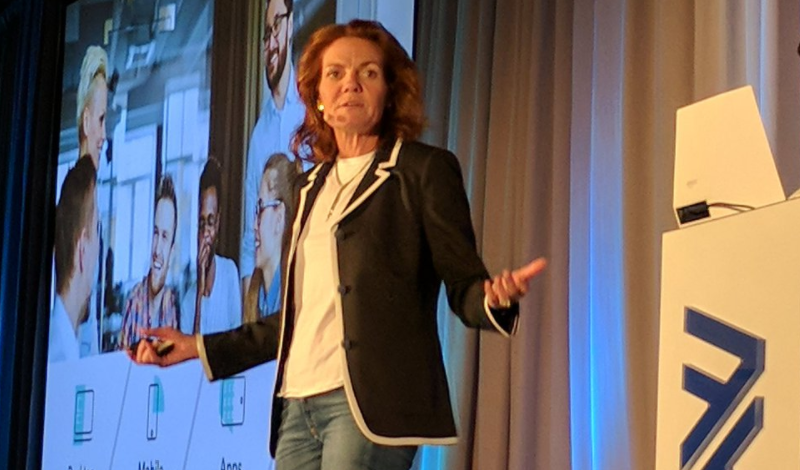
Fulcher welcomes to Shift17
Meet employees where they are: New mobile, Voice (Alexa) demo. Like many other vendors Zenefits follows the credo of people centricity, meaning that consumption of HR software needs to be made as easy and frictionless as possible… this means that HCM software needs to be consumed where users do work: Most prominently in chat software and ideally voice accessible. Zenefits showed a demo with Alexa, going through a time off request.
 
Zenefits Shift17 Constellation Research Holger Mueller
Carr talks Services
New Connect offerings – Ben Connect and Pay Connect. Zenefits has a strong platform and partner focus, but needs to make the consumption of partner services easy… meaning that it needs to do the integration work for these partners to allow easy uptake by its SMB customer base. Benefits does this through the Connect product family, and at Shift 2017 it unveiled the Ben Connect and Pay Connect products. Ben Connect provides integration to benefit providers, Pay Connect to 3rdparty payroll providers (ADP, Gusto, Paychex, and I believe on more provider).
 
Zenefits Shift17 Constellation Research Holger Mueller
Reeves talks Products
Native Zenefits Payroll now at 30 states. A year ago, Zenefits unveiled its payroll offering, supporting a handful of states, the vendor has now arrived at the support of 30 states… and remains committed to support all 50. I missed the roadmap presentation on this, but it supposedly exists, and is key for SMBs to plan their rollouts and / or to make software selection decisions.
 

MyPOV

A good user conference for Zenefits, that is going more into the direction of becoming an enterprise software vendor. New CEO Fulcher has brought in a new management team, with a new COO, CMO and head of product. All industry veterans, so we can expect good things to come for Zenefits customers. The new mobile product looks good, though Zenefits makes the common (SFO / Valley) mistake of favoring iOS over Android. With 50% of US smartphones being Android phones, not really people centric, but as mentioned a common and repeated flaw of HCM vendors.

On the concern side, Zenefits showed very little software. And while it is great to listen to Arianna Huffington, Patty McCord, Ben Horowitz and Shawn Achor – showing a live mobile demo and an Alexa demo is not cutting the balance between fuzzy feel good and tangible product. We saw the same recently at SuccessFactors conference (Oprah, the Cake Master etc.). Maybe both vendors have new management teams and need to cover over a pause in product development. But vendors should not forget, the main reason to attend their user conference is their product and its roadmap. All appreciation, vision and though leadership on general practices – comes later. Showing core software capabilities as slide show is not what users (and influencers) expect.

But for now, good progress by Zenefits, more software DNA in its executive team and likely its product future. Stay tuned.
 
Stay tuned.
 
Want to learn more? Checkout the Storify collection below (if it doesn’t show up – check here).

Find more coverage on the Constellation Research website here and checkout my magazine on Flipboard and my YouTube channel here. 
 
Future of Work Innovation & Product-led Growth Event Report Executive Events Chief People Officer

Digital Transformation Digest: Google Adds 'Zero-Touch' Enterprise Deployments for Android Devices, Red Hat's New Patent Promise, and IBM's Latest Open Source Moves

Digital Transformation Digest: Google Adds 'Zero-Touch' Enterprise Deployments for Android Devices, Red Hat's New Patent Promise, and IBM's Latest Open Source Moves

Constellation Insights

Google introduces 'zero-touch' enterprise deployment for Android devices: It's going to be easier and more secure to roll out enterprise Android devices, with Google's introduction of "zero-touch enrollment" capabilities.

Under the program, companies that purchase Android devices can use EMM (enterprise mobility management) software to automatically apply configurations and policies the first time a user turns the device on. Supported EMMs include VMWare AirWatch, BlackBerry, MobileIron, IBM and GSuite.

Initially, the feature is available only on Google's Pixel phone when purchased through Verizon. Google is working with Samsung, Huawei, Sony, LG and other device makers to add zero-touch; Sony's Xperia XZ1 and XZ1 Compact will be among the first additional devices to get it. Google is also working with a variety of other carriers besides Verizon.

POV: This is certainly a desirable feature given how much it can cut down on device management and end-user support tasks. It also has security benefits, since the devices won't ever be used in an un-managed state.

However, this is also an instance where Google is playing catch-up for a change, as Apple has offered similar capabilities through its Device Enrollment Program, as has Samsung with its Knox Mobile Enrollment service. It's nonetheless a welcome addition to Google's mobile enterprise capabilities with real benefits for customers.

Red Hat updates, expands its 'patent promise': In 2002, Red Hat issued a decree saying it would not enforce its patents against free and open-source software. Fifteen years later, the company has released a new version of the Patent Promise, one it says substantially extends the original's scope. Here's how Red Hat explains the decision, from an FAQ:

We issued the first Patent Promise 15 years ago. Since then, both Red Hat and open source have changed considerably, and some aspects of the Promise became outdated. Open source is what Red Hat does, and open innovation plays an increasingly important role in technology and beyond. Our expanded Patent Promise recognizes and is designed to protect open innovation.

The new Promise is substantially clearer and broader than its predecessor. While the old Promise covered approximately 35 percent of open source software, the new version will cover more than 99 percent. It applies to all software meeting the free software or open source definitions of the Free Software Foundation or the Open Source Initiative and listed by the FSF or OSI.

Both the original and new promise covered the entirety of Red Hat's patents. But the company today has more than 2,000 patents, compared to just a handful at the time of the first promise.

Both the new Promise and the original Promise covered all Red Hat’s patents. It’s worth noting that at the time of the original Promise, Red Hat had only a few patents, while now it has more than 2000.

POV: As a company based on open source software, Red Hat's pledge seems like a natural step. It doesn't appear that it provides any protection to companies from patent lawsuits brought by non-practicing entities—otherwise known as patent trolls—but clearly puts a flag in the ground stating that Red Hat is a trusted partner to companies looking to innovate with open-source software.

IBM open-sources Websphere Liberty for agile app development: Big Blue has open-sourced the code for Websphere Liberty, the ligher-weight version of its flagship Java application server. IBM's Ian Robinson explains why in a blog post:

We created Liberty five years ago to enable developers to easily and quickly create applications using agile and dev/ops principles. It has been an incredibly successful and popular transformation for WebSphere and now is the time to take it to the next level by moving the essential Liberty code base into the open.

This week IBM launched the Open Liberty project and moved our Liberty development effort to it. The code is available in GitHub under the Eclipse Public License V1, and our ongoing development for WebSphere Liberty will be based on this project. Open Liberty is focused on creating a runtime to support Java microservices that can be frequently updated and easily moved between different cloud environments.

At any time, developers can move up to the commercial versions of WebSphere Liberty, adding dedicated technical support and more advanced capabilities. Because Open Liberty and WebSphere Liberty are built on the same codebase this transition is seamless, so there’s no need to modify your applications.

POV: IBM is also open-sourcing its IBM J9 virtual machine implementation, which along with Open Liberty provides a full, IBM-approved Java stack.

While Open Liberty is easier to set up and manage, gets more frequent updates, and offers more deployment options than the full-blown WebSphere, it isn't as feature-rich. There are also many existing applications that would be difficult or not possible to move to Open Liberty due to feature gaps.

IBM is betting that moving Open Liberty to an open-source model will attract community support and subsequently more development resources and market traction around the code base. It's far from an unprecedented move, but still stands as another example of where open source wins, notes Constellation VP and principal analyst Holger Mueller.

"While IBM knows how to partner and work with open source, customers have to keep a watchful eye on vendors not just punting the code over," Mueller says. "I'm not saying that is the case here, but with all the struggles at IBM it's a potential risk to consider."
 

Future of Work Tech Optimization Digital Safety, Privacy & Cybersecurity

Progress Report - Kronos grows and grows

Progress Report - Kronos grows and grows

We had the opportunity to attend Kronos’ very first analyst day, held at the vendor’s new headquarters outside of Boston. It was the first day at the office for many of the executives and employees, a very nicely remodeled older office building (the former Wang HQ), with many interesting and useful features and capabilities. Interestingly there are no rooms, corner offices etc. facing the windows. The idea is to allow as much possible day light to flood the building. Not even CEO Ain has an office with a window.
 

So, look at my musings on the event here: (if the video doesn’t show up, check here)
 
 
No time to watch – here is the 1-2 slide condensation (if the slide doesn’t show up, check here):
 

Want to read on? 

Here you go: Always tough to pick the takeaways – but here are my Top 3:

 
Ain opens 1st Kronos Analyst Day
Kronos keeps growing in all dimensions. Kronos keeps doing well, having achieved the 1B milestone a few years ago, delivering 1.3B US$ in the last financial year and now aiming at 1.4B US$. The growth is documented in headcount, too – Kronos hired 1000+ in the last 12 months, one additional reason to open the new headquarters. And Kronos has left itself some room to grow – there is still space in the new office building.

 
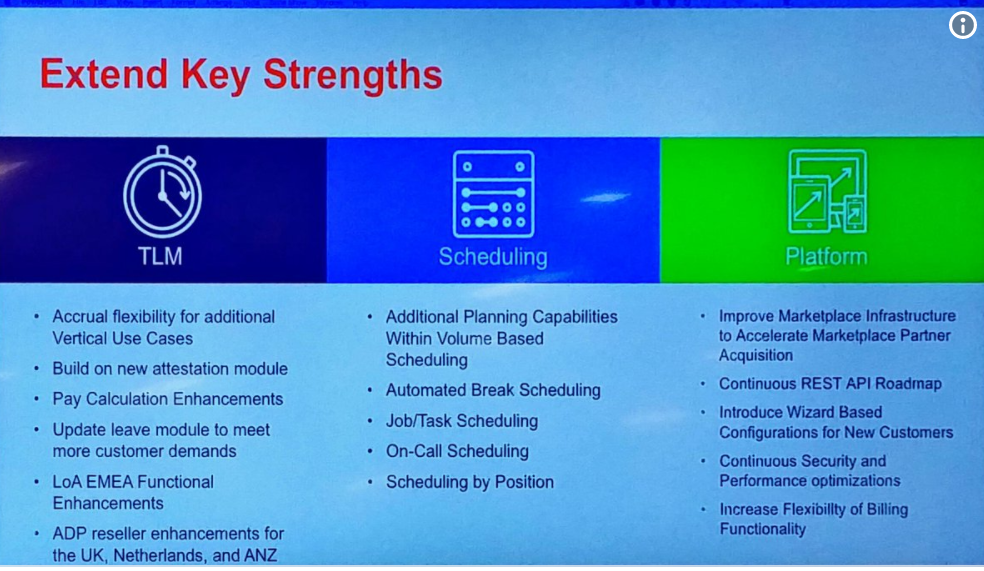
Workforce Ready Key Directions
Workforce Ready. Kronos’ SMB product is doing well. Adding and cross selling HCM capabilities seems to be something that Kronos has mastered well. The vendor claims they are the fastest growing HCM product, that has passed +100M US$ already. The functional highlight was improved reporting with new dashboards, an updated user interface and new mobile capabilities.

 
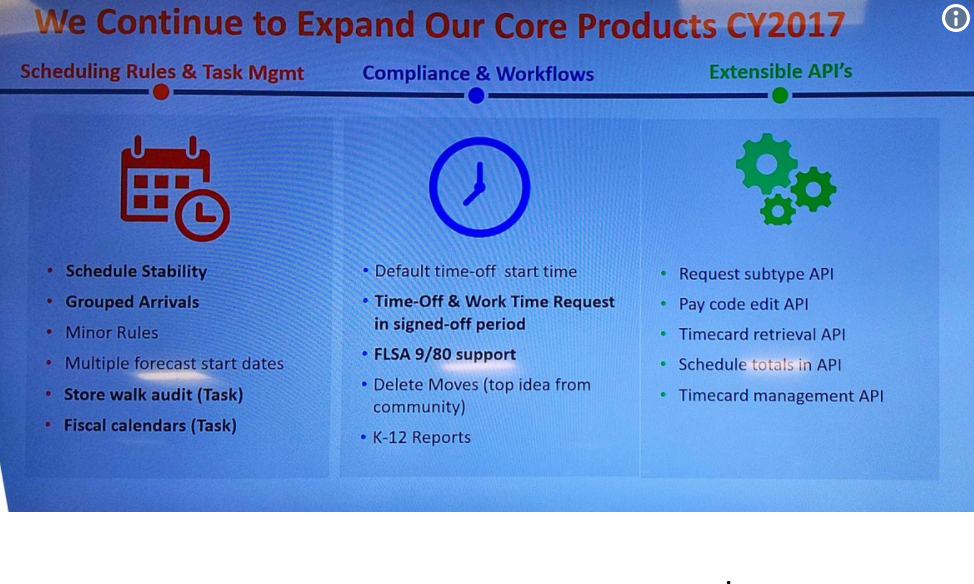
Workforce Central Directions

Workforce Central. Kronos’ larger enterprise product is doing well as well. Often used in conjunction with other HCM products, it has undergone, and will see more API work. RESTful integration is the writing on the wall. And it would not be Kronos if the vendor would not spend R&D on more advanced scheduling capability as well as new schedulers. Improved integration into 3rd party HCM products is another key investment theme.
 

MyPOV

Kronos is investing in product and growing on all fronts. It has carved out a working niche in SMB and has become the ‘Switzerland’ that can partner with the likes of Oracle, SAP and Workday for Workforce Management capabilities. It seems like competition in the field and is building out its capabilities. Good news for customers is that Kronos has overcome technical challenges from the past, and now offers a stable, reliable workforce management system, that clients need and deserve.
 
On the concern side, Kronos remains a conservatively run company. As it competes with vendors with more enterprise software DNA, it can find itself on the backfoot when it comes to visionary and sometimes flashy announcements. Customers should ask and dig deeper on Kronos’ innovation pipelines and plans, and likely are not going to be disappointed. Kronos has a large development team and is working on many new workforce management capabilities.

Stay tuned for Kronosworks later this year in Las Vegas, I am certain we will know a few things more about what’s next for Kronos customers.
 
    Want to learn more? Checkout the Storify collection below (if it doesn’t show up – check here).

    Future of Work Data to Decisions Innovation & Product-led Growth New C-Suite Tech Optimization AI Analytics Automation CX EX Employee Experience HCM Machine Learning ML SaaS PaaS Cloud Digital Transformation Enterprise Software Enterprise IT Leadership HR Chief People Officer Chief Experience Officer Chief Customer Officer Chief Human Resources Officer

    When AI and Personal Information Collide: The Privacy Implications

    When AI and Personal Information Collide: The Privacy Implications

    Constellation Insights

    Stanford University professor Michal Kosinski made waves recently for research he conducted that suggested AI can determine a person's sexual orientation based on pictures of their face. Now Kosinski is going further, saying that AI could also pinpoint someone's political leanings, level of intelligence and other personal data points based on photographs, as the Guardian reports:

    Faces contain a significant amount of information, and using large datasets of photos, sophisticated computer programs can uncover trends and learn how to distinguish key traits with a high rate of accuracy. With Kosinski’s “gaydar” AI, an algorithm used online dating photos to create a program that could correctly identify sexual orientation 91% of the time with men and 83% with women, just by reviewing a handful of photos.

    Kosinski’s research is highly controversial, and faced a huge backlash from LGBT rights groups, which argued that the AI was flawed and that anti-LGBT governments could use this type of software to out gay people and persecute them. Kosinski and other researchers, however, have argued that powerful governments and corporations already possess these technological capabilities and that it is vital to expose possible dangers in an effort to push for privacy protections and regulatory safeguards, which have not kept pace with AI.

    Kosinski is also known for his controversial work on psychometric profiling, including using Facebook data to draw inferences about personality. The data firm Cambridge Analytica has used similar tools to target voters in support of Donald Trump’s campaign, sparking debate about the use of personal voter information in campaigns.

    There is much more to the Guardian's full report, which is well worth a read.

    Analysis: AI advancements test, but don't rise above privacy laws

    Privacy regulators increasingly recognize that the creation of personal information through computer algorithims is a form of collection, says Constellation VP and principal analyst Steve Wilson, who leads the firm's coverage of digital security and privacy issues: "If a computer program sets a flag in a database saying 'this person is right wing,' or 'this person is LGBT,' then that represents an act of collection of personal information."

    This practice can be termed algorithmic collection, or synthetic PII, and is treated exactly the same under privacy laws as collecting the information by getting subjects to fill out a questionnaire. In some jurisdictions, such as Australia, PII related to sexual preference, health, political beliefs and biometrics are classified as sensitive and given extra protections, Wilson says.

    "Sensitive PII cannot be collected without consent, so automated algorithmic collection of a person's sexuality or politics is a huge problem, even if it's done for research purposes," he says. "This is another nice example of how technology does not outpace the law. If most people are intuitively uneasy about computers working out their sexuality or other deep, even unconscious traits, then they can get some comfort from the fact that existing laws put restraints on this type of action."

    The fundamental point is that there are limits to what personal information should be collected abotu people, and conditions on how it's collected, Wilson adds. "While new technology can create new ways to break the law, the fact is that privacy laws themselves remain as relevant as ever."

    Digital Safety, Privacy & Cybersecurity Chief Customer Officer Chief Information Officer Chief Digital Officer

    Today's Tip: Know When To Automate With Artificial Intelligence

    Today's Tip: Know When To Automate With Artificial Intelligence


    Six Factors For Powering AI Driven Smart Services

    Recent client conversations indicate a desire for designing new AI Driven Smart Services.   The rush to incorporate artificial intelligence into processes often requires a deeper examination of which services should be AI enabled.  Constellation’s latest framework for augmenting humanity encompasses six factors (see Figure 1):

    1. Repetitiveness.  The greater a process is repeated, the more likely the process should be AI powered.  One-offs and custom processes with minimal repetition are lower priority candidates for AI.
    2. Volume.  When the volume of transactions and interactions exceed human capacity, the smart service should be AI powered.  Volumes within human capacity will remain human powered.
    3. Complexity.  Good candidates for AI powered include complexity beyond human comprehension and simple tasks that can be optimized by AI.
    4. Physical presence.  Processes that require a heavy physical presence will most likely require human powered capabilities.  However, processes that put lives in jeopardy serve as great candidates for AI powered and automation.  In general, low physical presence requirements play well to AI powered approaches.
    5. Time to complete. High time to market requirements favor AI powered approaches.  Lower time to completion requirements will remain human powered.
    6. Nodes of interaction.  Simple interaction nodes will lean human powered.  AI serves best complex and high volume nodes of interaction.

    Figure 1. Constellation’s AI Powered Framework

    The Bottom Line.  Apply The AI Powered Framework To Smart Service Prioritization

    Six factors play a significant role in identifying which AI driven smart services deliver the greatest opportunities.  Early adopters have prioritized business processes using the Constellation business hierarchy of needs.  Align candidates to the five categories of regulatory compliance, operational efficiency, revenue growth, strategic differentiation, and brand.   Keep in mind, that AI enablement must require a strong data strategy, deep data governance, mature business process optimization, and a data driven design point.

    Your POV.

    So what will you automate first with AI?  Do you have a digital transformation strategy?  

    Please let us know if you need help with your Digital Business transformation efforts. Here’s how we can assist:

    • Developing your digital business strategy
    • Connecting with other pioneers
    • Sharing best practices
    • Vendor selection
    • Implementation partner selection
    • Providing contract negotiations and software licensing support
    • Demystifying software licensing


    Data to Decisions Future of Work Marketing Transformation Matrix Commerce Next-Generation Customer Experience Tech Optimization Innovation & Product-led Growth Digital Safety, Privacy & Cybersecurity New C-Suite AI Agentic AI LLMs Generative AI ML Analytics Automation Cloud CRM Data to Decisions Digital Transformation Disruptive Technology eCommerce Enterprise IT Enterprise Software finance HCM HR Machine Learning Next Gen Apps SaaS PaaS IaaS Supply Chain business Marketing Enterprise Acceleration IoT Blockchain ERP Healthcare Customer Service Content Management Collaboration B2C CX Leadership Chief Customer Officer Chief Information Officer Chief Marketing Officer Chief Digital Officer Chief Executive Officer Chief Technology Officer Chief AI Officer Chief Data Officer Chief Analytics Officer Chief Information Security Officer Chief Product Officer Chief Financial Officer Chief Operating Officer Chief Revenue Officer Chief People Officer Chief Human Resources Officer Chief Experience Officer

    News Analysis - Oracle Unveils New Programs that Transform how Customers Buy and Consume Cloud – Gloves Off

    News Analysis - Oracle Unveils New Programs that Transform how Customers Buy and Consume Cloud – Gloves Off

    Even though we are almost only two weeks off Oracle’s OpenWorld conference in San Francisco - Oracle is pushing the gas pedal. Yesterday Oracle announced its Sparc M8 chip / architecture – today it was Chairman and CTO Larry Ellison’s turn: New pricing.


    The press release can be found here. So, let’s dissect in usual fashion:
    At a live event today, Oracle Executive Chairman of the Board and CTO Larry Ellison announced new programs that lower costs by delivering increased automation and flexibility, and enable customers to get more value from their existing Oracle software investments. The new Oracle Cloud programs include Bring Your Own License to PaaS and Universal Credits.
    MyPOV – Nice summary. Pricing simplification has been on Ellison’s mind since a long time. In his view easier pricing accelerates sales processes, something he really wants. This move reminded me of Ellison pushing through a single global price list, published on its website, connected with the Oracle Store in the dot com era. It was revolutionary then – today it was visionary.
    “We are completely transforming the way all companies buy and use cloud by providing flexibility and choice,” said Ellison. “Today, we combined the lowest prices with the highest performance and more automation to deliver a lower total cost of ownership for our customers.”
    MyPOV – Rationale is key to Oracle and Ellison – and his presentation was more about how automation of the Oracle database processes allows Oracle to lower prices and compete with the competition. He even said at one point that Oracle would make cost a SLA item…
    While organizations are eager to move to the cloud, many have not due to obstacles that have forced them to choose between flexibility and lower costs. They have been challenged by the complexity of the cloud and the inability to rebalance spend across different services. Organizations have also been constrained by limited visibility and control over cloud spend. Until now, they have been unable to fully leverage their on-premises software investments in the cloud, having been limited to IaaS services or sacrificing key database features at the PaaS layer. Oracle’s new cloud programs address customers’ cloud adoption challenges by improving and simplifying the way they purchase and consume cloud services.
    MyPOV – Always good to see simplification. In a more complex and accelerated environment enterprises need all the simplification they need. And while pricing complexity is one problem, product fit and evaluation is even bigger. But Oracle is right – once enterprises have established the services they want - / need – budget risk is one of the main pre-occupations of CxOs. Though the ‘horror’ stories of early cloud days of enterprises burning through a month’s budget in few days because someone didn’t turn something off – are over – it remains a concern till today. But price is only half the equation – product / service selection remains a challenge.
    Bring Your Own License to Oracle Database PaaS: Delivering Increased Value Through License Mobility
    Currently, customers can bring their on-premises licenses to Oracle IaaS. Today, Oracle is expanding the offering by enabling customers to reuse their existing software licenses for Oracle PaaS, including Oracle Database, Oracle Middleware, Oracle Analytics, and others. Customers with existing on-premises licenses can leverage that investment to use Oracle Database Cloud at a fraction of the old PaaS price. Running Oracle Database on Oracle IaaS is faster and offers more features than Amazon, delivering the industry’s lowest total cost of ownership. Additionally, customers can further reduce management and operational costs required for on-premises maintenance by taking advantage of this PaaS automation.

    MyPOV – Good to see Oracle expanding its BYOL program. That lowers the hurdle for customers to move to the Oracle cloud – and helps against the competition. That is – in Oracle’s eyes most prominently AWS – so they are mentioned here… Oracle has gone at length that its IaaS Gen2 is cost effective – now it is getting aggressive on the pricing side. Always good to see vendors living up to their announcements.
    Universal Credits: Flexible Buying and Consumption Choices for Oracle’s PaaS and IaaS Services
    Oracle is introducing Universal Credits, the industry’s most flexible buying and consumption model for cloud services. With Universal Credits, customers have one simple contract that provides unlimited access to all current and future Oracle PaaS and IaaS services, spanning Oracle Cloud and Oracle Cloud at Customer. Customers gain on-demand access to all services plus the benefit of the lower cost of pre-paid services. Additionally, they have the flexibility to upgrade, expand or move services across datacenters based on their requirements. With Universal Credits, customers gain the ability to switch the PaaS or IaaS services they are using without having to notify Oracle. Customers also benefit from using new services with their existing set of cloud credits when made available.

    MyPOV – The real simplification comes here. And while pre-pay programs exist for IaaS since a while, they are usually tied to dedicated products and services. Having the portability across products and services is important for customers, especially in early phases of their cloud journey. Over time their footprint solidifies – but given where most Oracle customers are now, this move is a significant reduction in complexity. The option to use the credits for Oracle Cloud at Customers is a differentiation to pure public cloud based IaaS vendors. It caters well to customers who are still cloud concerned, who are in geographies where Oracle’s IaaS Gen 2 may not be yet, or where data residency requires in country operation of IT. 
     
    Behind the scenes it means – Oracle must have a lot of capacity. The dedicated service / product pre pay helps IaaS vendors to plan capacity and build out of their IaaS capacity. When customers can switch with little notice, an IaaS vendor must be confident to have enough capacity. Theoretically too much demand can create wait lists – but that would be bad for business… but an area to watch going forward.


    Overall MyPOV

    Always good to see simplification. Customers who are uncertain on which products and services they can consume can now start budgeting for instance for trials and proof of concept. BYOL is powerful for customers ready to move to cloud. So overall a good move by Oracle.

    Looking behind the scenes – we can assume a few things: Oracle is confident IaaS Gen 2 works. It just has poured another 2B in CAPEX in Q1 2018. First time Oracle has spent 2B+ CAPEX quarters in recent years (or at all – I did not go back). All these investments need load to get justified. If pricing held customers up – it has been simplified. And the move gives the Oracle sales force the instant chance to have a cloud conversation with customers – given the BYOL option – and the public cloud and cloud at customer options. The executives in 500 Oracle Parkway are making it was easy as possible to sales force and customers to move to cloud and generate cloud revenues. That Oracle is under pressure to show cloud growth (like all major enterprise vendors) is no surprise, and the last earnings call has not lowered pressure, despite good results.

    For the industry, its key to watch how well Oracle can move customers to cloud (or cloud at customer). For Oracle competitors, massive potential could disappear. As Constellation estimates that 30-40% of on premise systems are either Oracle systems, or systems so closely connected to an Oracle system – this is a key development to watch – to determine the overall move of the on-premise load to public cloud (the other one is the VMware / AWS partnership). If Oracle succeeds with this – we may see a fast move of almost all enterprise load to the cloud. The reasons are – when a year of server refresh goes missing, most of on premises IT becomes – very expensive. So expensive that the board s and CEOs are asking how fast the rest can move… Stay tuned. It’s going to be a crucial fall.


    For more on the event - check out the Storify embedded below. 
     
    Innovation & Product-led Growth Tech Optimization Future of Work Data to Decisions New C-Suite PaaS SaaS IaaS Cloud Digital Transformation Disruptive Technology Enterprise IT Enterprise Acceleration Enterprise Software Next Gen Apps IoT Blockchain CRM ERP CCaaS UCaaS Collaboration Enterprise Service Chief Information Officer Chief Technology Officer Chief Digital Officer Chief Data Officer Chief Analytics Officer Chief Information Security Officer Chief Executive Officer Chief Operating Officer