Oct 1 update
Oct 1 update
News and announcements for the week of October 1, 2018
Microsoft unveils big-data-capable SQL Server 2019 and extended AI capabilities to power data-driven innovation. Here’s my analysis.
Microsoft CEO Satya Nadella set the tone at the September 24-27 Ignite events in Orlando by sharing at least half a dozen stories of leading companies innovating and pioneering new business models with the aid of artificial intelligence (AI). It was a crisp, one-hour presentation long on vision and surprisingly short on promotion or even mentions of the significant technology announcements that followed.
Nadella warned the more than 30,000 attendees that the ability to innovate and drive new business models is as much or more about changing corporate cultures and business processes as it is about applying technology. And when the technology decisions are ready to be made, Nadella counselled executives to know which capabilities are commodities and which warrant custom development to drive differentiation. Nadella said he sees smart companies liberating data silos and moving the bulk of enterprise workloads and innovation initiatives to “the intelligent cloud” and the “intelligent edge.”
From the perspective of my data-to-decisions research, the standout tech announcements that followed Nadella's keynote included the public preview release of Microsoft SQL Server 2019, a string of Auto ML and artificial intelligence (AI) enhancements, and new analytical capabilities for big and small data. Here’s a look at what’s available, what’s coming and how they'll stand up.
SQL Server 2019 Evolves from Database to Unified Platform.
Introduced in public preview at Ignite, Microsoft SQL Server 2019 is an ambitious step forward from mere database to unified data platform. Those who wish to keep using SQL Server as a conventional database deployed in conventional ways will be able to do just that, but the release promises so much more. For starters, SQL Server 2019 is built to deploy and scale out using Kubernetes, so it’s ready to support whatever evolving, elastic hybrid deployment approach required.
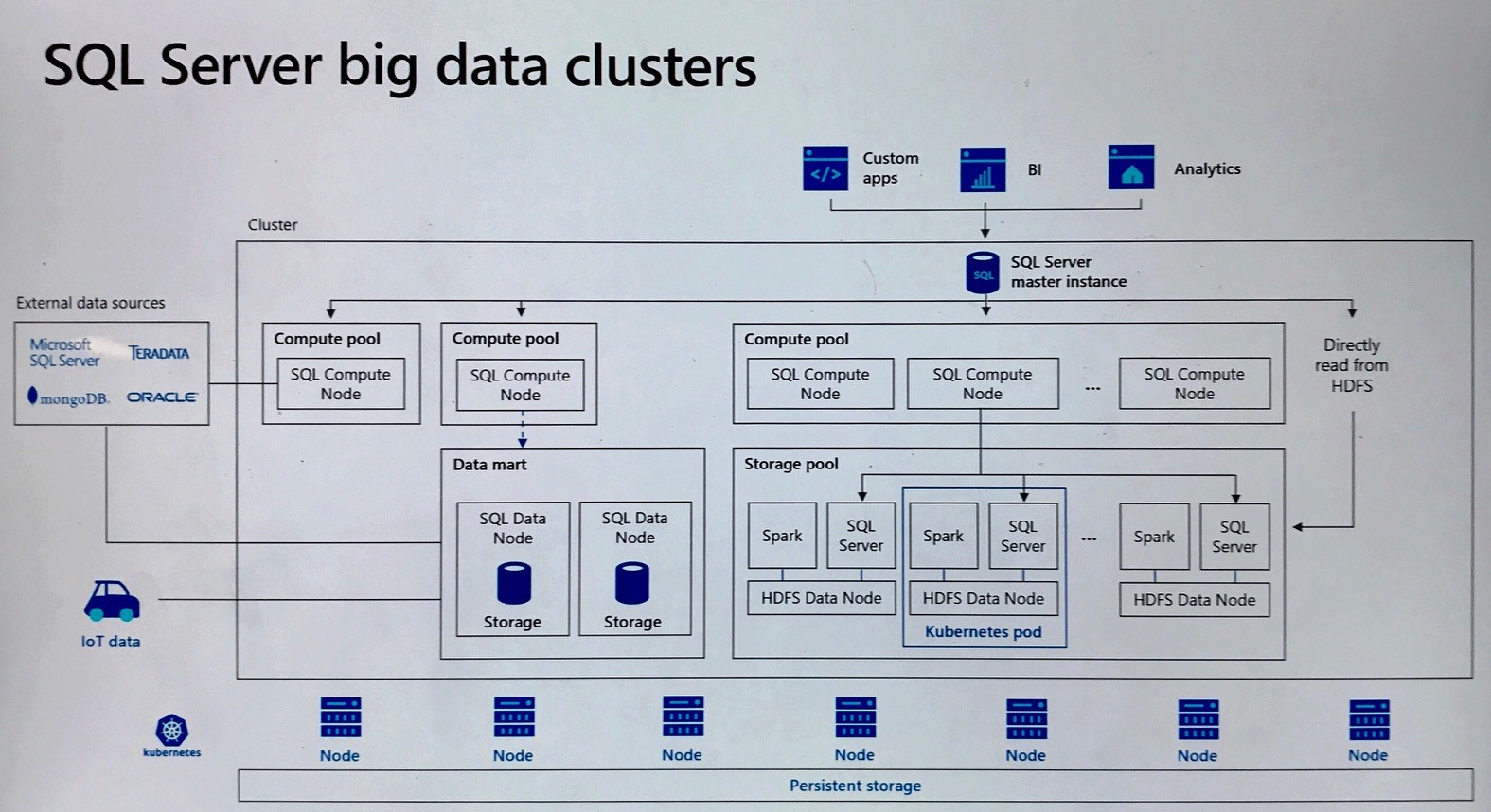
The next innovation is big data cluster software (see image below) that puts both SQL Server and Apache Spark query and processing engines on top of HDFS (Hadoop Distributed File System) data nodes. The architecture also supports high-scale, columnar data marts said by Microsoft execs to beat Impala and other database-on-HDFS options on query performance.
Microsoft’s Polybase technology, previously used mostly to tap into HDFS, will be used by SQL Server 2019 to tap into external sources such as Oracle, Teradata, MongoDB, PostgreSQL and IoT sources without moving data. As shown below, the architecture brings together the worlds of SQL and big data on a single platform. A new Azure Data Studio user interface, also announced it Ignite, will support both SQL-based querying and a notebook-style experience for data scientists.

Microsoft SQL Server 2019 deploys on Kubernetes and includes a big data cluster architecture that unifies the worlds of relational and big data analysis.
Data scientists and progressive data analysts and data power users have been blending structured, variably structured and unstructured data for years. In SQL Server 2019, all data, including highly structured data as well as raw log files, social streams, JSON data from mobile apps, web clickstreams and more can reside on one platform with elastic and scalable deployment capabilities and myriad data analysis possibilities. As noted, Microsoft SQL Server 2019 will still be deployable and usable as a conventional database. The heart of the database management system is all in the head node. But Microsoft expects visionary companies to also deploy the SQL Server 2019 big data cluster, included software that won’t be a separate SKU or extra-cost option.
MyPOV on Microsoft SQL Server 2019. This is a compelling unification of the SQL and big data worlds, but as a practical matter, many if not most enterprises have already re-platformed with some combination of Hadoop and Spark capacity. Many if not most also have a mix of cloud-based capacity including object storage. Finally, Microsoft’s rivals ranging from Oracle, Teradata and IBM to Cloudera, Hortonworks and MapR have also been working on blending, streamlining and cloud-enabling relational and big data capabilities.
I’m sure Microsoft SQL Server 2019 will keep current SQL Server customers on the upgrade path, but the Big Data Cluster capabilities are likely to get a mixed response. The unification will be very appealing In greenfield situations, but where there are legacy deployments, existing workloads and employee familiarity to consider, Microsoft will have to come up with very practical and cost-competitive migration options that avoid rip and replace. One Microsoft exec suggested existing HDFS instances could be brought under Microsoft management without having to move or recreate the clusters, but I suspect it won’t be that simple.
In short, I see SQL Server 2019 as driving greenfield, day-forward or gradual migrations to its unified platform, not immediate replacements. That’s fine. The platform won’t be generally available until next year and would-be customers will need time to plan their future data platform strategies.
ML and AI Roundup
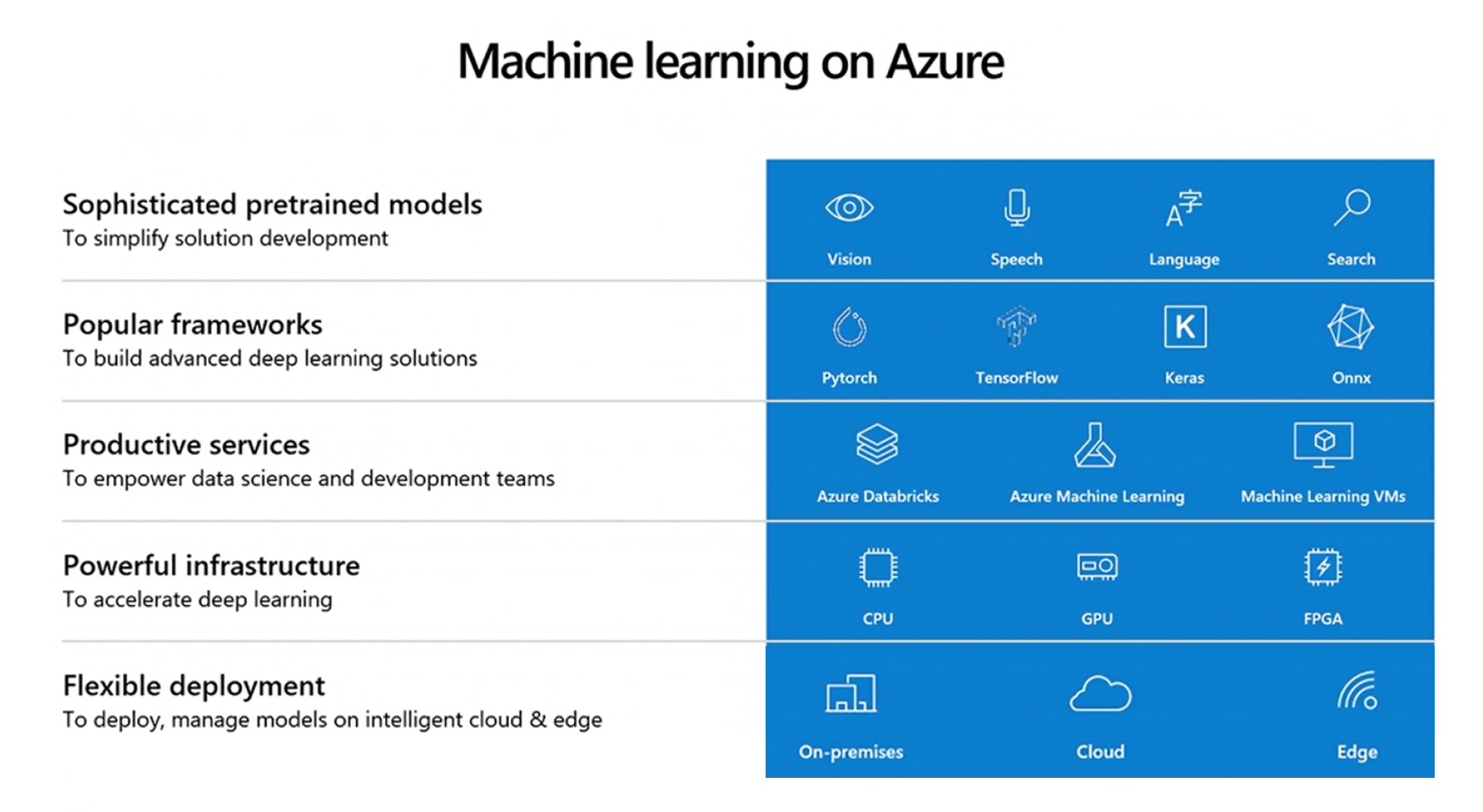
AI figured in many of the customer innovation stories that Nadella shared, whether it was BMW’s Azure-powered Intelligent Personal Assistant, Buhler adding machine vision to its grain-processing equipment to spot and extract foreign matter before it enters the food supply, or real estate services firm CBRE using Azure IoT to optimize energy usage and Azure Digital Twins to simulate and better manage office space. Microsoft made announcements on all five levels what it describes as its AI stack, shown below.

Microsoft is investing in machine learning and AI at five levels.
Cognitive Services: At the top are Microsoft’s Azure Cognitive Services, where the company announced the general availability of Speech services including speech-to-text, text-to speech and translation. It also delivered the ability to customize models by training against your own industry- or company-specific language and terms. MyPOV: These are the sort of services that Nadella alluded to as commoditized. Indeed, AWS, Microsoft and Google have all delivered vision, speech, language and translation services and the ability to do custom training, but I’d say Google has performance advantages on many of these core services.
Frameworks and Languages: Microsoft is beefing up support for Python and extending its work with Facebook, Nvidia and other partners on ONNX (the Open Neural Network Exchange) to encourage framework diversity and usability. MyPOV: It was interesting to see Google add support for Scikit-Learn and XGBoost at this year’s Google Next event, which was a win for framework diversity beyond TensorFlow. I like the objectives of ONNX and laud Microsoft for promoting openness, modeling efficiency and choice.
Services: At this level the big news was the introduction of automated machine learning and hyper parameter tuning. These are must-have features if data science is to be made accessible to developers, power-user analysts and aspiring data scientists. Azure ML also gained a Python SDK, another acknowledgement of the rise of this language. MyPOV: Microsoft is in a close horse race with AWS and Google, both of which have introduced similar automation and hyper parameter tuning features.
Infrastructure: Microsoft offers GPU capacity, but it’s alone among its cloud rivals in heavily pushing FPGA (field programmable gate arrays) for accelerated inferencing. Here it added support for five more deep learning algorithms (beyond the few previously supported) for image classification and recognition. MyPOV: Microsoft is touting cost and power-consumption advantages over GPUs in the inferencing role, but the evidence I’ve seen is in whitepapers and lab benchmarks. I’m waiting to see more real-world adoption and production success stories that prove these claimed advantages.
Deployment: At the deployment level, Microsoft has a particularly strong strategy around IoT and Edge deployment, and it’s clearly gaining adoption. WalMart’s CIO, Clay Johnson, shared details at Ignite on retailer’s massive IoT deployment aimed at optimizing energy usage across its 10,000-plus stores worldwide. MyPOV: Azure Sphere was a brilliant move to get Azure security and services built right into the microcontrollers that power sensors and devices. Azure IoT Edge is a comprehensive environment that supports deployment of models and gathering of intelligence and predictions from the edge. There are plenty of real-world customer success stories.
In Other News…
Other interesting data-related announcements from Ignite included the coming integration of Azure Cognitive Services and Automated ML into Microsoft Power BI, which fits with my research and predictions early this year on “How ML and AI Will Change BI and Analytics.” The company also introduced Azure Data Explorer, a powerful ad hoc discovery and visual analysis cloud service for big data discovery. Data Explorer looks like a handy, scalable service offering fast, big-data querying through a SQL-like intuitive language that can handle structured and variably structured data including log files, clickstreams and JSON data.
Microsoft also made a splashy Open Data Initiative announcement with the CEOs of SAP and Adobe joining Nadella on stage. Some cynically read this as an effort to steal thunder from Salesforce Dreamforce event, which followed Ignite by just one day. I’ll take partners Microsoft, SAP and Adobe at their word that they’re trying to help customers by developing and promoting open data-sharing standards and data schemas that could be used by other software providers (including, say, Salesforce and Oracle). It’s very early days however, as executives acknowledged, so we’ll have to see if this bears fruit. We’ll know whether it’s real if we hear about it again next year or three years down the road.
Related Reading:
Google Next: A Deeper Dive on AI and Machine Learning Advances
Cloudera Transitions, Doubles Down on Data Science, Analytics and Cloud
Amazon Web Services Adds Yet More Data and ML Services, But When is Enough Enough?
We had the opportunity to attend ADP's yearly analyst summit, held on September 20th 2018 at its innovation lab in Chelsea / New York City. With over 20 analysts, the event was well attended.
![]() |
| A HR Core / Lifion Screen |
![]() |
| The AI powered assistant that leads users to insights in ADP DataCloud |
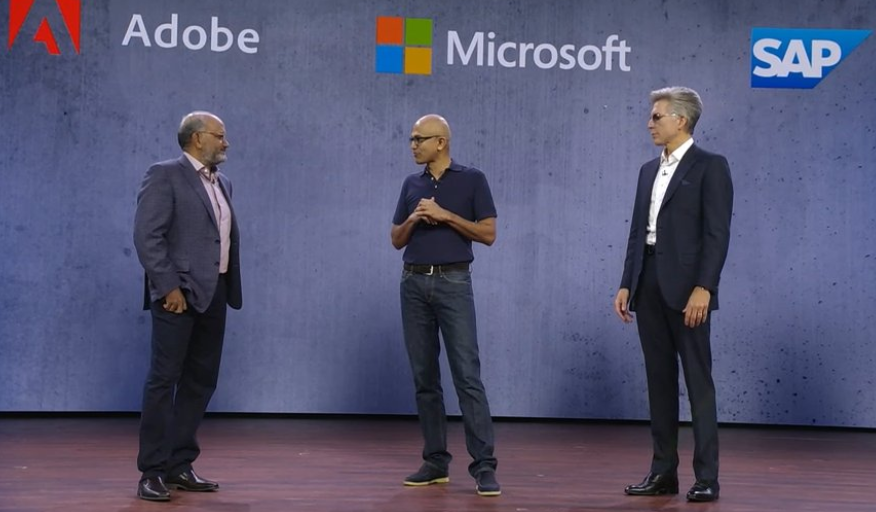
Today at Microsoft's Ignite conference in Orlando, Microsoft CEO Satya Nadella was joined by Adobe CEO Shantanu Narayan and SAP CEO Bill McDermott to announce the Open Data Initiative across the three vendors. Important enough to merit a traditional commented press release – you can find the original here. As this was a well concerted launch with three CEOs present – each vendor has put up their microsite for this, I recommend to visit them to catch the slightly different POVs of the vendors…- Adobe is here, Microsoft is here and SAP is here.
ORLANDO, Fla. — Sept. 24, 2018 — On Monday, the CEOs of Adobe (Nasdaq: ADBE), Microsoft (Nasdaq: MSFT) and SAP (NYSE: SAP) introduced the Open Data Initiative at the Microsoft Ignite conference. Together, the three longstanding partners are reimagining customer experience management (CXM) by empowering companies to derive more value from their data and deliver world-class customer experiences in real-time.
In today's world, data is a company's most valuable asset. However, many businesses struggle to attain a complete view of their customer interactions and operations, because they are unable to connect information trapped in internal silos. At the same time, important customer information also resides in external silos with intermediary services and third-party providers, limiting a company's ability to create the right connections, garner intelligence and ultimately extract more value from its own data in real time to better serve customers.
| The Adobe, Microsoft and SAP CEOs on stage at Microsoft Ignite Source: Microsoft Ignite Webcast |
Companies around the world use software and services from Adobe, Microsoft and SAP to run product development, operations, finances, marketing, sales, human resources and more. Today, Adobe, Microsoft and SAP are joining forces to empower their mutual customers with the Open Data Initiative, which is a common approach and set of resources for customers based on three guiding principles:
- Every organization owns and maintains complete, direct control of all their data.
- Customers can enable AI-driven business processes to derive insights and intelligence from unified behavioral and operational data.
- A broad partner ecosystem should be able to easily leverage an open and extensible data model to extend the solution.
Based on these principles, the core focus of the Open Data Initiative is to eliminate data silos and enable a single view of the customer, helping companies to better govern their data and support privacy and security initiatives. With the ability to better connect data across an organization, companies can more easily use AI and advanced analytics for real-time insights, "hydrate" business applications with critical data to make them more effective and deliver a new category of AI-powered services for customers.
"Adobe, Microsoft and SAP are partnering to reimagine the customer experience management category," said Shantanu Narayen, CEO, Adobe. "Together we will give enterprises the ability to harness and action massive volumes of customer data to deliver personalized, real-time customer experiences at scale."
"Together with Adobe and SAP we are taking a first, critical step to helping companies achieve a level of customer and business understanding that has never before been possible," said Satya Nadella, CEO of Microsoft. "Organizations everywhere have a massive opportunity to build AI-powered digital feedback loops for predictive power, automated workflows and, ultimately, improved business outcomes."
"Microsoft, Adobe and SAP understand the customer experience is no longer a sales management conversation," said Bill McDermott, CEO of SAP. "CEOs are breaking down the silos of the status quo, so they can get all people inside their companies focused on serving people outside their companies. With the Open Data Initiative, we will help businesses run with a true single view of the customer."
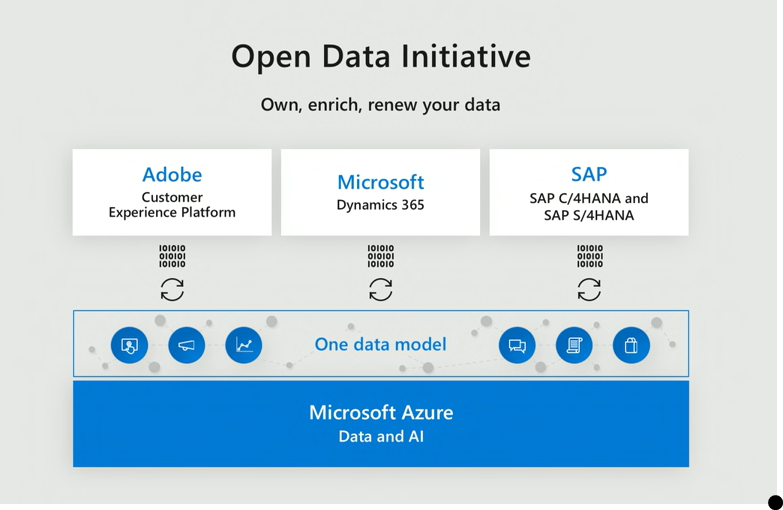
To deliver on the Open Data Initiative, the three partners are enhancing interoperability and data exchange between their applications and platforms — Adobe Experience Cloud and Adobe Experience Platform, Microsoft Dynamics 365, SAP C/4HANA and S/4HANA — through a common data model. The data model will provide for the use of a common data lake service on Microsoft Azure. This unified data store will allow customers their choice of development tools and applications to build and deploy services.
| A first Marketecture of the Open Data Initiative Source: Microsoft Ignite Webcast |
With the Open Data Initiative, companies will be able to:
- Unlock and harmonize siloed data to create new value
- Bi-directionally move transactional, operational, customer or IoT data to and from the common data lake based on their preference or needs
- Create data-powered digital feedback loops for greater business impact, while also helping to enable their security and privacy compliance initiatives
- Build and adopt intelligent applications that natively understand data, relationships and metadata spanning multiple services from Adobe, SAP, Microsoft and their partners
Technology leaders at top retail and consumer products companies, such as The Coca-Cola Company, Unilever and Walmart, have expressed support and excitement about the Open Data Initiative."This initiative from Adobe, Microsoft and SAP is an important and strategic development for the Coca-Cola System," said Barry Simpson, chief information officer at the Coca-Cola Company. "Our digital growth plans centered around our customers are fueled by these platforms and open standards. A more unified approach to the management and control of our data strengthens our ability to support our growth agenda and our ability to satisfy security, privacy and GDPR-compliance requirements. The industry needs to follow these leaders.""Every day, 2.5 billion people use a Unilever product in over 190 countries around the world," said Jane Moran, CIO, Unilever. "The Open Data Initiative from Adobe, Microsoft and SAP is an important undertaking that will help us reimagine customer experience management by bringing together data across our entire organization to build more direct, meaningful relationships with consumers in real time.""We're excited about the Open Data Initiative and the value it will unlock for Walmart," said Clay Johnson, executive vice president and enterprise chief information officer, Walmart Inc. "With greater ability to connect and harness the power of our data, we can enhance the associate experience and create entirely new ways to serve our customers online and in our stores."
Next-Generation Customer Experience Tech Optimization Data to Decisions Future of Work Innovation & Product-led Growth New C-Suite Marketing Transformation Digital Safety, Privacy & Cybersecurity Microsoft SaaS PaaS IaaS Cloud Digital Transformation Disruptive Technology Enterprise IT Enterprise Acceleration Enterprise Software Next Gen Apps IoT Blockchain CRM ERP CCaaS UCaaS Collaboration Enterprise Service Chief Information Officer Chief Technology Officer Chief Information Security Officer Chief Data Officer Chief Executive Officer
For many organizations, it has become clear that they're falling behind in the digital race and the data has long shown this. There is simply too much to digitize, too many points of integration, too many apps, too many channels, too much data and not enough time or resources. And don't forget a growing amount of technical debt and what I have called legacy IT mountain, namely the accumulation of all the enterprise infrastructure, systems, and data currently in operation to date. These drain invaluable budget, time, and energy away from much needed net new digital outcomes.
IT departments, digital divisions, and marketing technology teams – the three major groups that are struggling most – simply can't move fast enough to meet today's fast-paced and broad-based demands for new digital solutions and experiences that are highly integrated and personalized. At least, not structured and tooled the way they are today.
The industry has responded to this challenge in some ways however. One trend is DevOps, which aims to solve the collaboration gaps preventing faster and more agile joint functioning of development and operations teams in highly iterative and responsive ways. Microservices and APIs are another way that organizations are making IT more readily composable, malleable and easier to consume, giving rise to the realization of a better Digital Core that will fuel a more responsive, data-driven, recombinant, self-service, and experience-centric digital delivery model. Microservices in fact have arguably become the flexible business architecture that orgs have long sought. Consequently, they are the strongest target architecture model we know of today. Finally, low code tools have matured to the point than in the last two years it's finally been possible to get 5x and even 8x productivity gains in remixing microservices into on-demand digital experiences.
But as important advances as they are, DevOps, microservices/APIs, and low code tools are just enablers. They aren't digital solutions themselves and can't directly realize value creation. And certainly not at scale using the way most digital units are organized today in terms of structure, process, and tooling. We must somehow marshall our limited delivery bandwidth to be much more efficient and productive using these methods.
So while these are laudable shifts in the IT and digital industry, they are not enough. Backlogs are a major issue in most organizations and must be reduced if digital teams are to stay relevant. Organizations have to actually move much faster than they are today to meet stakeholder needs. To do so they need to offer ready access to all applications, enterprise systems, their data, and devices, combined with the simpliest and most powerful way to turn these vital digital assets into new experiences. And experiences means value, as digital experience is the most important boundary across which business value is delivered and captured with stakeholders today, both within and outside our organizations.
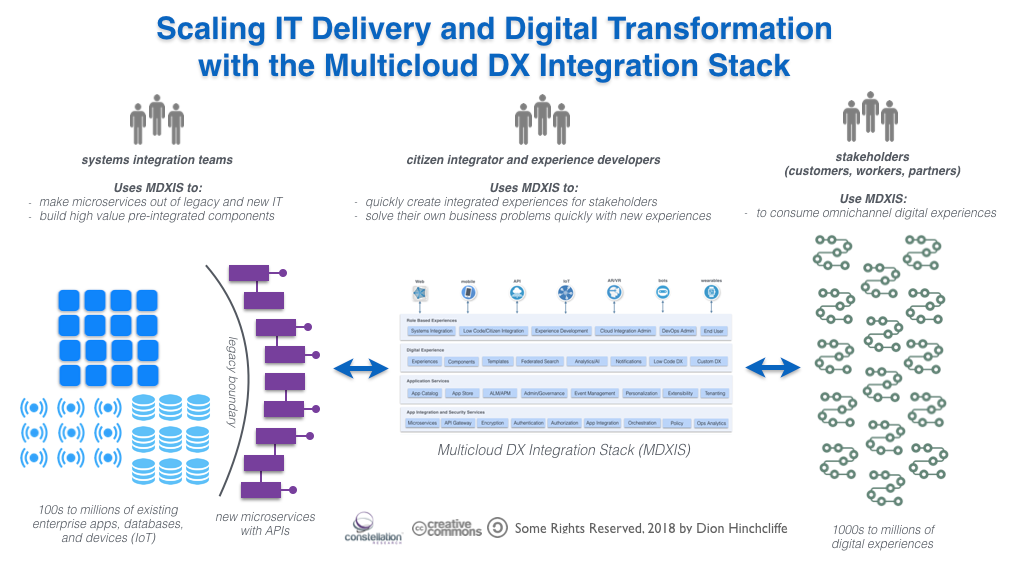
What's really needed is a truly agile cloud-native capability that can strategically aid organizations in building a strong architectural and data foundation using microservices and APIs, then quickly and securely expose them for knitting together into experiences that meet business requirements. And to enable this in a truly industrial scale fashion. That's because most organizations now have what I like to call a Tesla manufacturing problem (referring to the tremendous scale up and now-famous difficulties therein in mass manufacturing their first mainstream car, the Model 3.) Many of us have suddenly found ourselves in a position where there is similar skyrocketing demand for our digital offerings. But we don't have a good way to take our IT assets and make the key value creating artifacts, the digital experiences, nearly fast enough or robustly enough (fully omnichannel, deeply integrated, automated, and data-driven.)
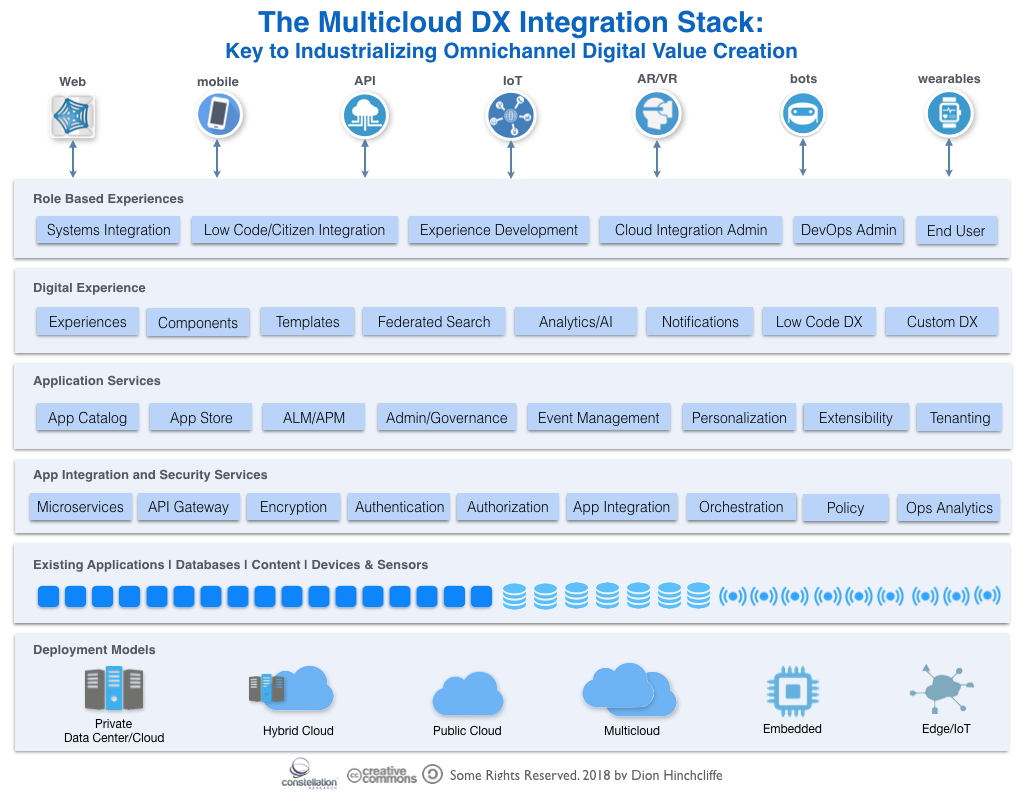
For lack of a better term – there are certainly others being bandied about, for this is far from a unique realization in the industry – I am calling such a capstone digital delivery enabler a Multicloud Digital Experience (DX) Integration Cloud or MDXIS.
Each word is very important in this term. It must be multicloud because such a platform must be able to reach digital systems and data wherever they reside, no matter the location. The end goal of the platform is the last mile and most important step of digital value creation, digital experiences. It's about integration of digital assets within those experiences, because deeply connected solutions is now one of the most difficult challenges and largest opportunities in technology and business today. Finally, it's a stack in the true sense, from low-level services and infrastructure at the bottom to the high-value outcomes at the top.
The MDXIS can be built or bought, and some organizations will do some of both, and may have to do both because few vendors are – or can, given the number and complexity of integration scenarios in particular – offer a one-stop-shop yet. However, it's this robust capability or some close version of it that enterprises will need to acquire and wield to overcome the current shortfall in their "manufacturing capacity." Because we now find ourselves in a stakeholder market much hungrier and expectant today for rapidly delivered, personalized, omnichannel digital experiences that meet their needs, whatever they are. Organizations that can marshall such a platform will be able to meet business challenges far faster, more reliably, more repeatably and at much higher scale to capture opportunity and marketshare faster than those who do not have such scaled assembly lines.
There are five layers (a sixth is the existing applications, databases, content, devices themselves, but for simplicity, we'll consider them external) to the MDXIS stack that must be fully realized in order to get the high throughput and maximum number of experiences per integrator/developer unit of time.
The first and bottom layer of MDXIS is the support for a robust number of deployment models, from private cloud and on-premesis all the way out to public cloud, the edge, and Internet of Things (IoT), even embedded systems as necessary. The second layer is the delivery of a well-design and managed set of business-level microservices exposed by APIs in a fully secure and policy-driven way. The third layer is application services that organize existing experiences using a catalog and app store model (used to self-service as well as provision parts of MDXIS for partner/supplier use, etc.), as well providing lifecycle and performance management, personalization capabilities, extensibility, automation, and event services. The fourth layer consists of digital experience functions including experiences themselves, components (re-usable experience parts), templates for common types of business scenarios (sales, project management, operations, e-commerce, marketing, etc.), federated search, analytics/AI, low-code tools, and the ability to create custom experiences by hand for unique situations. The fifth layer is made up of role-based experiences that enable rapid systems integration of existing IT assets into a consistent microservices architecture, low-code/citizen developer integration tools, experience development tools, a cloud integration admin experience for administering the entire industrialized capability, devops support, and as well as the end-user experiences themselves, the ultimate output of the exercise.
There are plenty of more details that should be understood, but I'll be covering these in an upcoming report that explores the MDXIS in far more detail. For now, it's enough to know that most organizations badly need this capability and that it's what's missing to deliver operationally on key parts of digital transformation (assuredly, it must be hand-in-hand with the softer critical elements like culture change and education.) The CIO and CDO in most organizations will likely own the MDXIS but it's likely to have the CMO as one of its great supporters. Because make no mistake, this capability can really only be achieved by a member of the C-Suite that can force other operating silos and apps owned across the organization to participate. That's because any part of the organization that can opt out of participating will greatly diminish the value of such a stack. It's exciting that we seem collectively to have a much better understanding of one of the missing pieces for digital leadership. The MDXIS is a critical element to raise the maturity level of most digital efforts.
Note: I am currently building a shortlist of existing and emerging new players in this space for those interested to evaluate. Note that MDXIS is different that my Digital Transformation Target Platforms and to Ray Wang's Digital Experience Integrated Platforms shortlists for several key reasons, not the least that most of the tools on both those lists don't qualify. That's because MDXIS platforms put a) an overarching emphasis on microservices as the main enabling business architecture to build the strongest composable and future-ready enterprise-wide digital core based on all IT and content assets of every flavor, b) primary emphasis on low code to enable high scale integration and experience creation by anyone, especially local digital change agents, and c) a relentless focus on high integration/developer throughput across the stack, at least a 5x improvement.
A very initial list of qualifiying MDXIS players for now, which some currently call iPaaS (but again, doesn't always emphasize the essential capabilities above), which I'll expand soon is as follows:
I do reserve the right to change this list as we learn more. If you have others to add to this list, please contact me, but do explain how it hits each of the points above.
New C-Suite Tech Optimization Marketing Transformation Next-Generation Customer Experience Marketing B2B B2C CX Customer Experience EX Employee Experience AI ML Generative AI Analytics Automation Cloud Digital Transformation Disruptive Technology Growth eCommerce Enterprise Software Next Gen Apps Social Customer Service Content Management Collaboration HCM Machine Learning SaaS PaaS Enterprise IT Leadership HR Chief Customer Officer Chief Information Officer Chief Marketing Officer Chief Digital Officer Chief People Officer Chief Human Resources OfficerThis week in San Antonio Texas, Digital Workplace vendor Igloo Software held their annual user conference Igloo Customer Experience (ICE, Igloo... get it!) In addition to attending, I had the honour of keynoting the second day. I highlighted some of the challenges employees are struggling with today, and how bringing together content, colleagues and conversations can help employees not only get work done but be creative and feel like they have a voice in the company. My talk was designed to complement the conference theme of providing customers with a Digital Workplace, the new term being used for intranets or communities.
Here is a short video review of the news, with more details below.
There were four main items announced at ICE:
1. Igloo Marketplace , a repository of templates and integrations that expand the capabilities of Igloo.
MyPOV: This is a significant step in evolving from a product to a platform. To compete against vendors like Microsoft and Google, you need to have a vibrant business partner ecosystem and you need to have integrations with the popular 3rd enterprise business applications. In order to create a seamless experience for employees, they need to be able to access their files, HR applications, CRM records and web-conferencing tools and more... all without switching between multiple applications. A marketplace or catalogue provides a central place for people to add the tools and integrations they need to get their jobs done.
2. "Unified Search: Through a partnership with Lucidworks, Igloo will be incorporating the latest in artificial intelligence, machine learning, and natural language processing technology to improve search speed and relevancy."
MyPOV: While this is not available yet, it is a move well aligned with the trend of using AI to help people find, filter and focus on the things they need, ideally with personalized and context-aware results. It's not just about finding the right content, it's about finding the right content at the right time in the right location. This partnership does not seem to be exclusive, leaving the door open for Igloo to leverage technologies from different vendors for things like image search or video indexing.
3. "Worldwide Data Residency: Igloo’s growing base of multinational enterprise customers will soon be able to use Azure for local data residency options in US, Canada and Europe"
MyPOV: This is a good indicator of the growth of Igloo's customer base. Clearly they are seeing demand outside of North America, and I look forward to hearing customer reference stories that leverage these new data centre options, as well as potential announcements around additional locations.
4. "General availability of the Networked Enterprise Edition provides complex and dispersed organizations with a hub and spoke architecture for connecting business units, vendors, suppliers, partners, and customers"
MyPOV: This appears to be a very interesting feature, enabling organizations to deploy a central "hub" of information that everyone can access, then multiple "spokes" that can be tailored to specific needs. I'd like to hear more about the benefits and challenges of administration and security of this architecture. Hopefully, Igloo will share case-studies and metrics around how their large customers are using this new feature.
No matter what you call it; Intranet, Employee Community, or Digital Workplace, the need to have a place where employees can create, share and discover knowledge is a critical component of empowering collaboration.
Several of the attendees I spoke to over the two days are currently using Jive Software or Microsoft SharePoint and are looking for alternatives. The high level of interest in Igloo is a good sign for the company, and they should continue to capitalize on the uncertainty in some of their competition's roadmaps and vision.
Igloo has always been very strong on design, not just in looks and branding, but in user experience around creating, finding and sharing knowledge.
They are now at the stage where they need to focus on enterprise needs such as scalability, security, compliance and administration.
The announcements at ICE this week are moves in the right direction, and validate why Igloo Software is one of the vendors on the Constellation ShortList™ for Corporate Intranet Platforms.
Future of Work
TIBCO is building out a comprehensive analytics portfolio through multiple acquisitions. Here's what's in store for Spotfire, Statistica and Alpine customers.
Sometimes one plus one really can turn into three. That’s the formula TIBCO is hoping will apply to multiple acquisitions in the data-management and data science spaces over the last 18 months including Alpine Data Labs and Statistica (both now part of the just-announced TIBCO Data Science Platform), and the CISCO Information Server, previously known as Composite Software and now called TIBCO Data Virtualization.
To set the stage, formerly public TIBCO was acquired by private equity firm Vista Equity Partners in 2014. It has annual revenues of about $783 million, according to Hoover’s estimate. Founded in 1997, the firm has long prided itself on punching above its weight among industry giants. It started out as a messaging and integration middleware vendor up against the likes of IBM and Oracle. The company has landed many large, notable customers over the years, including Adidas, Bank of Montreal, Coca-Cola, FedEx, Johnson & Johnson, Pfizer and Unilever.
TIBCO’s foray into analytics began with its acquisition of data discovery and visualization vendor Spotfire in 2007. The portfolio was extended in 2014 with the acquisition of Jaspersoft, a more reporting-centric, open-source business intelligence platform often used to embed analytical capabilities into commercial and custom software.
The analytics side of TIBCO is now billed as the “Augment Intelligence” portfolio, while the integration side is designed to “Interconnect Everything.” The two sides support each other, but I’ll focus here almost entirely on analytics. TIBCO NOW 2018, the vendor’s annual customer event, held September 4-6 in Las Vegas, gave some 1,600 attendees a great update and it gave me a better understanding of the company’s many acquisitions and strategy.
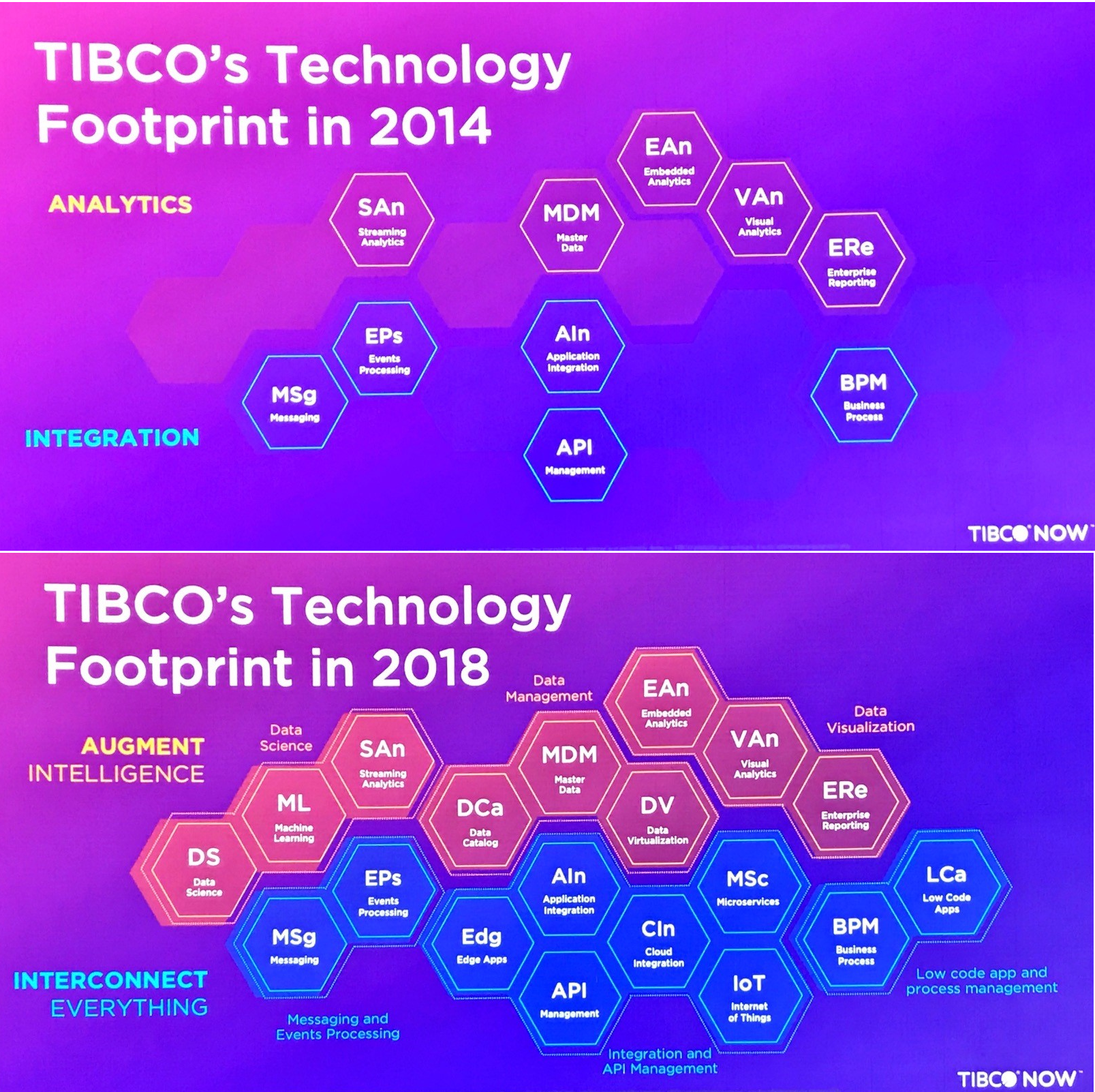
Since 2014, TIBCO has acquired Statistica, Alpine and the CISCO Integration Server (formerly Composite Software), among other assets, and has added a data catalog.
Analytics Update
Before we get into the vision and strategy, the key analytics-related announcements at TIBCO NOW included the following:
Spotfire gets smarter. Set for general availability this fall, Spotfire X (as in the 10.0 release – skipping 8.X and 9.X) adds natural language querying (NLQ) and AI-driven recommendations. NLQ lets users explore data through typed, English-language questions rather than SQL code. The AI-driven recommendations feature employs an ensemble of machine learning techniques to scan data and spot interesting variables, exceptions and drivers. The recommendations are exposed as a list of notable data-exploration possibilities.
Spotfire gets faster. Spotfire X gains a new Data Streams function from TIBCO’s StreamBase technology to support visual analytics on data streams. Spotfire Data Streams offers real-time intelligence for Internet of Things (IoT) applications and other (fast-growing) use cases for low-latency insight. Oil and gas, manufacturing, pharmaceutical and life sciences businesses are at the head of the list of potential customers. Spotfire Data Streams supports continuous monitoring as well as real-time analysis and comparison to historical data to support trend- and root-cause analysis.
Data science options integrated. TIBCO Data Science is a start on the integration of various TIBCO analytics and machine learning capabilities, including last year’s Alpine Data and Statistica acquisitions as well as the TERR (R server) and Statistics Server offerings long associated with Spotfire. Bundling brings together everything under a single license while initial integrations enable Statistica analytics to be run from Spotfire Analyst. Statistica can also call out to the Alpine engine to run analytics in cluster.
Jaspersoft gets cloud friendlier. TIBCO announced JasperReports IO to advance embedding of reports and visualizations in cloud-based apps. IO is a small-footprint rendering engine that wraps Java in RESTful endpoints for easier development. It’s initially available as a Dockerfile. Highly scalable microservices orchestrated by Kubernetes are a planned next step.
MyPOV On Key Announcements
Spotfire is a solid data discovery and visualization option that’s particularly popular with data-savvy analysts in manufacturing, oil and gas, life sciences, pharma and other demanding environments. TIBCO was ahead of the game in delivering integrated data-wrangling capabilities in 2015. Spotfire is not as intuitive for business users as is Tableau or Microsoft Power BI, but the addition of natural language query and AI-driven recommendations should help to make it more accessible.
The new streaming analysis capabilities in Spotfire X will give power users yet more sophisticated functionality for low-latency and IoT scenarios. Other upgrades in release X, including data visualization improvements and design-once, deploy-on-any-device responsive design, will please every Spotfire customer.
Every analytics vendor now seems to claim embedded analytics capabilities, but this is a market niche that Jaspersoft has focused on for a long time. Open source licensing gives developers a cost-effective, flexible foundation. With JasperReports IO, TIBCO is clearly intent on supporting state-of-the-art cloud architecture.
As for my take on the data science moves, let’s look at how the broader portfolio comes together.
The Data Intelligence Portfolio
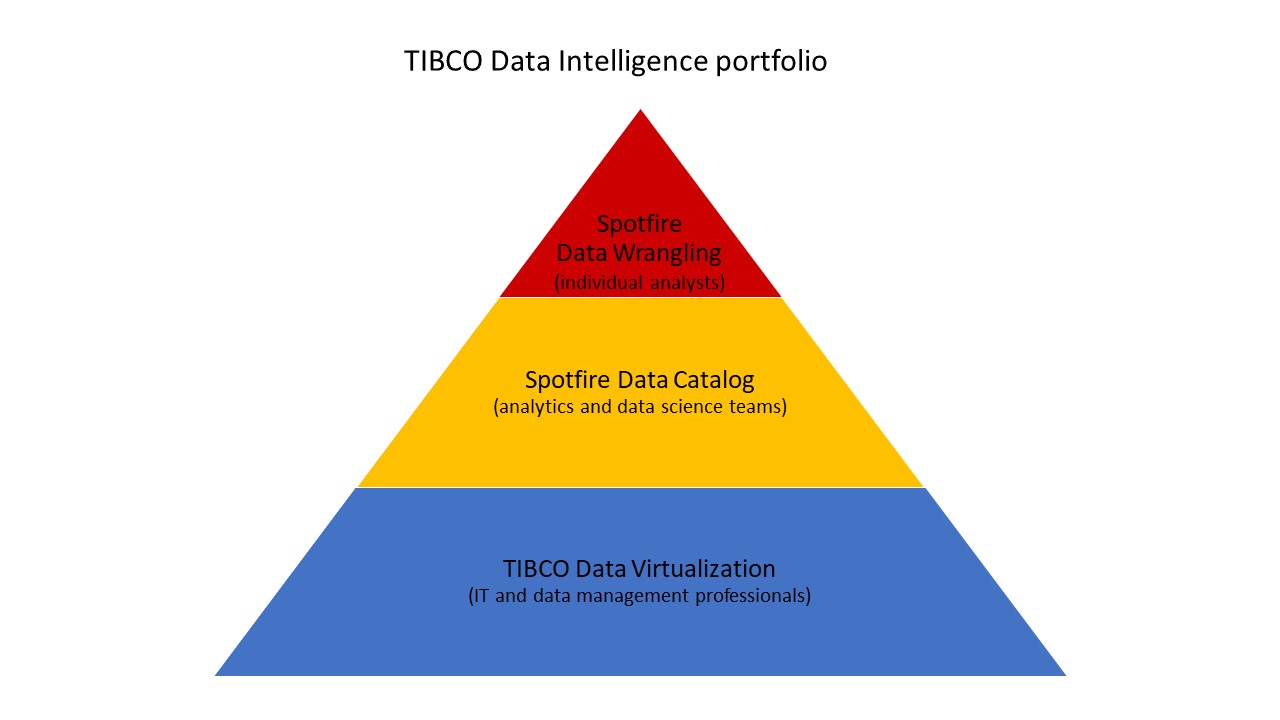
TIBCO executives say underlying data intelligence capabilities including data wrangling, data cataloging and virtualization will be a boon to analytics and data science teams alike.
To get a better understanding of TIBCO’s analytics strategy, I sat down with Brad Hopper, vice president, analytics product strategy, who drew out a simple pyramid to explain what he informally calls the data intelligence portfolio. It starts at the top of the pyramid with the data wrangling capabilities built into Spotfire. These features enable individual analysts and data scientists to combine, manipulate, clean up, standardize and otherwise munge data for visual analysis in Spotfire or in data science work.
Data analysts and data scientists don’t tend to methodically build out workflows with every data-manipulation step planned out in advance, as would an ETL professional. The focus is on letting these users wrangle the data, yet each step they take is captured and recorded in the background. Even if the steps weren’t applied in a linear, planned-out way, Spotfire’s Data Canvas retains a logically ordered, documented and trackable workflow of all the joins, transformations and cleansing and editing steps behind each new source that can be edited, perfected, reused and audited.
The next layer down in the Data Intelligence pyramid is the TIBCO Spotfire Data Catalog, which is built on technology from Attivio that supports machine-learning-based crawling and indexing of all data in the enterprise. This includes data lakes with unstructured information, which the catalog parses and enriches with metadata. Fuzzy matching helps to find relationships among data.
This middle layer is designed to aid search, discovery and data prototyping, so it’s aimed at teams using Spotfire, but Hopper also sees it coming into play for data scientists. Teams might develop marts for standardized dashboarding and visualization through Spotfire or reporting through Jaspersoft. The catalog and data wrangling tools will help data science teams spot and develop new data sets.
At the bottom of the Data Intelligence pyramid is TIBCO Data Virtualization (formerly Cisco Information Server/Composite Software). This is where IT can draw on the data workflows captured on the Spotfire Data Canvas and turn them into hardened data marts and sanctioned, production-grade data sources. The heavy lifting is done through virtualization rather than traditional ETL and data-movement. Also described, variously, as data fabric, logical data warehousing or virtual data layer, data virtualization approaches are gaining traction. TIBCO Data Virtualization competes directly with Donodo (which I recently wrote about in combination with Looker in this recent case study).
MyPOV on TIBCO’s Data Intelligence Strategy
Analytics and data science can only thrive where there is ready access to solid, well-managed data. Thus, I do like how the data catalog and data virtualization assets complement Spotfire and, potentially, Tibco Data Science. I’ve been following Composite Software for a long time, so it’s good to see stepped up investment in what’s now known as TIBCO Data Virtualization. I didn’t get to see enough at TIBCO NOW, so I’ve asked for deeper briefings on how DV works with modern cloud architectures, unstructured sources and object stores such as Amazon S3.
The breadth of TIBCO’s portfolio and the one-stop-shop/one-throat-to-choke opportunity it affords is likely to appeal to IT buyers. I’d make a point of getting analytics buyers in the loop, too. You might use DV to deliver IT-sanctioned data sources for data governance purposes, for example. One Spotfire customer lamented, during a DV session at TIBCO NOW, that users want direct, not virtualized, access to the tables and sources they already know. Adoption of TIBCO DV may require a bit of change management, even if it’s ultimately a boon to data access and governance.
As for TIBCO’s data science portfolio, I see the moves to bring together the Statistica, Alpine and Terr/Spotfire assets on one platform as appealing to existing customers, but I doubt the collection will win over greenfield converts. For one thing, they remain separate products with very basic points of integration at this point. For another, data scientists starting from scratch are embracing all things open source, including Jupyter and Zeppelin notebooks and direct coding of open algorithms. Alpine Data certainly tried to cater to this next-generation crowd, but it wasn’t winning in the marketplace.
For now, TIBCO’s access-to-everything licensing will appeal to existing Statistica and Alpine Data customers (as will the complement of catalog, data wrangling and DV capabilities, if they’re also Spotfire customers). Long term, however, I’d want to see deeper integration and refactoring that truly brings these assets together as a single product worthy of the “platform” billing, with connected workflows and consistent user interfaces.
In short, I like what TIBCO is doing with Spotfire, catalog capabilities and TIBCO DV. Only time will tell if the data science portfolio can become more appealing than the sum of its parts.
Related Reading:
Tableau Advances the Era of Smart Analytics
UltraMobile Takes an Affordable Approach to Agile Analytics
Alteryx Offers Gift of Time for Analytical Innovation
Data to Decisions Tech Optimization Big Data ML Machine Learning LLMs Agentic AI Generative AI AI Analytics Automation business Marketing SaaS PaaS IaaS Digital Transformation Disruptive Technology Enterprise IT Enterprise Acceleration Enterprise Software Next Gen Apps IoT Blockchain CRM ERP finance Healthcare Customer Service Content Management Collaboration Chief Executive Officer Chief Information Officer Chief Digital Officer Chief Technology Officer Chief Information Security Officer Chief Data Officer
Key Takeaways for Today’s Marketing & Sales Professionals from Tiffani Bova, Rober Glazer and Jen Grant
“Half the money I spend on marketing works, but I don’t know which half.”
This simple adage illustrates the marketing and sales problems of the past are still impacting teams across today’s organizations and industries. On a recent DisrupTV episode (121), its hosts R “Ray” Wang, founder and principal analyst at Constellation Research, and Vala Afshar, chief digital evangelist at Salesforce, interviewed three seasoned leaders addressing the future of marketing and sales. Be sure to check out the full replay for the interviews, but for now, here are the five takeaways from the discussions.
There isn’t just one right move to fix a problem. Tiffani Bova, global customer growth and innovation evangelist at Salesforce, former distinguished analyst and research fellow, and author of “Growth IQ,” warns executives should constantly reevaluate and ask the tough questions, rather than wait for slowdowns or panic mode in order to stay on top.
Ask your team: What’s working? What’s changed? What’s not working? How are your customers different? What has happened around you? Where do you want to go? Bova explained that she discusses these questions in client sessions and then asks, “how has your sales and marketing changed?” The answer usually is: “it hasn’t…”
This disconnect is what sets companies apart. It also explains why 52 percent of the Fortune 500 have been merged, acquired, bankrupted, or fallen off of the list since 2000,” according to a stat from Constellation Research. Don’t let one business metric (or even a full business model!) change around you without adjusting your strategies.
Bova’s book takes a modern spin on tried and true marketing strategies, highlighting some great case studies from McDonalds, Red Bull, Starbucks and Kylie Cosmetics. She stresses the importance of focusing on technique and leveraging a combination of strategies to figure out the best sequence for your business to flourish.
Flip the model on its head and pay only for results. Robert Glazer, founder & CEO at Acceleration Partners and author of Performance Partnerships,” explains that the value is in the results. We get into contracts and throw away money to gain menial results. You don’t have to get stuck in a contract with a partner for $20,000 a month, for example. This new model allows you to set specific goals and only pay for those agreed-upon outcomes. For every time you place me in X publication or X type of podcast, I will pay you $5,000. It’s much easier to track and measure these outcomes. You will get more value for your money and from your relationships by setting clear, actionable goals with the money tied to them.
It’s more damaging to have your “values” plastered on a wall or discussed only once, than to not have any values at all. Core values are key to successful teams and organizations. Hire by them. Promote by them. And fire by them. Be clear about where you are going and ensure the team is aligned. It’s as simple and hard as that, explained Glazer.
Make your team and your organization a place where people want to get on board with your values as a leader. Everyone - employees, contractors and partners – should align themselves and keep that focus in their day-to-day roles to ensure the short-term and the long-term direction is where you want it.
The HPPO (highest paid person’s opinion) is not always right. The strongest leaders know that the smartest person in the room is the room. Jen Grant, chief marketing officer at Looker, highlighted how in many organizations, teams are afraid to stand up to the HPPO or the HPPO wants to keep the data and insights locked at the top. Truly successful leaders understand the importance of everyone bringing their unique and diverse viewpoints to the table. It’s all about instilling empathy and trust.
Think about it. If we all lived in the same house, with the same family and attended the same schools, then we would all think along the same lines. Build your team with individuals from different backgrounds and locations, then they will bring different, unique ways of thinking to tackle the same problem. Use our differences to build strength in our outcomes. If everyone has access to the same data – sales and marketing, junior and senior employees, the HPPO – then we can remove the power struggle and work out the problems at a different, more successful level.
Glazer echoed these sentiments explaining that it’s important to also focus on time management, personal achievements, and health goals, for example, to really foster a strong, supportive culture for our diverse team members. Help everyone get over the bar in their own ways, and those strong accomplishments on the personal side will translate into business. Nurture your teams to grow your business on the inside and out.
It seems daunting to jump from B2C marketing over to the B2B world. The first instinct for many is, “it’s a business, so make it as boring as possible, and use lots of words and long sentences.” All joking aside, Grant highlights what seems to be a big challenge for marketers trying to make this shift.
Grant, who has successfully run marketing programs on both sides, reminded leaders that you are always marketing and selling to a person. Our goal is to inspire them, make them happy, support them, and build their trust. Whatever you are selling or promoting, it’s not to the “four walls” of an organization; it’s to a person who needs a problem solved.
The Bottom Line
As market leaders upend traditional sales and marketing myths, expect a balance of a more data-driven approach with a personalized authentic message. Brand still matters in sales and marketing, and every interaction with a prospect and customer must reflect the brand. However, how we engage will continue to evolve and brands and enterprises must be prepared for constant change.
What’s Next?
Where do you want to be in five years, 10 years, next month? As an executive, ensure everyone is focused on the same destination. Focus on the people – employees, partners, audience, etc. If you stay true to your guiding “light,” then growth and success will follow. For more knowledge sharing from smart executives, change agents and thought leaders, check out DisrupTV every Friday at 11 AM PT/2 PM ET.
Sep 5 and 6 Slack held their user conference Frontiers in San Francisco. The flow of the keynote was very well done, with Slack executives and customers (including 21st Century Fox, WeWork and others) working together to tell a consistent story around how Slack is evolving from just group messaging (a place for people to chat) to a collaboration hub (a place that integrates together multiple applications to enable people to do work). This theme of stream or newsfeed based tools becoming a place to "get work done" fits in well with the concept of Purposeful Collaboration that I've been writing about since 2013.
Logistically Frontiers was very well done, with a combination of entertainment, education and philanthropy. They recapped product highlights of 2018 including
and discussed several future features (ranging from Q42018 to "sometime in 2019")
but unfortunately, there was not a lot of "new and available now" type news. I would have liked to have heard:
Here is my quick video recap of Slack Frontiers 2018
MyPOV:
Slack certainly deserves credit for reinvigorating the enterprise collaboration market. Their rise to tech-stardom caused the traditional tech giants Microsoft, Google, Cisco and IBM to react and develop their own similar channel-based collaboration tools. But now with the market being so competitive, what comes next for Slack? I would have liked to have seen more emphasis on Slack Enterprise Grid, their platform for use at large companies.
As I pointed out on Twitter, I believe their future will involve more native functionality that enables them to evolve beyond just messaging to becoming more of a platform for executing core business workflows.
News: @SlackHQ raises another $427M via series H funding.
— Alan Lepofsky 🇨🇦 🇺🇸 Future of Work (@alanlepo) August 21, 2018
MyPOV: Slack's future is expansion beyond group messaging or even being an integration hub to include more native collaboration functionality.
VIDEO: https://t.co/iiKQzho1L2#futureofwork #employeeexperience #socbiz #esn
The way most people work today, struggling with information overload as they constantly switch between multiple applications is not the optimal way to work. Slack as well as several other vendors know this, and are working on ways to improve the employee experience. I've written about this future of work in what I refer to as Digital Canvases, and I look forward to seeing Slack continue to try and help employees work better together.
Future of Work