Vice President and Principal Analyst
Constellation Research
Holger Mueller is VP and Principal Analyst for Constellation Research for the fundamental enablers of the cloud, IaaS, PaaS and next generation Applications, with forays up the tech stack into BigData and Analytics, HR Tech, and sometimes SaaS. Holger provides strategy and counsel to key clients, including Chief Information Officers, Chief Technology Officers, Chief Product Officers, Chief HR Officers, investment analysts, venture capitalists, sell-side firms, and technology buyers.
Coverage Areas:
Future of Work
Tech Optimization & Innovation
Background:
Before joining Constellation Research, Mueller was VP of Products for NorthgateArinso, a KKR company. There, he led the transformation of products to the cloud and laid the foundation for new Business Process as a…...
It has been quiet on the global payroll front in general – the biggest news of the year has been incremental addition of countries by practically all major global HCM vendors (see here for the Market Overview).
The faster path – basically not playing the country-by-country monopoly game – is an acquisition - and that is what Ceridian just has done, with the acquisition of ADAM HCM. Let’s dissect the press release in my custom style, it can be found here.

Toronto, ON and Minneapolis, MN, December 6, 2021
Ceridian (NYSE: CDAY; TSX: CDAY), a global leader in human capital management (HCM) technology, today announced it has acquired ADAM HCM, a leading payroll and HCM company serving customers in 33 countries across Central America, South America, and the Caribbean. This acquisition positions Ceridian as a leading HCM provider in Latin America and will create value for existing and prospective customers in key markets, including Mexico and Brazil.
MyPOV - ADAM HCM has been a specialist for Latin America, pretty much since its inception, pitching its capabilities to typically North American headquartered companies (e.g., Bayer, Cargill, GM, Intel etc.) that have been disappointed by their large HCM vendor support for both Latin American and Caribbean countries. More recently ADAM HCM has focused on larger Latin America champions, with a focus on Brazil and Mexico headquartered (e.g., Vale) companies.
Trusted by leading global brands, ADAM HCM has a strong and tenured leadership team and extensive regional knowledge and experience. Through this acquisition, ADAM HCM customers will be able to access Ceridian’s award-winning platform for global HCM, allowing them to scale and grow globally across new geographies.
MyPOV – This is a neutral statement on the intentions of Ceridian. Certainly, ADAM HCM customers will get access to Ceridian payroll supported countries but that is only a small portion of the overall potential for this acquisition. Understandably, Ceridian is trying to not open its cards here to much – but the medium and longer term is clear – leverage the ADAM HCM payroll expertise and build out Ceridian payroll... the interesting aspect to watch out for – will Ceridian first ‘just’ integrated the ADAM HCM payrolls or start with a rebuilt of them in the native Ceridian technology stack… future will tell.
“This acquisition will accelerate Ceridian’s global growth strategy by extending the Dayforce platform into Latin America, a highly appealing region for our multinational customers,” said David Ossip, Chair and CEO, Ceridian. “Together with ADAM HCM, we’ll enhance our capacity to meet rising customer demand in Latin American countries, while delivering on our brand promise to make work life better for people everywhere.”
MyPOV – Ossip’s statement shows the real intention unequivocally – bring Ceridian to Latin America. ADAM HCM supports 30 countries across Latin America and the Caribbean. Once Ceridian has support for these countries in Dayforce, which will of course not happen overnight, but would make Ceridian the #2 amongst HCM vendors when it comes to native, on platform payroll support.
Today’s announcement will accelerate Ceridian’s commitment to deliver Dayforce Payroll in Mexico. Dayforce Payroll, Ceridian’s always-on, global payroll platform, improves accuracy by auditing payroll data in real-time while managing global compliance complexities – all within a single solution.
MyPOV – Support for Mexico payroll was announced by Ceridian earlier, this acquisition will certainly help the effort, and more importantly rationalize the investment sooner, as a larger customer base can be potentially sold to.
“We are thrilled to become part of Ceridian’s global team and broaden the reach of Dayforce into Latin America and the Caribbean,” said Brian Beneke, CEO, ADAM HCM. “In today’s borderless and fluid world of work, our customers will benefit from a single Dayforce experience that delivers innovation and experiences to help organizations and employees reach their full potential.”
MyPOV – They usual acquired CEO positive statement, glad Beneke mentions the Caribbean – which is an underserved, under automated region when it comes to payroll support.
Overall MyPOV
Ceridian continues its strategic acquisition spree of regional payroll players, that offer multiple country support already. Ceridian has shown that for the APAC region with the 2020 acquisition of Excelity and this February with Ascender. It even has a luxury and consolidation challenge there, as payroll offerings overlap. Now Ceridian is tackling Latin America and Caribbean. What’s next? Europe and Africa remain… as well as the Middle East. We won’t be surprised if Ceridian acquires there in 2022…
But it is one thing to acquire payroll providers, it is another one to get the know how into the go to platform (Dayforce) and another one to consolidate these payrolls and replace them with the Dayforce offering. Ceridian has shown in North America that it can do upgrades on a large scale at metronomic precision, as it upgraded the old Ceridian platform customers to Dayforce. And let’s not forget, Dayforce is a nice upsell for most of these customers who only HR Core and Payroll with their vendors, maybe some light Talent Management, but a full Talent Management suite, and the Ceridian ‘crown jewel’ on the Workforce Management side are massive upsell opportunities.
For not it is congrats to Ceridian, you first need to have the inhouse know how to build a payroll, and an acquisition is a good way to not only get the know-how, but also get real customer to convert to the new product to. Let’s see which countries will come out first wit the help of ADAM HCM.
Former Vice President and Principal Analyst
Constellation Research
Doug Henschen is former Vice President and Principal Analyst where he focused on data-driven decision making. Henschen’s Data-to-Decisions research examines how organizations employ data analysis to reimagine their business models and gain a deeper understanding of their customers. Henschen's research acknowledges the fact that innovative applications of data analysis requires a multi-disciplinary approach starting with information and orchestration technologies, continuing through business intelligence, data-visualization, and analytics, and moving into NoSQL and big-data analysis, third-party data enrichment, and decision-management technologies.
Insight-driven business models are of interest to the entire C-suite, but most particularly chief executive officers, chief digital officers,…...
Vice President and Principal Analyst
Constellation Research
About Andy Thurai
Andy Thurai is an accomplished IT executive, strategist, advisor, enterprise architect and evangelist with more than 25 years of experience in executive, technical, and architectural leadership positions at companies such as IBM, Intel, BMC, Nortel, and Oracle. Andy has written more than 100 articles on emerging technology topics for publications such as Forbes, The New Stack, AI World, VentureBeat, DevOps.com, GigaOm and Wired.
Andy’s fields of interest and expertise include AIOps, ITOps, Observability, Artificial Intelligence, Machine Learning, Cloud, Edge, and other enterprise software. His strength is selling technology to the CxO audience with a value proposition rather than the usual technology sales pitch.
Find more details and samples of Andy’s work on his…...
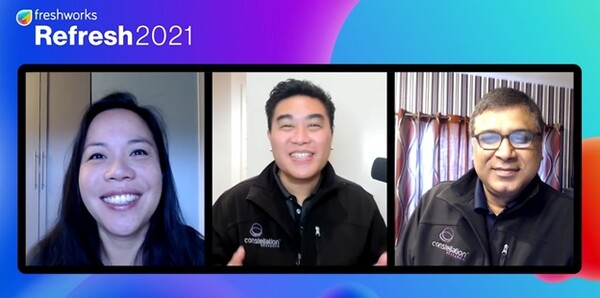
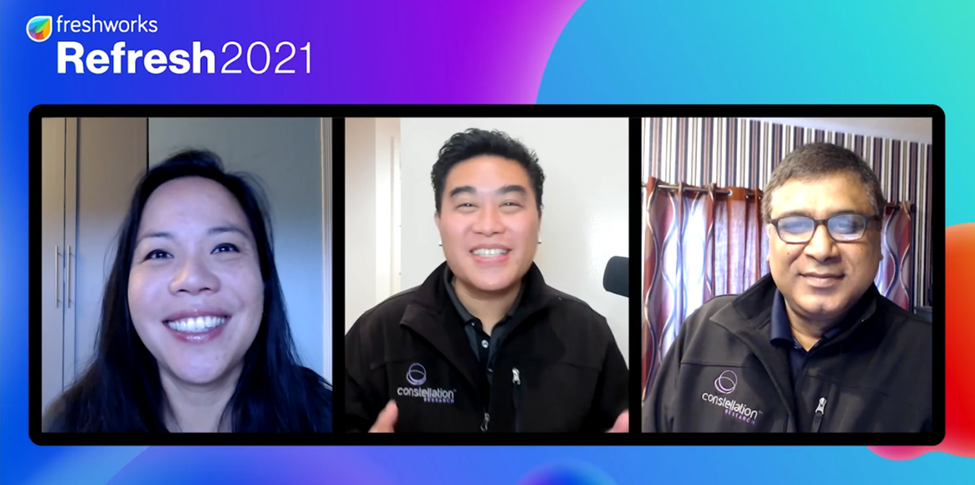
I was fortunate enough to be invited to attend and speak at the Refresh 2021 conference in Las Vegas earlier this month. For those who don't know Freshworks, they are a recently public company (Symbol: FRSH) that provides SaaS solutions in the Sales, Marketing, CRM, HR, and IT helpdesk/service areas
My first thought, for a change, Vegas has implemented a mask mandate policy in casinos (gasp!). Every conference venue now conducts vaccination validation and demands a negative Covid test onsite. While the town is back in demand and bustling with crowds, it is good to see these precautions as the covid doesn't seem to be going away any time soon.
At the conference itself, a few things stood out to me. Freshworks touted their ease of use, the total cost of ownership (TCO), return on investment (ROI), and scaling IT with business as their main differentiators. I am actually in the middle of reviewing the Incident Management, ITSM, ITOM vendors currently, and will let you know how they stack up against the competition. But, from what I saw at the conference, it is compelling enough to include them in your evaluation process.
Delivering on Delight
As with most technical conferences, this hybrid conference was well attended virtually with about 20k people joining globally, and with about 200+ in person. The theme of this conference was "delight." The entire line-up, keynotes, panels, and breakout sessions were all centered around how do you delight your customer.
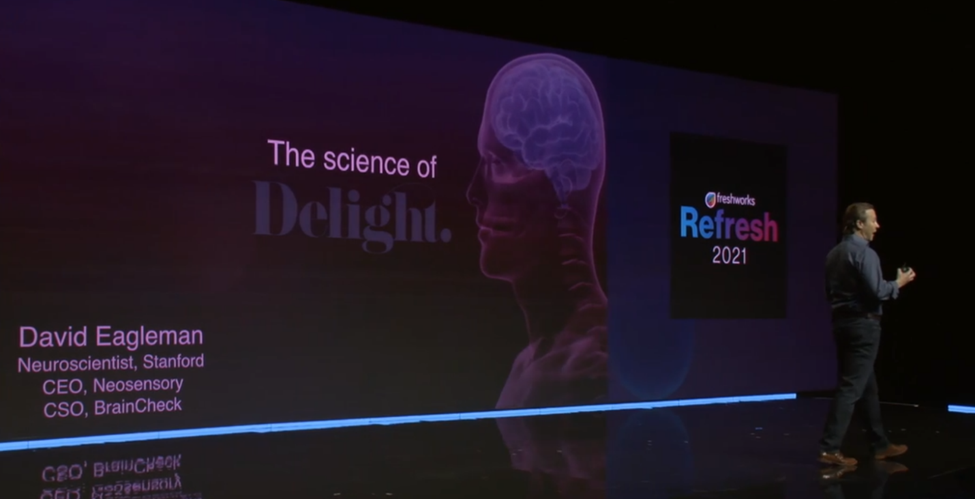
The day started with Stanford Neuroscientist David Eagleman (a Pulitzer nominee) talking about the science of delight. He pointed out that the human brain has 86 billion neurons with 100s of trillions of connections between them. While the delight happens at the neuron level, you can’t control it, but you can feel it, live it, enjoy it! According to him, while it is the conscious brain that makes the decisions, the unconscious brain decides based on the delightfulness of something that is underlying whether it is selecting a partner, a job, a car or a house, etc. A lot of times, the conscious mind messes up by overriding proper decisions made by the unconscious mind according to him. In other words, overthinking at times will only mess things up. You want things to be automated for decision making, fixing, etc. as most times the decisions made and executed by unconscious or automated systems are better than what collaborative thinking can result in.
Everything that is happening in cognition is happening incognito. Decision making such as choosing Pepsi vs Coke, or other decisions of branding decisions are all done incognito. A compelling example is when a charger is priced at $19 vs $29 (a $10 diff) we would be willing to walk a mile to save that $10, but whereas when you buy an iPhone that is $567, we are not willing to walk a few steps to save that $10. The way we make decisions is not rational, but it is based on context – valuing things when they are in different valuation metrics is hard to choose according to him.
More than the price itself, the customer experience, and the context surrounding that sets the value of pricing are more important. The decisions are made based on delighting the customer, it is based on emotions. Total value is much more than just the price or a total cost of ownership, it is based on connected customer experience and the delight that goes with it, according to David.
Girish Carries Forward Humility in All He Does
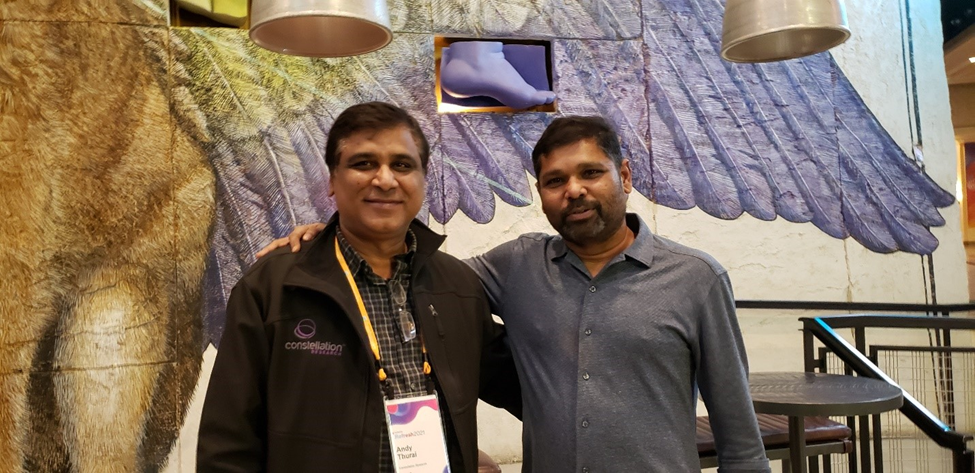
After David spoke, Founder and CEO Girish took to the stage. I have always admired Girish as he came from humble beginnings. I had a chance to chat with him a little bit when he had a moment.
The thing Girish pointed out was that customer wants "easy." He went on to talk about his experience in dealing with a vendor about replacing a brand-new TV broken in transit and how long it took to replace it even though it was under warranty and the customer experience that went with it. Painful!
He boldly claimed that the first generation of SaaS providers failed. He claimed they focused on re-platforming and reducing technology debt but failed on delivering customer experience. I agree with this thought, though disagree that all of them have failed. He started FreshWorks with a "fresh" view to provide those customer experience and usability in mind. He said he wanted to build something that will be easy about using the software right away instead of waiting for 18 months – the art of delight. You can't argue that.
He said Freshworks was built on five core principles – Modern, Unified, Salable, Intuitive, and Cost-effective – as table stakes and that is MUSIC to customer's ears. I liked the wordplay there!
At the end of the day, it is not just customer satisfaction but the customer experience that goes with it that matters more. In other words, it is not just the end result that matters, but the path to reach it – products and services should delight the customers and not leave them with a painful experience. A real boost in loyalty comes from reducing overall effort or reducing friction in doing business with you.
Freshworks also showed a persona-based live demo on-stage that was compelling. A combination of bots, automation, the collaboration between customer service, IT, warranty, finance, returns to solve an issue in a short time frame was powerful. They chose to demo a fictitious shoe company with a manufacturing defect and how teams can collaboratively handle the issue and take the customer experience to the next level.
The burden on IT is higher than ever to run the business with the remote workforce. Especially with customers used to the delightful experience of consumerization experience of B2C companies, providing an old, clunky, outdated user experience will hurt more than help your business, particularly the online engagement with customers at the channel of their choice.
Girish also said, "Marketing is not about spamming millions of customers with a generic email anymore. It is about sending each customer a highly personalized, individualized offer based on their needs, desire, and timing, and the digital channel of their choice" which I completely agree with.
Amy Purdy Delivers Stories of Personal Triumph
It would be remiss of me if I failed to mention the most compelling closing keynote that I have ever seen. Amy Purdy, a 3x paralympic medalist, talks about how she went from an Olympic-level snowboarder to the brink of death and came back alive again. She talked about turning any challenge into an opportunity by defying all odds. If you are passionate, you can do it! I won't do justice by narrating her story. You can watch it in its entirety here. https://web.cvent.com/hub/events/52b42838-fdea-4731-b8fd-51c212b052b5/sessions/88c63436-e43c-4c1c-adef-35f7efc2b240
Freshworks Platform Delivers on New ITSM/ISOM Capabilities
And finally, my favorite segment – ITSM, ITOM capabilities. They demonstrated the platform on how a business can move instead of being reactive to incidents to being proactive. While they are getting into the crowded AIOps market (I track about 50+ vendors in this space), the correlation engine from multiple monitoring solutions, AI sensing a shopping cart problem and create an auto incident instead of customer/support initiated ticket, ML-powered ticket routing and assignment, figuring out the actual underlying issue, the urgency of it, escalating it to the right person to solve the issue, and thus enabling a faster time to resolution resulting in enhanced customer experience are all making sense in connecting business with IT.
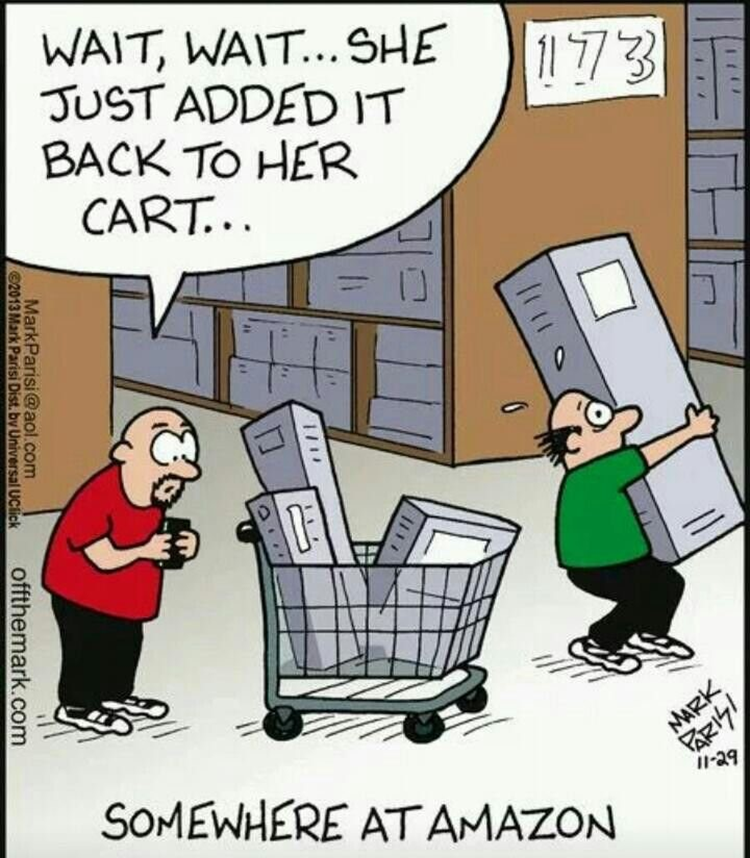
The persona-based demo involved Freddy the AI sensing the customer Phoebe having difficulty in completing the order, and figuring out the underlying issue, creating an auto ticket, routing it, NOC agent Pollack sensing that issue, and collaborating with Ash the on-call full-stack engineer to roll back the updates, and Leslie the CSR finally updating the customer to buy it again. While of course it was staged, it was pretty compelling to see the business and technology come together to support each other. I would love to see that with my vendors, but it feels like the below
[Pic Courtesy: Mark Parisi]
And I can't close this without mentioning my talk at the conference. I went head-on with the legendary Ray Wang discussing ITSM vs DevOps. I have battle scars to prove it! I think it was a great discussion which can be viewed at the following link (registration required).
Freshworks has a set of new offerings that goes end to end – whether it is combining marketing to sales to delight the customer, or tracing eCommerce problems from point of sale to the affected underlying services directly to help with troubleshooting to delight customers and employees – the offerings go from business side to IT side to make the connection easy.
Incident Management is an important, yet forgotten art, in the cloud era. Even smaller incidents can affect customer experience and brand value. A clunky, intermittent, hard to use system can drive customers quickly away regardless of the pricing and availability of goods.
The customer delight came through in my discussion with some of their top customers at the conference. While cost is a factor in selecting Freshworks, they also score high on usability, customer experience, and faster innovation – according to them.
Scaling IT with business is more important than ever. If your IT can't sustain the hyper-growth of your business, as and when needed, the game is over.
Connected customer/employee experience is more important than ever.
I am currently reviewing 11 vendors for my market overview research on Incident Management and FreshWorks is one of them. More details on my research can be found at the following links:
Principal Analyst and Founder
Constellation Research
R “Ray” Wang is the CEO of Silicon Valley-based Constellation Research Inc. He co-hosts DisrupTV, a weekly enterprise tech and leadership webcast that averages 50,000 views per episode and blogs at www.raywang.org. His ground-breaking best-selling book on digital transformation, Disrupting Digital Business, was published by Harvard Business Review Press in 2015. Ray's new book about Digital Giants and the future of business, titled, Everybody Wants to Rule The World was released in July 2021. Wang is well-quoted and frequently interviewed by media outlets such as the Wall Street Journal, Fox Business, CNBC, Yahoo Finance, Cheddar, and Bloomberg.
Short Bio
R “Ray” Wang (pronounced WAHNG) is the Founder, Chairman, and Principal Analyst of Silicon Valley-based Constellation Research Inc. He…...
Over $8.5 Billion Invested In 241 Quantum Startups
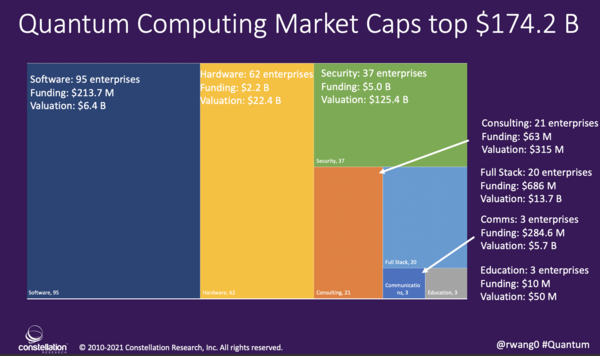
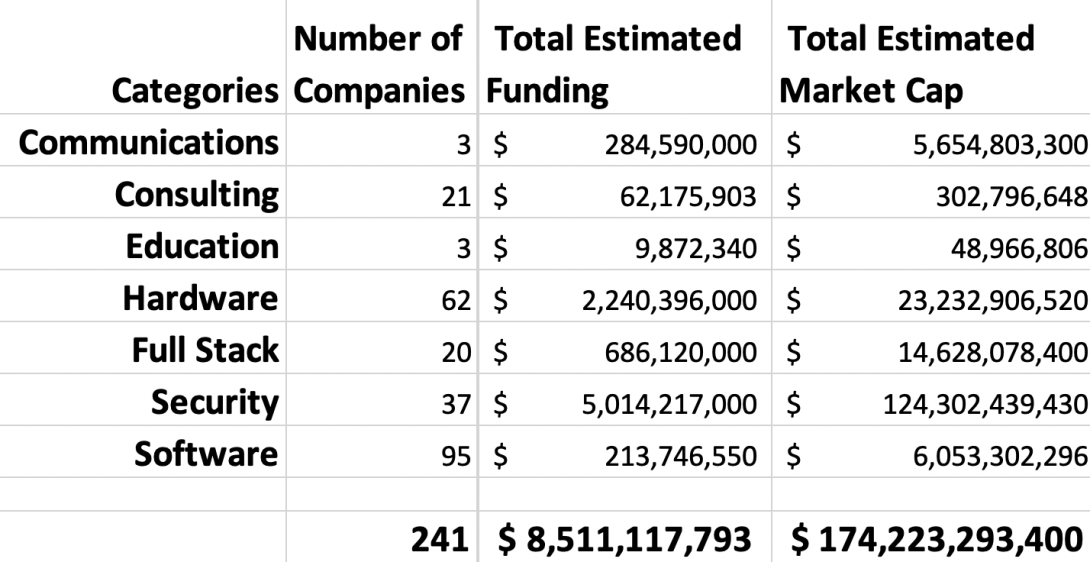
A recent analysis by Constellation Research found 241 companies in the Quantum Computing space in seven categories driving $8.512 billion in investment to date. A review of funding announcements, deals in pipe, and conversations with investors, demonstrated a tremendous appetite to fund all categories of the quantum ecosystem. The funding to date does not include investments from established digital giants such as Amazon, Google, IBM, Intel, Microsoft, and Nviidia.
Across the seven categories, security represented the highest estimated market cap at $124.3 B followed by hardware companies at $23.2B. Full stack vendors who deliver the complete quantum capabilities will drive $14.6 B in estimated market cap. Software came in at $6.1 billion and communications registered a $5.8 B estimated market cap (see Figure 1).
Figure 1. Investors Flock To The Quantum Landscape
Source; Constellation Research, Inc.
The Bottom Line: Expect A Period Of Innovation and Consolidation Ahead
The Quantum revolution has begun. Early investors have seen the potential and the market is entering a period of consolidation to acquire talent, intellectual property, and product offering roadmaps. With over 241 startups in this space, Constellation expects at least a dozen full stack winners to emerge along with five to seven specialists in each category and emerging use case. Security will continue to receive the most funding and attention. New players will continue to attract funding as the quantum field advances. The early days of quantum are here and the winners will emerge in the next five years.
Your POV
What quantum use cases drive your interest? Where do you see the quantum players win?
Developing your quantum and digital business strategy
Connecting with other pioneers
Sharing best practices
Vendor selection
Implementation partner selection
Providing contract negotiations and software licensing support
Demystifying software licensing
Reprints can be purchased through Constellation Research, Inc. To request official reprints in PDF format, please contact Sales.
Disclosures
Although we work closely with many mega software vendors, we want you to trust us. For the full disclosure policy,stay tuned for the full client list on the Constellation Research website. * Not responsible for any factual errors or omissions. However, happy to correct any errors upon email receipt.
Constellation Research recommends that readers consult a stock professional for their investment guidance. Investors should understand the potential conflicts of interest analysts might face. Constellation does not underwrite or own the securities of the companies the analysts cover. Analysts themselves sometimes own stocks in the companies they cover—either directly or indirectly, such as through employee stock-purchase pools in which they and their colleagues participate. As a general matter, investors should not rely solely on an analyst’s recommendation when deciding whether to buy, hold, or sell a stock. Instead, they should also do their own research—such as reading the prospectus for new companies or for public companies, the quarterly and annual reports filed with the SEC—to confirm whether a particular investment is appropriate for them in light of their individual financial circumstances.
Principal Analyst and Founder
Constellation Research
R “Ray” Wang is the CEO of Silicon Valley-based Constellation Research Inc. He co-hosts DisrupTV, a weekly enterprise tech and leadership webcast that averages 50,000 views per episode and blogs at www.raywang.org. His ground-breaking best-selling book on digital transformation, Disrupting Digital Business, was published by Harvard Business Review Press in 2015. Ray's new book about Digital Giants and the future of business, titled, Everybody Wants to Rule The World was released in July 2021. Wang is well-quoted and frequently interviewed by media outlets such as the Wall Street Journal, Fox Business, CNBC, Yahoo Finance, Cheddar, and Bloomberg.
Short Bio
R “Ray” Wang (pronounced WAHNG) is the Founder, Chairman, and Principal Analyst of Silicon Valley-based Constellation Research Inc. He…...
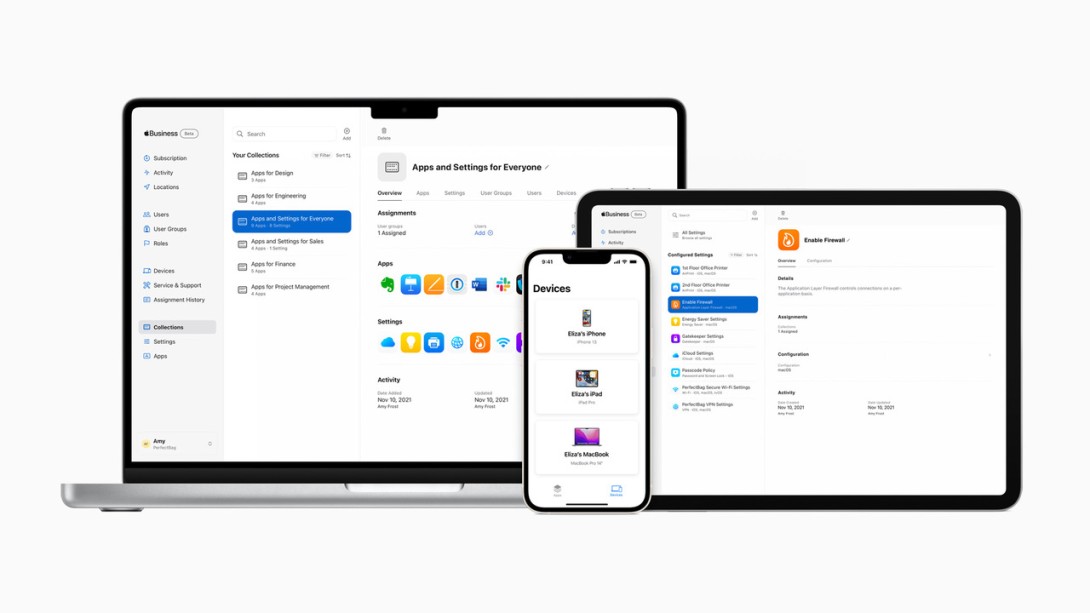
On Wednesday, November 10th, Apple introduced a new business service for companies up to 500 employees. Apple Business Essentials enables organizations to easily add users, onboard users, back up information, secure devices, receive 24/7 support, repair devices onsite, and manage the device lifecycle for deployment.
A new feature known as Collections enables easy configuration of settings and apps for the Individual user, group, and/or device level. Further, IT personnel can automatically push Wifi passwords, VPN settings, and make downloaded apps available to employees who sign in to a personally owned or corporate devices. As a result, this new service makes it possible for organizations to enforce security policies and critical security settings such full-disk encryption, privacy of personal and work data, and the ability to lock out lost or stolen devices. In conversations with technology executives with Apple shops, they are looking forward to the 4-hour or less onsite repair capabilities starting with the iPhone.
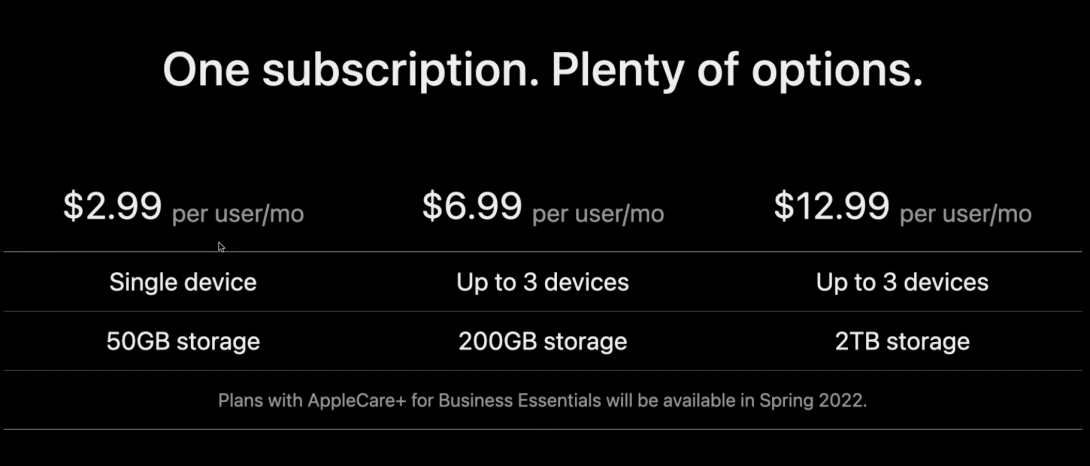
Apple is offering three Business Essentials plans that vary by number of devices and amount of storage (see Figure 1). Organizations can also add optional AppleCare+ to their existing plans.
Figure 1. Three Levels Of Apple Business Essentials Pricing Reflect Usage Based and User Based Pricing
The Bottom Line: Apple Just Made Managing And Securing Devices Much Easier For SMBs
Technology executives in the mid-market face constrained staffing and seek ease of use in adding and on-boarding users and devices; while enabling flexible technology choices amidst growing security threats. The Apple Business Essentials service offering makes it easy to allow SMBs to scale.
Vice President & Principal Analyst
Constellation Research
About Liz Miller:
Liz Miller is Vice President and Principal Analyst at Constellation, focused on the org-wide team sport known as customer experience. While covering CX as an enterprise strategy, Miller spends time zeroing in on the functional demands of Marketing and Service and the evolving role of the Chief Marketing Officer, the rise of the Chief Experience Officer, the evolution of customer engagement, and the rising requirement for a new security posture that accounts for the threat to brand trust in this age of AI. With over 30 years of marketing experience, Miller offers strategic guidance on the leadership, business transformation, and technology requirements to deliver on today’s CX strategies. She has worked with global marketing organizations to transform everything from…...
The time has come to recenter our attention and our intention when it comes to omnichannel. We’ve been chasing omnichannel for what feels like decades, repeating an exercise in pushing everywhere yet engaging nowhere. After such a long journey, the idea of even catching up with the expectations of the omnichannel customer can feel overwhelming.
To break this down into a more actionable conversation, I propose starting by admitting what omnichannel is not: Omnichannel is not a destination. It is less about the technical specifications of the various channels of engagement and more about the customers’ decisions about where to engage in their micromoments of need.
Conversely, what is omnichannel? Omnichannel is a promise and expectation. Omnichannel is bidirectional exchange of value. Omnichannel is an agreement between the buyers of services and the providers of those services on what, when, and how value will be exchanged—and that agreement is redefined and reimagined with every engagement.
It is also time to reset and even reimagine what omnichannel can be—and in some cases, already is. Let’s consider an example: the new face of commerce. The COVID-19 pandemic’s brute-force acceleration of digital commerce innovation catapulted consumers from pushing a shopping cart down the aisles of a grocery store to curb-side pickup and home delivery.
The lines that traditionally segmented B2B and B2C buying experiences into neat categories were upended, blurred, and in some cases completely redrawn, thanks to increased direct-to-consumer (D2C) interactions. Everyone started to rethink and reimagine how life around us actually operated, and then expected technology to bridge the gaps between need and possibility. Entire segments of retail, food service, and even grocery launched mobile and digital experiences enabling online shopping with a choice of curbside pickup, in-store pickup, or delivery.
The Ebb and Flow of the ‘New Normal’
We are also facing the reality that every day seems to breed a new business model or a new challenge to “normal” operations. Take the challenge facing airlines: Under normal circumstances, pricing models were based on historical data, leveraging years of “normal” to best predict and set pricing to achieve optimal revenue. But what happens when historical norms get thrown out the window? There was no historical data that could fit the new normal of pandemic travel. Pricing and the process for predicting pricing models needed to shift, and airlines leveraging platforms that could aggregate known behavioral and event data to predict and optimize price and promotions on the fly (no pun intended) won the trust of the business for optimizing revenue and the trust of the customer for optimizing value.
In B2B, the very concept of what an “experience” should be was quickly being replaced with expectations molded thanks to distinctly B2C experiences. It wasn’t just that the channels of how transactions unfolded were reimagined—entire business models were transformed, demanding new, flexible options for configuring, transacting, and deploying them.
If groceries could be ordered online and delivered, why couldn’t business materials and needs? If toilet paper could be purchased via subscription, why couldn’t training, service, or insurance? If the price of a first vacation could be optimized for both traveler and airlines, why couldn’t the price of software platform configurations similarly evolve?
Remembering the Lessons Learned
The pandemic forever changed the expectations for how service and value could be delivered. It forever changed the speed at which business models could transform and shift. And once the pandemic fades into history, the expectations for value, service, and flexibility will remain. Thanks to the past year, key lessons were learned (often by “failing forward”) that should be carried into this new age of reimagined omnichannel commerce.
Omnichannel is about being omnipresent, not about replicating actions in every channel. Relationship advice usually includes these words of wisdom: Show up, be present, and listen more than you talk. This is as true for relationships with commerce as it is for relationships of the heart. Today’s commerce expectation is not to shout loudest (or have the wildest booth on the tradeshow floor) to lure customers into the channel of an organization’s choosing. Omnipresent commerce is about showing up and being present in the moment the customer is defining. This raises a demand for signal intelligence to understand needs and behaviors—something that will get exponentially more challenging and complex as new channels of engagement enter the journey.
Channel boundaries don’t hold back commerce anymore. Operational boundaries still do. As routes to market shifted, the boundaries between operational systems and functions became glaringly obvious. As digital commerce experiences allowed customers to leverage tools such as configure, price, quote (CPQ), the operational barriers that blocked accurate and timely inventory or distribution intelligence became operational obstacles to delivering new and valuable digital experiences. Channel prioritization based on team or personnel preference—as opposed to channel prioritization based on a customer’s personal preference—can be addressed when artificial intelligence (AI) and machine learning (ML) tools work to identify the right channel for the right selling experience. Early thinking regarding omnichannel commerce assumed that all channels were created equal—and valued in equal measure by the customer. Nothing could be further from the truth. If operational boundaries and roadblocks are left in place (or even worse, fortified by inaction), seeing and managing what doeshappen within a channel will be impossible.
Crisis bred innovation—and now it needs to give way to purpose. In a time of extreme commerce emergency, the innovations in how to approach channels of engagement and the changing mechanics of how work gets done—to push the boundaries of where and how actions, content, engagement, and transactions could happen—were met with little resistance. We needed to do or try something. But in a post-pandemic environment, we will need to stop asking what the “new-normal” could be and just accept that new is normal. To meet the needs of customers on their own journeys, selling organizations need more than the permission to sell differently: They need tools to meet the customer where the customer chooses, with exactly what the customer wants and needs. This is where AI can take the lead in a meaningful way. By looking beyond simply automating sales tasks, an AI-powered selling motion can more effectively deliver consistent and personalized experiences, delivered via valued channels and contextualized for the individual buyer.
Centralization is key. The reality is that for most organizations, we have the channels our customers value and utilize most frequently already in place. The hurdle that must be addressed is how and where operational centralization needs to happen to make the biggest shifts in how quickly and easily our selling experiences can align to the new self-reliant digital buyer. Centralization doesn’t apply just to the data that powers experiences. It also applies to the platforms. It is easy to simplify the silos that stymie selling as being cultural or functional disconnects. It is time to admit that interconnected platforms have a direct impact on the capacity to connect and align operational processes. If the goal is to optimize revenue by tapping into the power of omnichannel engagement and selling, an interconnected platform can help B2B organizations to purposefully shift from siloed and disconnected selling processes.
This isn’t just about the buyer: Modern omnichannel commerce impacts our selling teams, too. Expectations for how fast things come together have changed—partially because of the expediency of the very digital channels and experiences we put into play out of pandemic necessity. Whereas customer relationships between sellers and buyers will always be impacted by those handshakes and face-to-face meetings, the expectation for detail and data at the snap of a finger is here to stay. Sellers don’t have the luxury of having a week to pull pricing and quotes together: They will have moments to meet the needs of the customer. The biggest question of all for organizations wanting to fully lean in to the momentum that transformation has unleashed on commerce is, Are we ready to empower our employees as much as we are willing to empower our customers? This is a new era of selling in which success (and growth) will hinge on eliminating the barriers and roadblocks between sales, commerce, and customer. It’s time to give our teams of sellers access to the easy button so they remain a valued channel of engagement by the customers who still rely on that relationship to see them through their journeys.
The time for questioning whether omnichannel is the right path has passed. The reality is that the customer is already well down that road, setting expectations and resetting buying norms. Once we rethink omnichannel, we can actually prepare for what comes next: the onset of the “metaverse”—that not-so-distant future of shared, connected, virtual spaces and persistent experiences across a self-defined and self-perceived virtual universe. And in the metaverse, customers won’t need to wait for organizations to get up to speed with their expectations. They will have already moved on to engage with an organization ready to meet their needs.