Results

TSMC's Q2: Six takeaways on genAI, AI demand

TSMC's Q2: Six takeaways on genAI, AI demand

TSMC’s second quarter earnings were better-than-expected and the chip manufacturer is becoming a barometer for generative AI infrastructure demand. High-performance computing (HPC) is now more than half of TSMC's revenue.

In addition, TSMC’s ability to be bleeding edge has made it the go-to partner for every generative AI infrastructure player including Nvidia and AMD, two companies moving toward an annual GPU cadence. 

TSMC's second quarter revenue was $20.92 billion, up 32.8% from a year ago, with earnings of $1.48 per American Depository Receipt unit. TSMC is projecting third quarter revenue to be between $22.4 billion and $23.2 billion.
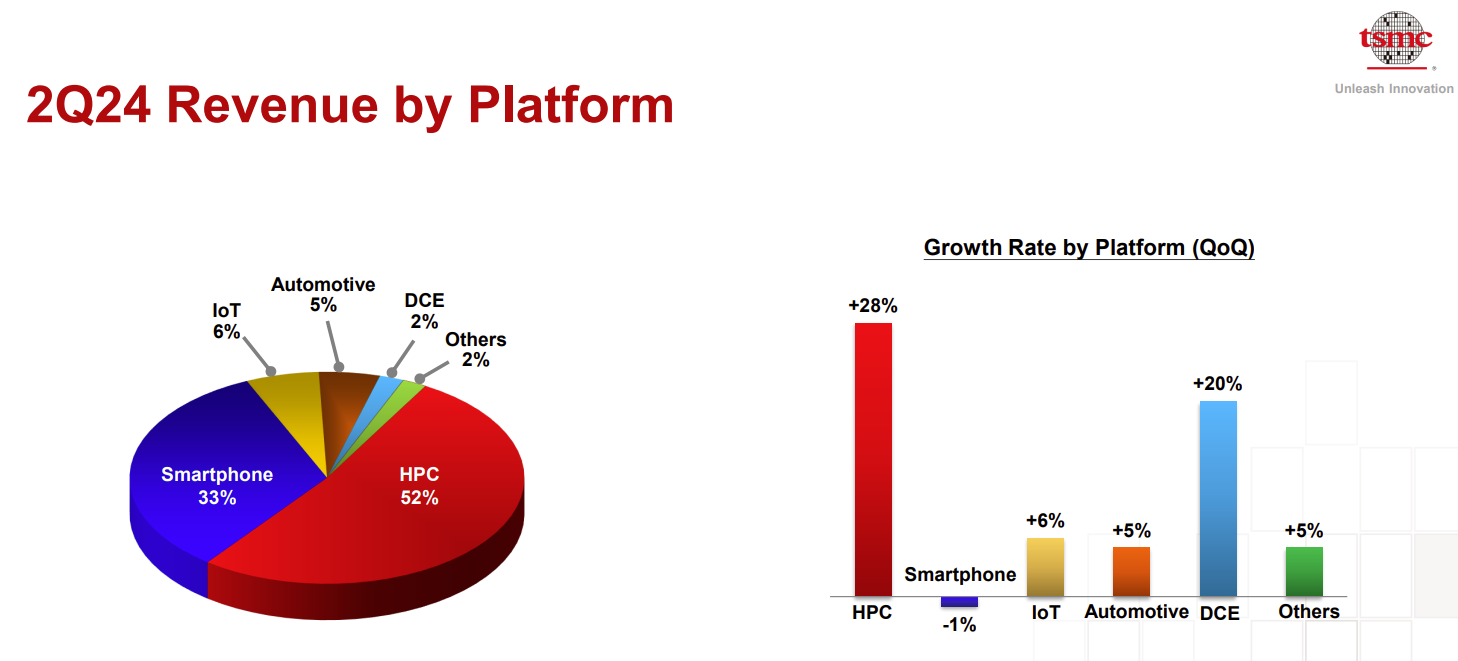
Here are the takeaways from TSMC's second quarter earnings call.

Demand for AI processors is still well ahead of supply. TSMC CEO C.C. Wei said the company is working hard to meet customer demand, but supplies of AI chips will remain tight. "We are working very hard to get enough capacity to support customers from now to next year and 2026," said Wei. "The supply continues to be very tight, all the way through probably 2025 and I hope it can be eased in 2026. That's today's situation."

TSMC is disciplined about adding capacity. "Our capital investment decisions are based on four disciplines, that is, technology leadership, flexible and responsive manufacturing, retaining customers' trust, and earning a sustainable and healthy return. To ensure a proper return from our investment, both pricing and cost are important. TSMC's pricing strategy is strategic, not opportunistic to reflect the value that we provide," said Wei.

Wei said TSMC won't repeat the same mistakes made in 2021 and 2022 where demand was driven by pandemic and shortages and not sustainable.

AI demand is more durable than previous boom-bust cycles. "AI demand is more real than two or three years ago," said Wei. "AI will be a very useful tool for human to improve productivity. Everything will need AI."

Wei noted that TSMC is also in line to buy its customers' products because it is leveraging AI to be more productive. Nevertheless, TSMC wants to make sure customers are realistic about future demand for AI chips. "We have a top-down bottom-up approach and discuss with our customers and ask them to be more realistic. I don't want to repeat the same kind of mistake two or three years ago, and that's what we are doing right now," said Wei.

AI will drive PC and smartphone processor demand. Wei noted that customers are all looking to put AI functionality into edge devices, but don't have a handle on demand and replacement cycles yet. He said that AI is likely to drive edge processor demand in about two years.

TSMC will raise prices, but each customer and category are different. Wei noted that doubling capacity isn't cheap--$30 billion to $32 billion in capex for 2024--and TSMC hasn't been able to meaningfully boost the gross margins. TSMC executives repeatedly said the company will "sell the value" so that customer wins also filter down to it.

Wei said: "This is an ongoing and continuous process, and we are continuing to sell our value. And by the way, my customers are doing very well also. You knew that. So, we should do well also."

"When TSMC wants to expand the capacity, we need the land, we need the electricity and we need the talented people," said Wei. "All of my customers are looking for leading-edge capacity for the next few years and we are working with them to support them, both in pricing and in capacity."

The company is ready for an annual GPU product cadence. Wei said typically every processor takes 1.5 years to 2 years to move from design to production. Nvidia gave TSMC the heads up a while ago. "We have been prepared. And not just from June when they announced it, but much earlier," said Wei.

Tech Optimization Data to Decisions Innovation & Product-led Growth Future of Work Next-Generation Customer Experience Digital Safety, Privacy & Cybersecurity ML Machine Learning LLMs Agentic AI Generative AI Robotics AI Analytics Automation Quantum Computing Cloud Digital Transformation Disruptive Technology Enterprise IT Enterprise Acceleration Enterprise Software Next Gen Apps IoT Blockchain Leadership VR business Marketing SaaS PaaS IaaS CRM ERP finance Healthcare Customer Service Content Management Collaboration Chief Information Officer Chief Executive Officer Chief Technology Officer Chief AI Officer Chief Data Officer Chief Analytics Officer Chief Information Security Officer Chief Product Officer

CR CX Convos: Is Looking Beyond Body Language Critical for Commerce?

CR CX Convos: Is Looking Beyond Body Language Critical for Commerce?

Check out the latest CR Convo with Liz Miller.

On CR Conversations <iframe width="560" height="315" src="https://www.youtube.com/embed/p3lkleO2SjM?si=NgciFgcU_UGR1APF" title="YouTube video player" frameborder="0" allow="accelerometer; autoplay; clipboard-write; encrypted-media; gyroscope; picture-in-picture; web-share" referrerpolicy="strict-origin-when-cross-origin" allowfullscreen></iframe>

OpenAI, Mistral AI aim for models that can show their work, tackle mathematical problems

OpenAI, Mistral AI aim for models that can show their work, tackle mathematical problems

The large language model (LLM) industry is racing to rid themselves of glaring weaknesses that hamper broader use cases.

OpenAI released a paper designed to improve legibility and verification so humans can better evaluate them. In a nutshell, OpenAI researchers pitted models against each other via a "Prover-Verifier" game that enhanced the ability for LLMs to show their work.

In a blog post, OpenAI said:

"We found that when we optimize the problem-solving process of strong models solely for getting the correct answer, the resulting solutions can become harder to understand. In fact, when we asked human evaluators with limited time to assess these highly optimized solutions, they made nearly twice as many errors compared to when they evaluated less optimized solutions. This finding highlights the importance of not just correctness, but also clarity and ease of verification in AI-generated text."

OpenAI then deployed the prover-verifier games that involve one model that generates a solution and another verifier that checks for accuracy. The goal was to ensure answers were right and make them easier to verify by humans and other models.

According to OpenAI, the ability to verify answers will improve trust and pave the way for autonomous AI systems. The methodology from OpenAI is just a first step and models still require grounding.

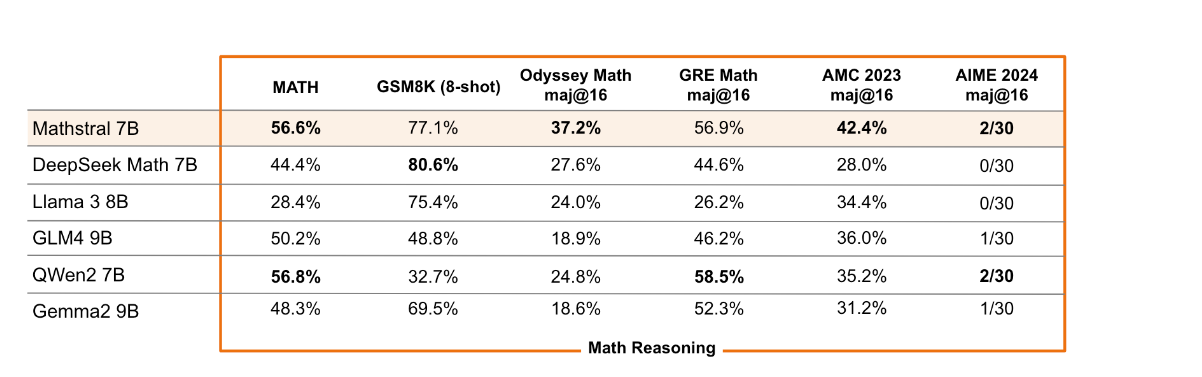
Mistral AI also released Mathstral, a model that's designed to "bolster efforts in advanced mathematical problems requiring complex, multi-step logical reasoning."

In a blog post, Mistral AI said Mathstral is built on Mistral 7B but specializes in STEM subjects. The company added that Mathstral highlights the benefits of building models for specific purposes.

Mathstral, which is released under an Apache 2.0 license, outscored most models on math reasoning.

With developments moving quickly it's clear that LLM creators are quickly looking to enable more complex problem solving that'll benefit enterprises.

Data to Decisions Innovation & Product-led Growth Future of Work Tech Optimization Next-Generation Customer Experience Digital Safety, Privacy & Cybersecurity openai ML Machine Learning LLMs Agentic AI Generative AI Robotics AI Analytics Automation Quantum Computing Cloud Digital Transformation Disruptive Technology Enterprise IT Enterprise Acceleration Enterprise Software Next Gen Apps IoT Blockchain Leadership VR GenerativeAI Chief Information Officer Chief Executive Officer Chief Technology Officer Chief AI Officer Chief Data Officer Chief Analytics Officer Chief Information Security Officer Chief Product Officer

F1 Technology, Analyst Hazing, Digital Body Language | ConstellationTV Episode 84

F1 Technology, Analyst Hazing, Digital Body Language | ConstellationTV Episode 84

This week on ConstellationTV episode 84, hear co-hosts Liz Miller and Holger Mueller analyze the latest enterprise #technology news and events (Formula1 #technology, #aws Summit, Cancelled #hubspot acquisition).

Then watch an entertaining Salon 50 interview to learn more about Constellation's newest analyst, Martin Scheider and hear from Liz Miller why digital body language is important for #commerce.

0:00 - Introduction: Meet the Hosts
01:32 - Enterprise #technology news coverage
18:04 - Salon50 with Martin Schneider
29:47 - Is Looking Beyond Body Language Critical for Commerce
42:44 - Bloopers!

ConstellationTV is a bi-weekly Web series hosted by Constellation analysts, tune in live at 9:00 a.m. PT/ 12:00 p.m. ET every other Wednesday!

On ConstellationTV <iframe width="560" height="315" src="https://www.youtube.com/embed/r4gysr8jjJU?si=gy5jwBV31E6Lnbv6" title="YouTube video player" frameborder="0" allow="accelerometer; autoplay; clipboard-write; encrypted-media; gyroscope; picture-in-picture; web-share" referrerpolicy="strict-origin-when-cross-origin" allowfullscreen></iframe>

Top 5 Takeaways from Qualcomm AI Day | With Analyst Andy Thurai

Top 5 Takeaways from Qualcomm AI Day | With Analyst Andy Thurai

Constellation VP & analyst Andy Thurai gives his top 5 takeaways after recently attending Qualcomm AI Day 2024. Watch the full recap to learn more about #qualcomm #innovation.

📌 Takeaway 1 - Smaller models and more efficient architecture will rule. 📌 Takeaway 2 - Edge is faster & scalable.
📌 Takeaway 3 - On-Device is private & faster.
📌 Takeaway 4 - Qualcomm is more than chips with their #AI hub.
📌 Takeaway 5 - Qualcomm AI research

On Event Update <iframe width="560" height="315" src="https://www.youtube.com/embed/HpDMm_Yi2Lk?si=KMTIDSToyG2u8wGr" title="YouTube video player" frameborder="0" allow="accelerometer; autoplay; clipboard-write; encrypted-media; gyroscope; picture-in-picture; web-share" referrerpolicy="strict-origin-when-cross-origin" allowfullscreen></iframe>

SugarCRM Adds Gen AI Tools with Latest Release

SugarCRM Adds Gen AI Tools with Latest Release

SugarCRM has announced two new generative AI features with its latest release, focused on driving user productivity and making text data generated by customer interactions more useful to sellers and customer service agents. These new Gen AI capabilities build upon existing predictive AI tools previously released.

The new features focus on summarization of interaction data and text from sales opportunities and support cases:

  • Opportunity Summarization provides a snapshot of strengths, weaknesses, and vulnerabilities to support improved sales outcomes. It includes expected outcomes, key contacts, and perceived risks. It also suggests next-best actions and helps create sales copy.
  • Case Summarization identifies potential blockers, issues, or risks. It suggests next-best actions and helps agents understand the context for more personalized service.

For both features, language translation is available. For global businesses this is not only a solid addition for managing multi-language business units but can also increase the pace of issue resolution for single location support teams serving a global customer base.

These new capabilities are powered by a native integration with OpenAI. As with most other Gen AI tools embedded into CRM systems, SugarCRM has done the work to ensure all outputs are grounded to reduce toxicity and hallucinations as well as masking sensitive information.  

SugarCRM has also published pricing for the new feature set. Adding the Gen AI capabilities is a $20 per user/per month surcharge on top of its core Sugar Sell and Sugar Serve sales and support product offerings. The base pricing includes 500,000 tokens, which given the use cases and SugarCRM’s midmarket customer focus, most customers would probably remain under the usage limits of the base pricing. (Some info on how OpenAI meters tokens here.) SugarCRM also notes that they cache all the results from all summaries in the system, so any subsequent views of the summary in Sugar Sell or Serve will not affect token usage, unless a change is made to that summary.

For users of Sugar, this is an easy path to add some useful tools without any heavy lifting. Embedded in the CRM, this allows for more contextual, grounded and “safe” usage of Ai tools in the workflow of deal and case management. However, from a cost perspective, it is a significant additional fee, as other CRM providers in the SMB and midmarket space seem to be adding a lot of these features with no explicit additional fees (at least at this time). If users of Sugar do not see the need to augment their Gen AI outside of the offered use cases, this is not a huge cost addition, but if firms are also adding proprietary ChatGPT licenses for marketing teams, other AI tools for RevOps, etc. – costs can creep. It is best to take a wider view and analyze the cost/benefits and wider use cases when selecting AI tools as either add-on features or as point SaaS products on their own.

Next-Generation Customer Experience Innovation & Product-led Growth Tech Optimization Future of Work Data to Decisions Digital Safety, Privacy & Cybersecurity ML Machine Learning LLMs Agentic AI Generative AI AI Analytics Automation business Marketing SaaS PaaS IaaS Digital Transformation Disruptive Technology Enterprise IT Enterprise Acceleration Enterprise Software Next Gen Apps IoT Blockchain CRM ERP finance Healthcare Customer Service Content Management Collaboration Chief Revenue Officer Chief Information Officer Chief Technology Officer Chief Digital Officer Chief Data Officer Chief Analytics Officer Chief Information Security Officer Chief Executive Officer Chief Operating Officer Chief AI Officer Chief Product Officer

SpreadsheetLLM may yet decipher, democratize spreadsheets for rest of us

SpreadsheetLLM may yet decipher, democratize spreadsheets for rest of us

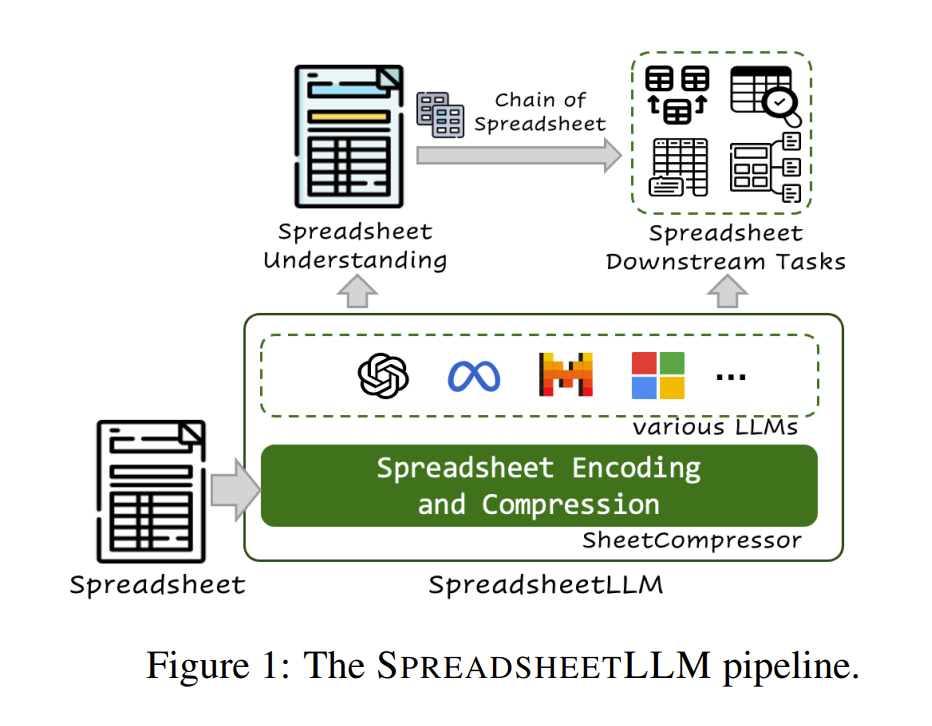
Microsoft researchers have cooked up SpreadsheetLLM, a method that encodes and optimizes large language models (LLMs) so they can understand spreadsheets.

Now there are only a few companies that would care about this use case--Microsoft and Google--but the impact of Spreadsheet LLM could be huge. Why? Despite analysts and every enterprise software company telling you that you shouldn't run your business on a bunch of spreadsheets flung around the office, you all still do it. You know who you are.

The interesting thing about SpreadsheetLLM is that it's a great lifehack to the reality that you'll have your damn Excel spreadsheets anyway and the rest of us need to understand what's going on.

Enter SpreadsheetLLM. In a paper outlining the project, researchers said they also created SheetCompressor, which is an encoding framework that compresses spreadsheets for LLMs. Researchers said:

"Spreadsheets pose unique challenges for LLMs due to their expansive grids that usually exceed the token limitations of popular LLMs, as well as their inherent two-dimensional layouts and structures, which are poorly suited to linear and sequential input. Furthermore, LLMs often struggle with spreadsheet-specific features such as cell addresses and formats, complicating their ability to effectively parse and utilize spreadsheet data."

Ultimately, SpreadsheetLLM can make understanding and analyzing spreadsheet data more accessible. The paper is a bit wonky, but SpreadsheetLLM appears to be an advance in processing and understanding spreadsheet data via various LLMs. SpreadsheetLLM could also be handy for data cleansing and all those functions we always Google for how-to videos (yes folks, Excel tips are a cottage industry).

Holger Mueller, Constellation Research analyst, said:

"Right after transactional databases, spreadsheets run the world. And the platform is Excel, so it's key for Microsoft to be at the forefront of using AI for better use of spreadsheets. Microsoft has done exactly that with SpreadsheetLLM, which could fundamentally change its UX and user reach. Verbal access to spreadsheets has massive value both for creating and analyzing spreadsheets. If Microsoft nails this, it not only secured the future of Excel but also change the future of work."

Data to Decisions Future of Work Innovation & Product-led Growth New C-Suite Tech Optimization Next-Generation Customer Experience Digital Safety, Privacy & Cybersecurity AI GenerativeAI ML Machine Learning LLMs Agentic AI Analytics Automation Disruptive Technology Chief Information Officer Chief Experience Officer Chief Executive Officer Chief Technology Officer Chief AI Officer Chief Data Officer Chief Analytics Officer Chief Information Security Officer Chief Product Officer

EY: CxOs ramping genAI budgets, skimp on data foundation

EY: CxOs ramping genAI budgets, skimp on data foundation

CxOs are racing to invest in generative AI but skimping on the data foundation needed to execute, according to an Ernst & Young (EY) survey.

EY's AI Pulse Survey, based on 500 US senior leader respondents, highlights the generative AI enterprise conundrum. Here's a look at some of the moving parts.

Among companies already investing in AI, the number of companies investing $10 million will roughly double from 16% to 30% in the next year.

  • But 36% of senior leaders say they're investing in data infrastructure at scale.
  • And 34% said they are building on an AI governance framework.
  • 37% of senior leaders said their organizations are training and upskilling employees on AI at scale.

These moving parts highlight how some enterprises may be headed to a crap in, crap out wall if they jump into AI without a strong data game.


GenAI’s prioritization phase: Enterprises wading through thousands of use cases

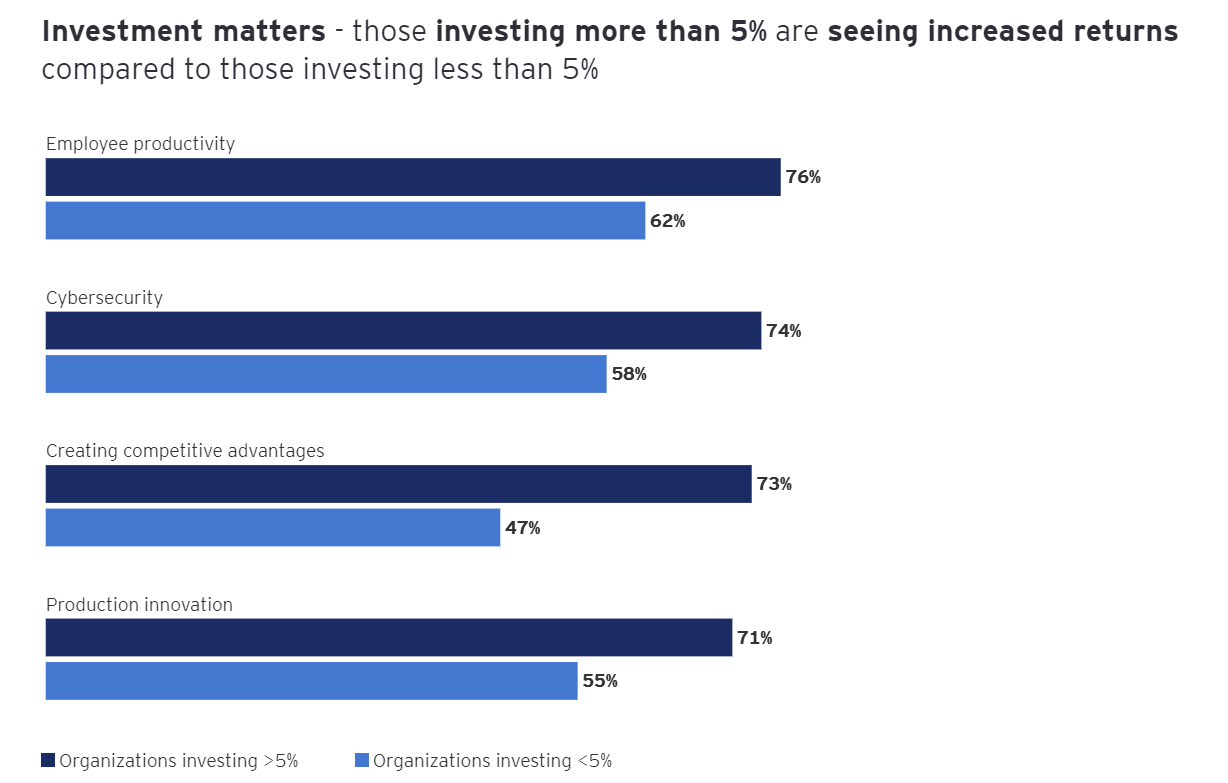
Nevertheless, EY found that CxOs are doubling down on generative AI. Three-quarters of executives said their firms are seeing positive returns across business functions. Indeed, 77% said they were seeing operational efficiencies, 74% saw employee productivity gains and 72% saw improved customer satisfaction.

Other items from the survey:

  • Companies investing 5% or more of total budgets on AI are seeing more returns.
  • 50% of senior leaders say they will dedicate 25% or more of total budgets toward AI investments.
  • 54% of CxOs investing in AI said their organizations are investing in ethical AI over the next year.

Data to Decisions Innovation & Product-led Growth Future of Work Tech Optimization Next-Generation Customer Experience Digital Safety, Privacy & Cybersecurity AI GenerativeAI ML Machine Learning LLMs Agentic AI Analytics Automation Disruptive Technology Chief Information Officer Chief Executive Officer Chief Technology Officer Chief AI Officer Chief Data Officer Chief Analytics Officer Chief Information Security Officer Chief Product Officer

HOT TAKE: M&A Continues to Heat Up Around Growth Optimization Technologies

HOT TAKE: M&A Continues to Heat Up Around Growth Optimization Technologies

The pace of M&A seems to be increasing as we move through the summer. One area where we are seeing an interesting flurry of deals is around companies that help foster growth in one form or another. This might be around promotions optimization for B2C, or around further empowering the strategic power of RevOps teams.

RevOps teams are slowly becoming more and more strategic members of the team, in terms of leveraging the data in their operations wheelhouse to analyze and predict how revenue activities might play out for the quarter, year, etc. A slew of startups have formed to aid this transition - aiming to leverage Gen AI and other new technologies to provide low/no code tools for RevOps teams to build and manage sophisticated analytical and predictive models aimed at various system data sets (lead management, CRM, ERP, etc.). Similar in how we saw CMOs become more like CIOs in the past decade plus...RevOps leaders are now required to have even more technical acumen in the age of AI and the expectation of predictive analytics inside the RevOps tech stack.

So, it is not surprising that we are starting to see a wave of M&A to support this shift. We are seeing larger established players add this functionality via tuck-in acquisitions. And a few smaller firms are joining forces to build out a more data rich, predictive platform for RevOps to leverage every day.

The latest of such moves is by startup Forwrd.ai scooping up LoudnClear.ai. Forwrd has been building up its business as an analytics dashboard of sorts that guides RevOps leaders. The addition of LoudnClear brings more conversational AI, allowing users to harness and act on revenue opportunity signals that may stem from multi-channel, synchronous or asynchronous interactions from both inside and outside the usual real of sales interactions.

For example, RevOps teams can use the combined entity to model alerts and workflows based on upsell opportunity signals arising inside a contact center conversation. Since many customer support agents are either not trained nor permitted to act on potential revenue opportunities, uncovering these signals and routing them to the right sales or success team member can make the most of every potential revenue opportunity if configured properly. Again, this is important, as RevOps teams need to be more data-driven, predictive and strategic, but have not traditionally come from technical backgrounds, so the addition of low/no code tools and conversational intelligence is a big evolution for the market.

A few weeks prior we saw RevOps analytics provider Setsail get acquired by Zoominfo. SetSail provides a number of interesting analytics and dashboard tools for RevOps teams to better analyze sales interactions, pipeline and deal flow etc., leveraging data from various social media and other internal systems to better understand how deals track. With Zoominfo being a data provider for pre-sales teams, you can see how the strategic combination empowers both RevOps teams and sellers with more data, recommendations around prioritization of daily actions, outreach cadence and identification of buyer committee members, etc.

The recent M&A in the growth operations area isn't limited to a RevOps focus. Infor recently closed its acquisition of Acumen which fleshes out its growth optimization offerings for CPG companies. (More on Infor's recent industry-focused M&A activities here.) As CPG companies need to be closer to both their distributors, retail partners and downstream customers, Acumen helps gather and analyze the right sets of data to best optimize promotions and other offers to drive the highest profitability for all players in the CPG value chain. As Infor continues to flesh out its vertical offerings, Acumen will fit nicely inside the Infor CloudSuite Food & Beverage and CloudSuite Fashion offerings, providing more trade promotion and other capabilities inside those existing industry focused cloud products.

As the M&A activity heats up in this sector, we are slowly seeing the RevOps management, data enrichment providers and others come together to become what is looking like a true full journey growth operations platform. As more and more enterprises create offices of the Chief Growth officer, these platforms and tools will equip these new C-suite members with the right data, insights and workflows to better drive strategic growth plans and empower their downstream supporting cast.

Next-Generation Customer Experience Revenue & Growth Effectiveness Chief Revenue Officer

GenAI may be the new UI for enterprise software

GenAI may be the new UI for enterprise software

Enterprise software could be disrupted as category windows become collateral damage to generative AI. The scenario: Today's go-to systems are relegated to plumbing as generative AI becomes the de facto user interface that democratizes data, insights, analytics and automation.

Today, enterprise software is dominated by category winners such as Salesforce in CRM, Workday in HR, Oracle and SAP in ERP, Microsoft in productivity and ServiceNow in workflows starting with IT service management.

Generative AI may upend this situation as horizontal services connect systems and provide an interface that essentially composes applications on the fly. In other words, genAI is the new UI and without the surface layer enterprise systems are simply data stores.

In recent days, we've seen the following:

Runway launched its financial planning application that aims to make it easier for businesses to run their finances. Runway is more about an ambient experience than something trying to replace your existing systems. Directionally, what Runway is trying to accomplish makes sense.

This post first appeared in the Constellation Insight newsletter, which features bespoke content weekly and is brought to you by Hitachi Vantara.

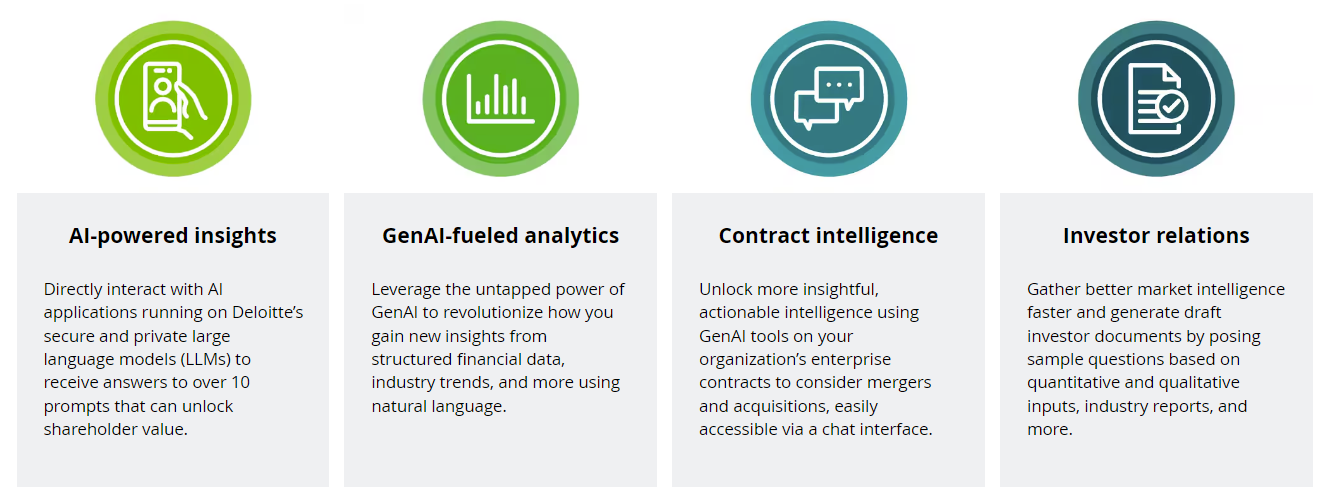
Deloitte launched an AI suite for CFOs and will likely expand into the rest of the C-suite. The general concept is generative AI that speaks finance and is trained on Deloitte, third party and enterprise proprietary data. This GPT for CFOs approach collects data from various source systems to provide a real-time view into enterprise financial health, insights and scenario modeling. The source systems for this GPT for CFO suite? Oracle and SAP (finance), Coupa (procurement), Salesforce (revenue), AWS Redshift, Snowflake and Databricks with more connections on deck.

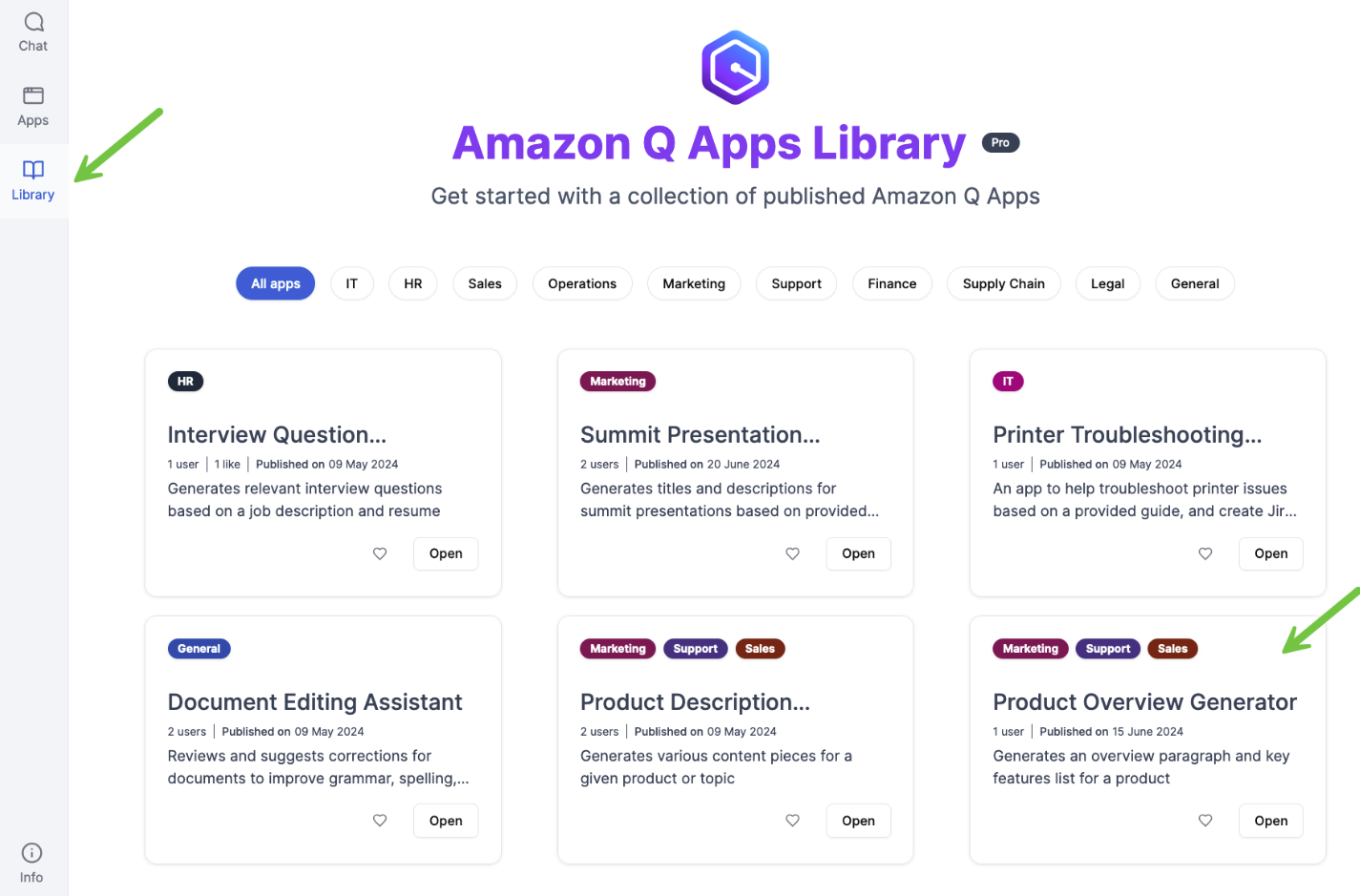
AWS said its Q Apps are generally available. AWS' Q effort is a horizontal approach to generative AI that enables enterprises to automate workflows, create agents that act on your behalf, and automate tasks. Amazon Q is already boosting developer productivity, but its Q Business effort is likely to be a long-tail play for C-levels.

Anthropic is also on the way toward bespoke software. The company’s Artifacts effort is about melding collaboration with genAI.

The theme for these new efforts is simple: Combine data sources, find issues and deliver fixes that drive value. All that is missing from these various efforts is the process mining and automation component that could pair up with evolving genAI interfaces. ServiceNow is tying these disparate enterprise parts together as a platform, but AWS could be downright disruptive. ServiceNow CFO outlines method to Pro Plus SKU pricing

How could Q be disruptive to enterprise software? A few reasons:

AWS has the infrastructure layer and tooling to drive efficiency and potentially compress enterprise software margins. AWS also doesn't have an enterprise software business to protect. AWS did it to data center hardware, moves fast and is focused on customer needs.

CIOs are receptive to hearing more about AWS, Amazon Q and Q Apps because they are tired of software vendors that are looking to maintain margins over customer needs. Enterprise vendors are bifurcating between those that are trying to preserve margins and those that'll absorb some compression.

It’s been a year of disgruntled CXOs in our BT150 meetups.

Enterprises realize technology is at an inflection point, but generative AI is moving so fast they will want horizontal approaches so they can abstract the systems underneath (and avoid lock-in).

Generative AI has created a market that's split between customers that want to build vs. want to buy. An enterprise operating system that enables you to adapt regardless of the enterprise software underneath is compelling. That enterprise OS will have to be built and AWS is all about builders.

Insights Archive

Data to Decisions Next-Generation Customer Experience Tech Optimization Innovation & Product-led Growth Future of Work Digital Safety, Privacy & Cybersecurity New C-Suite ML Machine Learning LLMs Agentic AI Generative AI Robotics AI Analytics Automation Quantum Computing Cloud Digital Transformation Disruptive Technology Enterprise IT Enterprise Acceleration Enterprise Software Next Gen Apps IoT Blockchain Leadership VR B2B B2C CX EX Employee Experience HR HCM business Marketing Metaverse developer SaaS PaaS IaaS Supply Chain Growth eCommerce CRM ERP finance Social Healthcare CCaaS UCaaS Customer Service Content Management Collaboration M&A Enterprise Service GenerativeAI Chief Information Officer Chief Executive Officer Chief Technology Officer Chief AI Officer Chief Data Officer Chief Analytics Officer Chief Information Security Officer Chief Product Officer Chief Digital Officer Chief Financial Officer Chief Operating Officer Chief Marketing Officer Chief Revenue Officer